Here are 10 URLs that are worth visiting to see what Google knows.
http://www.labnol.org/internet/important-google-urls/28428/
Wednesday, November 2, 2016

Tuesday, November 1, 2016
Model Hyperlinked Argument for Writing Class - why I hate the new screen-time rules for kids
Why I Hate the New Screen-Time Rules for Kids
Yes, we should limit how much time our kids spend in front of screens, but we're going about it the wrong way
Oct 25, 2016
LinkHere's the key argument move:
And that’s the crux of the issue: the new pediatric guidelines, just like the old ones, suggest that there’s a perfect way to interact with the TV.
I think there’s a more holistic way to think about these guidelines, including how your kids interact with the television. Yes, we should limit how much TV our children watch. And sure, if we have a second to help them understand a segment of Sesame Street, that’s great. But as parents, we should also read those guidelines with a grain of salt and remember they’re just guidelines, not hard-and-fast rules. If we don’t follow them, we’re not going to ruin our children. This kind of real-world thinking—both from parents and the AAP—would take off some of the unnecessary pressure.
It might also help if the AAP offered an alternative. The organization has released suggestions for how much time children should spend playing in fresh air. There are also many studies that have proven the benefits of playing in the park or woods. Promoting those guidelines in addition to those for screen time would at least give parents an alternative. Of course, I try to be realistic here, too. My family doesn’t make it to the park every day, but we do try to wrestle in the front yard or ride bikes down the street. On weekends, we do our best to go bigger. Maybe it’s a hike in the nearby mountains. In winter, it’s a trip to the local ski area to work on snowplowing. When we’re outside, at least, it’s nice that television is a distant thought for all of us.
Link:
What are people in your department saying about your leadership?
Dan Rockwell, the Leadership Freak, lists the following attributes of a person who people choose to follow:
Rockwell provides these additional tips:
(reference:Leadership Freak blog)
- He saw things in me I didn’t see in myself.
- She cared about people and ran a tight ship.
- I was confident she had my back.
- He had competencies I aspired to gain.
- She’s always pressing forward.
- She gave me opportunities to talk.
- She was humble.
- He expected a lot out of me and himself. He walked the talk.
- He’s passionate to learn.
- They have good character. (Everyone nodded when character came up.)
Rockwell provides these additional tips:
- Focus on adding value, not gaining followers.
- Become the person you would choose to follow. Would you follow you?
- Share your inner best intentions. Authenticity is more compelling than talent, skill, or competence.
- Honor people. People choose leaders who make them feel they matter.
(reference:Leadership Freak blog)
Monday, October 31, 2016
Thursday, July 14, 2016
HBR: How to Think about Organizational Culture
This was from Harvard Business Review, Management Tip of the Day on May 23, 2016:
May 23, 2016
How to Think About Organizational Culture
Organizational culture
shapes both employee productivity and business results, but often it is
ambiguous and hard to define. To help, think of culture as three layers with
increasing levels of importance:
- Culture is seen through symbols, rituals, stories, and organizational events — the first things we experience when we join an organization.
- Culture is reflected in how people in the organization think, behave, and feel — in other words, it appears in individual values, team norms, and unwritten rules.
- Culture is the company’s identity as perceived by its best customers, representing an outside-in view. For example, Apple wants to be known for its design and simplicity; Marriott, for exceptional service; Google, for innovation.
By
shifting the focus on culture from symbols (#1) and values (#2) to customer
expectations and company identity (#3), leaders can better create and
define a culture that wins in the marketplace.
Project-based Learning resources from Edutopia
Here's a great collection of materials from Edutopia about PBL.
http://www.edutopia.org/project-based-learning-getting-started-resources
http://www.edutopia.org/project-based-learning-getting-started-resources
Wednesday, July 13, 2016
Student Surveys on "the Whole Child"
The excerpt below is from “Hacking Education: 10 Quick Fixes For Every School,” by Mark Barnes and Jennifer Gonzalez. The following is from the chapter entitled, “Hack 10: The 360 Spreadsheet.”
link: https://ww2.kqed.org/mindshift/2015/08/26/rethinking-data-how-to-create-a-holistic-view-of-students/
THE HACK: COLLECT DATA ON THE WHOLE CHILD
Most teachers make an effort to get to know their
students, and many regularly distribute surveys at the start of each
school year to speed up that process. The problem is, most teachers read
these surveys once, then file them away. Sure, they might have every
intention of returning to the surveys and reviewing them later, but far
too often, that time never comes. We rely on our day-to-day interactions
for relationship building, and although we get to know some
students quite well this way, others just fade into the background.
A 360 Spreadsheet is a place for teachers to store and
access the “other” data we collect on our students, giving us a more
complete, 360-degree view of each student. It’s a single chart that
organizes it all and lets us see, at a glance, things we might otherwise
forget. Many teachers already keep track of students’ birthdays. Think
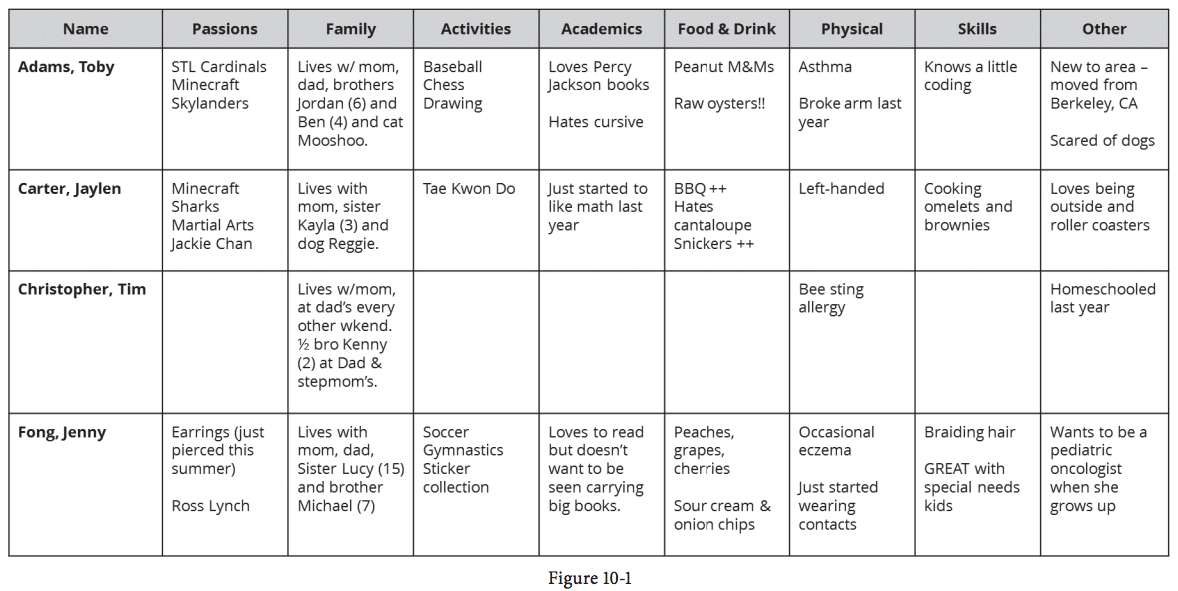
of this as a birthday chart on steroids. Figure 10-1 is just one
possible version of a 360 Spreadsheet:
Because the 360 Spreadsheet is a single document, teachers
can access it much more easily than they could a whole folder of
surveys. Having the information formatted this way also makes it
immediately clear which students a teacher needs to get to know better.
The chart in Figure 10-1 sorts student information into the following suggested categories:
• Passions: What is the student really
into? Keeping track of things like hobbies, collections, and other
hard-to categorize obsessions will help you connect with your students.
This information will boost your ability to help students select books
for independent reading, choose topics for writing or research projects,
or even better understand math or history concepts by placing them in
the context of things they are just crazy about.
• Family: The home environment plays a
major role in how well a student performs academically. This
category can include information about whether a student lives in one
home or travels between the homes of two parents.
It might ask about the number of people who live in
the household. It can also include other family-related facts, like
whether anyone at home is dealing with an illness, is currently
incarcerated, has special needs, travels frequently, or has a noteworthy
profession or skill set (Mom is a circus performer? Probably worth
noting.)
• Activities: This category will help you
better understand what outside activities fill up a student’s schedule
when they are not in school. Are they on a sports team? Do they have a
part-time job? Will they be busier on certain days of the week or at
certain times of the year? Not only will this information give you a
more complete picture of who your students are, it will build your
awareness of the other demands placed on their time.
• Academics: Here’s where you can put
things a standardized test won’t tell you about a student’s
academic needs and preferences: If a student struggles with
handwriting, expresses a strong desire to work alone, has a strong
interest in a particular subject area, or lights up during certain types
of activities, record this information; it will help you individualize
instruction later.
• Food & Drink: No, you are not a
caterer. But why not keep a list of each child’s favorite candy or
snack? While you’re at it, record food allergies on this chart
as well—the information is probably in the school paperwork already;
might as well add it here.
• Physical: Along with conditions that
are already listed on students’ official paperwork, this category
can include others that are not, but are still important, like needing
to use the restroom frequently or the tendency to get cold easily.
• Skills: Our students bring with them
talents and skills we may not even be aware of if we don’t ask, so
when you find these things out, include them in your chart. Has a
student been taking violin lessons for years? Add that. Do they know a
lot about dairy farming? Origami? Photography? Put it all in there. Not
only will knowing about these skills further develop your knowledge of
the student, they may also come in handy when you need help or
information about an area where you lack expertise.
• Other: This seems like it could be a
throw-away category, but making room for miscellaneous information is a
good idea. Things like sensitivities to loud noises, religious
practices, or random facts about student histories (e.g., “Lived in
China”) should also be recorded, even if they don’t necessarily fit into
any broad category. Although these categories offer vital information,
they are just suggestions.
Teachers can and should collect whatever information
is most relevant to them, information that will help you connect to
your students as whole people and build strong relationships with them.
Malcolm Gladwell Interview on Tim Ferriss Podcast
http://fourhourworkweek.com/2016/06/21/malcolm-gladwell/
Show Notes
- What have been the easiest — and hardest — books for Malcolm to write? [08:05]
- Who does Malcolm consider to be the “gold standard” of storytellers? [09:30]
- What working at The Washington Post for 10 years taught Malcolm about dealing with writer’s block. [12:30]
- Malcolm on story structure. [15:07]
- As early as the research stage, sometimes good stories write themselves. [18:27]
- Malcolm on taking and organizing notes. [22:18]
- How does Malcolm determine what starts a chapter (or a book)? [24:49]
- Trying different creative “recipes” for storytelling. [26:04]
- How Malcolm plans his speaking keynotes (and how he got better at it). [28:24]
- Malcolm’s speaking hero. [30:36]
- The elements of a good speaking performance. [33:17]
- Tying stories together to support a theme. [35:32]
- Getting better at asking questions. [40:55]
- The most worthwhile investment (of time) Malcolm has made. [45:57]
- Malcolm’s favorite failures. [48:18]
- Malcolm’s morning routines. [50:55]
- Why is Lapsang Souchong a controversial tea? [51:30]
- Why Malcolm prefers writing in noisy public places. [53:46]
- How Malcolm winds down from a day of work. [54:42]
- Malcolm’s bedtime routine. [55:45]
- The worst advice shared with young people today. [57:27]
- Malcolm’s flaws that turned into strengths. [1:02:07]
- Malcolm on giving and receiving advice. [1:04:38]
- The first person who comes to mind when Malcolm thinks of the word “successful.” [1:05:43]
- Systems Malcolm relies upon. [1:10:28]
- Two necessary contradictions elite runners face. [1:12:21]
- Books Malcolm has gifted the most. [1:13:18]
- The purchase of $100 or less that has had a positive impact on Malcolm’s life. [1:17:24]
- The most articulate person Malcolm has ever met. [1:18:29]
- Something Malcolm believes that other people think is crazy. [1:19:09]
- Malcolm’s reaction to Peter Thiel’s disagreement with one of his positions. [1:22:14]
- An innovator Malcolm finds particularly inspiring. [1:24:22]
- Advice Malcolm would give to his 30-year-old self. [1:26:39]
- How Malcolm started podcasting. [1:30:53]
- What Malcolm finds most novel about creating podcasts versus writing books. [1:31:46]
- How Malcolm feels about doing another season or two of podcasting. [1:33:14]
- What would be on Malcolm’s billboard? [1:35:18]
- Why does Malcolm believe in the legal maxim of “Difficult cases make bad law?” [1:36:07]
Monday, February 29, 2016
30-Minute Meetings
In this Harvard Business Review article, Peter Bregman argues that we should take on a "sprinter's tactic" when taking on our leadership responsibilities, and plan to accomplish things in half the time that we've previously planned. The main example is the "30 Minute Meeting," but he also speaks about the 30 minute phone call, the 30-minute coaching meeting, the 30-minute workout. The effect is that others are hyper-focused, too.
To make maximum use of this time, though, you need to insist on getting the most out of the 30 minutes: no multi-tasking, have a laser focus ("decide on the one thing that will make the biggest difference, and spend the 30 minutes on that"), prepare beforehand, be fully present.
To make maximum use of this time, though, you need to insist on getting the most out of the 30 minutes: no multi-tasking, have a laser focus ("decide on the one thing that will make the biggest difference, and spend the 30 minutes on that"), prepare beforehand, be fully present.
Subscribe to:
Posts (Atom)