|
| The opening page of Beethoven’s Fifth Symphony, whose first four notes make up one of the most famous motifs in all of music. Credit...Bärenreiter-Verlag, Kassel |
NYT article appreciates Herbert Blomstedt and his understanding of the tricky opening, especially after a new Barenreiter score for the 5th Symphony. There's a nice feature in the article that demonstrates different versions of the opening.
Although slightly different in tempos and textures as a result of Blomstedt’s adoption of the new editions of Beethoven’s scores that came out in the 1990s, both symphony cycles he has recorded — with the Staatskapelle Dresden from 1975 to 1980 and the Gewandhaus Orchestra of Leipzig, Germany, from 2014 to 2017 — remain beacons of good taste, with a distinctive spiritual power shining through the music. In both sets, that’s particularly true of the Fifth, which may be less brutally violent than under other conductors but has a merciful empathy to its relative restraint.
Asked to choose a page from the Fifth’s score, Blomstedt went for the first, which announces the four-note motif that dominates the symphony’s passage from darkness to light.
Why do you think Beethoven remains such an obsession for so many of us?
One could write a whole book about that, but one thing to me is characteristic. We know that Beethoven was a sufferer, but he never expresses his suffering in his music, like Mahler does. You can hear it in every bar of Mahler — I’m suffering, I’m suffering, I’m suffering — and it’s wonderful, the way he does it.
Beethoven was another type of person. He doesn’t put his emotions on display, and that makes it more objective. It can represent the suffering of everyone, not only his, but mine, the suffering of the whole society. The suffering of today, in Ukraine for instance. It could symbolize anything. That helps it to outlive the personal situation of the composer, or the personal situation of the interpreter. It’s something that we go through, as humans.
 |
| Kokei Kobayashi |
Dead my old fine hopes
And dry my dreaming but still...
Iris, blue each spring
-Shushiki
 |
| Georgia O'Keeffe, Red Poppy, 1927 |
"Interest is the most important thing in life; happiness is temporary, but interest is continuous."
- Georgia O'Keeffe
To be sure, decoding readers are skittish, young, and just beginning to learn how to use their expanding knowledge of language and their growing powers of inference to figure out a text. The neuroscientist Laurie Cutting of John Hopkins explains some nonlinguistic skills that contribute to the development of reading comprehension in these children: for example, how well they can enlist key executive functions such as working memory and comprehension skills such as inference and analogy. Working memory provides children with a kind of temporary space for holding information about letters and words, just long enough so that the brain can connect it to the children's increasingly sophisticated conceptual information.
As decoding readers progress, their comprehension becomes inextricably bound to these executive processes, and to what they know about words and to fluency. They are all related. Incremental increases in fluency allow for inference making, because there is added time for inferences and insights. Fluency does not ensure better comprehension; rather, fluency gives enough extra time to the executive system to direct attention where it is most needed to infer, to understand, to predict, or sometimes to repair discordant understanding and to interpret a meaning afresh. For example, in Charlotte's Web a decoding reader must realize what Wilbur's fate would be without Charlotte's intervention.
But what prepares the child to comprehend the splendidly sophisticated arachnoid reasoning behind this intervention? This phase of reading marks the time when the young child begins to learn how to predict from the delicate mix of what is said in a text and what is not said . It is the moment when children first learn to go “beyond th information given.” It is the beginning of what will ultimately be the most important contribution of the reading brain: time to think.
The assumption that "more" and "faster" are necessarily better requires vigorous questioning, especially since this assumption already increasingly influences everything in American society, including how we eat and how we learn, with doubtful benefits. For example, will the accelerated rate of change already experienced by our children have consequences that radically affect the quality of attention that can transform a word into a thought and a thought into a world of unimagined possibility?
Will this next generation's capacity to find insights, pleasure, pain, and wisdom in oral and written language be dramatically altered? Will their relationship to language be fundamentally changed? Will the present generation become so accustomed to immediate access to on-screen information that the range of attentional, inferential, and reflective capacities in the present reading brain will become less developed? And what of future generations? Are Socrates' concerns about unguided access to information more warranted today than they were in ancient Greece?
From Maryanne Wolf Proust and the Squid
Newly fluent readers learn from Twain's irony and from his powerful images and metaphors to go below the surface of what they read to appreciate the subtext of what the author is trying to convey. For young readers who are moving from simply mastering content to discovering what lies beneath the surface of a text, the literature of fantasy and magic is ideal.
One of the most powerful moments in the reading life, potentially as transformative as Socrates' dialogues, occurs as fluent comprehending readers learn to enter into the lives of imagined heroes and heroines, along the Mississippi or through a wardrobe portal.
Comprehension processes grow impressively in such places as these, where children learn to connect prior knowledge, predict dire or good consequences, draw inferences from every danger-filled corner, monitor gaps in their understanding, and interpret how each new clue, revelation, or added piece of knowledge changes what they know. To practice these skills, they learn to unpeel the layers of meaning in a word, a phrase, or a thought. That is, in this long phase of reading development, they leave the surface layers of text to explore the wondrous terrain that lies beneath it. The reading expert Richard Vacca describes this shift as a development from "fluent decoders" to "strategic readers" -- "readers who know how to activate prior knowledge before, during, and after reading, to decide what's important in a text, to synthesize information, to draw inferences during and after reading, to ask questions, and to self-monitor and repair faulty comprehension."
Engaging in dialogue with their teachers helps students ask themselves critical questions that get to the essence of what they are reading. For example, in reciprocal teaching, a method introduced by Annemarie Palinscar and Anne Brown, teachers explicitly help students learn to question what they don't understand, summarize the content, identify key issues, clarify, and predict and infer what happens next. When successful, this variation on the Socratic dialogue provides students with a lifelong approach to extracting meaning from more and more sophisticated text.
From Alan Jacobs in Hedgehog Review:
Someone who lived under a genuinely totalitarian regime, the great Russian thinker Mikhail Bakhtin, often wrote about what he called the “surplus,” a term he used in several ways. The one I want to emphasize is this: The surplus of any human being (me, you, my neighbor) is what exceeds description, what cannot be expressed in any sociological definitions of identity. In his magnificent essay “Epic and Novel” (1941), Bakhtin writes of the “surplus of humanness” that each of us possesses and that makes us—this is a numinous term for him—“unfinalizable.” No one can say the last and complete word about any of us. It is the ambition of all authoritarian regimes, social or political, to utter that final and definitive word about whoever comes within its orbit; it is, for Bakhtin, an ethical imperative to refuse that final word, whether uttered about myself or my neighbor.
But quite often inequities of power make it impossible to refuse directly and explicitly—and this is where, for Bakhtin, laughter comes in, and especially the laughter that arises in parody and satire. Bakhtin has a particular affection for comic novels whose heroes “cannot exhaust their possibilities.” They are “always retaining a happy surplus of their own,” and so always merrily carry on their “free improvisation.” In so doing they may delight us, but they also represent a “life process that is imperishable and forever renewing itself.”
The Years That The Days and Months Turned Into
by Shafer Hall
I was the kid who jumped
in the puddle in the rain,
and I was the rain
and I was the street
and I was the sky
reflected in the rain on the street

I was a trolley car engineer
and I was the trolley car

I was a scientist bent over a microscope
until the muscles in my back were knotted
and I was the tiny stuff in the dish
at which she stared

I was a song
and I was the old man
who sang to pass the time
and I was time that passed
and I was the comfort that came
and the sadness that was

I was a trash barrel fire
and the men who stood around it

I was a firefighter
and I was the coffee
the firefighter drank
to stay awake
through the disaster
that I was

I was the corn
and I was the folk singer
who protested me
cause I was changed

I was the angry one, and I was the sad one,
and I am the head shaking in wonder

I am a pile of bones
and I am the satiated parasites
in the dirt below the pile of bones
and I am the dirt who waits
for the rain
"The Years That the Days and Months Turned Into" by Shafer Hall. Used by permission of the poet.
and I was the sky reflected in the rain on the street I was a trolley car engineer and I was the trolley car I was a scientist bent over a microscope until the muscles in my back were knotted and I was the tiny stuff in the dish at which she stared I was a song and I was the old man who sang to pass the time and I was time that passed and I was the comfort that came and the sadness that was I was a trash barrel fire and the men who stood around it I was a firefighter and I was the coffee the firefighter drank to stay awake through the disaster that I was I was the corn and I was the folk singer who protested me cause I was changed I was the angry one, and I was the sad one, and I am the head shaking in wonder I am a pile of bones and I am the satiated parasites in the dirt below the pile of bones and I am the dirt who waits for the rain
"The Years That the Days and Months Turned Into" by Shafer Hall. Used by permission of the poet.
 | ||
| The Willem de Kooning Foundation / ARS | Willem de Kooning, “Asheville” (1948). |
Black Mountain College (from article by Louis Menand in the NYer).
What made Black Mountain different from other colleges was that the center of the curriculum was art-making. Students studied pretty much whatever they wanted, but everyone was supposed to take a class in some kind of artistic practice—painting, weaving, sculpture, pottery, poetry, architecture, design, dance, music, photography. The goal was not to produce painters, poets, and architects. It was to produce citizens.
Black Mountain was founded by a renegade classics professor named John Andrew Rice, who had been kicked out of Rollins College, in Florida. Rice believed that making something is a different learning experience from remembering something. A lot of education is reception. You listen to an expert explain a subject to you, and then you repeat back what you heard to show that you learned it. Teachers push students to engage actively with the material, but it’s easy to be passive, to absorb the information and check off the box.
Rice thought that this made for bad social habits. Democracy is about making choices, and people need to take ownership of their choices. We don’t want to vote the way someone else tells us to. We want to vote based on beliefs we have chosen for ourselves. Making art is making choices. Art-making is practice democracy.
Rice did not think of art-making as therapy or self-expression. He thought of it as mental training. As anyone who has tried to write a poem knows, the discipline in art-making is exercised from within rather than without. You quickly realize that it’s your own laziness, ignorance, and sloppiness, not somebody else’s bad advice, that are getting in your way. No one can write your poem for you. You have to figure out a way to write it yourself. You have to make a something where there was a nothing.
Bauhaus was all about abolishing distinctions between craft, or design, and fine art.
Black Mountain College was a holistic learning environment. Teachers and students worked together; people who came to teach (and who stayed—not everyone found the work conditions to their liking) sat in on one another’s classes and ended up learning as much as the students. When a new building needed to be constructed, students and teachers built it themselves, just as, at the old Dewey School, at the University of Chicago, the children grew their own food and cooked their own meals.
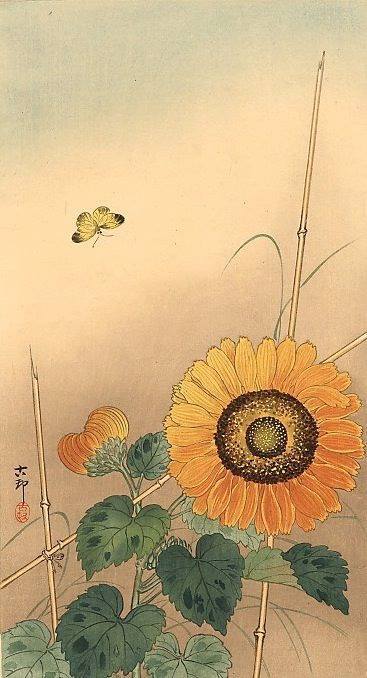
Ohara Koson (1877-1945), “Small butterfly and sunflower”
Mudita is word from Sanskrit and Pali that has no counterpart in English. It means sympathetic or unselfish joy, or joy in the good fortune of others. In Buddhism, mudita is significant as one of the Four Immeasurables. (Brama Vihara)
Defining mudita, we might consider its opposites. One of those is jealousy. Another is schadenfreude, a word frequently borrowed from German that means taking pleasure in the misfortune of others. Obviously, both of these emotions are marked by selfishness and malice. Cultivating mudita is the antidote to both.
Mudita also is said to be an antidote to indifference and boredom. Psychologists define boredom as an inability to connect with an activity. This may be because we're being forced to do something we don't want to do or because, for some reason, we can't seem to keep our attention focused on what we're supposed to be doing. And plugging away at this onerous task makes us feel sluggish and depressed.
Looked at this way, boredom is the opposite of absorption. Through mudita comes a sense of energized concern that sweeps away the fog of boredom.
In developing mudita, we come to appreciate other people as complete and complex beings, not as characters in our personal play.
How to cultivate mudita? Begin with a cheerful person who is a good friend. Contemplate this cheerfulness with appreciation and let it fill you. When this state of sympathetic joy is strong, then direct it toward a dearly loved person, a "neutral" person, and a person who causes difficulty.
Notes on the Below

by Ada Limón

—For Mammoth Cave National Park

Humongous cavern, tell me, wet limestone, sandstone caprock,
      bat-wing, sightless translucent cave shrimp,

this endless plummet into more of the unknown,
                            how one keeps secrets for so long.

All my life, I’ve lived above the ground,
            car wheels over paved roads, roots breaking through concrete,
and still I’ve not understood the reel of this life’s purpose.

Not so much living, but a hovering without sense.

What’s it like to be always night? No moon, but a few lit up
      circles at your many openings. Endless dark, still time
must enter you. Like a train, like a green river?

Tell me what it is to be the thing rooted in shadow.
      To be the thing not touched by light (no that’s not it)
to not even need the light? I envy; I envy that.

Desire is a tricky thing, the boiling of the body’s wants,
            more praise, more hands holding the knives away.

I’ve been the one who has craved and craved until I could not see
      beyond my own greed. There’s a whole nation of us.

To forgive myself, I point to the earth as witness.

To you, your Frozen Niagara, your Fat Man’s Misery,
            you with your 400 miles of interlocking caves that lead
only to more of you, tell me,

what it is to be quiet, and yet still breathing.

            Ruler of the Underlying, let me
speak to both the dead and the living as you do. Speak
to the ruined earth, the stalactites, the eastern small-footed bat,

to honor this: the length of days. To speak to the core
      that creates and swallows, to speak not always to what’s
shouting, but to what’s underneath asking for nothing.

I am at the mouth of the cave. I am willing to crawl.

 | |
| Paul Ranson, Sunflowers and Poppies, 1899. |
Sharon Salzberg begins one of her Insight Timer meditation sessions with the phrase:
I'm wishing you a restorative practice.
I find that phrase encouraging and helpful. It feels like a "performative" speech act. (I might have that work wrong. Here's Speech Act Theory) (Here's more at Wikipedia) Such acts are like spells -- the saying of them makes something happen.
In meditation practice, this is setting an intention for the the practice. It sets the stage; it brackets the next chunk of time from the ordinary; it does this bracketing in an optimistic, well-wishing way. The bracketing is also purpose setting.
Somehow it suggests that we're in this together, this is what we're hoping to do ("restoring") and I hope that it goes well.
It's also just "stopping" or "pausing." (Reminds me of "I just want to take a moment to say...")
It's the opposite of "and the next thing is." I noticed that the teacher of my recent Administrator Academy never set a purpose for any activity. He was a beginning stage teacher where everything is "OK, we've done this activity, now we're going to do this other activity. Next we're going to..."
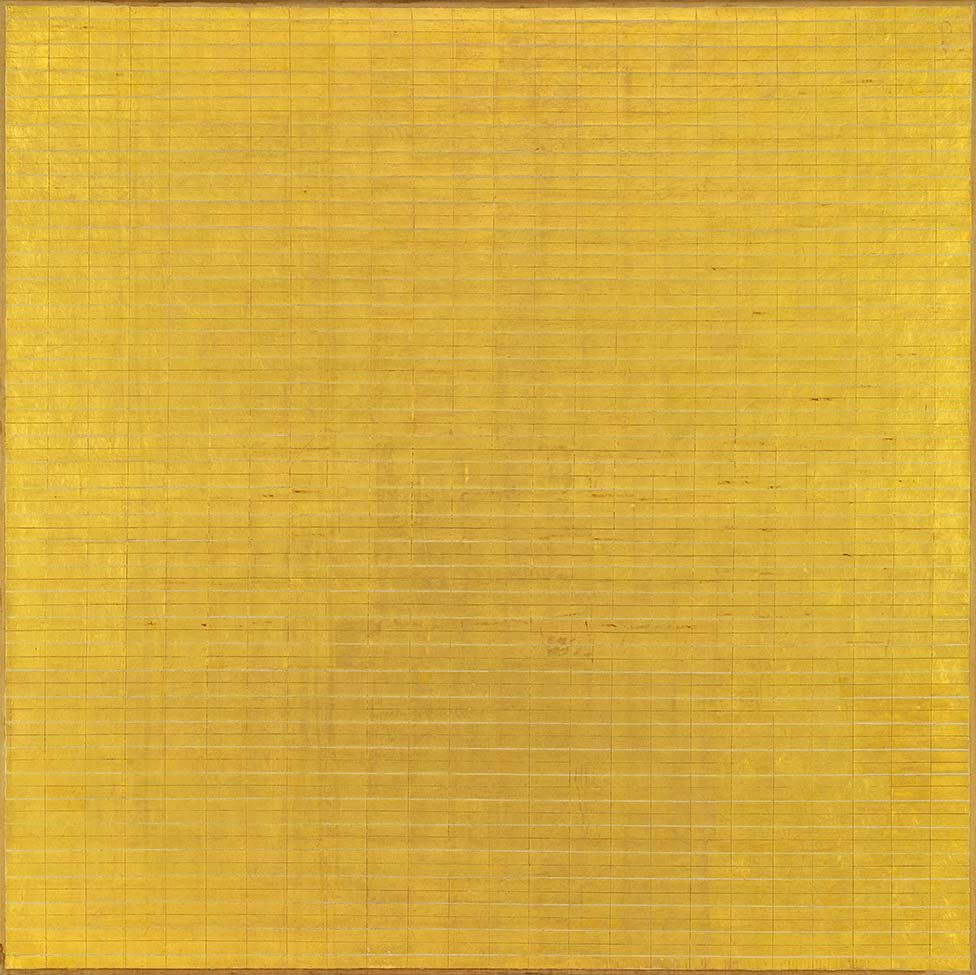 |
| Agnes Martin - "Friendship" - 1963 |
I try to be grateful. I often think about (but don't act on) the Kurt Vonnegut line about trying to SAY when you're happy. I took this 100 Things idea from Austin Kleon.
Food
Things
Accomplishments/Work
People/Relationships
Books
Adventures/Nature/Trips
Learning
Music
Life Hacks
 |
| Agnes Martin “Summer” (1964): |
Agnes Martin review from the BBC
There is little doubt that her fragile mental state informed her paintings. She was seeking tranquillity and order among chaos; to create images of beauty and happiness to dispel dark thoughts. She did so with a form of meditation, the purpose of which was to banish the act of thinking entirely. Her mind, once cleared, waited patiently in a semi-trance for an image to appear in her a head - an "inspiration" - which would show her the next painting to make. This is not as bizarre as it sounds, you hear artists of all types talking about a similar process to overcome "writer's block" or waiting for the "creative spark". Novelists speak of a book "writing itself" with them merely the conduits.
The way she achieved a state in which she could receive an inspiration, was to be completely alone with a giant Do Not Disturb sign hanging above her head for all to see from miles around.
That's perfectly normal. What makes her situation different, is the extremes to which she took the notion of seclusion.
Agnes Martin didn't so much get by without mod cons, but without any cons whatsoever. She lived alone on an isolated mesa in New Mexico with no running water or mains electricity. Admittedly, she did own a bath. Not tucked away in a cosy corner of her adobe shack, mind you, but outside in the yard. She would fill it with buckets of cold water at 10am and hope that by 4pm, shortly before the sun went down, it would be warm enough to bathe in.
If inspiration didn't call she wouldn't paint that day, week, or month. On one occasion, after a very successful show of her geometric abstract art in the 1960s, she downed tools completely. For seven years.
NYer review of a Agnes Martin show at the Guggenheim: 'A Matter-of-Fact Mystic" here
|
| Friendship (Gold leaf and oil on canvas, 6' 3" x 6' 3") 1963 |
From Helen Macdonald, H is for Hawk. So many examples of syntax and musicality. The great lines "The world gather about me. It made absolute sense. BUT the only things I knew were hawkish things..." The bargain she agrees to -- to see like a hawk makes her happy, sufficient, (making sense) -- makes her not in touch with human things (which include purpose).
It was always there, kneeling by Mabel on her prey, that the thoughts came, when I wondered how I could be doing this, how I could be hunting at all. I hate killing things. I’m loath to tread on spiders and get laughed at for rescuing flies. But now I understood for the first time what bloodthirstiness was all about. It was only when I was aligned with the hawk’s eye that it made sense, but then it made more sense than anything else in the world. When I saw birds fly overhead I’d turn my head and follow them with a kind of longing.
Hunting with the hawk took me to the very edge of being a human. Then it took me past that place to somewhere I wasn’t human at all. The hawk in flight, me running after her, the land and the air a pattern of deep and curving detail, sufficient to block out anything like the past or the future, so that the only thing that mattered were the next thirty seconds. I felt the curt lift of autumn breeze over the hill’s round brow, and the need to tack left, to fall over the leeward slope to where the rabbits were. I crept and walked and ran. I crouched. I looked. I saw more than I’d ever seen. The world gathered about me. It made absolute sense. But the only things I knew were hawkish things, and the the lines that drew me across the landscape were the lines that drew the hawk: hunger, desire, fascination, the need to find and fly and kill.
From Adam Grant:
Cynicism: We have a problem, but they don't want to solve it
Pessimism: We have a problem, but we can't solve it
Optimism: We have a problem, and we can solve it
Responsibility: We have a problem. Can I help solve it?
Initiative: We have a problem. Here's how I'm solving it
Looking into my bowl of rice, I see clearly that this food is the gift of the earth and the sky. I see the rice field, the vegetable farmer, the sunshine, rain, manure, and the hard work of the farmer...
—Thich Nhat Hanh, "Touching the Earth"
 | ||
| Blue button Porpita species, viewed from above.Credit...Denis Rieck |
NY Times article ("The Ocean’s Biggest Garbage Pile Is Full of Floating Life") reveals that there is unexpected ocean animal life that is found in the Great Pacific Garbage Patch, which contains 79,000 tons of floating garbage.
The Great Pacific Garbage Patch has been seen as an enormous symbol of humankind's careless attitude towards its own refuse. The threat from ocean plastic to birds and sea creatures, and (via microplastics) to all forms of life is well documented. It's been a goal for some groups to remove the trash heap.
“I had this hypothesis that gyres concentrate life and plastic in similar ways, but it was still really surprising to see just how much we found out there,” said Rebecca Helm, an assistant professor at the University of North Carolina and co-author of the study. “The density was really staggering. To see them in that concentration was like, wow.”
Now, animal conservationists are concerned that removing the sea trash will endanger these animals.
Dead Stars

by Ada Limon

Out here, there’s a bowing even the trees are doing.
                 Winter’s icy hand at the back of all of us.
Black bark, slick yellow leaves, a kind of stillness that feels
so mute it’s almost in another year.

I am a hearth of spiders these days: a nest of trying.

We point out the stars that make Orion as we take out
       the trash, the rolling containers a song of suburban thunder.

It’s almost romantic as we adjust the waxy blue
       recycling bin until you say, Man, we should really learn
some new constellations.

And it’s true. We keep forgetting about Antlia, Centaurus,
       Draco, Lacerta, Hydra, Lyra, Lynx.

But mostly we’re forgetting we’re dead stars too, my mouth is full
       of dust and I wish to reclaim the rising—

to lean in the spotlight of streetlight with you, toward
       what’s larger within us, toward how we were born.

Look, we are not unspectacular things.
       We’ve come this far, survived this much. What

would happen if we decided to survive more? To love harder?

What if we stood up with our synapses and flesh and said, No.
     No, to the rising tides.

Stood for the many mute mouths of the sea, of the land?

What would happen if we used our bodies to bargain

for the safety of others, for earth,
                 if we declared a clean night, if we stopped being terrified,

if we launched our demands into the sky, made ourselves so big
people could point to us with the arrows they make in their minds,

rolling their trash bins out, after all of this is over?
I wrote about Limon's PBS Newshour piece, where she references the great line "we are not unspectacular things" here.
 | ||
| Vincent van Gogh | . Vase with Twelve Sunflowers, 1888 |
“All things are potential paragraphs for the writer,” wrote Shirley Jackson in her lecture, “Memory and Delusion” (collected in Let Me Tell You):
I cannot find any patience for those people who believe that you start writing when you sit down at your desk and pick up your pen and finish writing when you put down your pen again; a writer is always writing, seeing everything through a thin mist of words, fitting swift little descriptions to everything he sees, always noticing. Just as I believe that a painter cannot sit down to his morning coffee without noticing what color it is, so a writer cannot see an odd little gesture without putting a verbal description to it, and ought never to let a moment go by undescribed.
I was playing bridge one evening with a musician, a chemistry teacher, and a painter when, during a particularly tense hand, a large porcelain bowl that we kept on the piano suddenly shattered. After we had all calmed ourselves down, we found four completely individual reactions. Looking at all the tiny scattered pieces, I thought that I had never realized before how final a metaphor a broken bowl could be. The chemistry teacher pointed out that someone had emptied an ashtray into the bowl with a cigarette still burning, and of course the heat had shattered the bowl. The painter said that the green of the bowl was deepened when the light caught the small pieces. The musician said that the sound it made when it broke was a G sharp. Then we went back and finished our bridge hand.
Someday I know that I am going to need that broken bowl. I will keep the recollection of those scattered pieces, lying on the piano, and someday when I want a mental image of utter destruction the bowl will come back to me in one of a dozen ways. Suppose, for instance, that someday I had occasion to describe a house destroyed by an explosion; the manner of destruction would be different, of course, but what I can remember is the way the little pieces of the bowl lay there so quietly after they had been for so long parts of one unbroken whole; now, not one of them could have found its place again, and the compactness that had held them together no longer existed in this world.
Suppose I wanted to describe the effect of a sudden shock—I had just played a jack of spades when the bowl broke, and for what must have been three or four seconds I sat staring at the jack of spades uncomprehendingly before I caught my breath again. Suppose someday I want to describe the sense of loss over a treasured and valuable article—my green bowl was not particularly valuable, or I wouldn’t have let people dump ashtrays into it, but I can remember how I felt when I swept up the pieces and put them in the garbage and how entirely destroyed the pieces looked.
 |
| Gustav Klimt, The Sunflower - 1907 |
Sharon Salzberg ends an Insight Timer session by saying:
See if you can bring some of this loving energy into your day.
(from the British Library blog). The British Library has a fragment of a Greek letter that is the ancient equivalent of a postcard from a sightseeing trip, written on papyrus in the 1st or 2nd century AD in Middle Egypt. A man called Nearchus is writing to his friend Heliodorus to tell him about his trip on the River Nile. After the short greeting, Nearchus tells his friend why he started to travel:
‘As many people embark on ships today to travel and see the excellent works of human hands, I have also decided to follow their example and sailed downstream on the Nile towards Syene'.
His next stop, the Siwa Oasis, is quite a distance away: it is in the Western Desert near the Libyan border. Siwa had a famous sanctuary where the ram-headed god Amon gave oracles to his visitors, which Nearchus was keen to visit:
‘I went to Libya where Amon chants his oracles to everyone. I have received very promising words and I scratched the names of all my friends on the wall of the sanctuary for eternal memory…’
Just like Alexander the Great, who visited the same site some 500 years earlier and was proclaimed the son of Amon by the oracle there, Nearchus also received good news from the god. He also tells us that he scratched his friends’ names on the temple wall. Although this may sound very alarming today, putting names on the temple wall was considered pious at that time. It was to ensure that the absent friends would be present at the holy place forever – exactly as Nearchus assures his friend.
 |
| Kokei Kobayashi "Hydrangea" (1937) |
On Hydrangeas
dew drops gather
the morning sun
-Chiyo-ni
Alan Jacobs' blog includes this reference from Andy Crouch’s new book. He has a trailer for it here.
To rebuild households would begin to undermine Mammon itself. If we lived this way together, we would begin to fundamentally change our economy in the most literal sense and eventually change the structure of economic life more broadly — what we value, measure, and reward. To begin this kind of economic restoration does not require us to change the practices of Wall Street, the Federal Reserve, or the European Central Bank — or even to know, exactly, what ought to replace them. We just (just!) have to redirect our energies away from Mammon’s domain and turn toward a realm where Mammon has nothing to offer. And then we need to invite others to join us under that new shelter.
 |
| Gustav Klimt - Birch in a Forest, 1903 |
From Art of Noticing newsletter; these are collected from a recent NYT Magazine piece about advice from artists.
As a high schooler, I wrote terrible poems. But when I realized the subject of writing wasn’t far away from me but close by — in the field behind your house, or the dirt beneath your feet — I understood what a poem could be. I wrote about my parents, my grandparents, my family in Louisiana — people I didn’t see in the books I read. Understanding that literature was about them was probably the biggest leap for me. I didn’t discover some confidence in myself; it was more like, “I have to tell this story.” Doing so was very urgent and important. I stand by that. It was crucial to learn that poetry was about everyday people, places and things. It was finding the extraordinary in the everyday.
It feels like my job now is to figure out how to remain engaged with the world, in love with the world, turned on by the world; how to remain capable of delight in the pleasures of inventing and imagining; how to keep seeking out plausible occasions for hope while remaining as brave and as honest as I’m capable of being; how not to despair; how to believe that generating meaning is the surest way to defeat despair; and, while continuing to try to do all these lively things that writing has always demanded and needed, to keep a watchful eye on mortality and incorporate what I’m seeing into what I write. …
OK, advice: Try to get enough sleep. Eat sensibly. Stay politically active. Keep reading; keep rereading; keep observing; keep synthesizing. Do not despise the young (even when they’re insufferable, rude, frightening). Locate within yourself the primal sympathy and hold tight to it; find soothing thoughts that spring out of human suffering, but stay angry; feel free to toy with the faith that looks through death, as long as you remember that it’s most likely a placebo; and be grateful for years that bring the philosophic mind, even if they also bring wattles and wrinkles and digestive infirmities. And at least consider the possibility that silence in a writer isn’t necessarily failure.
Don’t close yourself off. Whether it’s a room of one’s own, or revisiting your memories of self at various stages in your growth, or buying yourself a collection of materials, or going on a hike and collecting natural artifacts, or listening to your favorite music orchestrated publicly or selected privately, or finding new favorites or new friends, or simply going to the gym, on a bike ride, a horseback ride or playing in the snow or on the beach — context is everything. Put it into play and into work.
 |
| "Loving Love" by Agnes Martin 2000 - DACS 2020/BRIDGEMAN IMAGES |
Tweedy relates how the band created the songs:
It’s a style of recording that forces a band to surrender control and learn to trust each other, along with each others’ imperfections, musical and otherwise. With no ‘one’ person in charge, the goal can be vague. But a certain type of faith emerges. A belief that we’re all heading toward the same destination, and we either get there together or not at all. It’s messy. Like democracy.
Tweedy continues to seem to me like a wise old Buddha.
This reminds me of the Marilyn Robinson/Barack Obama quotation about how democracy needs to be constantly remade.
I also love how "the goal can be vague" when you there is trust and accept imperfections.
It demands a surrender of control and acceptance that "we either get there together or not at all."
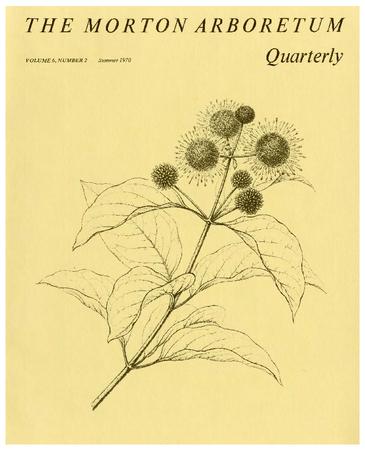
Morton Arboretum Quarterly magazines
Here's a PDF of one. Check out page 14 for a pen and ink drawing by Anthony Tyznik, for Arboretum landscape architect as well as the article on page 16 about which native Illinois plants need protection and should not be picked. It's from 1970. Both the drawing and the list of plants are interesting. How much cool stuff you can find like this. It reminds me of the PDF archive of Chicago Wilderness.
 |
| Animals In The Forest, by Yumiko Higuchi, contemporary Japanese embroidery artist |
“The enemy of creative work is boredom, actually,” Brain Eno says. “And the friend is alertness. Now I think what makes you alert is to be faced with a situation that is beyond your control so you have to be watching it very carefully to see how it unfolds, to be able to stay on top of it. That kind of alertness is exciting.”
As Visconti and Bowie struggled to find a new direction—not so much composing songs as carving them out of blocks of sound—Eno took to showing up at the studio with a selection of cards he called Oblique Strategies. Each had a different instruction, often a gnomic one. Whenever the studio sessions were running aground, Eno would draw a card at random and relay its strange orders.
Be the first not to do what has never not been done before
Emphasize the flaws
Only a part, not the whole
Twist the spine
Look at the order in which you do things
Change instrument roles
For example, during the recording of the Lodger album, Carlos Alomar, one of the world’s greatest guitarists, was told to play the drums instead. This was just one of the challenges that Eno’s Oblique Strategies cards imposed, apparently unnecessarily.
The cards drove the musicians crazy. (This annoyance cannot have come as a surprise to Eno. During work on an earlier Eno album, Another Green World, the cards reduced Phil Collins, the superstar drummer from Genesis, to hurling beer cans across the studio in frustration.) Faced with one piece of card-inspired foolishness, Carlos Alomar told Eno that “this experiment is stupid”; the violinist Simon House commented that the sessions often “sounded terrible. Carlos did have a problem, simply because he’s very gifted and professional . . . he can’t bring himself to play stuff that sounds like crap.”
Yet the strange chaotic working process produced two of the decade’s most critically acclaimed albums, Low and “Heroes,” along with Iggy Pop’s most respected work, The Idiot and Lust for Life. Low was arguably the bravest reinvention in pop history—imagine Taylor Swift releasing an album full of long, pensive instrumentals and you get a sense of the shock. It’s hard to argue with such results, and Brian Eno’s Oblique Strategies now have a cult following in creative circles. The Berlin trilogy of albums ends with Bowie’s Lodger, a record with a revealing working title. It was originally called Planned Accidents.
Here‘s a minimal, online version of Oblique Strategies.
Instructions on Not Giving Up

by Ada Limon

More than the fuchsia funnels breaking out
of the crabapple tree, more than the neighbor’s
almost obscene display of cherry limbs shoving
their cotton candy-colored blossoms to the slate
sky of Spring rains, it’s the greening of the trees
that really gets to me. When all the shock of white
and taffy, the world’s baubles and trinkets, leave
the pavement strewn with the confetti of aftermath,
the leaves come. Patient, plodding, a green skin
growing over whatever winter did to us, a return
to the strange idea of continuous living despite
the mess of us, the hurt, the empty. Fine then,
I’ll take it, the tree seems to say, a new slick leaf
unfurling like a fist to an open palm, I’ll take it all.
This week, pretty late because of our cold spring, is the week of blossom confetti and "almost obscene display." I feel connected to Limon's sense that BOTH the "funnels" and the "greening" get to her. And I love that the greening inspires her with it's "strange idea of continuous living despite..." I love the conceit of being inspired by nature. It's a poetic version of post-card sentiments like "10 ways to learn from trees." Limon's poem "Notes on the Below" is also about being inspired by a natural object; but in that poem it's not the 'continuous living" but "to be quiet, and yet still breathing" and "to speak to the core/that creates and swallows, to speak not always to what's/shouting, but to what's underneath asking for nothing."