
Bark shedding tree, garden, typical haul, 6’ tall bellflower along Bemis path.
https://earthzine.org/phenology-wheels-earth-observation-where-you-live/
Another example: Nature Journaling (link)

Indiana Dunes Nature Center interactive phenology wheel link
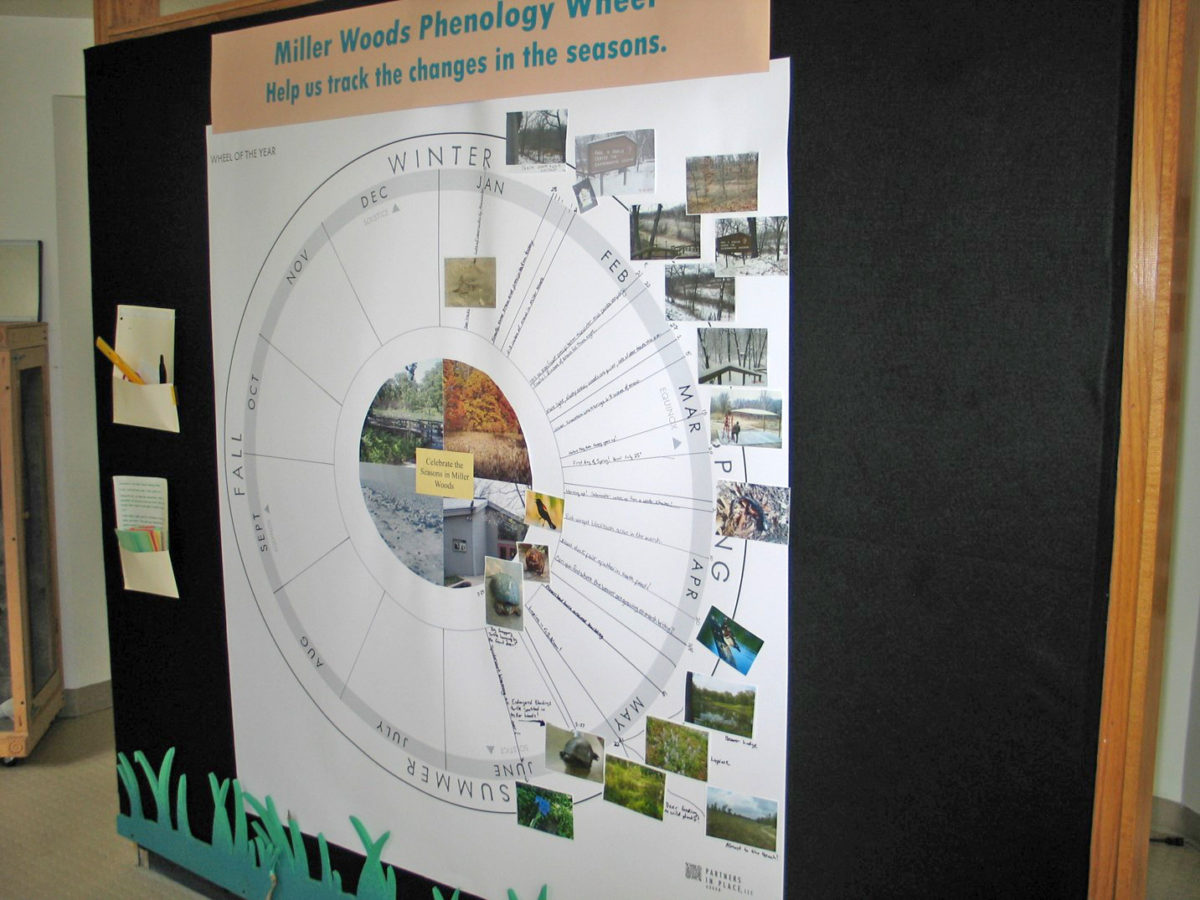
Also, phenology wheels can be created of the moon... that's maybe the most "usual" use of the wheel. Link. https://www.acornecoliving.ca/blogs/homeschool/moon-study-and-lunar-phenology-wheels

"Phenology" is "the study of climate-related biological rhythms." I learned this recently in this NYT article about a guy who wrote a newspaper garden column for 45 years in Alaska and how his columns provide evidence for climate change. There's a passage about how everyday nerds (gardeners, fly fishermen, birders. etc.), keeping track/noticing everyday nature, have unwittingly provided this evidence of climate change.
Until the recent past, few people ever set out to create a long-term record of climate change, says Abe Miller-Rushing, an ecologist at Acadia National Park in Maine. Many have done so by accident, though. Foresters write down when trees bud. Flyfishers monitor when aquatic insects hatch. Birders track when migrating birds appear in their yards. Phenology, the study of climate-related biological rhythms — when flowers bloom, for instance, when frogs sing, when birds migrate — had long been viewed as boring, Miller-Rushing says. “Once you had things figured out, you had it figured out, because it happened the same every year.” But then it began to become clear that things weren’t happening the same every year.
...
One of the great nerds was Henry David Thoreau, whose notebooks (in addition to his works on Civil Disobedience and living for two years by Walden Pond) are unexamined gold mines.
Since 2003, Miller-Rushing has pored over dozens of long-term records. He has scoured data from the diaries of Henry David Thoreau for notes on when flowers bloomed. Others have been searching French ledgers that stretch back to the Middle Ages for wine-grape harvest dates, sifting through imperial Chinese documents for mention of the arrival of locust swarms, examining 17th-century Japanese diaries for information about the timing of the annual cherry-blossom festivals. These documents — often created for mundane reasons, because flowers and harvests and pests are what gardeners have always concerned themselves with — have become sources of useful data. “It’s really valuable to have those kinds of observations,” Miller-Rushing says. “How things have changed over the past hundred or 200 or more years can really tell us a lot about the changes we can expect over the next hundred or 200 years
***
Another famous Phenologist was Aldo Leopold.... link here.
***
All of this delights my nerd self. I love "middle seasons" and diaries (like my journal history project that keeps track of what happened "this week" for years past), and notebook keeping.
Walt Whitman, recovering from a paralytic stroke, as he contemplated what makes life worth living
After you have exhausted what there is in business, politics, conviviality, love, and so on — have found that none of these finally satisfy, or permanently wear — what remains? Nature remains… the trees, fields, the changes of seasons — the sun by day and the stars of heaven by night.
from Brain Pickings
a hot day's treasure
they say, little clump
of trees
-Issa Kobayashi
We experienced that while walking on a warm and humid afternoon. A section of the suburban street that had layers of protective trees on both sides of the street felt noticeably cooler.
The poem helps me think that each day has a treasure... even a hot day which I don't like so much.

Simone Weil famously said that "attention is the rarest and purest form of generosity."
In How to Do Nothing, Jenny Odell argues that given the contemporary politics of attention, to actively choose who or what to hear or see “forms the ground not only for love, but for ethics.” (Here's the original Medium article that preceded Odell's book.)
Juliana Castro says in her blog post about how different languages deal with the verb attention in different ways (and the common root of "care" in all of them), "As people and corporations discuss and capitalize on the monetization of our attention, I want to reclaim attention as an act of care.


We memorialize heroes with larger-than-life statues. Sword-raised, horse-backed heroes. Firefights with bronze figures lugging hoses. Unknown veterans with cannons, tanks.
In OKC there are 143 chairs to commemorate the dead in the Murrough Building bombing
In Germany there are bronze stars in the ground to memorialize the local dead Jewish population who died in local concentration camps
On May 10, 1933, in the Bebelplatz in central Berlin, members of the National Socialist Student Union burned 20,000 books, objecting to the “un-German spirit” of many Jewish, communist, and liberal authors. Joseph Goebbels declared that “the era of exaggerated Jewish intellectualism is now at an end … and the future German man will not just be a man of books … this late hour [I] entrust to the flames the intellectual garbage of the past.”
In 1995, Israeli sculptor Micha Ullman created a memorial room under the plaza, with empty shelves enough to accommodate 20,000 books. A plaque set into the cobblestones bears a quote by Heinrich Heine:
That was but a prelude;
where they burn books,
they will ultimately burn people as well
https://www.futilitycloset.com/2021/07/15/the-empty-library/
 |
| Moon at Magome, 1930 by Hasui Kawase |
Tara Brach's meditation on Insight Timer titled "Loving this Life" has an abundance of helpful phrasings for meditation.
Feeling the aliveness... sense of aliveness and awareness...
feeling feet from the inside, widening attention to whole body
listening to and feeling the whole moment; sensing quality of presence
Choosing to be here, inviting yourself back into this moment
open receptivity to this swim of sensation
saying yes in a radical way to what's here
open again to sound... just listen, re-relax thru body; feel quality of gentleness
ends with loving kindness to self:
May I feel happy (and sense what that means to you)
may I be safe and at ease (and visualize what that means to you)
May this heart and mind be awake and free

"Life, friends, is a people business," Victor Jr. pronounced with a stained tea towel slung over his cushy shoulder, this after we'd fist-bumped Rafe and Hardtime and group hugged good night with Mrs. Parnthong, who was visiting 20 Whet for the first time. Val and I assumed he was parroting some philosophizing chef in a video he'd watched, but the dappled glints in his eyes made you wonder if another dimension had opened to him, that he was realizing as a lot of grown-ups never do-that what was fundamentally good for you was staying busy, making something new every day, and having kind social contact.
 |
| Sunset at Ichinokura, 1928. |
Earlier I've collected some work by Japanese wood block print artists. I stumbled upon this posting about Hasui Kawase by Brain Pickings blogger Maria Popova. Hasui Kawase's art was selected recently by someone on Twitter who often matches haiku and prints. I'm grateful for learning more about Japanese prints and reading more haiku. Popova says of Hasui Kawase, "after the First World War, a young Japanese man was embarking on a life of celebrating the inexhaustible consolations of nature in uncommonly poetic visual art."
|
| Moon at Magome, 1930. |
Popopa says:
Born into a Tokyo family of rope and thread merchants, Hasui Kawase (May 18, 1883–November 7, 1957) grew up dreaming of becoming an artist. His parents pressed him to continue in their path, but he persisted in following his own, drawing quiet inspiration from the example of his maternal uncle — the creator of the first manga magazine.
He did take over the family business, but he was moonlighting in art while running it — sketching from nature, copying one master’s woodblock prints, learning brush painting from another.
 |
| Spring Moon at Ninomiya Beach, 1931. |
Over the next thirty-five years, Hasui became a master of shin hanga — the “new prints” movement fusing traditional Japanese art, the art of shadows, with the Western aesthetics of light and the European novelty of perspective. He went on to create several hundred consummate woodblock prints, watercolors, oil paintings, and hanging scrolls, animated by a tender reverence for the beauty and majesty of nature. One hundred of them are collected in the lavish annotated volume Visions of Japan: Kawase Hasui’s Masterpieces. In the final year of his life, the Japanese government classified Hasui as a Living National Treasure.
 |
| Snow on Lake, 1922. |
https://www.brainpickings.org/2021/03/22/hasui-kawase-prints/
 |
| (image: Hasui Kawase) |
when there are mountains
I look at the mountains
when it rains
I listen to the rain
- Santoka
(image: Hasui Kawase)
The Reverend Mr. Beebe notices how well she plays Beethoven's Op. 111 (Piano Sonata #32) and notes the disjunction between the passion she plays with and the timid way she lives.
Miss Katherine Allen asks, "Why, whatever’s the matter with Miss Lucy?" The Reverend Beebe replies jokingly, "I put it down to too much Beethoven."
The idea that "too much Beethoven" can affect, change your personality is fun. Music as a tonic, a medicine, a drug, a changer!
In the scene above, In this scene: Beethoven Piano Sonata no.21 in C major, Op.53. Music begins ⅔ of the way through the second movement, Introduzione, and continues through the first few bars of the third movement, Rondo.
In the second part of the clip, Lucy plays some Schubert (see below) later in the movie after Cecile has engaged to her.
The music is great. It makes me want to read the book to see what E.M. Forster says about music and personality and being human.
1 (15-ounce) can chickpeas or 1 1/2 cups (250 grams) cooked chickpeas
1/4 cup (60 ml) fresh lemon juice (1 large lemon)
1/4 cup (60 ml) well-stirred tahini, see our homemade tahini recipe
1 small garlic clove, minced
2 tablespoons (30 ml) extra-virgin olive oil, plus more for serving
1/2 teaspoon ground cumin
Salt to taste
2 to 3 tablespoons (30 to 45 ml) water
Dash ground paprika or sumac, for serving
In the bowl of a food processor, combine the tahini and lemon juice and process for 1 minute, scrape the sides and bottom of the bowl then process for 30 seconds more. This extra time helps “whip” or “cream” the tahini, making the hummus smooth and creamy.
Add the olive oil, minced garlic, cumin, and a 1/2 teaspoon of salt to the whipped tahini and lemon juice. Process for 30 seconds, scrape the sides and bottom of the bowl then process another 30 seconds or until well blended. Open, drain, and rinse the chickpeas. Add half of the chickpeas to the food processor and process for 1 minute. Scrape sides and bottom of the bowl, then add remaining chickpeas and process until thick and quite smooth; 1 to 2 minutes.
Most likely the hummus will be too thick or still have tiny bits of chickpea. To fix this, with the food processor turned on, slowly add 2 to 3 tablespoons of water until you reach the perfect consistency.
Taste for salt and adjust as needed. Serve hummus with a drizzle of olive oil and dash of paprika. Store homemade hummus in an airtight container and refrigerate up to one week.
2 ripe avocados
1/4 teaspoon salt, plus more to taste
1 tablespoon fresh lime or lemon juice
2-4 tablespoons minced red onion or thinly sliced green onion
1-2 serrano (or jalapeño) chilis, stems and seeds removed, minced
2 tablespoons cilantro (leaves and tender stems), finely chopped
Pinch freshly ground black pepper
1/2 ripe tomato, chopped (optional)
Billy Collins' poem "Istanbul," relates the pleasures of going to a Turkish bathhouse. The stanza that I like creates a picture of how his body feels when he acknowledges the pleasures and is grateful for the pleasures of being taken care of.
But it was not until he sudsed me / behind my ears and between my toes / that I felt myself filling with gratitude / the way a cloud fills with rain, / the way a glass pipe slowly fills with smoke.
From Elizabeth Kolbert's "Under a White Sky" about how humans are exerting strong selective pressure on natural selection in ways that Darwin ("If feeble man cand do so much by his powers of artificial selection" as he did with creating a wide range of Fancy Pigeons, there was "no limit to the amount of change that could be effected by 'nature's power of selection') couldn't imagine.
"Feeble man" is changing the climate, and this is exerting strong selective pressure. So are myriad other forms of "global change": deforestation, habitat fragmentation, introduced predators, introduced pathogens, light pollution, air pollution, water pollution, herbicides, insecticides, and rodenticides. What do you call natural selection after The End of Nature?

Elizabeth Kolbert's Under a White Sky: The Nature of the Future
Humans add Asian carp to our environment (for the excellent purpose of controlling pests without chemicals), then need to create extraordinarily elaborate and costly systems to fight that carp and keep them from further devastating the environment. They dam the Mississippi and then work endlessly to mitigate the harm that causes. Under a White Sky is the tale of human hubris in the "After Nature" world -- first creating environmental disaster, then trying (hubristically) to fix it. The book includes tales of humans creating artificial eco-systems in air-plan hangar-sized buildings in Death Valley to save a pupfish which human activities endangered and tales of re-creation of indoor coral farms to "assist evolution."
Here's one of my favorite sections of the writing shows how our language reflects our very complicated relationship to nature:
It's often observed that nature -- or at least the concept of it -- is tangled up in culture. Until there was something that could be set against it -- technology, art, consciousness -- there was only "nature," and so no real use for the category. It's also probalby true that by the time "nature" was invented, culture was already enmeshed in it. Twenty thousand years ago, wolves were domesticated. The result was a new speciid (or, by some accounts, sub-species) as well as two new cateogoreies: the "tame" and the "wild." With the domestication of wheat, around ten thousand years ago, the plant world split. Some plants became "crops" and others "weeds." In the brave new world of the Antrhopocene, the divisions keep multiplying.
Consider the "synanthrope." This is an animal that has not been domesticated and yet, for whatever reason, turn out to be peculiarly well suited to life on a farm in the big city. Synanthropes (from the Greek syn for "together," and anthropos, "man") include racoons, American cros, Norway rats, Asian carp, house mice, and a couple of dozen species of cockroach. Coyotes profit from hman disturbance but skirt areas dense with hyman acitivty; they have been dubbed "misanthropic synanthropes." In botan, "apophytes" are native plants that thrive when people move in; "anthropophytes" are planst that thrive when people move them around. Anthropophytes can be still further subdivided into "archaeophytes," which were spread before Euroeans arrived in the New World, and "kenophytes," which were spread afterward.
Of course, for every species that has prospered with humans, many more have declined, creating the need for another, bleaker list of terms....(82)
Kolbert goes on to name the wide variety of terms we've need to come up with to represent endangeredness. She goes on to say that one way we could have made sense of the "biodiversity crisis" is to accept it. Another is to try to change it. "And so we've created another class of animals. These are creatures we've pushed to the edge and then yanked back. The term of art for such creatures is "conservation-reliant," though they might also be called "Stockholm species" for their utter dependence on their perssectors." (84)
From HDT journal - July 6, 1840:
Let the daily tide leave some deposit on these pages, as it leaves sand and shells on the shore. So much increase of terra firma. his may be a calender of the ebbs and flows of the soul; and on these sheets as a beach, teh waves may cast up pearls and seaweed.
Jordan Metzle Iron Strength Workout
warmup - 30 secs each of - jumping jacks, high knees, extended arm squats, Russian solider walk (walking high kicks)
1. plyometric jump squats (arms extended; as you sit, push butt back, like sitting, jump off of heals) (6 sets of 15)
2. core superset: dumbell rows from plank position - 15; push-ups - 15; sit ups - 15; then start again... total of 5 minutes
3. Plyometric lunges (engage the core); (10) then plyometric single leg toe touches (add plyometrics after you...) Stand on your left leg with your right leg out in front of you and raised off the floor. Place your arms straight out to the side at shoulder height. Bend your left leg at the knee and squat down to touch your left hand to the toe of your right foot; then come back up. (do lunges, then left toe touches, then lunges, then right toe touches)
4. Mountain Climbers and Leg downs (5 minutes) sets of 15
5: Dumbbells - overhead push press, bicep curls, deadlift (from holding them at sides to by ears, starting with palms back) sets of 15.
6. Burpees - 4 sets of 10
7. Planks and stretching - 60 seconds each side and center planks; stretch: seated hampstring (20 seconds) open leg seated hamstring, pigeon, back stretch (lie down, knees one way, arms and head the other), hip flexor stretch, I'm a little teapot
3.
7 min workout - link
Advanced 7 min workout - link
Jordan Metzle. Link
Henry David Thoreau said, in Walden,
When first I took up my abode in the woods, that is, began to spend my nights as well as days there, which, by accident, was on Independence Day, or the Fourth of July, 1845, my house was not finished for winter, but was merely a defense against the rain.... The winds which passed over my dwelling were such as sweep over the ridges of mountains, bearing the broken strains, or celestial parts only, of terrestrial music. The morning wind forever blows, the poem of creation is uninterrupted; but few are the ears that hear it.
I recently discovered this playlist of 65 hour-long meditation sessions that Kabat-Zinn led during the pandemic. I have listened to a couple of them and found them especially helpful in dropping into a calm sense of being attentive and open.
Marie Howe tells Krista Tippett of On Being (episode: "The Power of Words to Save Us") how much she loves terms "ordinary time" in the church calendar and how fascinating it was (and is to her) in contrast to the "non ordinary" times of the church.
Ordinary time originally meant to me when I would go through the missal when I was a kid. Remember, those swaths of time between high holy seasons was ordinary time. there was always coming, the coming of ordinary time, the coming of ordinary time, the coming of — and then first Sunday of ordinary time, second Sunday of ordinary time. I remember just thinking what a strange and wonderful way of talking about everyday life. And so this notion of when nothing dramatic is happening, but this is where we’re living. It’s not Easter. It’s not Christmas. It’s not Lent. It’s not Advent.
Tippet responds:
Here’s another line from “Nowhere.” “This is how things happen, cup by cup, familiar gesture after gesture. What else can we know of safety or of fruitfulness?” What struck me in that and also in the piece you just read, there are those tiny rituals of life in there. It strikes me that these rituals of ordinary time themselves are a little bit like poetry, these condensed, kind of economical little packets of beauty and grace that carry so much more forward than is obvious.
All this week Jennie and I have been saying "Oh, it's Thursday: what were we doing this time last week?" Last week we were on a road trip to Burlington, Vermont. With some ease, we are able to recall what exactly we did -- road bikes to the Colchester causeway, had breakfast at the August the First bakery, walked down to the arts district.
"Vacation time" seems different than "ordinary time." It's easier to remember, it's slower, it has more memory handles. "Vacation time" can mean "the quality of time when you're on vacation" (maybe I'm thinking specifically about road trip vacations?). The whole time can be like "the method of Loci" memory technique. "It's Friday: what were we doing this time last week?" is easy to answer. Ask me three weeks ago what my favorite parts of July 2 are, and I'd be helpless to answer.
We have different times -- ordinary time, high holidays, "advents" and "lents" of different kinds. I don't know why this is important to being human, why it adds meaning or gravitas to days, but it does.
This all calls to mind the rituals of remembering: anniversaries, etc.
I know that social media apps will do call up pictures from years ago on this date.... as does Google Photos or Apple Photos. Two years ago on this date. Ten years ago this week. Some of these are really worth memorializing.
I was thinking yesterday of the HDT book "The Daily Henry David Thoreau: A Year of Quotes from the Man Who Lived in Season." by Laura Dassow-Walls. You could build a year of anniversaries to celebrate and remember.
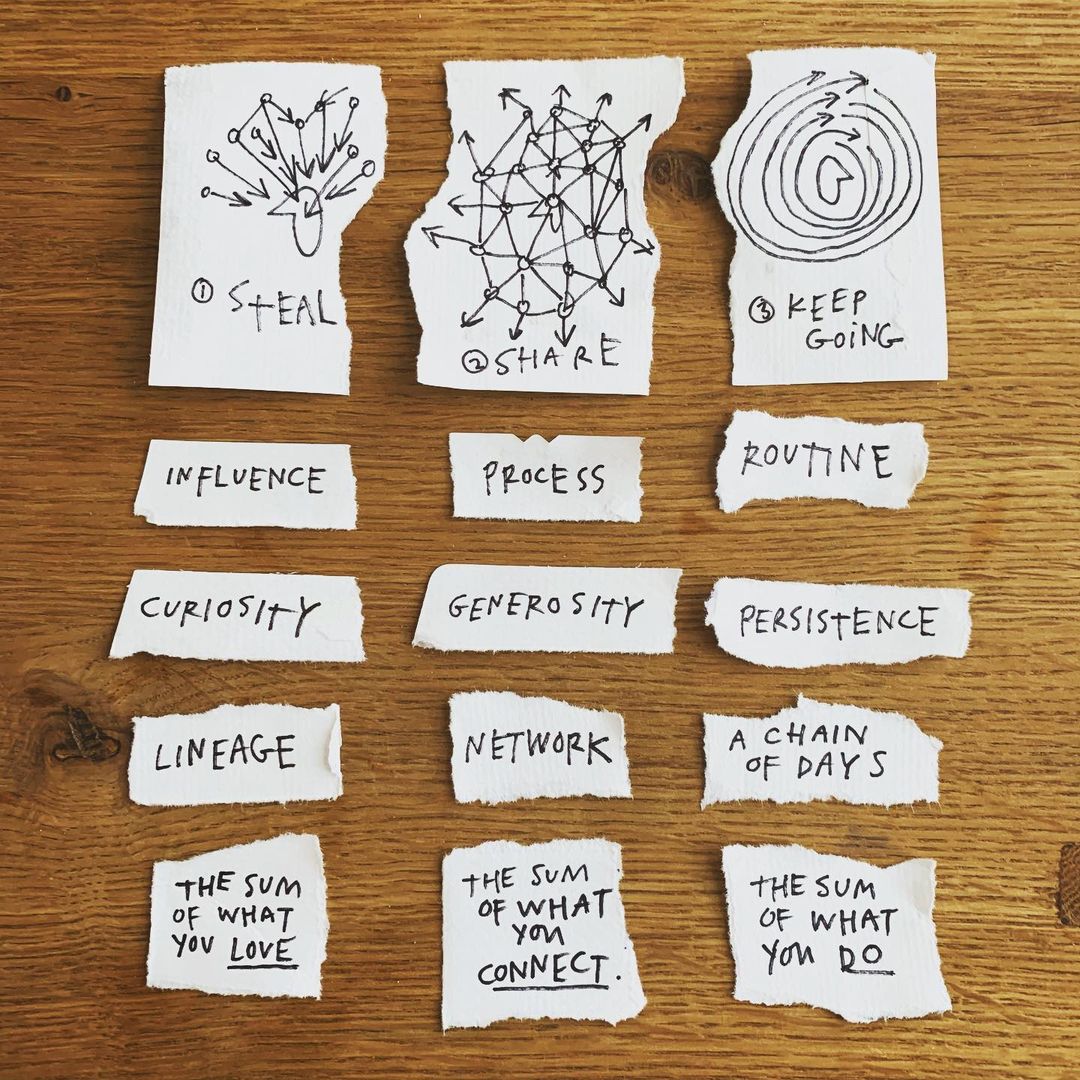
Conveniently, I have a trilogy of books that map nicely to 3 talks, but because each subsequent book after Steal grew out of the one before it, there’s a bit of crosstalk between them. (For example, the chapters “Something small, every day” from Show, “Every day is Groundhog Day” from Keep Going, and “Be Boring” from Steal all speak to the idea of daily practice and routine.) So, funny enough, I’m combining what I usually do for talks: narrowing each book down to an essential idea, and then building up each talk by weaving in material from all over…
What I find interesting is that he continues to spiral around nuggets of "truths" about being and working. Where do we get ideas? (lineage, family tree, scenius). We need to have a daily routine of work (groundhog day, persistence). What should you do with your work (share, create a community).
It strikes me that you could edit it even further: have a persistent, daily ROUTINE. Be CURIOUS. Be GRATEFUL. Build a NETWORK. You could also add "find your lineage" or "trace family trees." But it all boils down to a small number of key ideas.
For some reason, it's reminding me of John Wooden's Pyramid of Success or his Seven Point Creed. And it reminds me of the Noble 8-fold path in Buddhism. I'm thinking now that all of them have a "pinnacle" to the pyramid... but they're all very different!

Preparing for his talks, Kleon is forced to think about what those nuggets are... and test to see which ideas are related and how related they are. I like that reflection and restatement. What works for me? What is true and just? I like the reflective life... the opposite of mindlessly moving through days.
I'm thinking about this partly because I recognized recently that I have a totally new idea about relationships (from birdhouse to garden) and that gives me some insight that I didn't have before. And because I'm approaching one full year of blogging, I've been thinking of indexing ideas and summarizing ideas.

