
 |
| Prunus, attributed to Kano Einō, mid- to late 1600s |
Before going to work each morning, generate a good motivation, thinking “I’m going to offer service. Whomever I come in contact with today, be they colleagues, clients or others, I want to benefit them in whatever big or small way possible.”
Thubten Chodron
Agile Results (link) is "a systematic way to achieve both short- and long-term results. It works for all aspects of your life, from work to fun. The key to achieving results in our ever-changing world is learning and responding to change."
Here's how:
Three Wins
Think in threes to focus your time, energy, and your actions. Identify three wins that you want to achieve:
- Three wins for the day.
- Three wins for the week.
- Three wins for the month.
- Three wins for the quarter.
- Three wins for the year.
- Bonus – Three wins for your decade, and three wins for your life.
These wins act as your tests for success and they focus your tasks, while making it a game. Focusing on three wins also helps you reframe problems into challenges. At the same time, it helps you identify, acknowledge, and appreciate your personal victories.
Monday Vision, Daily Wins, Friday Reflection
This is a simple way to get started with Agile Results:
On Mondays, identify three wins that you want for the week. Ask yourself, “If this were Friday, what are three things I would want to have achieved or accomplished?”
Each day, identify three wins that you want for the day. Ask yourself, “What are the three wins I want for today?” Say them out loud. Write them down on paper. Saying them out loud simplifies them, and writing them down on paper helps them stick.
On Fridays, identify three things going well, and three things to improve. Make a recurring appointment with yourself on Fridays. In your appointment, ask yourself, “What are three things going well?.” Follow up with, “What are three things I want to improve?” Identity three things you can do to carry the good forward, or change your approach so that you can make next week, a better experience.
 |
| Christopher Marley, Inspectrum II, 2021, butterflies, 26 in. x 48 in. Donald Winnicott on the True and False Self. I'm interested in how the True Self is expressed as confidence, calm, and curious and creative. This is all from Wikipedia. True self "Only the true self can be creative and only the true self can feel real." Winnicott believed one of the developmental hurdles for an infant to pass is the risk of being traumatised by being too aware too soon of how small and helpless they really are. A baby who is too aware of real-world dangers will be too anxious to learn optimally. A good-enough parent is well enough attuned and responsive to protect the baby with an illusion of omnipotence, or being all-powerful. For example, a well-cared-for baby usually does not feel hungry for very long before being fed. Winnicott thought the parents' quick response of feeding the baby gives the baby a sense that whenever she's hungry, food appears as if by magic, as if the baby herself makes food appear just by being hungry. To feel this powerful, Winnicott thought, allowed a baby to feel confident, calm and curious, and able to learn without having to invest a lot of energy into defences. False self In Winnicott's writing, the "False Self" is a defence, a kind of mask of behaviour that complies with others' expectations. Winnicott thought that in health, a False Self was what allowed one to present a "polite and mannered attitude"[44] in public. But he saw more serious emotional problems in patients who seemed unable to feel spontaneous, alive or real to themselves anywhere, in any part of their lives, yet managed to put on a successful "show of being real". Such patients suffered inwardly from a sense of being empty, dead or "phoney". Winnicott thought that this more extreme kind of False Self began to develop in infancy, as a defence against an environment that felt unsafe or overwhelming because of a lack of reasonably attuned caregiving. He thought that parents did not need to be perfectly attuned, but just "ordinarily devoted" or "good enough" to protect the baby from often experiencing overwhelming extremes of discomfort and distress, emotional or physical. But babies who lack this kind of external protection, Winnicott thought, had to do their best with their own crude defences. One of the main defences Winnicott thought a baby could resort to was what he called "compliance", or behaviour motivated by a desire to please others rather than spontaneously express one's own feelings and ideas. For example, if a baby's caregiver was severely depressed, the baby would anxiously sense a lack of responsiveness, would not be able to enjoy an illusion of omnipotence, and might instead focus his energies and attentions on finding ways to get a positive response from the distracted and unhappy caregiver by being a "good baby". The "False Self" is a defence of constantly seeking to anticipate others' demands and complying with them, as a way of protecting the "True Self" from a world that is felt to be unsafe. Winnicott thought that the "False Self" developed through a process of introjection (a concept developed early on by Freud) or internalising one's experience of others. Instead of basing his personality on his own unforced feelings, thoughts, and initiatives, the person with a "False Self" disorder would essentially be imitating and internalising other people's behaviour – a mode in which he could outwardly come to seem "just like" his mother, father, brother, nurse, or whoever had dominated his world, but inwardly he would feel bored, empty, dead, or "phoney". Winnicott saw this as an unconscious process: not only others but also the person himself would mistake his False Self for his real personality. But even with the appearance of success, and of social gains, he would feel unreal and lack the sense of really being alive or happy. The division of the True and False self roughly develops from Freud's (1923) notion of the Superego which compels the Ego to modify and inhibit libidinal Id impulses, possibly leading to excessive repression but certainly altering the way the environment is perceived and responded to. However, it is not a close equation as the Id, Ego and Superego are complex and dynamic inter-related systems that do not fit well into such a dichotomy. The theory more closely resembles Carl Rogers' simplified notions of the Real and Ideal self. According to Winnicott, in every person the extent of division between True and False Self can be placed on a continuum between the healthy and the pathological. The True Self, which in health gives the person a sense of being alive, real, and creative, will always be in part or in whole hidden; the False Self is a compliant adaptation to the environment, but in health it does not dominate the person's internal life or block him from feeling spontaneous feelings, even if he chooses not to express them. The healthy False Self feels that it is still being true to the True Self. It can be compliant to expectations but without feeling that it has betrayed its "True Self". |
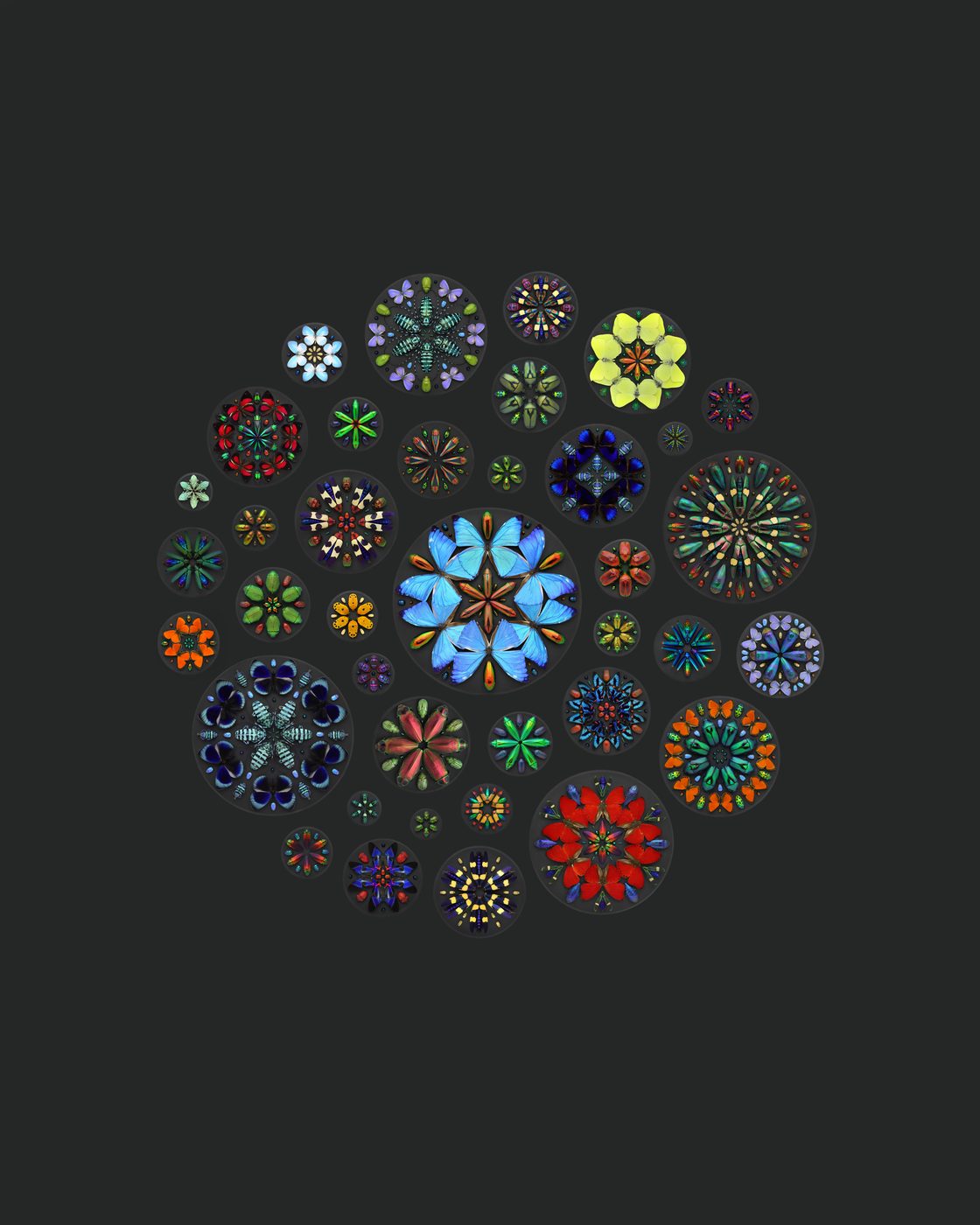 |
| Christopher Marley, Continuum II, 2022, Coleoptera spp, Scutelleridae spp, Lepidoptera spp. 40 in. x 40 in. |
There are several studies, starting with the first one in the nursing home, where we gave people control — made people mindful. People need to understand when I’m talking about mindfulness, it has nothing to do with meditation. Meditation is a practice that you engage in, presumably to result in post-meditative mindfulness. Mindfulness, as I study it, is more immediate. It’s the very simple process of noticing. And as you notice, the neurons are firing. And the study that you suggested and several others shows that it’s literally and figuratively enlivening. If you ask somebody how much of the day are you noticing, aware of what’s around you and so on, people would think virtually all the time. Sadly, much of the research has shown me that virtually all of us, much of the time, are mindless. We’re not there. And, Steve, when you’re not there, you don’t know you’re not there. And it’s because of those absolutes that I mentioned a moment ago that leads us not to be there. If you knew what I was going to say next, why would you listen to me? And when we’re not paying attention, the system more or less is turning itself off. And being there is so easy. You sit up and you pay attention. And when you do that, you’re engaged and it’s exciting. And we have so many findings of the advantages of being mindful. The neurons are firing, you end up happier, healthier. In some sense you light up. People find you more appealing, more charismatic, more authentic, and trustworthy. We even find that it leaves its imprint on the things that you’re doing. If you do something mindfully versus mindlessly, people tend to prefer the mindful version of it. Everything seems to change. I’ve been doing this for, gosh, 45 years — it’s just better for us. We come alive when we’re engaged. And becoming engaged follows from our knowing that we don’t know and the fun in finding out.
Short introduction...
LEVITT: One of the things I’ve heard you say about mindlessness is that people, when they’re in a mindless state, they’re typically in error, but rarely in doubt.
LANGER: Yeah, no, that’s very important because when you’re mindless, it’s not even that you’re saying to yourself that you’re certain. You just proceed without any doubt. And people have run away from doubt without recognizing: if you don’t have doubt, then you don’t have choice. People don’t want doubt, but they want choice. The most important way, from a top down perspective, to become mindful is to appreciate uncertainty — that with everything changing, everything looking different from different perspectives, you can’t know. Now what happens is, individually, when we don’t know, sometimes we’re afraid. I think I’m supposed to know. I don’t know. I don’t want anyone to know I don’t know. So then I pretend or I avoid. And I’m here to free everybody to say nobody knows. I think that the most powerful position one should assume is one of being confident but uncertain.
* * *
When I started to paint — I’m 50 years old — prior to that, if you had asked me what color are leaves, I would have said — mindlessly forgetting about the fall when leaves change color — I would have said they’re green. Then I start painting, and I start seeing more. You look at trees, and there are hundreds of different color greens that change as the sun changes in the sky, changes in the seasons and so on. Once you wake up, there’s just so much more. Everything feels new and potentially exciting.
***
LEVITT: In your studies, you teach people to have a mindful approach. What’s the process of opening people up to that state of being?
LANGER: There are three things. The first was for people to respect uncertainty and to make a universal attribution for not knowing, rather than a personal attribution. Nobody knows. So then everything is there to be found out. And that will necessarily make you mindful. So the respect for uncertainty. The second is: ask yourself, you walk out your door and notice three new things. Notice three new things about the person you may be living with; three different ways of doing whatever you’re doing. Look for multiple answers to any question that you’re asked and so on. And the third way is, when we’re learning something, not to learn it the way most of us have sadly learned most of the things we know, with absolutes. The best way to learn is to learn conditionally. Rather than “is,” you should learn “could be,” “would be,” “possibly,” “it would seem that,” “might be.” And when you know that it could be, you’re open to possibilities that otherwise won’t occur to you.
***
So basically, really the question you’re asking is, why are you so stressed? And we have a culture that says, well, everybody’s stressed. Work has to be stressful. And I don’t agree with any of that. What people need to understand is that events don’t cause stress. What causes stress are the views you take of the event. If you open it up and take a more mindful view, knowing that things can be understood in multiple ways, you’re not likely to choose the one that’s driving you crazy. This is one thing I say frequently now, for which I don’t have data, but I believe that stress is our biggest killer. If you took people who were given some dread diagnosis, and you let them get used to it after a few weeks and then you start measuring their level of stress, that would predict the course of the disease over and above genetics, nutrition, and dare I say, even treatment. That’s how important I think stress is to our well being. And again, given that stress is psychological, that suggests that we can control it. And I think that there are lots of ways that are not very hard for people to do. Ask yourself the next time you’re stressed, is it a tragedy or an inconvenience? I missed the bus, or I burnt the roast, or I didn’t finish the project — so what? You become wiser to these as you get older, but this is the sort of thing I try to teach my students in their early years in college. Why do we have to wait to learn this? Another thing we might recognize is that most of the things we’re stressed about never occur. So we should use the rule: no stress before it’s time. We should not accept that things have to be stressful. And again, an example I’ve probably overused, but Steve, you and I go out to dinner and the food is great. Wonderful. It’s a win. You and I go out to dinner, and the food is awful. Wonderful. I’ll eat less, that’ll be better for my waistline. For me, I have a very clear understanding that events are neither good nor bad, but that the way I understand them will make them so. It’s just a matter of recognizing that nothing is important in and of itself. We give it the importance, and sometimes that works to our disadvantage.
***
there’s something that I came up with that doesn’t sound as big, but that was probably, for me, the most important thing that I came to in my career. And that was the very simple understanding that behavior makes sense from the actor’s perspective or else the actor wouldn’t do it. So, for example, I’m very gullible. I am. If you say to me, “Ellen, for a woman of your age and your experience, it’s pathetic.” And so I’ll look back at my behavior and I’ll say, “You’re right. I’m going to try to not be so gullible.” But I’m always going to fail. Because from my perspective, I’m not intending to be gullible. I’m trusting. And as long as I’m trusting, I’m going to be gullible. So then I realized that every single negative characteristic we have to describe ourselves or anybody else has an equally strong but oppositely valenced alternative. For every negative thing, there’s a positive version of it. And that if you want to change people, what you need to do is speak to them from the perspective from which the action is originating. You want me to stop being gullible? You have to get me to stop valuing being trusting. And my guess is you would probably like the fact that I’m trusting now that you see it that way. Or try to get me not to value it, in which case I’d be able to change. But as long as I value being trusting, I’m going to be gullible. We did this in a study forever ago where we had people — we gave them behavior descriptions and said, “Circle those things that you keep trying to change about yourself and you fail.” So for me, I’d circle gullible, I’d circle impetuous, impulsive. I won’t tell you the others. And then you turn the page over, and in a mixed up order of the positive versions of each of these. And then we say to people, “Circle those things you really value about yourself.” I value my being trusting and spontaneous. Well as long as I do, I’m going to be vulnerable to the insults on the other side of the page.
***
we have lots of things that sound good that have another side to them. When you say to somebody, “Try.” You don’t try to eat an ice cream cone. You just eat it. Now, trying is better than giving up. But there’s an even better way of being, which is just to presume everything is going to be fine, presume you can do it, and go forward and don’t waste your time. We did a little research on trying versus doing, and even with the doing of things, people get themselves crazed. People think they want perfection. And you can either do things perfectly mindlessly, or imperfectly mindfully. Let’s say you’re a golfer, and oh, wouldn’t it be wonderful if you could get a hole in one each time you swung the club? Well, no! After the first couple of times, you’d see there’s no game there. What makes the game is the imperfect performance. If we recognize that it’s the challenge, that’s exciting for us, we’d possibly enjoy the so-called challenges more.
***
But if we go back to chronic illnesses, mindfulness is the best thing for our health. And so all the while we have this chronic illness, we increase our mindfulness, our enjoyment, our engagement with the world, we’re going to be affecting our health. Then, the last thing in this I call it attention to symptom variability. So when you are diagnosed with a chronic illness, people think that your symptoms are going to stay the same or just get worse. But it turns out nothing moves in only one direction. There are always little blips. Imagine the stock market is increasing. It doesn’t go up in a straight line. It’ll go up, it’ll go down a tiny bit, go up. So when it’s a little better, what’s happening? Why is that? So all we do is we have people, we call them periodically throughout the day, throughout the week, and we ask them, “How is the symptom now? Is it better or worse than the last time we called, and why?” The “and why” is the important question. Well, this procedure works. There are four things that happen. The first: when many people have chronic illnesses, they feel helpless, which is bad for their health, and certainly for their happiness. So now you’re doing something for yourself. Second, as soon as you notice that there are times where you feel a little better, wow, that’s good because I thought I was always in maximum pain. Third, when you ask the question “why” and you start paying attention to when it hurts, when it doesn’t, what might be different today or this hour from two hours ago and so on, you’re being mindful. I believe that you’re more likely to find a solution if you’re looking for one than if you’re not. We went ahead and did this with all sorts of disorders. We have multiple sclerosis, Parkinson’s, chronic pain, stroke, and across all of them, we’re getting positive findings. What’s nice about this and what I like about all of the so-called medical treatments and the way that we come up with is that there are no negative side effects. And also that you can be doing this while you’re waiting for the results from the doctor. I’m not suggesting that we don’t seek out medical help when needed. The suggestion I’m making that we partner, at the least, in our own health care.
***
I think lots of people in today’s world are doing all sorts of things to extend their lives. And I think that rather than spend time trying to add more years to our lives, what we should be doing is adding more life to our years. And by doing that I think it will have the surprising effect of having us live longer.

Outside Lies Magic by John Stilgoe. The best part of the book, for me, is in the introduction, which focuses on resisting the "programming" that we receive from electronics, technology, even educational media. How do we produce lots of new ideas? How can we be more creative? (Here's a PDF of the first chapter.)
Get out now. Not just outside, but beyond the trap of the programmed electronic age so, gently closing around so many people at the end of our century. Go outside, move deliberately, then relax, slow down, look around. Do not jog. Do not run. Forget about blood pressure and arthritis, cardiovascular rejuvenation and weight reduction. Instead pay attention to everything that abuts the rural road, the city street, the suburban boulevard. Walk. Stroll. Saunter. Ride a bike, and coast along a lot. Explore. Abandon, even momentarily, the sleek modern technology that consumes so much time and money now, and seek out the resting place of a technology almost forgotten. Go outside and walk a bit, long enough to forget programming. long enough to take in and record new surroundings: Flex the mind, a little at first, then a lot. Savor something special. Enjoy the best-kept secret around-the ordinary, everyday landscape that rewards any explorer, that touches any explorer with magic.
The whole concatenation of wild and artificial things, the natural ecosystem as modified by people over the centuries, the built environment layered over layers, the eerie mix of sounds and smells and glimpses neither natural nor crafted all of it is free for the taking, for the taking in. Take it, take it in, take in more every weekend, every day, and quickly it becomes the theater that intrigues, relaxes, fascinates, seduces, and above all expands any mind focused on it. Outside lies utterly ordinary space open to any casual explorer willing to find the extraordinary. Outside lies unprogrammed awareness that at times becomes directed serendipity. Outside lies magic.
End of chapter
I hope this book encourages each reader to widen his or her angle of vision, to step sideways and look at something seemingly familiar, to walk a few paces and see something utterly new. I also hope this book makes each reader aware that his or her personal observations and encounters in the most ordinary of landscapes can and will raise questions and issues routinely avoided by programmed educational and entertainment authorities.
And I hope this book makes each reader aware that education and entertainment media teach nothing about being original, about being innovative, about being creative or inventive. How does one learn to be creative? How does one develop the ability to produce lots of new ideas, to respond to problems easily and energetically? I think the answers lie outdoors

Daily Living Tips link

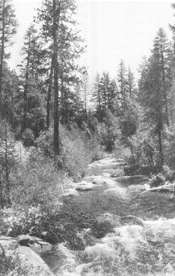 |
| A Mountain Stream |
From My First Summer in the Sierra by John Muir. Chapter 3: A Bread Famine
From John Muir.
And the dawns and sunrises and sundowns of these mountain days, --the rose light creeping higher among the stars, changing to daffodil yellow, the level beams bursting forth, streaming across the ridges, touching pine after pine, awakening and warming all the mighty host to do gladly their shining day's work. The great sun-gold noons, the alabaster cloud-mountains, the landscape beaming with consciousness like the face of a god. The sunsets, when the trees stood hushed awaiting their good-night blessings. Divine, enduring, unwastable wealth.
Seagulls
by John Updike
A gull, up close,
looks surprisingly stuffed.
His fluffy chest seems filled
with an inexpensive taxidermist's material
rather lumpily inserted. The legs,
unbent, are childish crayon strokes—
too simple to be workable.
And even the feather markings,
whose intricate symmetry is the usual glory of birds,
are in the gull slovenly,
as if God makes too many
to make them very well.
Are they intelligent?
We imagine so, because they are ugly.
The sardonic one-eyed profile, slightly cross,
the narrow, ectomorphic head, badly combed,
the wide and nervous and well-muscled rump
all suggest deskwork: shipping rates
by day, Schopenhauer
by night, and endless coffee.
At that hour on the beach
when the flies begin biting in the renewed coolness
and the backsliding skin of the after-surf
reflects a pink shimmer before being blotted,
the gulls stand around in the dimpled sand
like those melancholy European crowds
that gather in cobbled public square in the wake
of assassinations and invasions,
heads cocked to hear the latest radio reports.
It is also this hour when plump young couples
walk down to the water, bumping together,
and stand thigh-deep in the rhythmic glass.
Then they walk back toward the car,
tugging as if at a secret between them,
but which neither quite knows—
walks capricious paths through the scattering gulls, as in some mythologies
beautiful gods stroll unconcerned
among our mortal apprehensions.

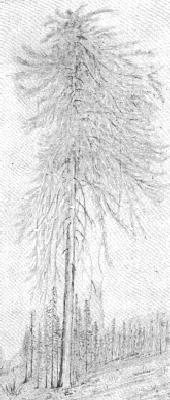 |
| John Muir's Sugar Pine sketch |
From My First Summer in the Sierra by John Muir. Chapter 2: In Camp on the North Fork of the Merced
Sugar pine cones are cylindrical, slightly tapered at the end and rounded at the base. Found one to-day nearly twenty-four inches long and six in diameter, the scales being open. Another specimen nineteen inches long; the average length of full-grown cones on trees favorably situated is nearly eighteen inches. On the lower edge of the belt at a height of about twenty-five hundred feet above the sea they are smaller, say a foot to fifteen inches long, and at a height of seven thousand feet or more near the upper limits of its growth in the Yosemite region they are about the same size. This noble tree is an inexhaustible study and source of pleasure. I never weary of gazing at its grand tassel cones, its perfectly round bole one hundred feet or more without a limb, the fine purplish color of its bark, and its magnificent outsweeping, down-curving feathery arms forming a crown always bold and striking and exhilarating. In habit and general port it looks somewhat like a palm, but no palm that I have yet seen displays such majesty of form and behavior either when poised silent and thoughtful in sunshine, or wide-awake waving in storm winds with every needle quivering. When young it is very straight and regular in form like most other conifers; but at the age of fifty to one hundred years it begins to acquire individuality, so that no two are alike in their prime or old age. Every tree calls for special admiration. I have been making many sketches, and regret that I cannot draw every needle.
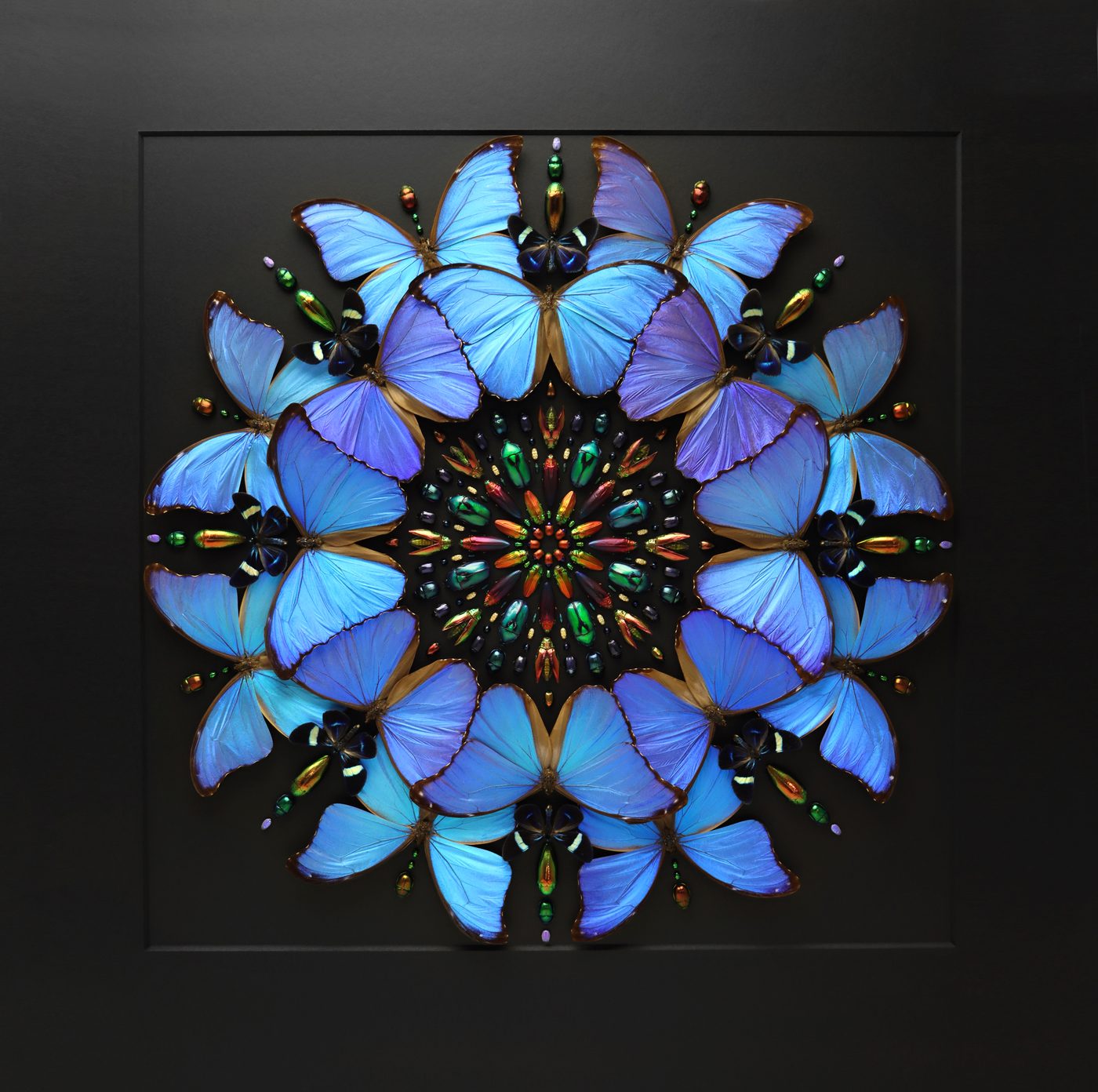 |
| Christopher Marley, Lambent Prism, 2020, butterflies, beetles 40 in. x 40 in. |
With the vote all but upon him now, he seemed always to be in motion. and the motion would be faster, almost frenzied. As he talked to senators, his hands never stopped moving, gesturing expressively, chopping the air with that snake-killing gesture, opening a palm to illustrate a point, punching the air with a fist, jabbing a lapel with a finger, patting a senator's shoulder, straightening his tie, grabbing his lapel, hugging him if he agreed to the proposition being made.
If he dropped down into his own front-row center chair, he might sprawl down in it, stretch out both long legs across the aisle, or lean far back, crossing them. But he wouldn't stay in any pose long. "Jiggling, scratching, crossing and uncrossing his legs," leaning back in his chair with a hand up to his face as he whispered to Russell close behind him or to a senator who had approached with information or an inquiry, pulling out a tally sheet, writing something on it, tucking it back in his pocket, "he seemed," in the words of one report, "simply unable to sit still for a moment." Abruptly, galvanized by a sudden thought, he would leap out of his seat, "going from slouched to almost frenetic in an instant,” as another reporter put it, to rush over to a senator.
“There is nothing more notable in Socrates than that he found time, when he was an old man, to learn music and dancing, and thought it time well spent.”
—Montaigne
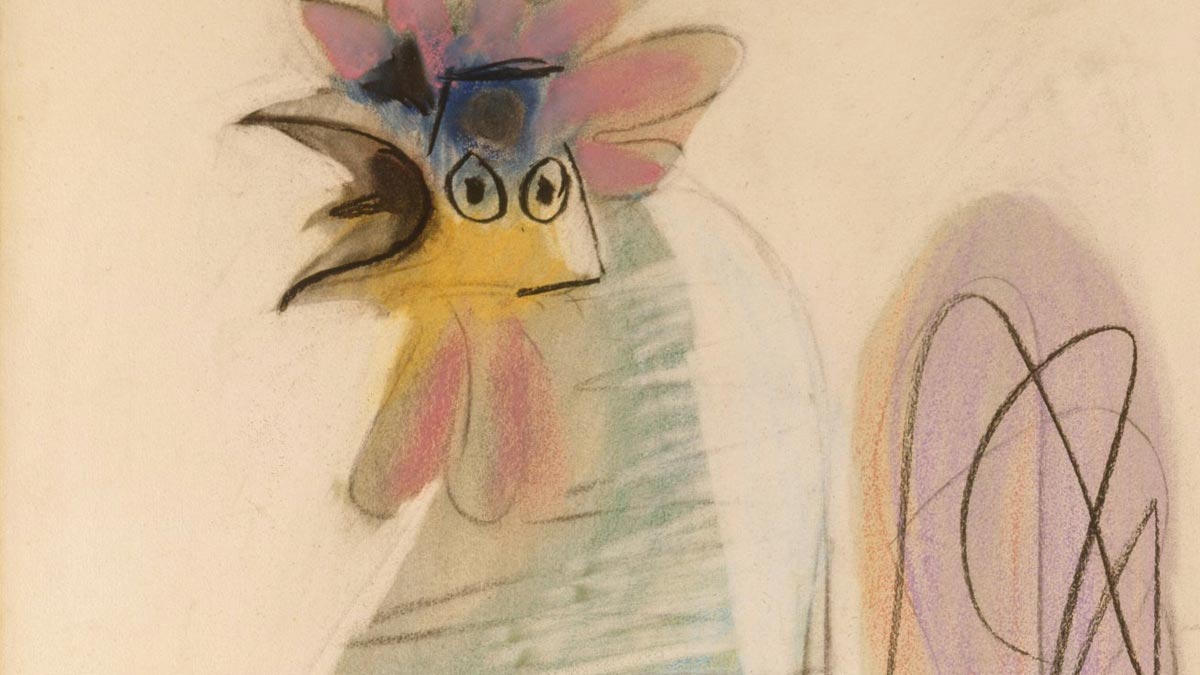 |
| Pablo Picasso, Rooster, 1938 (detail). Pastel on paper. Milwaukee Art Museum. |
From James Clear newslette
Take whatever you are trying to accomplish and ask, “How could this be as easy as possible?”
How could I make meditating each day as easy possible? How could I make showing appreciation to my partner as easy as possible? How could I make finding great investment opportunities as easy as possible? And so on.
You may be surprised how effective the easy version can be.
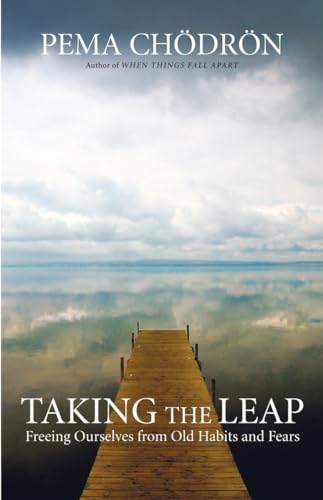
Page: 5. These qualities [basic to all human beings] are natural intelligence, natural warmth, and natural openness.
Page: 7. But as my teacher Chögyam Trungpa Rinpoche used to say, we can approach our lives as an experiment. In the next moment, in the next hour, we could choose to stop, to slow down, to be still for a few seconds. We could experiment with interrupting the usual chain reaction, and not spin off in the usual way. We don’t need to blame someone else, and we don’t need to blame ourselves. When we’re in a tight spot, we can experiment with not strengthening the aggressive habit and see what happens.
Page: 8. pausing becomes something that nurtures you; you begin to prefer it to being all caught up. People who have found this helpful create ways of interjecting pausing into their busy lives. For instance, they’ll put a sign on their computer. It could be a word, or a face, an image, a symbol—anything that reminds them. Or they’ll decide, “Every time the phone rings, I’m going to pause.” Or “When I go to open my computer, I’m going to pause.” Or “When I open the refrigerator, or wait in line, or brush my teeth. . . .” You can come up with anything that happens often during your day. You’ll just be doing whatever you’re doing, and then, for a few seconds, you pause and take three conscious breaths.
Blue highlight | Page: 14. All kinds of things happen when we meditate—everything from thoughts to shortness of breath to visual images, from physical discomfort to mental distress to peak experiences. All of that happens, and the basic attitude is, “No big deal.” The key point is that, through it all, we train in being open and receptive to whatever arises.
Blue highlight | Page: 14. What I’ve noticed about the people whom I consider to be awake is this: They’re fully conscious of whatever is happening. Their minds don’t go off anywhere. They just stay right here with chaos, with silence, with a carnival, in an emergency room, on a mountainside: they’re completely receptive and open to what’s happening. It’s at the same time the simplest and the most profound thing—rather like one continual pause.
Blue highlight | Page: 15 In the face of anything we don’t like, we automatically try to escape. In other words, scratching is our habitual way of trying to get away, trying to escape our fundamental discomfort, the fundamental itch of restlessness and insecurity, or that very uneasy feeling: that feeling that something bad is about to happen.
Blue highlight | Page: 15 With meditation we train in settling down with whatever we're feeling, including the addictive urge to scratch [here, the metaphor is about kids with poison ivy], the addictive urge to avoid discomfort at any cost. We train in just staying present, open, and awake, no matter what’s going on.
Blue highlight | Page: 16. The three classic styles of looking for relief in the wrong places are pleasure seeking, numbing out, and using aggression: we either zone out, or we grasp. Or perhaps we develop the style of scratching in which we obsess and rage about other people or indulge in self-hatred.
Blue highlight | Page: 17 There is a deep-seated tendency, it’s almost a compulsion, to distract ourselves, even when we’re not consciously feeling uncomfortable. Everybody feels a little bit of an itch all the time. There’s a background hum of edginess, boredom, restlessness. As I’ve said, during my time in retreat where there were almost no distractions, even there I experienced this deep uneasiness.
Blue highlight | Page: 19. Everything I did, the way I smiled, the way I talked to people, the way I tried to please everybody—it was all to avoid feeling this way. I realized that our whole façade, the little song and dance we all do, is based on trying to avoid the groundlessness that permeates our lives.
Blue highlight | Page: 19. One way to practice staying present is to pause, look out, and take three deep breaths. Another way is to simply sit still for a while and listen. Simply listen to the sounds in the room. For one minute, listen to the sounds close to you. For one minute, listen to the sounds at a distance. Just listen attentively. The sound isn’t good or bad. It’s just sound.
Blue highlight | Page: 20 when you notice that your mind has wandered off, you gently come back. You come back because the present is so precious and fleeting, and because without some reference point to come back to, we never notice that we’re distracted—that once again we’re looking for an alternative to being fully present, an alternative to being here with things just exactly as they are rather than the way we would prefer them to be.
Blue highlight | Page: 23 The fundamental, most basic shenpa is to ego itself: attachment to our identity, the image of who we think we are. When we experience our identity as being threatened, our self-absorption gets very strong, and shenpa automatically arises. Then there is the spin-off—such as attachment to our possessions or to our views and opinions. For example, someone criticizes you.
Blue highlight | Page: 26 Not acting out, or refraining, is very interesting. It’s also called renunciation in the Buddhist teachings. The Tibetan word for renunciation is shenluk, and it means turning shenpa upside down, shaking it up completely. It means getting unhooked. Renunciation isn’t about renouncing food, or sex, or your lifestyle. We’re not referring to giving up the things themselves. We’re talking about loosening our attachment, the shenpa we have to these things.
Blue highlight | Page: 26 In general, Buddhism encourages us never to reject what is problematic but rather to become very familiar with it. And so it is here: we are urged to acknowledge our shenpa, see it clearly, experience it fully—without acting out or repressing.
Blue highlight | Page: 31Our energy and the energy of the universe are always in flux, but we have little tolerance for this unpredictability, and we have little ability to see ourselves and the world as an exciting, fluid situation that is always fresh and new. Instead we get stuck in a rut—the rut of “I want” and “I don’t want,” the rut of shenpa, the rut of continually getting hooked by our personal preferences.
Blue highlight | Page: 31 The source of our unease is the unfulfillable longing for a lasting certainty and security, for something solid to hold on to. Unconsciously we expect that if we could just get the right job, the right partner, the right something our lives would run smoothly. When anything unexpected or not to our liking happens, we think that something has gone wrong.
Blue highlight | Page: 31 Even at the most mundane level, we get so easily triggered—someone cuts in front of us, we get seasonal allergies, our favorite restaurant is closed when we arrive for dinner. We are never encouraged to experience the ebb and flow of our moods, of our health, of the weather, of outer events—pleasant and unpleasant—in their fullness. Instead we stay caught in a fearful, narrow holding pattern of avoiding any pain and continually seeking comfort. This is the universal dilemma.
Blue highlight | Page: 32 The approach here is radical. We are encouraged to get comfortable with, begin to relax with, lean in to, whatever the experience may be. We are encouraged to drop the storyline and simply pause, look out, and breathe. Simply be present for a few seconds,
Blue highlight | Page: 39 There is a formal practice for learning to stay with the energy of uncomfortable emotions—a practice for transmuting the poison of negative emotions into wisdom. It is similar to alchemy, the medieval technique of changing base metal into gold. You don’t get rid of the base metal—it isn’t thrown out and replaced by gold. Instead, the crude metal itself is the source of the precious gold.
Blue highlight | Page: 41 Pete was obsessed with the Star Wars series at that time, so one day when this was happening, I asked him, “Pete, what would Obi-Wan Kenobi do?” Pete got a curious, receptive look on his face. I could see him contemplating my question, and he began to sit up very straight and smile. He suddenly manifested as a powerful person who trusted in himself. But then he couldn’t resist—
Blue highlight | Page: 41 If we choose to work with this kind of practice, it’s wise to start by practicing with little bouts of shenpa, the small irritations that happen all the time. If we become familiar with catching ourselves, acknowledging that we’re hooked, and pausing in these ordinary everyday situations, then when major upheavals come, the practice will be available to us automatically.
Blue highlight | Page: 46 In meditation we train in letting our thoughts go again and again, over and over, and go right to the root of our discontent. We allow the space to see the very mechanics of how we keep ourselves stuck.
Blue highlight | Page: 47 Our attitude can be that we keep getting another chance, rather than that we’re just getting another bad deal. For just a moment or two, pause and contact whatever you are feeling right now. If you can precede this by recollecting something that’s bothering you, that will be even more helpful. If you can contact feelings such as worry, hopelessness, impatience, resentment, righteous indignation, or craving, that will be especially rewarding.
Orange highlight | Page: 47 For a moment or more, touch the quality, the mood, the bodily felt sensation free of the storyline.
Orange highlight | Page: 48 If we can get curious about this emotional reaction, if we can relax and feel it, if we can experience it fully and let it be, then it’s no problem. We might even experience it as simply frozen energy whose true nature is fluid, dynamic, and creative—just an ungraspable sensation free of our interpretation.
Blue highlight | Page: 48 Our repetitive suffering does not come from this uncomfortable sensation but from what happens next, what I’ve been calling following the momentum, spinning off, or getting swept away. It comes from rejecting our own energy when it comes in a form we don’t like.
Blue highlight | Page: 49 Instead of getting better and better at avoiding, we can learn to accept the present moment as if we had invited it, and work with it instead of against it, making it our ally rather than our enemy.
Orange highlight | Page: 50. This is a work in progress, a process of uncovering our natural openness, uncovering our natural intelligence
Orange highlight | Page: 50 and warmth. I have discovered, just as my teachers always told me, that we already have what we need. The wisdom, the strength, the confidence, the awakened heart and mind are always accessible, here, now, always. We are just uncovering them.
Blue highlight | Page: 50
We are rediscovering them. We’re not inventing them or importing them from somewhere else. They’re here. That’s why when we feel caught in darkness, suddenly the clouds can part. Out of nowhere we cheer up or relax or experience the vastness of our minds. No one else gives this to you. People will support you and help you with teachings and practices, as they have supported and helped me, but you yourself experience your unlimited potential.
Blue highlight | Page: 50 Our devotion to a teacher has nothing to do with his or her lifestyle or worldly accomplishments. It’s their state of mind, the quality of their heart that we resonate with.
Blue highlight | Page: 51 spiritual toolbox.
Blue highlight | Page: 51 He described the basic practice as being completely present. And emphasized that it allowed the space for our neuroses to come to the surface. It was not, as he put it, “a vacation from irritation.”
Blue highlight | Page: 53 we’re in this interesting middle state, somewhere between not always caught and not always able to resist biting the hook. This is called “the spiritual path.” In fact, this path is all there is. How we relate moment by moment to what is happening on the spot is all there really is. We give up all hope of fruition and in the process we just keep learning what it means to appreciate being right here.
Blue highlight | Page: 54 Instead of blaming our discomfort on outer circumstances or on our own weakness, we can choose to stay present and awake to our experience, not rejecting it, not grasping it, not buying the stories that we relentlessly tell ourselves.
Blue highlight | Page: 55 When we begin to see clearly what we do, how we get hooked and swept away by old habits, our usual tendency is to use that as a reason to get discouraged, a reason to feel really bad about ourselves. Instead, we could realize how remarkable it is that we actually have the capacity to see ourselves honestly, and that doing this takes courage. It is moving in the direction of seeing our life as a teacher
Blue highlight | Page: 55 stay present, but learning to stay with a sense of humor, learning to stay with loving-kindness toward ourselves and with the outer situation, learning to take joy in the magic ingredient of honest self-reflection. Chögyam Trungpa called this “making friends with ourselves.” This friendship is based on knowing all parts of ourselves without prejudice. It’s an unconditional friendliness.
Blue highlight | Page: 56 In the Buddhist teachings on compassion there’s a practice called “one at the beginning, and one at the end.” When I wake up in the morning, I do this practice. I make an aspiration for the day. For example, I might say, “Today, may I acknowledge whenever I get hooked.” Or, “May I not speak or act out of anger.” I try not to make it too grandiose, as in, “Today, may I be completely free of all neurosis.” I begin with a clear intention, and then I go about the day with this in mind. In the evening, I review what happened. This is the part that can be so loaded for Western people. We have an unfortunate tendency to emphasize our failures. But when Dzigar Kongtrül teaches about this, he says that for him, when he sees that he has connected with his aspiration even once briefly during the whole day, he feels a sense of rejoicing. He also says that when he recognizes he lost it completely, he rejoices that he has the capacity to see that.
Blue highlight | Page: 58 when we review our day, it’s common to perceive it all as bleak, as if we didn’t get anything right. But maybe if somebody else is there, a partner for example, he or she might say, “What about the fact that you were getting all worked up, and you went out for a walk and came back calmed down?” Or, “I saw you smile at that man who was sitting in the corner all hunched over and depressed, and I saw him brighten up.” Sometimes other people have to point this out to us.
Orange highlight | Page: 59
our most ordinary days we have moments of happiness, moments of comfort and enjoyment, moments of seeing something that pleased us, something that touched us, moments of contacting the tenderness of our hearts. We can take joy in that. I find that it’s essential during the day to actually note when I feel happiness or when something positive happens, and begin to cherish those moments as precious. Gradually we can begin to cherish the preciousness of our whole life just as it is, with its ups and downs, its failures and successes, its roughness and smoothness.
Blue highlight | Page: 59 Until we start this journey of acknowledging when we’re being hooked, little things unconsciously trigger us all the time. The slightest setback or annoyance will trigger us and we’ll be blind to what’s going on. Life just becomes increasingly more of a struggle and we never can figure out why. Once we start seeing, of course we still get triggered, but there’s a very important difference: the magic of recognition, the miracle of compassionate acknowledgment. It’s the miracle of being conscious rather than unconscious. The more we do it, the more our ability to do it grows.
Blue highlight | Page: 61 We have this mistaken idea that either we have regret or we get rid of it. Trungpa Rinpoche talked about holding the sadness of life in our heart while never forgetting the beauty of the world and the goodness of being alive. There comes a time when we are able to be pierced to the heart by our own suffering, and the suffering of others, and by our own regrets, without it dragging us down. The Dalai Lama went on to say that being dragged down by regrets or held back by them would be to no one’s benefit, so he learns from his mistakes and goes forward doing all he can to help others.
Blue highlight | Page: 63 If you are inclined to train in being open-endedly present to whatever arises—to life’s energy, to other people, and to this world—after a while you’ll realize you’re open and present to something that’s not staying the same. For example, if you are truly open and receptive to another person, it can be quite a revelation to realize that they aren’t exactly the same on Friday as they were on Monday, that each of us can be perceived freshly any day of the week. But if that person happens to be your parent or sibling, your partner or your boss, you are usually blinded and see them as predictably always the same. We have a tendency to label one another as an irritating person, a bore, a threat to our happiness and security, as inferior or superior; and this goes way beyond our close circle of acquaintances at home or at work.
Blue highlight | Page: 71 Instead of being not here, instead of being caught up, absorbed in thinking, planning, worrying—caught in the cocoon where you’re cut off from your sense perceptions, cut off from the sounds and the sights, cut off from the power and magic of the moment—instead of that you could choose to pause. When you go out for a walk in the country, in the city, anywhere at all, just stop now and then. Punctuate your life with these moments.
Blue highlight | Page: 75 The natural warmth that emerges when we experience pain includes all the heart qualities: love, compassion, gratitude, tenderness in any form. It also includes loneliness, sorrow, and the shakiness of fear. Before these vulnerable feelings harden, before the storylines kick in, these generally unwanted feelings are pregnant with kindness, with openness and caring. These feelings that we’ve become so accomplished at avoiding can soften us, can transform us.
Blue highlight | Page: 76 Jill Bolte Taylor’s book My Stroke of Insight, she points to scientific evidence showing that the life span of any particular emotion is only one and a half minutes. After that we have to revive the emotion and get it going again. Our usual process is that we automatically do revive it by feeding it with an internal conversation about how another person is the source of our discomfort. Maybe we strike out at them or at someone else—all because we don’t want to go near the unpleasantness of what we’re feeling. This is a very ancient habit. It allows our natural warmth to be so obscured that people like you and me, who have the capacity for empathy and understanding, get so clouded that we can harm each other. When we hate those who activate our fears or insecurities, those who bring up unwanted feelings, and see them as the sole cause of our discomfort, then we can dehumanize them, belittle them, and abuse them.
Blue highlight | Page: 84 I’ve known many people who have spent years exercising daily, getting massages, doing yoga, faithfully following one food or vitamin regimen after another, pursuing spiritual teachers and different styles of meditation, all in the name of taking care of themselves. Then something bad happens to them and all those years don’t seem to have added up to the inner strength and kindness for themselves that they need to relate with what’s happening. And they don’t add up to being able to help other people or the environment. When taking care of ourselves is all about me, it never gets at the unshakable tenderness and confidence that we’ll need when everything falls apart. When we start to develop maitri for ourselves, unconditional acceptance of ourselves, then we’re really taking care of ourselves in a way that pays off. We feel more at home with our own bodies and minds and more at home in the world. As our kindness for ourselves grows, so does our kindness for other people.
Blue highlight | Page: 88 One of the most helpful methods I’ve found is the practice of compassionate abiding. This is a way of bringing warmth to unwanted feelings. It is a direct method for embracing our experience rather than rejecting it. So the next time you realize that you’re hooked, you could experiment with this approach. Contacting the experience of being hooked, you breathe in, allowing the feeling completely and opening to it. The in-breath can be deep and relaxed—anything that helps you to let the feeling be there, anything that helps you not push it away. Then, still abiding with the urge and edginess of feelings such as craving or aggression, as you breathe out you relax and give the feeling space. The out-breath is not a way of sending the discomfort away but of ventilating it, of loosening the tension around it, of becoming aware of the space in which the discomfort is occurring. This practice helps us to develop maitri because we willingly touch parts of ourselves that we’re not proud of. We touch feelings that we think we shouldn’t be having—feelings of failure, of shame, of murderous rage; all those politically incorrect feelings like racial prejudice, disdain for people we consider ugly or inferior, sexual addiction, and phobias. We contact whatever we’re experiencing and go beyond liking or disliking by breathing in and opening. Then we breathe out and relax. We continue that for a few moments or for as long as we wish, synchronizing it with the breath. This process has a leaning-in quality. Breathing in and leaning in are very much the same. We touch the experience, feeling it in the body if that helps, and we breathe it in.
Orange highlight | Page: 96 This book has been an attempt to look closely at how we stay stuck in this kind of narrow, self-absorbed vision. It has also been an attempt to pass on some of what my teachers have taught me about how to get unhooked. The motivation for presenting this material, however, is not solely the wish that each of us might become happier. The primary intention is that we might follow the advice contained here in order to prepare ourselves to look beyond our own welfare and consider the great suffering of others and the fragile state of our world. As we change our own dysfunctional habits, we are simultaneously changing society. Our own awakening is intertwined with the awakening of enlightened society. If we can lose our personal appetite for aggression and addiction, the whole planet will rejoice.
