
The season of seeds preparation... rudbeckia drying with seed heads in background, backlit grass seed heads, acorns drying on the tree, redbud seed pods now crispy dry.
The season of seeds preparation... rudbeckia drying with seed heads in background, backlit grass seed heads, acorns drying on the tree, redbud seed pods now crispy dry.
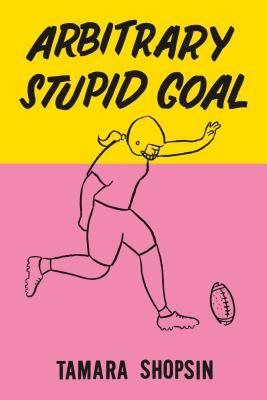
From Tamara Shopsin's Arbitrary Stupid Goal:
At the beginning of the book:
My father knew a family named Wolfawitz who wanted to go on vacation but didn’t know where.
It hit them. Take a two-week road trip driving to as many towns, parks, and counties as they could that contained their last name: Wolfpoint, Wolfville, Wolf Lake, etc.
They read up and found things to do on the way to these other Wolf spots: a hotel in a railroad car, an Alpine slide, a pretzel factory, etc.
The Wolfawitzes ended up seeing more than they planned. Lots of unexpected things popped up along the route.
When they came back from vacation, they felt really good. It was easily the best vacation of their lives, and they wondered why.
My father says it was because the Wolfawitzes stopped trying to accomplish anything. They just put a carrot in front of them and decided the carrot wasn’t that important but chasing it was.
The story of the Wolfawitzes’ vacation was told hundreds of times to hundreds of customers in the small restaurant that my mom and dad ran in Greenwich Village. Each time it was told, my dad would conclude that the vacation changed the Wolfawitzes’ whole life, and this was how they were going to live from now on — chasing a very, very small carrot.
At the end, about the goal:
A goal that isn’t too important makes you live in the moment, and still gives you a driving force. This driving force is a way to get around the fact that we will all die and there is no real point to life.
But with the ASG there is a point. It is not such an important point that you postpone joy to achieve it. It is just a decoy point that keeps you bobbing along, allowing you to find ecstacy in the small things, the unexpected, and the everyday.
What happens when you reach the stupid goal? Then what? You just find a new ASG.


The Dream of the Earth by Thomas Berry
“…the universe, by definition, is a single gorgeous celebratory event.” (Berry, “Returning to Our Native Place,” in The Dream of the Earth, 5).
“Our relationship with the earth involves something more than pragmatic use, academic understanding, or aesthetic appreciation. A truly human intimacy with the earth and with the entire natural world is needed. Our children should be properly introduced to the world in which they live.” (Thomas Berry, “Human Presence,” in The Dream of the Earth, 13).
Our challenge is to create a new language, even a new sense of what it is to be human. It is to transcend not only national limitations, but even our species isolation, to enter into the larger community of living species. This brings about a completely new sense of reality and value.” (Thomas Berry, “The Ecological Age,” in The Dream of the Earth, 42).
“The universe is the primary revelation of the divine, the primary scripture, the primary locus of divine-human communication.”
“Here we might observe that the basic mood of the future might well be one of confidence in the continuing revelation that takes place in and through the earth. If the dynamics of the universe from the beginning shaped the course of the heavens, lighted the sun, and formed the earth, if this same dynamism brought forth the continents and seas and atmosphere, if it awakened life in the primordial cell and then brought into being the unnumbered variety of living beings, and finally brought us into being and guided us safely through the turbulent centuries, there is reason to believe that this same guiding process is precisely what has awakened in us our present understanding of ourselves and our relation to this stupendous process. Sensitized to such guidance from the very structure and functioning of the universe, we can have confidence in the future that awaits the human venture.” (Thomas Berry, “The New Story,” in The Dream of the Earth, 137).
“The most difficult transition to make is from an anthropocentric to a biocentric norm of progress. If there is to be any true progress, then the entire life community must progress. Any progress of the human at the expense of the larger life community must ultimately lead to a diminishment of human life itself.” (Thomas Berry, “Bioregions: The Context for Reinhabiting the Earth,” in The Dream of the Earth, 165).
“We might summarize our present human situation by the simple statement: that in the 20th century, the glory of the human has become the desolation of the Earth and now the desolation of the Earth is becoming the destiny of the human."
"From here on, the primary judgment of all human institutions, professions, programs and activities will be determined by the extent to which they inhibit, ignore, or foster a mutually-enhancing human/Earth relationship.”
“We must say of the universe that it is a communion of subjects, not a collection of objects. ”
We must, however, reflect on what is happening. It is an urgent matter, especially for those of us who still live in a meaningful, even a numinous, earth community. We have not spoken. Nor even have we seen clearly what is happening. The issue goes far beyond economics, or commerce, or poetics, or an evening of pleasantries as we look out over a scenic view. Something is happening beyond all this. We are losing splendid and intimate modes of divine presence. We are, perhaps, losing ourselves.
What primordial source could with no model for guidance shape such a fantastic world as that in which we live: shape of the orchid, the coloring of the fish in the sea, the winds, the rain, the variety of sounds that flow over the earth, the croaking of the bullfrogs, the sounds of crickets, the pure joy of the the pre-dawn singing of the mockingbird. Experience of such a resplendent world activated the creative imaginations of Mozart in the Magic Flute, Dante in his divine comedy, and gave to Shakespeare that range of sensitivity, understanding, and emotion that bound expression in this place. All of these are derived from the visionary power that is experienced most profoundly when we are immersed in the depths of our own being and of the cosmic order itself in the dream world that unfolds within us in our sleep. (chapter 6? 70% of the way thru the book)
The human condition could be overcome by our entrepreneurial skills. Nuclear energy would give us limitless power. Through genetic engineering we could turn chickens into ever more effective egg laying machines, cows into milk making machines, steers into meat making contrivances, all according to human preference, not according to the inner spontaneities of these living beings as determined by their genetic coding, a coding shaped by some billions of years of experiment and natural selection. Ever-heightened consumption was seen as the way to human fulfillment. Every earthly being was reduced from its status as a sacred reality to that of being a natural resource, available for human use, for whatever trivial purposes humans might invent. (chapter 6, 79% done)
“It's not possible to save the world by trying to save it. You need to find what is genuinely yours to offer the world before you can make it a better place. Discovering your unique gift to bring to your community is your greatest opportunity and challenge. The offering of that gift — your true self — is the most you can do to love and serve the world. And it is all the world needs.”
― Thomas Berry, Soulcraft: Crossing into the Mysteries of Nature and Psyche
 |
| The season we are in |
Rudbeckia plants are finishing their life cycle. The blooms, which I just learned is called a "disc flower" or "inflorescence," is drying and withering. This picture shows several stages of that withering: from yellow, to green, to dark brown (I think these are ripe seeds) to tiny dark brown balls (after the birds have stripped the seeds)?
The dark center of a Rudbeckia is not a single structure but a collection of individual, tiny flowers called disc flowers, surrounded by larger, modified petal-like structures known as ray flowers or ray florets. The entire head of flowers, which appears as one large flower, is technically called an inflorescence in the Asteraceae family to which Rudbeckia belongs.
 |
| a couple weeks ago, this was a joyous handful of yellow flowers |


I'm listening to The Serviceberry by Robin Walls Kimmerer. Here are some notes:
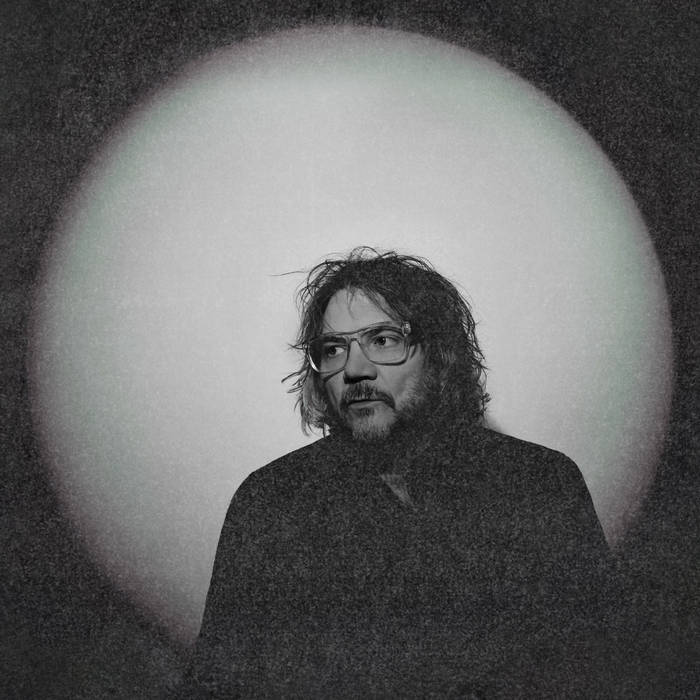
Jeff Tweedy is interviewed on the NYer Radio Hour as he releases a new triple album called Twilight Override.
Jeff Tweedy: I like going to work every day, and I like having a practice of writing and that tends to provide a lot of material. There was an inspiration to make a triple record. Just kind of like just to fly in the face of how short everything is getting, and how fast everybody wants everything to be. You don't have to listen to it in one sitting. I think the songs, hopefully, stand on their own, but I do like the idea of giving someone almost two hours to be pulled along by an outpouring of songs.
Amanda Petrusich: It feels almost like there's like a little bit of a punk rock. A thread of defiance through this, which is it is almost a sort of resistance to modern life or the way we consume culture now.
Jeff Tweedy: It's driven by a belief in individuated self-expression. That that's a really essential part of rock and roll, it's an essential part of art, in my opinion. It's a continuation of an art form to me, that is defiant. It grows out of a music that was formed around the inspiration and genius of probably the least free of our fellow citizens. I think that's what resonates to me still, is that it's like the best expression of what the dream of America, an American ideal, would be. The individualism, the liberty to be yourself, to think freely.
I don't know. It's not just America. The world pushes against that, I think. When you think about how the internet works, it really is like a conformity machine. It's really efficient with that.
Tweedy: The biggest concern with aging, to me, is obviously your body. Having your body stay in service of your desires. Just being more aware of our body's fallibility, something like that. If time is represented a lot on the record, which I think it is, in some ways I think I tried to organize the record as past, present, and future, with the three discs. It was certainly on my mind, but I don't know anybody that isn't like, kind of obsessed with time.
I have panic disorder. One of the things that comes with that is feeling like you're never going to be okay, and then you are. I've seen people facing circumstances much more harrowing than I'll probably ever face in my life, with a lot more resolve and fearlessness. I've been fortunate enough to work with Mavis Staples a lot in my life. Like, several records. She lives in Chicago. I always think about her history, the history of the movements she was a part of, her family history, and her joy that is not put on at all. It is so rebellious to me. Defiant. It's like, dance at them. Dance at the bastards.
[laughter]
Jeff Tweedy: I have a lyric on the record, and I was like, not to quote-- [chuckles] that's what we're here for.
Amanda Petrusich: Please. Yes, that's what we're here for.
Jeff Tweedy: I want to dance right into the light. Instead of seeing the light at the end of your life and thinking, "Oh, like--" I do want to be like, "Oh, yes, here we go. Let's--" [chuckles]
Amanda Petrusich: I love that.
Jeff Tweedy: I'm ready.
Amanda Petrusich: That's almost a response to that Dylan Thomas line, right? I think it's Dylan Thomas. The rage, rage against the dying of the light. To [crosstalk]-
Jeff Tweedy: Yes, for sure.
Amanda Petrusich: -instead. Yes, dance right in.
[laughter]
Jeff Tweedy: It's this way, guys.
[laughter]
Amanda Petrusich: I love that.
Jeff Tweedy: The conga line.
Amanda Petrusich: [laughs] Just going to limbo right on into the afterlife.
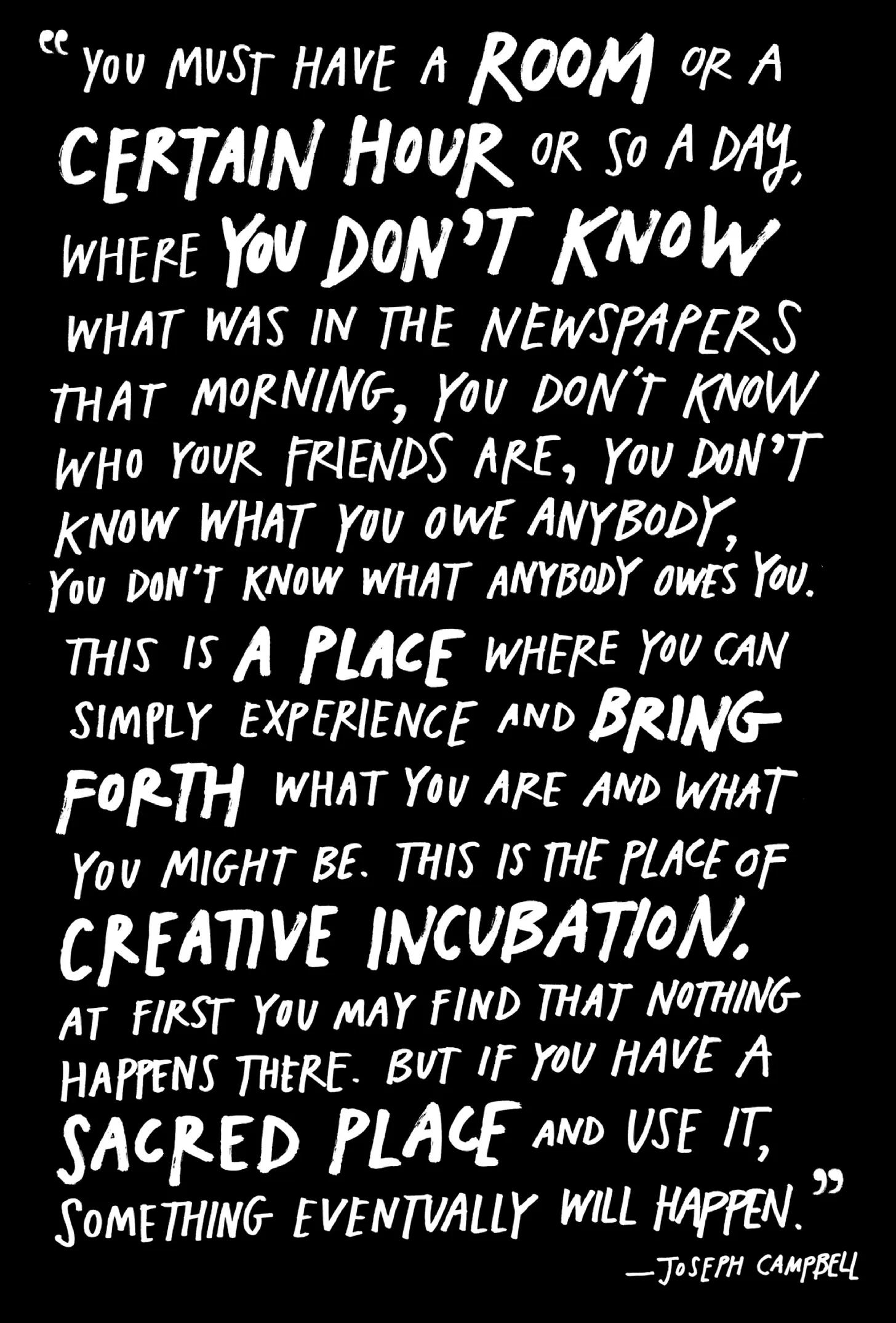
Austin Kleon writes about building the discipline to make stuff, when "there's always a bunch of 'admin work' to do.
Here’s what I’ve been doing — I call it the one-hour studio.
At some point in the day, I go into the studio. I don’t touch my computer. I set a timer for one hour. I try to make some art. When the timer goes off, I either stop or keep going, depending on what’s on my calendar.
That’s it! If I do this enough days in a row, a body of work shows up.
Sounds so simple, right? Simple, but not easy.
The hardest part, I’ve found, is giving myself that one hour to spend. I have the enormous privilege of being my own boss and setting my own schedule, but there’s always a bunch of “admin” work to do. In fact, like many people, I could spend all day, every day, “jumping on a call” or answering freaking email.
I make the majority of my living writing books and writing this newsletter — but I wouldn’t have anything to write about if I didn’t, you know, actually make stuff! It makes it a little easier to budget playtime in the studio if I think of it as “research and development.”
I also try not to look at social media or the news before I go into the studio. This is probably more difficult than blocking off the time, honestly. What I’m trying to do is set up what Joseph Campbell called a “bliss station.”
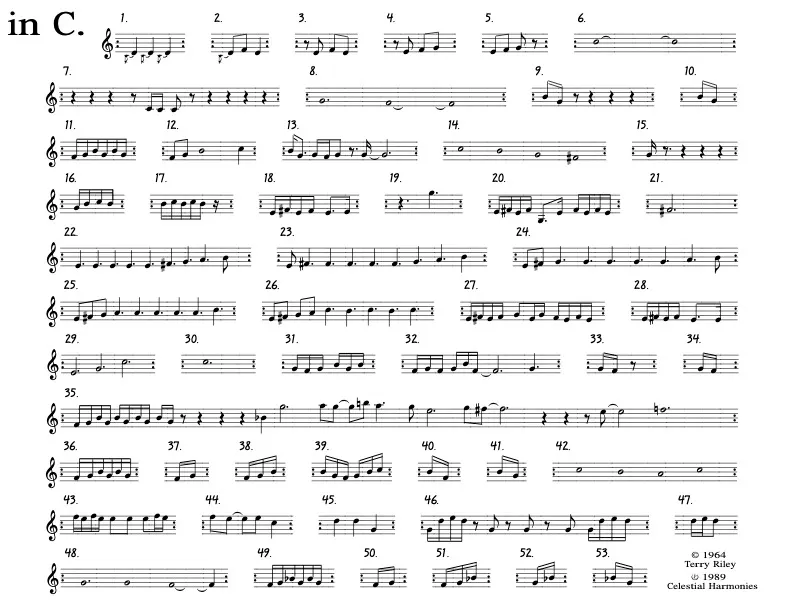
(from Mason Currey) “In C” is a musician-led performance that’s different every time it is played. The score is a single sheet of paper showing 53 melodic patterns. The musicians are instructed to work their way through these patterns at whatever pace feels right to them, listening to what their fellow musicians are doing, trying to create something interesting together without trying to predict or control what that might be.
Create a Culture that Invites Ideas In*
Letting go of control is a big theme in Riley work. In 2022, he told the Louisiana Museum:
If you know what you’re doing in the arts, then you’re doing it wrong. That’s a pretty good maxim. If you don’t know what you’re doing, then you’re on the right track, because you’re open to the whole world of possibilities. You don’t want to already have the possibilities in you; you have to invite them in. So as an artist you have to create a culture that invites ideas in.
Interview in Classical Voice site
In introduction: It is impossible to speak of Riley’s music without referencing his energy and world outlook. There’s something unique about the man — a transcendent joy at the wonder with which life constantly unfolds — that infuses his musical explorations. It’s not something you can pin down, but it inevitably brings a smile and sense of affirmation.
Before I got into raga, which entered my life in 1970, I was already doing concerts where I was pretty much in the moment. Of course, the training in raga trains you for that, because you observe yourself into the ragas and practice them every day, and then whatever happens, happens.
It’s like life. What can you absolutely control in this life? I’ve seen over and over again that whatever I’ve planned out to the nth detail usually collapses along the line and turns into something else. So the best thing I think you can do in your life is keep yourself as loose as you can. It’s a world without time. I really don’t divide my categories up too much like composing and playing. Everything seems to be fuller and richer than ever.
Well, you know, it’s a world without time. I really don’t divide my categories up too much like composing and playing. Everything seems to be fuller and richer than ever. I’m doing quite a bit of writing; I’m just heading to Japan to play a few concerts. As long as you have your health, that’s the main thing. When the health goes, everything goes. And the mind is definitely a part of health.
But I do see the need for people who want to do the arts to survive in the world, even if they’re doing it totally out of love (and, of course, it has to be that way, because why else would you work yourself 16 hours a day to do something unless you really loved it?). There’s this big Capitalist Monster out there, ready to suck money out of whatever arises. Young and old people do get caught up in it. You have to have some sort of spiritual base to sustain yourself through all that.
It’s all wrapped up in music for me. To me, music is a complete and total path of spirituality, physical exercise, joy and ecstasy. It’s got everything in it, so I really haven’t branched out into meditation or other adjacent practices that much. From time to time I’ve tried them out, but I find music is a totally satisfying and fulfilling path in life.
This is currently my favorite poem:
On a branch
floating downstream
a cricket singing
Kobayashi Issa (tr. Jane Hirshfield)
I'm going to use it in class to talk about how poems work chronologically and through images.

How Writing Poetry Can Freeze Time by Heidi Seaborn (from Lit Hub)
The act of writing a poem stills time—freezing the action, emotion, meaning of a moment. Carrie Fountain wrote a beautiful poem, but it’s also the story of one February evening with her children who “are so young they cannot imagine a world/like the one they live in.” In the poem, she preserves a slice of their childhood, even as the poet is already looking ahead “I know they will someday soon/see everything and they will know about/everything and they will no longer take/never mind for an answer.” That time has no doubt already arrived for the poet and her children.
Witnessing even the dull dailiness of our lives through writing also leads to the kind of discovery Ada Limón, our recent U.S. Poet Laureate, describes in her poem “Not the Saddest Thing in the World.” On an ordinary day, she finds a dead bird and buries it, and goes “about [her] day” realizing that the ordinary has been transformed, that “Now something’s/breaking always on the skyline…” Limón’s poem urges us to lift our eyes, to see and record even the smallest events, for they each have significance.In preparation to celebrate my mother’s 90th birthday, I read through fifty years of her travel journals. I realize that even in the desert of Turkmenistan or in the Mekong Valley, it’s the ordinariness of breakfast, of meeting someone in a market or washing clothing in a bucket that make an experience extraordinary. It is the poetry of being in a place. In her journals, there is an intimacy in the daily details that allow our family to visualize my mother (and my father when he was alive) not only exploring the world but living in it. It’s a gift to her family....So, if you ask me. “Do I regret the years without poetry?” No, I don’t regret putting my dream of being a poet on hold for forty years, but yes, I keenly feel the loss of what is left out of my story. That I failed to witness a span of my life in writing. Poetry is of course much more than mere documentation. But a daily writing practice for a poet heightens observational skills, deepens emotional tentacles and alerts all our senses. These days after a walk with my husband, I return with souvenirs of all I’ve gathered: an overheard conversation, the suddenness of a dogwood tree in bloom, the wind’s bite. While he, on the other hand, went for a walk. I can’t wait to get to the page, to capture the fragments.It’s those fragments that I regret not scribbling in the margins. The lost conversations and observations that if chronicled, I could return to, once I was ready to recommit to poetry. That not writing for those decades, I missed discovering and documenting the deeper meaning of the life I was so busy living.But who wants to live with regrets? So let me phrase it differently, as advice. Right now open your Notes app or grab a pen and a scrap of paper and write something—an observation, a response, a list of no-regrets, a poem. Consider it a valentine to the future you. To those you love. Write in the margins of your busy life. Maybe it will be the opening line of your next chapter.
On This Day (09/19):
 |
| each week at Fullersburg, the cottonwoods are making fall happen |
Macfarlane ends the Canada section with saying "I am rivered." The placement of that phrase makes me think that there is something important about that. I can't really get my head around it. But slightly earlier in the section there's this section which is mostly a quotation from his friend Wayne, which is compelling:
Rivers are running through me, I think; I've been flowed through and onwards.
When I mention this to Wayne, he nods in recognition.
'Oh yes,' he says, 'T've also felt something like this. I think it's important to recognize that this kind of merging doesn't happen as an epiphany; it's a chronic rather than an acute process. Paddling into those headwinds. The appearance of a pine marten at the first river camp. Being slapped and dunked and twisted by the rapids. I've not felt ... entirely myself, as if I've been somehow - and not voluntarily, and not entirely pleasantly - hybridized with the larger situation in which we have been participating during this journey, which includes, perhaps above all, this giant body of moving water with whom we have all been flowing.' p. 290
Here we get, in more concrete terms, a different picture than "I experienced some good things on our kayak trip, and some challenging adventures." Instead, the situation is one vast scene and he is "participating" in the situation. The medium of all of it is this vast and powerful body of water that has carved rocks. The participating, the hybridizing is called "a merging."
I also appreciate the catalog: paddling into the wind, appearance of a rare animal, being manhandled by the river.
On This Day (09/18):
From Is a river alive? by Robert Macfarlane. In the Canada/kayak section of the book. Before they began on the river journey, Rita had foretold that he and his friend would both get questions answered by the river. That day they had done a few rapids on the river; Macfarlane writes extensively about the experience of the river's power and danger. He writes about the structure of the river, which contains eddies that push upstream, and constant curling back. That night, he has this mini revelation, which is set up by describing his setting as "eery" and magical and special:
That night the moon is full and huge and made of egg yolk, and bright enough to read by. The trees cast moon-shadows across our tents. Spruces living and dead stand in silhouette. The wind has gone, and it is cold enough to see my breath plume inside the tent.
We burn pieces of driftwood, and the flames lick them while loons chain-call up and down the valley.
The river runs flow and counterflow in my brain. I see spirals forming everywhere: on the eddy-lines, under the pull of our paddles, in the grain of the driftwood, the licks of fire, the sky-gyres of a watchful osprey.
Far upstream, gold-dust pollen swirls atop a dark deceleration of water at a bend of the river, like a star map.
Far above, the ongoing helical collision of the Andromeda and the Milky Way galaxies, which began 4-5 billion years ago, spreads across the dark sky like pollen on water.
I fish the run-out pool below the rapid, and catch six trout.
p. 273
He experiences the swirls everywhere. Earlier his friend says that the historian Vico says that history isn't circular, but helical... seen from the side it's a spiral. So, he sets us up for the revelation in a number of ways. Earlier, there's a strange scene where pollen had covered the entire lake and causes strange effects on paddling. So, far (I'm just a couple pages past this) he doesn't expound on it. I really admire how he makes the point simply by describing his immediate experience. It feels like he's saying that this eddying is the related nature of the world above and below. That is related to, in part 2, where the Indian writer says that the wasps, flying through his house and outside to plants, are the connective tissue, ligaments (?)
On This Day (09/17):

Some striking sentences from Is a River Alive? by Robert Macfarlane
In the wind and the sun, the wood is a light box. The big beeches, with their early green leaves, form a roof made of stained glass: a Gothic church interior, constantly shifting and reconfiguring itself. (191)
Our plan is to follow that river -- in kayak and foot -- for a hundred miles or so south through the forest, to its mouth at the sea: a hard journey of ten to fourteen days, if all goes well. (199)
Other times, something more like 'Wayne Radio' occurs: the mouth-vent opens and psychic convection currents start bringing up weird exfluvia from his brain's core-mantle boundary: funny noises, repetitions of words, bizarre accents, abysmal puns, arcane trivia, fragments of old poems, etc. (202)
He's the son of a Marine Corps fighter-pilot, so as a kid his family shifted around from air station to air station. He moved home fourteen times in eighteen years: no stability, no permanence." (209)
River, rock, forest, mist. A raven, hexing. (277)
If the cloud-forest was a place of reticulation, and Chennai one of circulation between waterbodies, the Mutehekau Shipu's mode is, surely, purely flow, I think, and its grammar of animacy is one of ands and throughs and tos and nows, of commas not full stops, of thens not buts, aura not edge, of compounds and hyphens and fusings, silver-blues and grey-greens and mist-drifts and undersongs, process not substance, this joined to that, always onrushing, always seeking the sea and here and there turning back upon itself, intervolving, eddying in counterflow to cause spirals and gyres that draw breath into water, life into the mind, spin strange reciprocities, leave the whole world whirled, whorled. (289). [here in full river syntax mode]
On This Day (09/16):

"I am thankful for the unknowable field" wrote Yuvan. "It lets me see my paper wasps with wonder every day. It also lets me see my sister and uncle in some place together in the hereafter, unknowable from here. It grips me with fright sometimes when its field shows me the abysses, the thresholds of the knowable. Death among them -- As though life and death were a binary! Then the unknowable field queers that binary, showing so many unknowables as deep as death, in life itself." (p. 151)
In the notes section of the book, I find that this comes from March 6, 2023 Instagram Post: The post is about "awe" and "unknowability"
I don’t know - is a good place to start for anything, I think. Why, for instance, the paper wasps shifted nest from inside the vacuum cleaner cover in my balcony to the white-flowering Ixora plant among all the other plants, after the Mandous cyclone. Most of the previous nest in the first site has gone missing too. Did they chew up their old paper cells and regurgitate their new ones from them? I'm not sure. There are about 15 cells and 10 wasps in the old site with the shrunken nest, and about 200 cells and atleast 40 wasps on the two-tiered Ixora nest. I couldn’t count too well as the wasps get jittery when I peer at them. They vibrate their wings, stomp their feet and their lit-camphor yellow eyes glare penetratingly, fumingly into mine. Their sign is very clear even across species - “ back off, you’re too close”. Who stayed at the vacuum cleaner and who moved? How did they decide? I don’t know. But not-knowing widens the world and the wasps and lets me keep discovering ‘intra-connections’, as Karen Barad may put it.
When two men came to fix the pigeon mesh in my balcony I told them about the paper wasps and how we’ve been living with them and them with us for the past three years. The balcony is mostly their space, and the sweat bees’ and blue-banded bees’. I warned them not to disturb the Ixora. But they did by mistake, brushed against it and gave it a shake. A cloud of bright orange panic swarmed around the plant. Yet quite courteously only one wasp came flying out till the fingers of one of the men, stung him on his knuckle and went back. He took it lightly. And as the work went on the wasps flew into and out of the balcony - from Ixora to Neem to Tecoma, from home to open-plots to the apartment gardens and balconies and back. Like winged collagen, like connective tissue with a temper.
I’ve been feeling drawn to ‘unknowability’ this last month and the vastly varied human relationships with it. In the last four years I’ve witnessed the death of four close people. For three of them I crushed their hot burnt bones into ash and dissolved them into the sea. So it is not surprising that I wonder, with some urgency, what happens at death. I’ve been reading about near-death experiences - both the literature against and for it. I stayed with a bunch of studies which took the middle ground - recording the narratives of cardiac arrest patients in intensive care units, who, as it were, (brain) died and came back. All of them across countries, independently seem to say similar things. There are certain things they see and feel and understand somewhat commonly when they die - but there was no way to explain this medically or even verify its truth. This was beyond the threshold of certain-knowing. Those who do have these experiences, their life and perspective is totally changed - for reasons immeasurable, unknowable. Mortality is another word for the small sphere of the known. We become soil and seagrass. Or there is some hereafter. Or there is a superposition of both planes, and more - like the beautifully metaphysical Euler’s formula. It is unknowable from here.
I’ve generally grown wary of the following voices and have found it to be a healthy practice. Those which say 1) Everything is known (often a religious claim) 2) Everything can be known (sometimes a scientific claim, but not only) 3)The unknown/unknowable is not of any consequence (almost always the stance of an industrial/corporate entity causing ecological devastation). A good amount of my work revolves around creating hell for the third category of entities - infusing into their narratives and documents unknown animacies and the unknowable of every kind. Un-spinning their stories inside out and tearing them apart. This is every activist’s campaign partner.
I am thankful for the unknowable field. Dacher Keltner, a scientist of Awe - studies this human relationship with the unknown/unknowable and tells us that this field gives our life meaning. We call it awe. It lets me see my paper wasps with wonder everyday. It lets me wake up excited for work as an educator. It also lets me see my sister and uncle in some place together in the hereafter, unknowable from here. Un-feelable? I am not sure. It grips me with fright sometimes when the field shows me abysses, the critical thresholds of the knowable. Death among them - as though life and death were a binary. Then the unknowable field comes and queers that belief, showing so many unknowables - as deep as death - in life itself.
On This Day (09/15):
 |
| The arugula and mesclun are flourishing now, 6 weeks after the 8/1 planting |
From Is a River Alive (p. 223)
Rita in Canada is giving advice to Robert:
When you are on the river you must thinkig of her, the water, you must think like her,' say Rita, tapping her foot in emphasis.... "You' - she points a finger at me -- 'you speak of birds in your writing, yes? Well, be a bird. Be a tree. Be a river. Yes. On the river, be a river."
On This Day (09/14):

Great Bluestem
From Is a River Alive? by Robert Macfarlane
Yuvan laughs. "Yes! And [Thomas] Berry coined the word "inscendence", as you are surely aware, meaning "to enter deep within",' he says. 'Where "transcendence" is the impulse to rise above the world and its cares - the weight of the body, say, or the burden of mortality - "inscendence" is the impulse to climb into it, to fathom its depths and delve towards its core.' p 153
Earlier, Macfarlane quotes Berry as saying that "the universe should be considered a communion of subjects not a collection of objects," which to me emphasizes something similar to the Martin Buber "I-Thou" distinction. p152
On This Day (09/13):

Silver in Best Portrait category: Maxime Legare-Vezina, “Voice of the Ash Forest.” Canada common raven (Corvus corax), Jasper National Park, Alberta, Canada
Is a river alive? by Robert Macfarlane.
Pale whalebacks of ice-smoothed rock surface and vanish in the shallow bays: deep-time belugas.
"What would happen," says Wayne, 'if we could record and understand the songs of the whales, extending back to the deepest antiquity of their species? Would their songs be bardic or historical? Would they document the rises and falls of ocean levels? Would they be cartographic, mapping the routes of these immense sub-surface canyons and mountain ranges through which whales must steer on their submarine wanderings?'
'Whale-cries as ... song-maps?' I ask.
'Absolutely. We know for certain that whale communities teach one another. There's the now-famous example of the orcas in the Gibraltar Straits who have shared both the knowledge of, and at some level the purpose behind, attacking the keels and rudders of sailing boats in the Straits. Or the example of sperm whales in the early decades of whaling, who taught each other to flee from whaling boats after the first few seasons of slaughter, and who then developed their counter-strategies not only laterally within social groups but also intergenerationally, with parents teaching calves.'
Wayne and I have both been reading new findings about whale song and whale speech, coming out of a research group called Project CETI, the Cetacean Translation Initiative, where marine biologists have used Al to analyse datasets of whale recordings, and begun to isolate language units, building and corroborating both a possible syntax and lexis for whale speech.
It feels, I say to Wayne, as if we're on the brink of a great and long overdue unlearning of supposed human superiority in terms of language. That we're close now to opening our ears to the countless idioms and dialects, the vast broth of other species speeches, within which we've unwittingly lived and moved since the beginning.
Just imagine if we do become able to "speak whale", Wayne says.
On This Day (09/12):

