Monday, November 30, 2020

Arthur Sze - "Transpirations" "have you lived with utmost care?"


Transpirations

Leafing branches of a back-yard plum—

branches of water on a dissolving ice sheet—

chatter of magpies when you approach—

lilacs lean over the road, weighted with purple blossoms—

then the noon sun shimmers the grasses—

you ride the surge into summer—

smell of piñon crackling in the fireplace—

blued notes of a saxophone in the air—

not by sand running through an hourglass but by our bodies igniting—

passing in the form of vapors from a living body—

this world of orange sunlight and wildfire haze—

world of iron filings pulled toward magnetic south and north—

pool of quicksilver when you bend to tie your shoes—

standing, you well up with glistening eyes—

have you lived with utmost care?—

have you articulated emotions like the edges of leaves?—

adjusting your breath to the seasonal rhythm of grasses—

gazing into a lake on a salt flat and drinking, in reflection, the Milky Way—

(published 4/13/2020 in The New Yorker)

Transpiration is "the passage of water through a plant from the roots through the vascular system to the atmosphere"; which is referred to in the middle of the poem; to transpire also means "to happen."

I love how the poet includes so many senses.  And, like a haiku, so many lines reference seasons.  I like the "rhyme" ((or the "seasonal rhythm"?) of ideas line to line -- branches in the first two lines, the leaning of lilacs and grasses, igniting fires and wildfires -- To me, this is a poem about being aware of details of the natural world. 

On Middle Season 33

The top pictures are from Fullersburg Woods where beavers are having a heyday.  In these pictures you can see all the little trees have been recently chewed down.   The park rangers have put wire fencing around some very large trees that the beavers were girdling -- trees that are 2+ feet in diameter.  In the bottom pictures, you can see the blooming Christmas cactus (Mom called it "Thanksgiving Cactus").  And the continuing waves of migration of sandhill cranes. 
 

 1. Sandhill cranes.  Bigger waves of them heading south.  Heard them through the door while working on November 27, 28, and while raking on November 30.

2. Walking on Thanksgiving - November 26 - a pack of coyotes set off howling by the siren of a fire truck in Oak Brook.

Sunday, November 29, 2020

On Newtonian physics in a crowded bar


Dan Ariely is a professor of psychology and behavioral economics at Duke University and the author of Predictably Irrational.  His research focuses on how to tweak human behavior -- and that depends on understanding what shapes human behavior in the first place.  He says, "Let's say we go to a bar, and we see people that are dating.  We also notice that the place is noisy, that it's dark, that it's crowded, that there's alcohol: all sound observations. 

But now, as a social scientist, I want to think of it like a Newtonian physics problem and say: "what are the forces at work?  What pulling people in different directions that is showing up as an interest in being in this place?"

Maybe going to a noisy place helps people overcome moments of awkward silence.  Maybe being in a loud place allows people to sit closer to each other, and from time to time whisper or talk in each other's ear.

Maybe being around a lot of other people offers some sense of safety -- but also enough activity to keep one from feeling like the center of attention.  And so forth.

(I found this in Rob Walker's The Art of Noticing (p. 46))

Saturday, November 28, 2020

5 Things I Learned from the Gottman Institute


  1. The Bid. Turn toward your partner's bids for emotional connection connection builds trust.  And the Emotional Bank Account.

  2. The Magic Ratio.  Successful couples have a 5:1 ratio of positive interactions.  Be interested, express affection. demonstrate they matter, intentional appreciation, find opportunities for agreement, empathize and apologize, accept your partner's perspective, make jokes
  3. The Four Horsemen.  
  4. Repair Checklist. In an argument, how do you pull out?  What can you say?   How do you keep from sliding off the cliff?

  5. Magic 6 Hours a Week.   Partings. Reunions. Appreciation and Admiration. Affection. Date Night. State of the Union Meeting.

Friday, November 27, 2020

A Collection of Writing Prompts from Kleon and Walker

Here are some writing prompts I found that I'll use when I get back to 

from Kleon

  1. Makes a T-chart list: What excites you? What drains you?  (at the bottom: "do more of this, do less of this)
  2. Write one of your favorite quotes here (left side of page); Say it 5 different ways: 1.   2.  " (right side of spread)
  3. Page with this written 5 times: "Thanks to _______________/ who taught me ____________"
  4. Negative Manifesto.  I will not ____.  (repeated 7x)
  5. Plagiarize yourself: find an old piece of writing, cut it up, rearrange it, and paste it here. 
  6. If you can't come up with your own ideas: 1. identify a opular idea that you despise and would like to destroy; 2. find an old opposite idea everyone's forgotten and resurrect it.
  7. 10 Things I want to Learn...
  8. 4 frames on a page: "Paste pictures of your heroes in the frames provided for when you feel lost/or lonely" (the text is spread among the frames)
  9. Cheerful retrospection.

    When I write in my diary, I often try to start with Paul Chowder’s advice in the novel The Anthologist, paraphrased this way by author Nicholson Baker:

    If you ask yourself, ‘What’s the best thing that happened today?’ it actually forces a certain kind of cheerful retrospection that pulls up from the recent past things to write about that you wouldn’t otherwise think about. If you ask yourself, ‘What happened today?’ it’s very likely that you’re going to remember the worst thing, because you’ve had to deal with it–you’ve had to rush somewhere or somebody said something mean to you–that’s what you’re going to remember. But if you ask what the best thing is, it’s going to be some particular slant of light, or some wonderful expression somebody had, or some particularly delicious salad. I mean, you never know… 


  10. Copy a passage from one of your favorite books backwards. 
  11. placekeeper
  12. Because nearly everyone in the world believes their job to be difficult. I once went to a party and met a very beautiful woman whose job was to help celebrities wear Harry Winston jewelry. I could tell that she was disappointed to be introduced to this rumpled giant in an off-brand shirt, but when I told her that her job sounded difficult to me she brightened and spoke for 30 straight minutes about sapphires and Jessica Simpson. She kept touching me as she talked. I forgave her for that. I didn’t reveal a single detail about myself, including my name. Eventually someone pulled me back into the party. The celebrity jewelry coordinator smiled and grabbed my hand and said, “I like you!” She seemed so relieved to have unburdened herself. I counted it as a great accomplishment. Maybe a hundred times since I’ve said, “wow, that sounds hard” to a stranger, always to great effect. I stay home with my kids and have no life left to me, so take this party trick, my gift to you.

    Paul Ford - How to be polite (link)

from Walker

Thursday, November 26, 2020

on HDT "my Thanksgiving is perpetual"

link


Here’s what Henry David Thoreau said 160 years ago, 12/6/1856, in a letter to his friend, Harrison Blake

I am grateful for what I am and have. My thanksgiving is perpetual. It is surprising how contented one can be with nothing definite…. My breath is sweet to me. O how I laugh when I think of my vague, indefinite riches. No run on my bank can drain it, for my wealth is not possession but enjoyment.

The Monadnock Press has published online a lot of Henry David Thoreau writing, including letters to Harrison Blake, and essays and poems, here

Wednesday, November 25, 2020

Superpower - Power to Choose


I've been considering the core components -- for me -- of meditation, of Buddhism, and mindfulness.  I came across the blog of the UMass Memorial Health Care Center for Mindfulness, the program started by Jon Kabat-Zinn.  It strikes me now that mindfulness is distinct from meditation. 

This blog post is a clear picture of mindfulness as a way to live "off the cushion."  It reminds me of David Foster Wallace's "This is Water."

I’m stuck in line at the RMV waiting to get my licensed renewed. Actually, I think I’m stuck in the line that leads to the line where I can renew my license. I don’t like this. Not one bit. But I have to renew my license. I have to get around to work, to buy food and go to the beach. I have no control over my current situation or how this RMV office is organized or operated for that matter. I have lots of opinions about this by the way. But absolutely no control over any of it.

However … I have every bit of control over how I deal with this situation. And so I choose to not let myself spiral into a mass of anger and frustration that will unleash itself at the poor defenseless clerk when I finally make my way to the front of the line.

I can make this choice because I can feel myself starting to get agitated. My foot is tapping, breath is shallow and fast, shoulders are tense and closer to my ears. Various thoughts all related to the theme “this is ridiculous” are running fast and furious in my mind.

I know this because I am aware in this very moment – awake and aware of what I am feeling physically and emotionally, and what’s running through my head that’s making me feel worse.

And I choose in this moment to focus my attention on my breath … again and again. I bring my attention to my breath. Feeling the air as it enters through the nostrils, moves through my body with a slight expansion in the rib cage and then feeling a gentle release as the air leaves my body.

At some point, I begin to consider we are all in this together: those of us in line and those of us behind the desk. My sense of righteous indignation starts to loosen feeling in its place a growing sense of community. Yep, right here in the RMV line.


Tuesday, November 24, 2020

Brief Summary Notes on the Year 2020


In January, I started yoga with Jennie, learned how to solve a Rubik's Cube, took kids on a train trip to Chicago to eat at the Publican and walked to a number of used bookstores, took Henry to a DePaul basketball game, continued therapy myself and supported therapy with both kids separately.  Supported Jennie when her grandfather Tony died and she got a migraine.  I made recipes from Nothing Fancy and The High Protein Vegetarian Cookbook.    I loved reading Philip Glass's Words Without Music and watching the Netflix documentary Game Changers.

In February, J. and I went to lots of good restaurants: Posto 31; the Heritgae, Elizabeth (for her birthday), Elio Pizza in Addison.  We also went to see Dana Hall trio at Parkers and Ricardo Muti conduct Beethoven 2 and 5 at the CSO.  C and I went to Camp Sagawau to XC ski.  February was also a tough month.  I tried and failed new therapy for C (Victoria). C begins staying over (for what will be an 8-month stay) at the apartment and home; K poisoned kids with stories of J and me, leading to turmoil and crisis at the house.  I finish Words Without Music and The Topeka School.

In March, things fell apart. Covid happens.  I track the numbers as they grow across New York.  These numbers (as I write this on December 1) seem miniscule.  Schools across Illinois get cancelled.   I took a trip with J to St. Louis.  I made lots of vegetarian meals from the new cookbook.  I started a sourdough.  C begins playing Boggle with J and me over the phone.  C and I do walks and bike rides. Then J and C meet at Fullersburg. Then J came to UpTown a couple times for dinner.  I read True Grit and The Plague.  We watch "I am not OK with this" and begin "Tiger King" on Netflix.

In April, the lock down digs in.  I do Mariano's curbside order.  C and J become more integrated with Boggle and dinners and bike rides and working on J's garden.  I got divorced on April 27.  J and I put a bid on a house and lose the bidding.  We watch "don't F with cats" and "Tiger King."

In May, we bought a house in Western Springs and worked on Jennie's house to get it ready to sell (specifically the bathroom upstairs and the basement wall).  C and I ride bikes many times to CH while we play Quixx, frisbee, garden, play basketball; I'm running 2-4 miles 3x/ week; or walking 20K steps.

In June, Jennie and I got engaged in Grant Park. Jennie sold her house.  We did several bike rides on the I&M canal trail; BLM protests were happening.  Jennie and Charlotte and Henry G began spending more time together, playing pickleball, going for walks in WS, having dinner at the UpTown.  C and I biking a lot, often to the Zoo or CH.  I am running more - up to 4.5 miles.  I read - 10 pages per day - Bloodlands, get back to playing guitar; begin watching Westworld.  

In July, we move into Ellington.  We do many improvements: mold remediation in attic, add carpet to stairs, move from J's garage to new garage, add pulley system for canoe, build basement shelves, paint all rooms in the house, build some IKEA bookshelves and dresser.  J and I do several "bike dates" - to Vistro, to Burger Antics (riding 18 miles).  I begin Zoom meetings that continue through the year with Mike and Andy.  Henry is kicked out of his mom's house, I walk with him a couple times.  There are growing conflicts with Charlotte, increasing frequency.  She blows up and we do not go to Peoria for Sam's graduation.

In August, mom and dad host a 50th birthday party and graduation party for Henry.  Work/school starts early (10th).  I ride my bike 14x this month.  We continue moving in - putting cabinets on walls of garage, getting both cars in garage, getting new blinds, getting LR chairs, fix FR bathroom door, finish clean-out of UpTown apartment. CCL behavior getting worse. I reach out to psychs.  She spends the night with Karrie when she will not go with us to Milwaukee and refuses therapy.  I reach out to old therapists for help.  My phone screen breaks; I get it repaired and get new battery.

In September, both J and I doing remote learning; C, too. Together, we go to Morton Arboretum, kayak on salt creek, play boggle, hacky sack, watch Eco Challenge.  Jennie and I go to Kettle Moraine, see "zero Cost House" on Zoom, go to Lou Malnati's on a bike date, hang out after school on the patio with a pop tart and soda and take walks in neighborhood.  I hang mirror in DR.  Things continue to deteriorate with C.  She refuses therapy with Brian D (J and I work with him). We ask C to be at her mom's house for 2 days/month.  Henry L calls crying from school; we do a short walk; I help him with a paper.  I read End of October, Encyclopedia of an Ordinary Life, and I am not your perfect Mexican Daughter. I begin a 100-day blogging challenge.

In October, things get really bad.  C ends up moving out after denying therapy from Brain D.; after we do an evaluation at Rogers Mental Health, after J and I talk to Zylstra and Brian for parenting help.  I have to find Henry, who is stays out all night and is sleeping in Cicero (2 out of 3 nights).  I take him to the ER.  I get a root canal.  I expose myself to Henry who has Covid.  There's lots of drama in getting Henry tested. The month ends with me waiting to hear if Henry is positive.  We get the family room finished (cover and paint fireplace and install TV). Living room couches arrive, coffee table, we buy IKEA bookshelf.  I read Waiting for the Weekend, End of October, I am Not Your Mexican Daughter.  J and I make pot roasts and cinnamon rolls, and this mixture of mushrooms, blue cheese, walnuts, and garlic for steaks and pork chops.

In November, I test positive for Covid.   I pass it on to Jennie.  Her symptoms start later, but continue longer.  Charlotte is stuck at 714 12th for 3 weeks.  The fraught 2020 Election between Biden and Trump happens.  Water leaks in basement a couple times.  Once I'm not lethal, dad comes over and we work on tiling for several days.  We have to stop to work on fixing front door threshold and weather striping.  C comes back on the 17th, heads back after rudeness on same day.  I do a CEL presentation with Ian Schwartz on Zoom.  Uncle Larry dies.  We watch a lot of  The Crown.  I read The Hidden Life of Trees and Getting Unstruck by Pema Chodron and Erosion by Terry Tempest Williams and March by John Lewis and The Best of It by Kay Ryan.  I continue my run of biking to work. - 68 days by the end of the month.  I continue by blogging challenge.

In December, things begin to knit.  I get my temporary filling for the root canal replaced.  J and I both get cars fixed at Wheeling Auto Center.  Dad and I finish the tile project for the entryway.  We get estimates for basement drain tile project, and schedule Tim of Wet to Dry.  (The basement continues to leak causing the bucket brigade, and we had to get a plumber to snake out the drain from the kitchen.)  J and I take a pre-Christmas trip to Door Couty.  We have Leo and Anita over for NYE.  We learn how to play "Jacks" card game.  We go to Matt's house for Xmas morning.  I finish 100 blog posts.  I read Caste, finish Thoreau bio, finish Art of Noticing.  J and I watch Dick Johnson is Dead, Crown Season 3, re-watch Won't You Be My Neighbor.  I ride my bike 13x to make a grand total of 81 for the first semester.  


Monday, November 23, 2020

On Being an Emotional Mirror


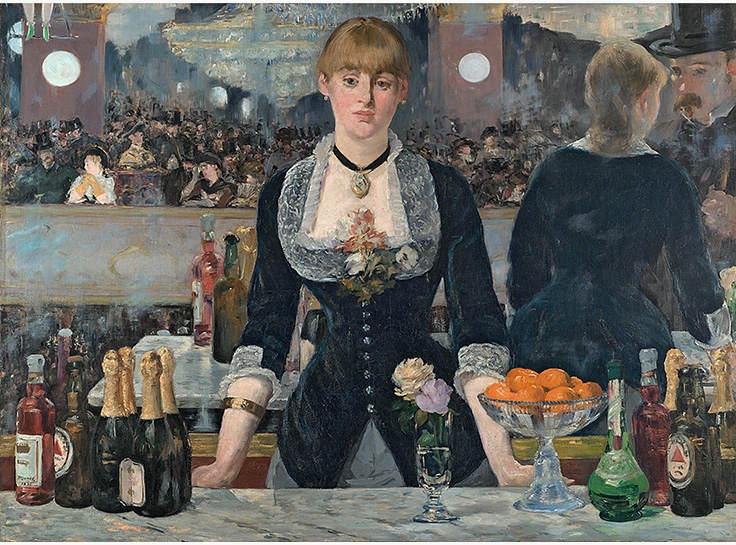
Edouard Manet's "Bar at teh Folies-Bergere"

Psychologist Haim Ginott knew the importance of adults WORDS in children’s lives. “Children learn about their physical likeness by seeing their image in a mirror,” he writes in Between Parent and Child,

They learn about their emotional likeness by hearing their feelings reflected to them…. the function of an emotional mirror is to reflect feelings as they are, without distortion:

“It looks like you are very angry.”

“It sounds like you hate him very much.”

“It seems as if you are disgusted with the whole situation.”

To a child who has such feelings, these statements are most helpful. They show clearly what his or her feelings are. Clarity of image, whether in a looking glass or in an emotional mirror, provides opportunity for self-initiated grooming and change.

At times of strong emotion there is nothing as comforting and helpful as a person who listens and understands. What is true for adults is also true for children. Caring communication replaces criticism, lecturing, and advice with the healing balm of human understanding.

When one of our children is distressed, afraid, confused, or sad, we naturally rush in with judgment and advice. The clear, if unintended, message is: “You are too dull to know what to do.” On top of the original pain we add the new insult.

Ginott also believed that parents tend to deny the importance of emotions in children. And to Ginott, emotions are not just an occasional occurrence for humans; it’s air we breath.

Emotions are part of our genetic heritage. Fish swim, birds fly, and people feel. Sometimes we are happy, sometimes we are not; but sometimes in our lives we are sure to feel anger and fear, sadness and joy, greed and guilt, lust and scorn, delight and disgust. While we are not free to choose the emotions that arise in us, we are free to choose how and when to express them, provided we know what they are. That is the crux of the problem.

Many people have been educated out of knowing what their feelings are. When they felt hate, they were told it was only dislike. When they were afraid, they were told there was nothing to be afraid of. When they felt pain, they were advised to be brave and smile. Many of us have been taught to pretend to be happy when we’re not.

As adults, how do we honor kids’ emotional nature and keep them from feeling that emotions are natural (and so keep up their ability to communicate, form relationships, and grow)?

When a child is in the midst of strong emotions, he cannot listen to anyone. He cannot accept advice or consolation or constructive criticism. He wants us to understand him. A child’s strong feelings do not disappear when he is told, “It is not nice to feel that way,” or when the parent tries to convince [them they have no] reason to feel that way.

Strong feelings do not vanish by being banished; they do diminish in intensity when the listener accepts them with sympathy and understanding.

This seems similar to American psychologist Carl Rogers, says children, as much as possible, have to feel “unconditional positive regard” from their parents and teachers.

***

Haim Ginott is perhaps best known -- at least in teaching circle, for this quote about creating climate in his book, Teacher and child: a book for Parents and Teachers

I have come to the frightening conclusion that I am the decisive element. It is my personal approach that creates the climate. It is my daily mood that makes the weather. I possess tremendous power to make life miserable or joyous. I can be a tool of torture or an instrument of inspiration, I can humiliate or humor, hurt or heal. In all situations, it is my response that decides whether a crisis is escalated or de-escalated, and a person is humanized or de-humanized. If we treat people as they are, we make them worse. If we treat people as they ought to be, we help them become what they are capable of becoming.


Sunday, November 22, 2020

On aphids and ants


If you were an aphid, you'd think that your job was to suck sap from trees and plants and reproduce.  Their story is strange enough as it is, because almost everything they consume they excrete.  But to ladybugs, aphids are food.  And, for ants, aphids are cattle, protected, shepherded and milked.  

Read this account of the strange and complex relationship in The Hidden Life of Trees by Peter Wohlleben:

Aphids (sometimes also called plant lice or greenflies) are much lazier than woodpeckers.  Instead of flying about industriously and hacking out holes here and there, they attach their sucking mouth parts to the veins of leaves and needles.  Thus positioned, they get royally drunk in a way no other animals can. The tree's lifeblood rushes right through these tiny insects and comes out the other end in large droplets.  Aphids need to saturate themselves like this because the sap contains very little protein -- a nutrient they need for growth and reproduction.  They filter the fluid for the protein they crave and expel most of the carbohydrates, above all sugar, untouched.  Little wonder it rains sticky honeydew under trees infested with aphids.  Perhaps you've had the experience of parking your car under a stricken maple only to come back to a thoroughly filthy windscreen.

For many animals, however, sap-sucking pests such as aphids are a blessing. First, they benefit other insects such as ladybugs, whose larvae happily devour one aphid after another.  Then there are forest ants, which love the honeydew the aphids excrete so much that they slurp it up right from the aphids' backsides.  To speed up the process, the ants stroke the aphids with their antennae, stimulating them to excrete the honeydew.  And to prevent other opportunists from entertaining the idea of eating the ants' valuable aphid colonies, the ants protect them.  There's a regular little livestock operation going on up there in the forest canopy.  

The natural world is filled with examples like this.  If you just look at a bit of the relationship, you see something relatively straightforward.  But if you pull back the viewfinder, you see something much more wondrous and complex.  And it's more complex than "the food chain" -- it's not just that simple.

The world is like that, interconnected and unexpected.  You can think of yourself as the aphid, the ladybug, or the ant.  And probably, we are the aphid, slurping the sap while we are, oblivious, both protected and being used by others.

Saturday, November 21, 2020

On “ the world will not devote itself to making you happy”

image from Times UK article about National Gallery show about Shaw
 

Writer George Bernard Shaw on living a life that burns bright:

This is the true joy in life:

being used for a purpose recognized by yourself as a mighty one;

being a force of nature instead of a feverish, selfish little clod of ailments and grievances complaining that the world will not devote itself to making you happy.

I am of the opinion that my life belongs loop to the whole community, and as long as I live it is my privilege to do for it whatever I can. I want to be thoroughly used up when I die, for the harder I work the more I live.

I rejoice in life for its own sake. Life is no “brief candle” for me. It is a sort of splendid torch which I have got hold of for the moment, and I want to make it burn as brightly as possible before handing it on to future generations.

Friday, November 20, 2020

On Middle Season #32


The moon, in the bottom right picture, was one day after the new moon.  It followed the sunset.  Throughout the week, it trailed the sunset further and further and got bigger and bigger, like the picture on the top left.  The bottom left is the fallen fronds of the bald cypress that are in the rain gardens in front of the school.  Most other leaves are down and blown away.  They create complex patterns and look like a wig.  The top right: witch hazel.  Blooming now... what is pollinating these blooms?

Things I noticed that didn't fit in pictures:

  1. Sandhill cranes overhead, trying out Vs, flying to southeast;  Some flights as early as November 15th.  Many flights of the cranes on November 18th, 19th, and 20th. 
  2. Incredibly strong winds.  Winds gusting powerfully and suddenly can affect your walking, making a trip through the Mariano's parking lot a jerking, sliding affair.  A sawn tree stump on my bike ride to work, facing east, the ring of sod and dirt pulled up around it, the earth wrenched open, a scar.
  3. Looking up into the bare elm trees.  They are amazing!  The biggest creatures in the neighborhood.  


Wednesday, November 18, 2020

Things I Learned from "The Art of Noticing"


Here's Rob Walker's original "How to Pay Attention" article on Medium. He turned it into this book.  Here's his newsletter.  Here is an interview at Core77. Walker teaches a class at the New York's School of Visual Arts in the Products of Design program.

And here are the things I learned from the book.  (lower in the blog post I've listed some favorite quotes and all the references to books and people and ideas I want to follow up with later.) 

Noticing Exercises/ "Practice Paying Attention"

  1. Every year, at some point in our class, I ask my students to "practice paying attention" before our next meeting.  There are no other parameters.  Each student resolves this deliberately vague request differently.   
  2. As part of a class about color, artist Munro Galloway assigned students a one-hour walk.  "let color be your guide.... what are the colors that you become aware of first? what are the colors that reveal themselves more slowly? what colors do you observe that you did not expect? what color relationships do you notice?"
  3. Start a Collection.  George Nelson documented arrows, public clocks, manhole covers, street corners, geometric shapes, ephemeral traces such as footprints (includes tire treads).  Nelson's hunts were sometimes more conceptual - contrast (look for hardness and softness and the contrast between these two qualities." or angles, curves, texture, repetition, contrasts between new and old, natural and built, colorful and drab, crumbling and pristine
  4. Count with the numbers you find.  George Nelson created numbers from 1-100.  (here's a slideshow of them.)
  5. Slow Art Day.  "Look at five works of art for 10 minutes each, and then meet together over lunch to talk about their experience." Slow Art Day webpage/blog.
  6. Dan Ariely: "Let's say we go to a bar, and we see people that are dating.  We also notice that the place is noisy, that it's dark, that it's crowded, that there's alcohol: all sound observations. 

    But now, as a social scientist, I want to think of it like a Newtonian physics problem and say: "what are the forces at work?  What pulling people in different directions that is showing up as an interest in being in this place?"

    Maybe going to a noisy place helps people overcome moments of awkward silence.  Maybe being in a loud place allows people to sit closer to each other, and from time to time whisper or talk in each other's ear.  Newtonian Physics in a Crowded Bar.  (see my post here)
  7. Sketch a Room you just left. Take in your physical environment carefully, then move to a differnet one.  Now sketch the layout of the room you left.It doesn't need to be a detailed re-creation, but strive to capture the basics of the space, in cluding what is in it -- the positioning of the doors and windows, for instance, and the footprint of the furniture.
  8. Look like a historian.  A few years ago, Matthew Frye Jacobson noticed something simultaneously startling and mundane while walking around Midtown Manhattan.  A massive jumotron-style screen offered a looped image: a young woman, bouncing soft-pornishly on a trampoline and flashing an improbable smile.  Titillating or offensive, she was difficult to miss.  What Jacobson, a historian and the chair of American Studies at Yale University, really noticed was how easily we take the likes of Bouncing Jumbotron Woman for granted.  He asked his students to consider a photograph of this spectacle.  At a glance, they could of course tell that the scene was not from 1930s -- or even 1970s -- America.  They also knew, after a moment of reflection, that there ar nations and cultures in the world right now where this scenario couldn't exist.  Jacobson posed a question: What are the preconditions, the things that have to be in place, for this visual to be a casualy accepted part of a public environment? The classroom explore dthe evolution of technology; shifting personal politics and cultrual mores; feminism and antifeminism; varied social normas around sex, advertising...  "There was nothing that I could have told them," Jacobson said, "that would have been as powerful a lesson."
  9. Pick a spot, a local park or something, where there are people coming and going.  Sit there for an hour and write down three things you notice about each person that you see.  If there's too many people, just pick one at a time. But just note something.  It can be physcila or less tangible, like the way their voice sounds or the way they laugh or how their shoulders are unched or are they wearing a wedding ring.... You may notice patterns or disruptions of patterns.  You may learn something about yourself in what you notice.  
  10. Review the Everyday. My friend Marc Weidenbaum is a music writer, among other things, and he has a very interesting personal ritual.  "I like to review everyday sounds," he explains "as if they were commercial music releases." The whir of an electric toothbrush, the rattly hum of an old taxi, the moan of a foghorn, the purr of cat: He'll think up a descripton of the sound, the context in which it occurred, and 'whatever continuity it's part of (cultural, technological, regional, aesthetic, etc.)" he explains.  "I describe how it functions as a sonic event." He collects his everyday sound "reviews" on his site https://disquiet.com/
  11. Listen Selectively. Listen Critically.  Ethan Hein, teaches music technology at NYU.  Hein has his students pick a single sound within a song, listen for it, and tune out everything else.  Maybe it's the bass; maybe it's the vocal. Or maybe this means zeroing in on the chorus and identifying each sound within that  Hein makes his students create lists and diagrams of their conclsuions.  What instrument or piece of gear produced that sound?  Who played or programmed it?  Why did they play it as they did?  "Just attending to these sounds is enough for casual fans," hein says. It's less important to identify gear than to land on a subjective description that rings true, such as "that thing that sounds like a seagull." (some artists send out "song stems") Here's Hein's blog filled with music-related postings.
  12. Ambient sounds.  ambient sounds are arre not in the foreground, that don't nitrude, but rather those that we normally tune out as irrelevant, like the minor rustling of a plastic bag caught in a tree.  Such incidental noises could be an irritant, but actively seeking them out flipped her perceptoin.  Instead of trying to tune them out, one could collect them. [this reminds me of John Cage's quote: "“Wherever we are, what we hear is mostly noise. When we ignore it, it disturbs us. When we listen to it, we find it fascinating.”
    —John Cage
  13. Take a Sound Shot of Your Neighborhood. Peter Cusack has called his work sonic journalism, an auditory equivalent of photojournalism.  Back in 1998 he started a project called "Favourite sounds of London," a collecting submissions -- short audio clips - from Londoners and posting the results on a dedicate site with a playable map.  This has since inspired similar projects from Berlin to Beijing, and most recently Cusack's own favouritesounds.org site has offered a map of favorite sounds of the British city of Hull: traffic, playground noise, squawking birds, a band at a fair, a public fountain.  Cusack himself has embarked on other projects, notably "sounds from Dangerous Places," collecting audio from environmentally damaged sites around the world.  Rob Walker suggests doing this in your neighborhood.  He calls them "sound shots" (like snapshots).  It makes me recall the Spanish man (Miguel Angel Blanco) in Robert MacFarlane's book The Old Ways who has a library of more than 1,100 books -- "though its books are not only books, but also reliquaries. Each book records a journey made by walking, and each contains natural objects and substances gathered along that particular path: seaweed, snakeskin, mica flakes, crystals of quartz, sea beans, lightning-scorched pine timber, the wing of a grey partridge, pillows of moss, worked flint, cubes of pyrite, pollen, resin, acorn cups, the leaves of holm oak, beech, elm."  (see this website about the "Library of the Forest")
  14. Deep Listening.  Pauline Oliveros, who came up with this term, has a short 1974 text called Sonic Meditations.  offers sets of poetic instructions: take a walk at night, walk so silently that the bottom of your feet becomes ears.  In any space you wish, listen to all possible sounds.  When one sound grabs your attention, dwell on it.  Does it end? think about what it reminds you of.  Consider sounds from your past, from dreams, from nature, from music.  Now think of a sound that reminds you of childhood; see if you can find something reminiscent of that sound now.  Dwell on what you find.  Then, return to listening to all sounds at once.  (This seems like a great way to listen to music.  It also reminds me of this Amanda Petrusich New Yorker article reviewing Song Exploder podcast/TV show.)
  15. Make a Sound Map. As part of a course on sound in the media landscape, writer Marc Weidenbaum takes his students on a soundwalk.  This is a walking tour of sounds rather than sights.  One such tour began in a market street mall, taking in the retail soundtrack.  Then it headed outside adn moved east on a route punctuated by street chatter, traffice noise, and the occassional siren; paused aoutside the lobby of an exclusive residential building offering "private silence"; considered the auditory effects of the waterfall feature of a MLK memorial; and got interrupted by a street evangelist bellowing through a megaphone.  Students learn to notice not just how sounds work but also where they come from, and when, and why.  Weidenbaum instructs students to identify three sounds in a two-block radius and to 'pin' each sound's origin point on a digital map, describing it and noting its meaning or function.  Should it include the ephemeral and unmoored sounds of a passing bird's squak, an airplane, distant thunder? Or should it stick to more geographically immobile examples: a church bell, a penned rooster, the warning horn of a drawbridge? As an extra-credit assignment, W encourages his students to chart a soundwalk of their own, designing it around a particular theme with multiple audible points of interest.  The result is a narrated journey, as he puts it, addressing "the sonic aspects (be they aesthetic, cultural, historical, functional, etc.) " of a place.  "The world is a museum.  You are the docent."
  16. Take a Scent Walk.  Victoria Henshaw, a British scholar, urban planner, and author of the 2013 book Urban Smellscapes, devoted her career to the subject.  her practice include organizing smellwalks in Sheffield England.Artists Kate McLean and Sissel Tolaas amassed a smell archive stored in thousands of airtight jars, and has conducted more than fifty city smellscape projects in London, Istanbul, Tokyo, Calcutta, Auckland, and elsewhere.  She has a handy PDF at  https://sensorymaps.com/about/
  17. Detect Imaginary Clues.  From Lynda Barry in Paris Review.  Take a bus to a bar.  Get buzzed.  Head homeward on foot.  Before you start your trek, think of a question, big or samll you'd like answered.  Tell yourself that you will encounter three clues to the answer to this question in the next 90 minutes.  Tell yourself on e will be in the form of a person, one will be in the oform of trash or something laying on the ground, and one will be something located above eye level."  Get home and write about how it answer your question.  
  18. Record 10 Metaphor-free observations about the actual world this week.  Poet Marie Howe asks her students to write down "ten observation s fo the actual world" every week.  What she has in mind sounds fairly simple.  "Just tell me what you saw this morning, like in two lines.  'I saw a water glass on a brown tablecloth, and the light came through it in three plceas,'" she explained during an interview on the public radio show On Being.  "No metaphor. It's very hard."  "To resist metaphor is very difficult, because yo have to actually endure the thing itself, which hurts us for some reason." Howe tells her students: no abstractions or interpretations.  After a a few weeks, they get it.  "it is so thrilling. Everyone can feel it.  Everyone is just like , "wowo."  The slice of apple, and then that gleam of the knife, and the sound of the trash can closing, and the maple tree outside, and the blue jay. I mean, it almost comes clanking into the room."  .  The students have finally worked around their need to interpret and have simply foudn a way to engage ith the world as it is, through their senses -- "just noticing what's around them," without comparison, without reference point of metaphorical shortcut.
  19. Annotate the world.  The Wadsworth house, built in 1726 and now used for administrative offices, is one of the oldest buildings on Harvard U's campus.  In the past it served as the home to a number of university presidents, whose namese were later listed on a block gray monument just outside.  In 2015, someone added a pink sheet of paper to that monument, serving as a real-world annotation.  It read: "This house was alos a place of enslavement.   Among those held in bondage in the s building were: Titus, Venus, Juba, Bilhah."  ... slaves owned by a couple of the Harvard presidents listed on the monument.  This was the work of the "Harvard and Slavery" project, spun out  of a seminar at the school dedicated to exploring the neglected subject of slavery's role in the school's legacy.  Whether as a form of protest or education or both, the real-world annotation offers a new filter for the world.  What landmark or monument do you already know that tells a story of itself-- but not the WHOLE story?  What would you add for others to learn?  And as you encounter new landmarks and monuments, what questions can you ask to find out more that might currently be hidden, or at least left out?
  20. Make a One-Minute Video About a Place.  Paola Antonelli, the senior curator, department of architecture and design, at New York's Museum o fModern Art, in her visionary 2011 show Talk to Me included a project called "myblocknyc," which encouraged individuals to create one-minute videos about their block and compile these on an interactive map, making it possible to explore the city through the sensibilities of locals.  Edit the video down to a single minute that depicts a place and the things defining it.
  21. Create a Field GuideHow about a Field Guide to Area Dogs, based on your observations? Determine names, physical descriptions, relative friendliness, and barking styles.  Or research a Field Guide to Intriguing Personal Objects Spotted in Cubicles on the fourth Floor
  22. Seek Out Strangers.  Radio Producer Aaron Henkin took a very structured approach to engaging with strangers.  His goal: "to meet and interview everybody who lived and worked on one cty block in Baltimore." The result was an audio documentary -- and a lot of lessons learned from talking to people he didn't know.
  23. Do a StoryCorps Interview.  They have published hundreds of questions.  Here are some: who has been the most important person in your life? Can you tell me about him or her?  What was the happiest moment of your life? The saddest? Who has been the biggest influence on your life? What lessons did that person teach you? Who has been the kindest to you in your life? What are the he most important lessons you've learned in life? What is your favorite memory of me? Are there any funny stories your family tells about you that come to mind? What are you proudest of? When in life have you felt most alone?  
  24. Or interview an elder.   As about a job your interviewee had early on, what they liked or didn't like about school, or the first time they left home, or the biggest risk they ever took, or even what technologies made a  difference or an impression.  What do they wish someone would ask?
  25. Ask Five Questions. Give Five Compliments. In the course of a week, try to ask five questions and dole out five compliments.  The questions don't need to be grandiose or existential, just honest expressions of curiosity.  You'll find that this requires an alert attentiveness toward other people and what they're saying.
  26. Walk Together Silently. Lead groups on hour-long nature walks with no talking.  "Only at the end of the hike do they discuss what they experienced, with the idea being that silence allows our senses to take over, so we can smell, see, and hear more accurately.  This exercise is designed to keep your mind alert to what is really around you in the moment.  
  27. Exhaust a Place.  George Perec boldest effort to try to pay the infra-ordinary its due attention took the form of a slender, lovely book called An Attempt at Exhausting  aPlace in Paris, published in 1975.  To write it, he planted himself for the better part of three days on a particular Parisian plaza -- disregarding the spectacular architecture and instead noting everything that came into his field of vision.  his list -- a postal van, a child with a dog, a woman with a newspaper, a man with a large A on his sweater -- became poetry of the everyday.  (For book Everything We Touch, Paula Zuccotti asked subjects to document every object they touched during a 24-hour period.)
  28. Make an Immaterial Inventory.  Artist Brian Rea made a list of things he was worried about.  He created a huge handwritten mural of fears for a group art show.  30-foot wide, 15-foot tall.  Here's  Fast Company article about it.
  29. Make an Insanely Detailed Inventory.  Read about Matt Manhattan and others and make a detailed inventory.
  30. Make a Personal Map. The organizers of a project called "Where You Are" asked sixteen writers and artists to make maps...  Denis Wood hand-drew a map as memoir (titled "The Paper Route Empire") to capture Cleveland as it exists in his chidhood memories.
  31. Treasure the Dregs. Rick Prelinger, film maker of No More Road Trips suggests we should "film the gas stations" when we make road trip movies... because they reveal the most interesting things in the future.  

Quotations

Pay attention.  Be astonished.  Tell about it.  - Mary Oliver

Our life experience will equal what we have paid attention to, whether by choice or default. - William James

“Wherever we are, what we hear is mostly noise. When we ignore it, it disturbs us. When we listen to it, we find it fascinating.”
—John Cage

Saul Bellow calls it "first-class noticer"

curiosity is "joyous exploration".. Todd Kashdan, psych prof at George Mason University.  "the recognition and desire to seek out new knowledge and information, and the subsequent joy of learning and growing."

"A wealth of information creates a poverty of attention"  economist Herb Simon, 1971 

allokataplixis - the "heightened and delighted attention to the ordinary, which manifests in someone new to a place." (ecologist Liam Heneghan)

Sister Corita Kent's "instant finder" - an empty 35mm slide holder.

Milton Glaser - "The great benefit of drawing... is that when you look at something, you see it for the first time.  And you can spend your life without ever seeing anything."

"sketch noting" is what Austin Kleon did when attending lectures.

Marc Weidenbaum.  "The world is a museum.  You are the docent."

 "Our life experiences will equal what we have paid attention to, whether by choice or default." Williams James

St. Benedict's rule (link)

How should we take account of, questin, describe what happens every day and recurs every day: the banal, the quotidian, the obvious, the common, the ordinary, the infra-ordinary, the background noise, the habitual? - Georges Perec

Between stimulus and response there is a space.  In that space is our power to choose our response. - Viktor Frankl (what is there in this space?)

References to Books and People

Marina Abramovic... Abramovic method

Paola Antonelli, the senior curator, department of architecture and design, at New York's Museum of Modern Art

Amanda Tiller. Genograms.  "Everything That I Know" is a written documentation of exactly what the title suggests, all from memory, in an ongoing series of books.

Dan Ariel. Predictably Irrational 

James Benning.  Draw it With Your Eyes Closed. (class called "Looking and Listening" at the California Institute of the Arts) 

John Berger Ways of Seeing (book/documentary)

Hamish Fulton.  British artist who created an itinerary of very dry bare-bones entries -- anti-travelogue; here's his Tate Gallery exhibition

Joshua Glenn and Carol Hayes Taking Things Seriously - authors and designers write short essays about an unusal object of personal significance to them, but whuld not be obviously significant to anyone else

Lewis Hyde Trickster Makes the World

Alexandra Horowitz On Looking (walking around her neighborhood with a series of experts)

Sister Corita Kent Learning by Heart: Teachings to Free the Creative Spirit

Jason Kottke 23 Ninja tips for your next photo walk

Matt Green.  I'm Just Walkin' project... sets out to walk every single street in NYC

George Nelson How to See

Rob Forbes See for Yourself (founder of Design Within Reach)

Douglas Rushkoff Present Shock: When Everything Happens Now  and podcast Team Human

Amy Siskind.  theweeklylist.org

John Smith The Girl Chewing Gum (narrated short movie)

William  Helmreich also walked every block of NY - wrote a book The New York Nobody Knows

Nicola Twilley Gastropod podcast

Lawrence Weschler Seeing is Forgetting the Name of the Thing One Sees

Denis Wood Rethinking the Power of Maps