
 |
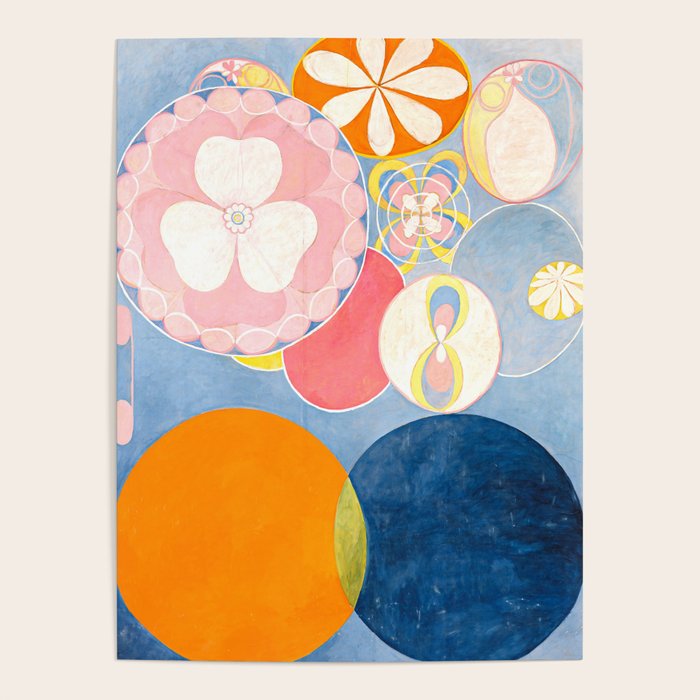
| Hilma af Klint (Swedish, 1862-1944) The Ten Largest, No. 6 |
AS LIVING BEINGS, our deepest wish is to be happy, peaceful and free from suffering. When we operate on the premise that the causes of happiness and suf fering lie outside of ourselves in other people, possessions, positions or places we often quarrel with others, disparage them, try to ruin their reputation, steal from them or even physically harm them. Holding the view that happiness comes from outside drags us into a tug of war with the external world, as we try to get what we like and think will make us happy and try to avoid what we dislike and believe will cause us pain. However, we will never succeed in changing other people or the environment into what we want them to be. Even if we could manage to get everything just the way we want it, in the next moment things would change. We would end up living in a state of constant frustration and anxiety, feeling that our emotions and our lives are beyond our control.
In this process we fail to look inside ourselves and to realize that it is how we are thinking, interpreting and viewing situa tions that determines whether we are happy or miserable. With a little reflection, this fact becomes evident. Remember a day when you were in a bad mood even though nothing special happened to provoke it. It is likely that found you many of the people you encountered that day to be rude and disagreeable. Meanwhile on the days when you Are in a good mood, even if you get some unexpected criticism, you're able to listen and take it in. This demonstrates that our moods influence how we interpret the situations we encounter and thus how experience them. we experience them
Nowhere in our present education system are we taught to observe how our internal moods and ideas influence whether we experience delight or unhappiness. Instead, we buy into the idea that happiness comes from outside of ourselves, for exam peo ple, from material possessions or other people. When we think like this, it is easy to become self-centered, viewing other ple as if their only purpose is to bring us happiness, and if they do not do a very good job of it, we feel that we're entitled to complain. When our happiness is dependent on the actions of others, which are out of our control, we will never be happy.
For this reason, setting aside some time each day for spiri tual practice is important. This is a quiet time that we can use to "get in touch" with ourselves, to become our own friend. We check in with ourselves,"What is of real importance in my life? How do I feel? What are the ethical principles that guide my life?" If our minds are filled with many confusing thoughts or emotions, we can use this time to meditate or do spiritual reading in order to rebalance ourselves. In this to live with integrity, in a way that corresponds to our ethical principles and not just chase after external things in order to way, we learn convince others and ourselves that we have a life." We need to treat ourselves with respect, not self-indulgence, can cultivate our good qualities and counteract our so that we faults.
It is often said that to feel love and compassion for others we must first feel love and compassion for ourselves. A lack of love and compassion for ourselves leads to harsh criticism of ourselves, which, in turn, carries over to how we feel about and speak to others. Furthermore, a judgmental attitude to wards ourselves will make us miserable and inhibit us from cultivating and experiencing love and compassion. Therefore it is important to become friends with ourselves, having a caring attitude and be kind when talking to ourselves.
 |
| Hilma af Klint (Swedish, 1862-1944) The Ten Largest, No. 7, Adulthood |
From Open-Hearted Life
Emotions 'organize' our minds by affecting many aspects of our mental experience:
From evolutionary perspective, according to Kolts, emotions are here for 3 reasons. (I'm dubious about this breakdown, but it's interesting!)
In Compassion-Focused Therapy, there are 3 types of emotions: the threat system, the drive system, and the safeness system. (Refers to emotions that help us detect and respond to threats, help us to pursue goals and acquire things that we need to survive and reproduce, and those that evolved to help us feel safe, connected with other and at peace.
From Jeff Tweedy newsletter: the #31 just highlights the idea of not being overly previous about making something and getting on with it.
After all these years, I finally figured out I should start numbering the daily poems I write.
Poem #31
People who dress alike:
Teams even
When they’re traveling
In sweat suits
Minor tweaks for the individual
Cheer squads
Nike slides
Then flowered Nike slides
Cops
Every man in a small town
Except for the local newspaper guy
Who still dresses like a newspaper guy
I’ve seen in minor municipalities
A flamboyant mortician
Sticking out
Back a little ways
Behind the mourners
All dressed alike
 |
| Le Poids du Monde 1-20, 2016, by Etel Adnan. Photograph: Tristan Fewings/Getty Images |
 |
| Etel Adnan’s three “Untitled” paintings from 2010, with bands of radiant color that create a sky and sea with startling lucidity, and a low sun searing even as it dips.Credit...David Heald/Solomon R. Guggenheim Foundation |
Etel Adnan, Lebanese artist (and writer and poet) died in November 2021 (Guardian obit)
When she returned to the US for good in 1979, settling with her partner the Lebanese artist and ceramicist, Simone Fattal, in the town of Sausalito, the nearby Mount Tamalpais became her muse. A large 1985 painting titled after the landmark shows a peachy foreground stretching up to a grey peak against a gorgeous blue sky. “That mountain became my best friend,” she said. “It was more than just a beautiful mountain: it entered me, existentially, and filled my life. It became a poem around which I orientated myself.”
:quality(70)/cloudfront-eu-central-1.images.arcpublishing.com/thenational/V5YXISAYDH7JSWHXOKCWLPMWPA.jpg)
 |
| Untitled 2012, an oil on canvas work by Etel Adnan, the Lebanese-American writer and painter, at Callicoon.Credit...Ccourtesy of the artist and Callicoon Fine Arts, NY |
 |
| Hilma af Klint (Swedish, 1862-1944) The Ten Largest, No. 8, Adulthood |
Compassion is a gift that we give freely to others. Expecting something in return, even a thank-you note, can lead to disappointment.

Compassionate Intention
As you go through your day, try to be creative in bringing a compassionate intention to the situations you face. For example, when washing dishes, consider that you are doing so that others may eat without contracting diseases. When interacting with others, do so with the intention to make their day a bit brighter. Pick a few situations you regularly encounter during a day, and experiment with how you could bring a compassionate intention to the situation and see how if affects your experience of the situation.
Take a few deep breaths and notice the feelings and thoughts you're experiencing. Now say to yourself 'hungry child.' Notice any feelings that arise when you say those words and allow them to sink in.
Happy and Free From Suffering
As you go through your day and encounter different people, remind yourself that like you, one of their deepest, innermost wishes is to be happy and not suffer. When you're at a red light, on the train, walking down the street or waiting in a queue, look at the people around you and reflect, "This person, like me, wants to be happy and avoid suffering." Let this knowledge enter your heart.
Then take it a step further and extend kind wish to them, "May you be happy and free from suffering." Similarly, we can extend this kind wish to ourselves. Repeatedly extending compassionate wishes can transform our minds as we gradually build compassionate habits, they replace our habits to judge, criticize and shaem that keep us caught up in anger, anxiety and negativity.
Compassion and Emotions
Think of a time when you were behaving aggressively or when you completely shut down and refused to communicate with another person. What emotions did you feel at that time? Now think of a time when you were behaving kindly and compassionately. How did you feel then? You'll find that as you move from feeling threatened to feeling safe in a situation, your ability to experience and act with compassion increases.
Noticing Our Self-Talk
Try to notice the different ways you talk to yourself. Is your internal voice harsh and critical, or kind, validating and encouraging? When you observe that your self-talk is serving no purpose other than to keep you locked into negative emotions, come back to observing your breath and let your mind settle. Then shift your thoughts to an internal voice that is more reality-based, helpful and encouraging. Recognize that you have good qualities and talents. Rejoice in them and aspire to use those qualities and talents to benefit all living beings.
How We Feed Our Minds
Think about the diet you've been feeding your mind. What things have you watched, listened to and thought about that have helped you become more like the person you want to be? Have you exposed yourself to things that have served little purpose but to distress or to reinforce unhealthy or unwanted habits, thoughts or emotions? Think about how you could fill your mind with more nutritious substances.
Identifying and Taking Responsibility for Emotional Habits
During the process of growing up, most of us will have picked up emotional habits that may not help u in the present. See if you can identify things that you do or way that you react that get in the way of your happiness. Try to understand where you learned these habits and responses. Taking responsibility for these habits and responses try to commit to figuring out ways to replace these tricky reactions with strategies that work better and to learn to cope with the emotions that accompany them.
Using Imagery
Start by considering one of these compassionate qualities that you'd like to develop: warmth, kindness, nonjudgment, confidence, courage, patience, humility, distress tolerance, humor, generosity, loving-kindness
Imagine how it feels to have these qualities. What would if feel like to have patience, deep kindness, confidence, or generosity? Having these compassionate qualities, what would you be motivated to do? What desires and intentions would arise in you? What thoughts would you think? Being kind and patient, how would you understand your own struggles or those of others? How would you spend your time, and what sorts of things would you? How would this perspective change the way you engage in your everyday activities?
Equalizing Self and Others
Take a few moments in a public place to become aware of the people around you. Shifting your attention away from your own concerns, allow yourself to connect with the understanding that these beings around you have life stories that run every bit as deep as your does, filled with hopes, dreams and aspirations, and with their own struggles and challenges. Recall that, just like you, they wish to be happy and to avoid suffering. Allow yourself to experience a sincere wish that they have happiness and that they be free from suffering.
A Compassionate "Homework Assignment"
Come up with some ways to bring compassion, kindness, and generosity into your daily life. Create a list of compassionate actions you could do. Then each day, pick one and do it. As you do so, bring to mind the wish to become deeply compassionate and see this action as a way to move towards this goal. As you complete your "homework," take note of how it feels to behave in this kind, compassionate way. Notice the emotions that arise in you as you purposefully take actions to benefit others.
Noticing the Positives
As you interact with others throughout the day, make an effort to notice their positive qualities. Almost everyone that we encounter has strengths that are worthy of our admiration, even if we have a difficult relationship with that person. Se if you can discover their positive qualities, and and when you find one that you particularly admire, let them know: "I was really impressed with the way you handled that situation. You did not get angry or back down when your neighbor raised his voice, but kept trying to communicate with him." "The project you were working on was completed on time, was laid out in a logical manner and covered all the necessary topics." Be sincere -- false flattery is neither kind nor compassionate. Observe how this practice of searching for the good in others impacts how you see them, how you feel about yourself and your relationship with them.
In Chapter "What Is Compassion and Why Do We Need It?" Kolts lays out the logical argument for living compassionately.
 |
| The Ten Largest, Group IV, No.4 by Hilma af Klint |
His Holiness the Dalai Lama frequently says, "If you want others to be happy, practice compassion. If you want to be happy, practice compassion."
Compassion means "sensitivity to suffering and the motivation to help alleviate it. The first involves openness to being moved in the face of pain and suffering -- we allow ourselves to bear witness to the difficulties that we and other face, and to be touch by this suffering. This experience of being moved by suffering gives rise to the second component: the motivation to help make things better."
Chodron, in the next chapter, adds this to the definition, distinguishing compassion from love:
Feeling compassion means being concerned about the suffering of others and wishing them to be free from suffering and its causes. Compassion is closely related to love, which is the wish for living beings to have happiness and its causes.
I really like the idea of "happiness and its causes" which emphasizes that happiness (or suffering) is always a conditioned thing.
In "Confusion about Compassion," Chodron warns that sometimes what looks or feels like compassion isn't. You could be a "people-pleaser," which is about self-profetection rather than genuine care for another. It also doesn't involve "interfering with other people's lives and fixing their problems. Becoming Ms. or Mr. Fix-It brings the focus back to us.... Sometimes the most compassionate thing to do is to teach others how to help solve their own problems and then to step back and give them the opportunity to do so. When they succeed, their self-confidence will increase. If they don't, hopefully they will learn from their mistakes. If they ask us for tips on how to deal with the situation, we can do that while at the same time respecting their autonomy."
Chodron goes on to say that with compassion we understanding that others are overwhelmed by their emotions, but we don't but ourselves in harms way. In fact, "compassion may entail acting in a way that the other peson does not like at all. With genuine compassion, we may even have to jeopardize a relationship with someone we care about in order to benefit that person." Compassion "also gives us the confidence to say "no" when faced with someone's manipulative behavior. Giving into their scheming or pleas helps neither them nor us in the long run. Although the other person may be angry, we do not doubt our decision when we know that what we are doing is a good choice done with a compassionate motivation."
Kolts sets the compassionate life in opposition to other possible stances in life:
In the fact of all this pain and hardship, compassion is the only response that makes sense. Sure, we could do lots of other things. We could become upset, look for people to blame, and get mad at them. We could simply close our eyes to the things we don't like, pushing away painful feelings or numbing them with drugs or alcohol. We could look the other way when confronted with the suffering of others or even blame them for their struggles. The trouble is that the challenges in life -- whether they are feelings inside of us we'd rather not have, conflicts with other people or problems in the world -- don't go away when we ignore them. In fact, they general get bigger.
Viewing the world with compassion allows us to relinquish the need to judge and shame ourselves or other people for having entirely human feelings. Instead, we can learn to balance our emotions so we will be at our best. Our confidence grows as we learn that we can face tolerate and work to improve difficult emotions and situations. This confidence helps us relate to life on its own terms, without being crippled by fear and worry. It allows us to shift from an anxious vigilance that is continually keeping watch for potential mistakes or difficulties to a more open, balanced experience that helps us respond to challenges whiles savoring the good things in life and being grateful for them.
Kolts defines compassion not as "just being nice all the time."
courage requires courage -- the courage to bring ourselves face-to-face with the difficulties of life and powerful emotions that sometimes arise within us. It requires courage and commitment to stay, to tolerate the distress and discomfort we feel when encountering these difficulties as we learn to work with them. Compassion is anything but weakness.
finally...
When we feel safe, accepted and valued, we are able to face problems in life and take responsibility for them. This is a gift we can give to others and to ourselves; it's a gift that benefits the giver as much as the recipient.
 |
| Hilma af Klint "The Ten Largest, No. 02, Childhood, Group IV" |
From "An Open-Hearted Life," by Thubten Chodron and Russell Kolts
The conditioned fear of closeness with others is something called 'fear of compassion,' and it can make relationships very complicated. We can both desperately want to have close, supportive or intimate relationships with others and find ourselves being anxious and frightened when we're in such relationships... Many children who now live [in an adolescent residential facility] have had experiences that taught them not to trust others. Some found themselves taken in by well-meaning, loving families who had the best of intentions to provide these children with safe, loving homes. These families had visions of enveloping these young people in love and support, and expected that the children would attach to them in return, feeling safe and thriving. The reality was often very different. In response to these families' efforts at creating closeness, the children often withdrew or even became aggressive. These kids had learned that the people who were supposed to take care of you could hurt you or disappear when you most needed them. So instead of attaching and loving these families back, the children fought them: testing the relationships, distancing themselves, acting out and having extreme emotionally reactions -- just the way we act in situations of threat.
***
If we're trying to help others who have learned to fear compassion, we have to go in knowing that things won't always go smoothly. We must let go of the expectation that those we seek to help will automatically respond to our efforts with appreciation, gratitude, and affection. Paying attention and responding to the cues they give us -- their nonverbal behavior, their level of talkativeness -- we should not try to get too close too quickly. We must be willing to patiently weather the storms, sending a constant message of compassion: I am here for you. You are worth caring about. I will not hurt you. I will wait patiently, and will be here when you are ready. Although we can be sensitive to their suffering and offer help, warmth and support, compassion is more about steadfastness than action when we're interacting with people whose lives have taught them to fear closeness rather than be comforted by it. We can't change anyone, but we can help to create the conditions in which change is possible.
 |
| Heathens, 1920 by Hilma af Klint |
From "An Open Hearted Life"
We have many different motivations, linked to a wide range of goals -- we may want to form and maintain relationships; acquire money, status or possessions; pursue meaning and happiness in life. At other times we may not be aware of our motivations at all -- going through the day checking off items on a "to do" list, disconnected from the awareness of why we're doing these things. However, it's possible for us to choose and consciously cultivate a motivation in our minds, just as we cultivate seeds in a garden. Specifically, we can resolve to do whatever it is we're doing for beneficial reasons. There are considerable advantages to doing this: the motivation behind an action -- the reason we're doing it -- deeply influences the manner in which we do the action, how we feel while we're doing it, as well as the outcome of the activity. Over time, pausing to consciously cultivate a compassionate motivation before we act can transform our mental state, assisting us to make wise decisions and enhancing our lives.
....
Buddhist teachers encourage us to examine our motives before we act, making sure they are not selfish or unkind, and that our ultimate goal is to benefit others and free them from suffering. Imagine acting with the motivatio to free all beings -- including yourself -- from suffering. Try not to get caught up thinking, "That's silly, there's no way I could possibly do that." Simply imagine how you would feel, think and behave if you had such a motive.
....
Try taking a moment to set your motivations each morning before getting out of bed: "Today I will do my best to show kindness and compassion to those with whom I interact." "Today I will try to be less judgmental." "Today, I will provide a model of patience and perseverance for my children, so they will learn these qualities." Experiment with setting your motivation in this way each morning and see how this impacts your day.

Ruskin drawing instruction here at the Ashmolean. (discovered this on Alan Jacobs' blog)
Suppose you have to paint the Narcissus of the Alps. First, you must outline its six petals, its central cup, and its bulbed stalk, accurately, in the position you desire. Then you must paint the cup of the yellow which is its yellow, and the stalk of the green which is its green, and the white petals of creamy white, not milky white. Lastly, you must modify these colours so as to make the cup look hollow and the petals bent; but, whatever shade you add must never destroy the impression, which is the first a child would receive from the flower, of its being a yellow, white and green thing, with scarcely any shade in it. And I wish you for some time to aim exclusively at getting the power of seeing every object as a coloured space. Thus for instance, I am sitting, as I write, opposite the fireplace of the old room which I have written much in, and in which, as it chances, after this is finished, I shall write no more. Its worn paper is pale green; the chimney-piece is of white marble; the poker is gray; the grate black; the footstool beside the fender of a deep green. A chair stands in front of it, of brown mahogany, and above that is Turner’s Lake of Geneva, mostly blue. Now these pale green, deep green, white, black, gray, brown and blue spaces, are all just as distinct as the pattern on an inlaid Florentine table. I want you to see everything first so, and represent it so. The shading is quite a subsequent and secondary business. If you never shaded at all, but could outline perfectly, and paint things of their real colours, you would be able to convey a great deal of precious knowledge to any one looking at your drawing; but, with false outline and colour, the finest shading is of no use.
The article goes on and on with this kind of thing. There's this:
One kind of practice must have for its object the making you sensitive to symmetry, and precise in mathematical measurement. The other kind of practice, and chief one, is to make you sensitive to the change and grace by which Nature makes all beauty immeasurable. Thus you must learn to draw a circle and ellipse with perfect precision with the free hand; and at the same time must learn that an orange is not to be outlined by a circle, nor an egg by an ellipse, nor any organic form whatever by any mathematical line. In drawing a face, you must be able to map the features so that one eye shall not be higher than the other; but you must not hope to draw the arch of lip or brow with compasses. And while every leaf and flower is governed by a symmetry and ordinance of growth which you must be taught instantly to discern, much more must you be taught that it obeys that ordinance with voluntary grace, and never without lovely and vital transgression.
And this:
To begin, then; you see the Narcissus has six white leaves. Three of these, the undermost, are its calyx, and the three uppermost its corolla. These are two parts of every flower which it is well to ascertain before you begin to draw it; on which subject, please remember this much of elementary botany, and do not be provoked at my digressions; for the first principle of all I wish to enforce in my system here at Oxford is, that you shall never make a drawing, even for exercise, without proposing to learn some definite thing in doing so; nay, I will even go so far as to say that the drawing will never be made rightly, unless the making it is subordinate to the gaining the piece of knowledge it is to represent and keep. Observe, then, that the calyx and corolla are not two parts of the flower, but the corolla is the flower, and the calyx its packing case: in the bud the flower is folded up and packed close within the calyx, often with most ingenious pinching and wrinkling for room; (pull a poppy bud in two, and unfold the poppy, the first you can find this year among the corn), and therefore the calyx has altogether less life in it than the corolla, and is as a leathern or wooden thing in comparison: also it stops growing, or nearly so, when the corolla begins; and sometimes drops off at once, as in the poppy aforesaid, or fades wretchedly, as in the buttercup, or stays on, stupid and bewildered, long after the flower is dead, as in the rose. But the main point for you to note is that, as a calyx has at first to shut close over the flower; its leaves are nearly sure to be sharp pointed, that they may come together and fit close at top, while a corolla leaf is as characteristically flat at the end, that is to say, heart shape, with the broad end outwards, because it usually is the fourth or fifth part of a cup, cut down from the edge to the middle.
 |
| Gustav Klimt Fir Forest I, 1901 |
Me imperturbe, standing at ease in Nature,
Master of all or mistress of all, aplomb in the midst of irrational things,
Imbued as they, passive, receptive, silent as they,
Finding my occupation, poverty, notoriety, foibles, crimes, less important than I thought,
Me toward the Mexican sea, or in the Mannahatta or the Tennessee, or far north or inland,
A river man, or a man of the woods or of any farm-life of these States or of the coast, or the lakes of Kanada,
Me wherever my life is lived, O to be self-balanced for contingencies,
To confront night, storms, hunger, ridicule, accidents, rebuffs, as the trees and animals do.
 |
| Klimt - Pine Forest II, 1901 |
Beginning My Studies
Beginning my studies the first step pleas'd me so much,
The mere fact consciousness, these forms, the power of motion,
The least insect or animal, the senses, eyesight, love,
The first step I say awed me and pleas'd me so much,
I have hardly gone and hardly wish'd to go any farther,
but stop andloiter all the time to sing it in ecstatic songs.

Thich Nhat Hanh died today. His work taught me more about kindness and calming the mind than just about anyone else I've ever read. He even inspired MLKJr. May he live on in our acts of kindness and deep understanding. (@revtabor)

From New Yorker
This one is about Tree 103, the tallest known tree in New York.
This one is about Betty White.
I'd like to come back and write about what I love about Orlean's writing -- so concrete, so identifiable and unpredictable.
https://www.kennedy-center.org/whats-on/mo-willems-beethoven-exhibit/
Interesting Outside article by Alex Hutchinson about the differences between HIIT and SIT training and how they differently affect improvements in "peripheral adaptation" and "central adaptation."
The usual way of explaining VO2 max, the canonical measure of aerobic fitness, is that it’s a function of how quickly you can pump oxygen-rich blood to your muscles. You need lots of blood to carry the oxygen, and a big strong heart to pump it out. And it’s true that endurance training, over time, tends to increase the total amount of blood circulating in your body, and the amount that your heart can pump with each stroke.
That’s only half the story, though. Back in 1870, a German physician named Adolf Fick explained what became known as the Fick principle, which basically says that the amount of oxygen your body uses is the amount your heart pumps out minus the amount that returns to the heart unused. Your muscles may be screaming for oxygen, but if they can’t extract and metabolize it before the blood rushes past, then pumping faster won’t help. That means there’s a whole other set of adaptations that determine your fitness, like the density of the network of capillaries that seep blood into your muscles and the quantity and efficiency of the mitochondria that fuel contractions in your muscle cells.Together, these two results suggest that longer, slower efforts with less rest increase fitness through central adaptations, while shorter, faster efforts with more rest trigger peripheral adaptations. Of course, it’s not all or nothing. All types of training will produce both central and peripheral adaptations.
How should that change your workout?
The takeaway from the new meta-analysis, according to Rosenblat, is that “you should likely include both interval types, but cycle through the two types.” His advice is alternating a two-week SIT cycle and a four-week HIIT cycle. The sample workouts he gave based on his previous article were 4 x 30 seconds with 4:00 recovery and 5 x 5:00 with 2:30 recovery. My own takeaway is a little broader. Just because two workouts produce the same external results—a similar improvement in race time or VO2 max, say—doesn’t mean they’re doing the same thing inside your body. That means the workouts are not interchangeable. In the real world, if you’re choosing between short sprints, longer intervals, and continuous runs, my bet is that the best choice is “all of the above.”
Gottman
Look for ways of letting the other person know that they are important and valued, focus on what you cherish in each other and share those thoughts regularly, and show affection on a regular basis.
Here are some ways you can share fondness and admiration in your relationship:
| Katsushika Hokusai Ejiri in Suruga Province |
NY Times close read of Katsushika Hokusai: “Ejiri in Suruga Province.” It’s the 10th image in his renowned cycle “Thirty-Six Views of Mount Fuji.”
The year is 1830 or so: the waning days of the Tokugawa shogunate. And from the northwest, a wind is blowing with the force of a steamroller.
“Ask for stories, not answers.”
“I’ve found that simply saying, ‘Tell me about that [painting/plant/photo/guitar, etc.’] leads to interesting stories,
Getting Beyond Small Talk: Study Finds people enjoy deep conversations with strangers
adapted from the “fast
friends” paradigm (Aron et al., 1997):
1. For what in your life do you feel most grateful? Tell the
other participant about it.
2. If a crystal ball could tell you the truth about yourself,
your life, your future, or anything else, what would you
want to know?
3. If you were going to become a close friend with the other
participant, please share what would be important for him
or her to know.
4. Can you describe a time you cried in front of another
person?
 |
| Piet Mondrian, Composition in Color A, 1917 |
Yesterday I recounted Thubten Chodron's chapter on The Four Immeasurables and how it was immediately relevant to me.
There's something else that was interesting in the chapter. Buddhism often seems psychologically insightful to me. This chapter, which is Chodron's lay telling of Buddhist teaching on this subject, is no different.
Each of the Four Immeasurables has a "close enemy," which appears to be that quality but is a distorition of it, and a "far enemy," which is its opposite and needs to be counteracted.
The close enemy of love is clinging attachment or possessive love for another person. This emotion appears to be love in that it is attracted to another person, but clinging and self-centeredness corrupt it. We remedy this by reflecting that it is our mind that has exaggerated that person's good qualities or projected good qualities that aren't' there and then clung to this person, mistakenly thinking that they are the objective source of our happiness. Ill will and hatred are the far enemies of lobe and are counteracted by cultivating patience and fortitude and by wishing others to have happiness and its causes.
In terms of equanimity, that I wrote about yesterday...
Indifference, apathy and uncaring are the close enemies of equanimity. We have to be especially careful not to slide into these by misunderstanding the meaning of equanimity and closing our heart. Equanimity is open-hearted care and concern felt equally towards all being, without being biased towards one person and against another. Attachment, anger, and partiality are the far enemies of equanimity.
 |
| I took this photo by the buried nuclear waste in Palos this morning. It seems an appropriate photo for this posting. |
I've been feeling confused, conflicted, and guilty about my struggles with Charlotte and Henry. They do not reach out, they often ignore texts. (They agree to be taken for dinner. They are rigid about not coming to my house or "ever" changing their minds about Jennie. They are not interested or curious -- at all -- about me.). This past weekend was Hannah's wedding. My mom: "why don't you go talk to your kids"? (because they are abusive to me pretty often and they'd like to make it seem as though they have a relationship with me, but not acknowledge the existence of Jennie.).
Today I went for a hike in Palos with Erwin. He too, says, "keep trying. Don't give up."
Yet continuing to try and offer help and wanted to offer myself in relationship to either of them is hurtful because I'm continually feeling rejected. They (clearly) need help. I am willing and able to offer it. But I can't do that while the deal is they ignore Jennie and have no relationship with me and continue to have contempt, etc.
Also, the continual stress on Jennie has produced, this weekend, a 2-day headache. Yesterday, she said that she was done with it.
So, after tentatively feeling like I need to take a real break, since nothing is working, I get these "keep trying" messages from mom and Erwin. I don't know what that means in a way that isn't enabling selfish, hurtful behaviors.
Last night, while I'm tired, ready for bed, I come read Chapter 35 ("The Four Immeasurables") from An Open-Hearted Life by Thubten Chodron. It's a topic I've come across a couple times before (and blogged about). It recounts the four ways we can/should relate to others compassionately. This has been a struggle for me in terms of the kids (and Karrie).
Then I come across the paragraphs about equanimity.
Equanimity (impartial, open-hearted concern for all beings) is our response in two situations. One is when the other person is doing well and doesn't nee our help. Here we refrain from interfering in others' lives by giving advice that is both unasked for and unnecessary because they are already doing well. In other words, giving people credit for their ability to manage their own affairs, we calm our "need to be needed" and let others be.
This section, especially the phrase "need to be needed" is a sore spot for me. I definitely feel sad and frustrated partly because the kids very clearly are telling me that I am not needed (or even important).
The second situation in which equanimity is the desired response is when someone is facing difficulties, we try to help, but they do not accept our aid. In this case, rather than chiding the other person or pushing them to do something that they are clearly resistant to doing, we step aside. For example, if our elderly parents want to remain at home when we think they would be safer at an assisted living facility, we need to realize that they are willing to risk taking a fall in return for the benefit of living in the familiar, comfortable and comforting environment of their home. We have to honor their priorities and decisions.
That is precisely the issue that's happening with parents now, since this past wedding weekend also saw dad hitting a curb and blowing a tire when he was driving at night and mom forgetting their suitcase at home. But it's also the situation with my kids. They do not want any help from me, will not enter into a true relationship with me (for now).
* * *
 |
| Hilma af Klint "Series VIII. Picture of the Starting Point (1920) |
“A year from now you will wish you had started today.”
— Karen Lamb

But these 10 breaths also made me more in tune with nature time, world time, rather than Dave time.
I began to get a sense for me being a character in the grand drama rather than being a victim of my cascading self centered thoughts. Marienette not victim.
Sensation was like merging into traffics.
I finished my first 10x10 this year yesterday: Basement workouts that are made up of 10 minutes of yoga, 10 minutes of interval training on the stationary bike, 10 minutes of resistance training.
What are my take-aways from the 10?
I came across this disturbing quotation recently:
What you seek in vain for, half your life, one day you come upon, all the family at dinner. You seek it like a dream, and as soon as you find it you become its prey. —Henry David Thoreau
I wonder what he's specifically referring to.
"New beginnings are often disguised as painful endings." - Lao Tzu
“Often when you think you're at the end of something, you're at the beginning of something else.” -- Fred Rogers
Some music has the power to transport us... and create in us the most intense feelings... it can be poignant, blistering... often there are specific moments when it happens.
I blogged about one by Jean-Phillipe Rameau's Castor et Pollux recently here.
end of Mahler S2, the 4 sustained chords at end
Mahler songs
Beethoven SQ
Bach Goldberg Variation Prelude #1... 3:35
Teachers point things out. Are you ready to see? Ready to listen?
Yesterday, Terry Bruns witnessed a convo between Kate and me. Kate was worried that she gave too many As this semester. Terry said, after Kate left, "Isn't it a shame that teachers who are so good doubt themselves so much?" Kate is a veteran, well-respected. I didn't hear her concern as "self-doubt" and that I should consider addressing that in a positive way as a Department Chair.
Only when Terry points it out do I see it. In that moment, she is my teacher.
Being a teacher is 'pointing things out" so that students can see the world (writing, literature, self-regulation, etc.)
But what prepares someone to listen, to see? Why was I not able to hear Kate, but able to hear Terry?
Thoreau writes in many different ways that we see what we are prepared to see.
A man receives only what he is ready to receive, whether physically or intellectually or morally, as animals conceive at certain seasons their kind only. We hear and apprehend only what we already half know. If there is something which does not concern me, which is out of my line, which by experience or by genius my attention is not drawn to, however novel and remarkable it may be, if it is spoken, we hear it not, if it is written, we read it not, or if we read it, it does not detain us. Every man thus tracks himself through life, in all his hearing and reading and observation and traveling. His observations make a chain. The phenomenon or fact that cannot in any wise be linked with the rest which he has observed, he does not observe. By and by we may be ready to receive what we cannot receive now. I find, for example, in Aristotle some thing about the spawning, etc., of the pout and perch, because I know something about it already and have my attention aroused; but I do not discover till very late that he has made other equally important observations on the spawning of other fishes, because I am not interested in those fishes.
As I reread this selection, I note not only the italicized part, also also the "Every man thus tracks himself through life, in all his hearing and reading and observation and traveling. His observations make a chain" and "By and by we may be ready to receive what we cannot receive now." The three separate sentences strike me as three different and important ideas.
In Show Your Work! I wrote about a way of working I call “chain smoking”: lighting the beginning of one project up with the end of another.“We work because it’s a chain reaction,” Charles Eames said.Each piece leads to the next.
One pivotal moment of my life was when Jennie said that we need to continue working on our relationship. I was confused and said that I typically think of relationship as a birdhouse that you build. You work hard and make it just how you like it, and then it's done for good. Luckily, she still wanted to be with me. She suggested that it actually takes continued time and effort -- going on dates, sending love notes, etc.
Stuff from the Gottman Institute seems to have that down in ideas like The Magic 6 Hours a Week. I learned a lot from that and other ideas about relationship tending.
I've revisited this idea recently in terms of the idea of "caring for."
First, I realized that I need to recommit to doing Gottman things with Jennie, recommit to building the relationship, caring for (not Jennie per se, but) the relationship.
Second, I realized that all relationships need this kind of tending and caring. It's not just (as I currently do) "connect with X number of people each day/week", it's "care for the relationship with X and Y and Z" with gifts of interest and attention and compassion. Gottman's ideas are a trove of actions to attend to this. (I've also recently been introduced to Kat Vello's work about how to make real connections with people.)
Third, chores can be thought of in this way - not as stuff to get done so that you can get to a TV show or doomscrolling or smoke cigars, but as 'caring for the birdhouse." I'm thinking of the difference between having a chore like "water the plants" once a week to "caring for plants." The later will have you checking in more, pruning dead leaves, looking for resident caterpillars.
Even my understanding of caring for birdhouses has changed. Earlier I though of it in binary terms - thati it's done or not done... now, the current thought is (a) that it's more-or-less continuous work, (b) it's important work, like a key function of life, and also, (c) it's done a mental/spiritual practice that can help us build/define our skillful interface with the world that is 'caring.'
Fourth, care for myself -- self-care I hesitate to write - can be thought of as having a relationship with my inner self (sub-conscious), my brain (learning, creating, apprehending the world), and my body (my GI, my blood vessels, my muscles)...

“It’s good to hear your voice” or “I’ve been looking forward to talking to you” seem like good replacement options to me, and I plan on practicing them this week, as I have a rare string of daily phone calls coming up.
I don't see "it's good to see you" or "I've been wanting to touch base" or (if you recall some tidbit) "I've been wondering how X is going."
There's lots more at Kat Vellos's website here about skillfully checking in.
This reminds me of an early blog post I did on "just checking in"... and some conversational shortcuts to get started there.
Julia Rothman in the NYT suggests that we should create, instead of a resolutions list, a More/Less list. Like this:

In October, I began planning my year-end "more and less" lists (rather than NY resolutions)
More
Less
Adam Grant tweets:
Writing is more than a vehicle for communicating ideas. It's a tool for crystallizing ideas.
Writing exposes gaps in your knowledge and logic. It pushes you to articulate assumptions and consider counterarguments.
One of the best paths to sharper thinking is frequent writing.
Steve Magness Tweet from this thread: "Here are my 10 lessons on living, handling discomfort & loss, and improving our physical & mental health"
Find time & people to be authentic with.
Most of us live on the surface. We present an acceptable piece of ourselves to the world.
But we also need to have people you can go deep with. To have conversations without judgment, to struggle with, to find genuine connection.
* * *
From an old journal entry: Making food that others appreciate is important to me. Having a menu that others appreciate is important... not just having the same thing all the time. With wife #1, I never got that. Mostly, she was disengaged, eating what, when she wanted, leaving me the planning and making of food and menu. There was never appreciation, except in the very rare instances.
I never trusted her in the very rare event that she did say something -- often theatrically - often for the benefit of kids to try to encourage them to eat.
Fake enthusiasm.
Emerson talked about enthusiasm being the most important ingredient. Fake enthusiasm corrodes though.
 |
| (image: Kiitsu Suzuki) |
New Year's Day -
everything is in blossom!
I feel about average.
― Issa Kobayashi (tr. Richard Haas)


