
Hydragrangea paniculta (quick fire?), the morning moon with pine cones, the early droppings of hone locust collecting on the driveway, ginkgo fruit and leaves in neighborhood
In Michael Easter's The Comfort Crisis, Elliot talking about misogis - hard, kooky adventures that you do once or twice a year to test your boundaries:
Everyone today has such outward-facing lives. They do stuff so they can post on social media about some badass thing they did to get a bunch of likes.
Misogis are inward facing. A big part of the value proposition is that I'm going to do something that's really uncomfortable. I'm going to want to quit. And it's going to be hard not to quit because no one is watching. But I'm not going to quit because I'm watching. And then I can reflect back on how I was the only person watching myself and I still rose to the occassion in a big way. There's some deep satisfaction in that. Did you really do what you think is the right thing when you were the only person watching? Or do you need an audience or a big pat on the back for that? Are you not important enough to do it for you?
Rob Walker did a talk and tour at the Dallas Museum of Art in 2019. One of his suggestions was for people to ...
PLAY “BUY, BURN, OR STEAL”*
From The Comfort Crisis by Michael Easter.
I was comfortable, quite literally, every single moment.
I awoke in a soft bed in a temperature-controlled home. I commuted to work in a pickup with all the conveniences of a luxury sedan. I killed any semblance of boredom with my smartphone. I sat in an ergonomic desk chair staring at a screen all day, working with my mind and not my body. When I arrived home from work, I filled my face with no-effort, highly caloric foods that came from Lord knows where. Then I plopped down on my overstuffed sofa to binge on television streamed down from outer space. I rarely, if ever, felt the sensation of discomfort. The most physically uncomfortable thing I did, exercise, was executed inside an air-condition building as I watched cable news channels that are increasingly bent on confirming my worldview rather than challenging it. I wouldn't run outside unless the conditions were, well, comfortable. Neither too hot, too cold, nor too wet.
***
The Englishman never touches the ground.
Emerson travels to London in 1847. Richardson writes: "In England he saw mostly cities where all life moved on machinery.
The Englishman never touches the ground. The steamer delivers him to the cab, the cab to the railway train, the train to the cab, the cab to the hotel, and so onward.
From Seth Godin's blog: He talks about the challenge of both defending the status quo and defending something new:
The easy argument to make is that the thing we have now is better than the new thing that’s on offer.
All one has to do is take the thing we have now as a given (ignoring its real costs) and then challenge the defects and question the benefits of the new thing, while also maximizing the potential risk.
“A hand-written letter is more thoughtful, more likely to be a keepsake, and a more permanent record than a simple email.”
On the other hand, the technophile defending change simply has to list all the new features and ignore the benefits we’re used to.
“An email is far faster, cheaper and easier to track than a letter. It is more likely to be saved, and it can be sorted and searched. Not to mention copied and forwarded with no problem.”
And he gives a good example from a recent NYT article:
And the danger is pretending you’re being fair, when you’re not. In this silly article from the Times, the author (and their editors) are wondering if oat milk and pea milk are a “scam.”
This is a classic case of defending the status quo. Here’s a simple way to tell if that’s what you’re doing: imagine for a second that milk was a new product, designed to take on existing beverages made from hemp, oats or nuts. Defending oat milk against the incursion of cow milk is pretty easy.
The author could point out the often horrific conditions used to create cow milk. “Wait, you’re going to do what to that cow?” They could write about the biological difficulty many people have drinking it. Or they could focus on the significant environmental impact, not to mention how easily it spoils, etc.
Or imagine that solar power was everywhere, and someone invented kerosene, gasoline or whale oil. You get the idea…
This is a clever idea to argue FOR the new.
 |
Screenshot of app 72 Seasons (screenshot by the Claire Voon for Hyperallergic)
There's a new app that reminds you what microseason (ko) you are in. According to Hyperallergic:
Many people measure their year in four seasons; others, just two. In ancient Japan, the total came to a whopping 72, with each lasting about five days, all together making up 24 larger divisions known as sekki. While this may sound confusing, these 72 microseasons are meant to express the passing of the calendar year as a soothing, poetic journey that draws your focus to the subtle shifts of the natural world. Rather than simple descriptors like “summer” or “wet,” these 72 kō instead have names that translate into mellifluous phrases such as, “Dew glistens white on grass,” “First peach blossoms,” or “Bush warblers start singing in the mountains.” These titles originally arrived from Chinese sources, but the Edo period’s first official astronomer, Shibukawa Shunkai, rewrote them in 1685 to better fit the Japanese climate.
The App, called 72 Seasons, introduces users to more than just the name of the season.
Designed with an interface that resembles a Japanese scroll, “72 Seasons” shows you one microseason at a time, updating about every five days so you really have to take the seasons as they arrive. Each comes with seasonal words, foods, activities, and illustrations often drawn from ancient Japanese texts or prints as well as explanations for their significance in Japanese culture. “The Bear Retreats to its Den,” for instance, which spans December 12 to 16, presents the Japanese artichoke as a seasonal vegetable and the sea cucumber as both seasonal fish and word. And the plump slug, as the app explains, is a favorite subject of haiku poets; one included example: The sea cucumber/speaks of its anguish/to the jellyfish.
 |
| J. M. W. Turner: Sun Setting over a Lake 1840 |
HDT on September 24, 1859:
A man must attend to Nature closely for many years to know when, as well as where, to look for his objects, since he must always anticipate her a little.... I would know when in the year to expect certain thoughts and moods, as the sportsman knows when to look for plover.
On September 25 (in "Autumnal Tints" in 1862)
Why, it takes a sharpshooter to bring down even such trivial game as snipes and woodcocks; he must take very particular aim, and know what he is aiming at.... And so is it with him that shoots at beauty; though he waits til the sky falls, he will not bag any, if he does not already know its seasons and haunts, and the color of its wing, -- if he has not dreamed of it, so that he can anticipate it; then, indeed, he flushes it at every step.
From Rob Walker Newsletter "Be a (Re)Visitor"
The prompt: Take a look at your digital picture stash, and seek out two or three of the oldest shots of places or things that you could actually revisit. Now revisit them! Take a new picture, if you like. Commit to further visits in the future. See what’s different; see what happens.
This gets at the idea of revisiting a scene over time, but gives you a handy jump start: You don’t have to think up some spot to visit and wait a few years for the payoff, you can find some spot you’ve already visited and give it a fresh check-in right now. (Plus, it’s a good excuse to actually go through old photos — which we tend to just leave in digital piles, unappreciated and ignored.)
That said, this exercise still leaves open an unpredictable future, and in a way creates personal landmarks.
** of course this reminds me of the maps created by Miguel Angel Blanco (maybe Libraries of the Forest?) in Robert Macfarlane's book The Old Ways. Here's a blog post about it.
From Macfarlane:
"The library of Miquel Angel Blanco [in Madrid, Spain] is no ordinary library. It is not arranged according to topic and subject, nor is it navigated by means of the Dewey Decimal system. It's full name is the Library of the Forest, La Biblioteca del Bosque. It has so far been a quarter of a century in the making, and at last count it consisted of more than 1,100 books -- though its books are not only books, but also reliquaries. Each book records a journey made by walking, and each contains natural objects and substances gathered along that particular path: seaweed, snakeskin, mica flakes, crystals of quartz, sea beans, lightning-scorched pine timber, the wing of a grey partridge, pillows of moss, worked flint, cubes of pyrite, pollen, resin, acorn cups, the leaves of holm oak, beech, elm. Over the many years of its making, the library has increased in volume and spread in space. It now occupies the entire ground floor and basement of an apartment building in the north of Madrid. Entering the rooms in which it exists feels like stepping into the pages of Jorge Luis Borges story: 'The Library of Babel' crossed with 'The Garden of the Forking Paths,' perhaps....
"The Library of the Forest owes its existence to storm and snow. Between
30 December 1984 and New Year's Day 1985 a severe winter gale struck
the Guadarrama Mountains, the sierra of granite and gneiss that slashes
north-east to south-west across the high plains of Castille, separating
Madrid (to the south) from Segovia (to the north). Thousands of Scots
pines that forest the Guadarrama were toppled. For those tempetuous
days, Miguel was trapped in his small house in Fuenfría, a southern
Guadarraman valley. When at last the storm stopped and the thaw came, he
walked up into the valley, following a familiar path but encountering a
new world: fifteen-foot-deep drifts of snow, craters and root boles
where trees had been felled, sudden clearings in the forest. As he
walked, he gathered objects he found along the way: pine branches,
resin, cones, curls of bark, a black draughts piece and a white draughts
piece. When he returned home to his house he placed the gathered items
in a small pine box, lidded the box with glass, sealed the glazing with
tar, bound pages to the box with tape and gave the whole a cover of
card-backed linen.
"His manufacturing method is unchanged in its fundamentals. All his
book-boxes contain objects he has collected while walking; the results
of chance encounters or conscious quests. The found objects are held in
place within each box by wire and thread, or pressed into fixed beds of
soil, resin, paraffin or wax. Thus mutely arranged, each book-box
symbolically records a walk made, a path followed, a foot-journey and
its encounters. And the library exists as a multidimensional atlas -- an
ever-growing root-map, and a peculiar chronicle of a journey without
respite."
From Mindfulness. Langer describes an experiment
We tried to find out whether encouraging children to make distinctions actively would teach them that handicaps are task- and context-specific. Children were shown slides of people and then given a questionnaire relating the people shown with different kinds of skils. For the experimental group, we asked for several answers to each question on the questionnaire. For the control group, we asked for only one answer to each question.
Most of us are brought up to find the answer rather than an answer to questions. We do not easily come up with several alternatives. By requiring that children in the first group give several different answers to each question, we were also requiring them to draw mindful new distinctions.....
One of the slides, for example, pictured a woman who was a cook. She was identified as deaf. The experimental group was asked to write down four reasons why she might be good at her profesion and four reasons why she might be bad. The control group was akded to list one good and one bad reason.
A second part of this training in discrimination present problem situations and asked the children "how" they might be solved. They were to list as many ways as they could think of (experimental group), or they were simply asked whether they could be solved (control group). For instance, when viewing a woman in a wheelchair they were either asked in detail how this person could drive a car or simply asked, Can this person drive a car.
A third exercise in making distinctions involved finding explanations for events. WE gave the children a slide and. ashort writen description of what was happening (for instance, a gril spiling coffee in the lunchroom). The experimental group was told to think up several different explantions for the situation while the control group again considered only one explanation.
After this 'training' the children were given several tests to assess prejudice. One was a measure of general disability discriminatino. They were shown slides of children with and wihtou various handicaps and were asked to indicate whom they wanted on their team for activities such as checkers, soccer, a singalong, a tug of war, a wheelchair race, a game of Frisbee, seesawing, and pinning the tail on the donkey. We chose handicaps and actiities so that nonhandicappped children would be more suited for some activities, handicapped children for other, and for some activities it would not matter....
Those given training in making mindful distinctions learned to be discriminating without prejuice.
 |
| Still Life - Vase with Fourteen Sunflowers, 1889 |
I'm listening to This is Your Mind on Plants by Michael Pollan. In the mescaline chapter, describing his trip, Pollan writes about his sense of being caught up in the current sensory experience of the world -- being so filled with sensory input that he can't think about the past or the future. He uses the term "sufficient" several times in his notes while he's tripping and in explaining his preceptions. (The "Doors of Perception" were opened.) The input of senses - the vast variety of the world -- was "sufficient" for him. He didn't need to fill himself with other things.
While I was walking and listening to the book, I began making connections:

Novelty
Mindfulness is not controlled processing. Controlled processing such as memorizing information for a test can be exhausting; multiplying three-digit numbers by four-digit numbers can also be exhausting. Both of these are usually carried out as mindless, not mindful, activities. Multiplication and memorizations could be made mindful by trying them in new ways, but rarely do we do this. To do an act mindfully, novelty must be introduced. (xxiv)
Labelling
Attention to context and variablity may be effective for our interpersonal lives as well. Whenever we call someone by some dispoitional name -- "lazy," "inconsiderate," "self-centered" -- we are treating that peroson as if she or he has an incurable condition, overlooking any evidence to the contrary. As I have pointed out in this book, behavior makes sense from the actor's perspective, or else she or he wouldn't have carried it out. When we find ourselves being judgmental, we are being mindless. You may be trying to be reliable, someone who can be counted on, but others see you as rigid; when you see yourself as spontaneous, other may think you are impulsive; you may be trusting but are seen as gulllible; and so forth. By simply questioning why we may have sensibly behaved as we did or the reasons for the behavior of others, we see the motivations behind them and also realize that, like our symptoms, they change from time to time, and place to place. With this more respectivful view of others, our relationship are likely to improve.
Preconceptions of old people
Despite the fact that many of us know very few elderly adults personally, we have very strong ideas about aging. Many of these ideas are permature cognitive commitments. As we saw in the study discussed at the end of Chapter 3, positive mindsets about old age may result in richer aging. Those who had been exposed ot a more optimistic image of old age in their youth were more alret and more active in old age. But this is not the image most of us carry. When we are young, we hear expressions like "old bat," "dodering old fool," "Poor little old lady" from people with very negative views of old age before we ever start thinking of ourselves as potentially old people.
By unquestioningly assuming that old age means frailty and weaknes, we expect little of the old people around us, and of ourselves as we grow older. The consequence of such mindsets is an interactive spiral gradually wearing us down. Self-esttem, of course, is underminded and causes more suffering because elderly people blame themselves rather than the situation they are in.
Finally, Use of word "aging" rather than "changing"
It is interesting to note how rarely the term development is used to describe changes in the later years. ... change in later years is still typically described as aging... Agging has come to refer to the darker side of growing older. To make change in later life one must fight against all sorts of popular mindsets.
Both retirees and residents of a nursing homes participated in this pilot study. They were introduced to one of four ways to monitor their daily choices over an extended period of time. The types of monitoring varied in the complexity of the thinking required, and also in the amount of control exercised by the subjects. We assumed that the more complicated thinking and more control would increase mindfulness.
The first ("least mindful") group was asked simply to monitor and evaluate particular activities each day for a week (for example, the first drink they chose during the day). The second group monitored different behaviors each day. The third group was asked to focus on different activities each day, but also to list, for each one, three alternatives they could have selected but did not. The last ("most mindful") group was the same as the third group, except the subjects chose which activities to monitor.
... For virtually each measure, the more decisions and control required of the subjects, the more likely they were to have become (1) less depressed; (2) more independent and confident; and (3) more alert and differentiated in their choices. (85-86)
Rob Walker Newsletter has "Sound Diary" as an exercise in noticing:
The prompt: Keep a sound diary for a set period of time (a week, a month, whatever works for you). Note everyday sounds, mechanical sounds, natural sounds — and musical sounds, old and new. At the end of that period, review your findings. Consider repeating the exercise.
 |
| photo credit: Shawn Poynter for The New York Times |
Richard Powers has a new novel - Bewilderment. The NYT interviews him here.
For Powers, our inability to confront the climate crisis is a failure of imagination as much as a political and social one, a catastrophe that stems from humanity’s tendency to put ourselves at the center of the story.
“If you look at contemporary fiction, the stories that these books tell have no agency except humans,” he said.
He wants to challenge our innate anthropocentrism, both in literature and how we live.
“The world’s breaking down, and psychology begins to seem like a bit of a luxury,” he said.
--
“I was deep into the story before I realized that I was writing a book that was trying to re-engage the questions that were left hanging at the end of ‘The Overstory,’” Powers said. “Namely, how did we lose our sense of living here on Earth? How did we become so alienated and estranged from everything else alive? How did we get convinced that we’re the only interesting game in town, and the only species worthy of extending a sense of the sacred to?”
Almost any activity can be undertaken mindfully. In one investigation we asked people to engage in disliked activities. Those who hated watching football were to watch football; those who disliked classical/ rap music were to listen to it; those who didn't like art were to spend time looking at paintings. In each case we formed four groups: one group just did the activity, one group was told to notice one new thing about it, one group was told to notice three new things, and the final group was told to notice six new things. The more they noticed, the more they liked the activity. Boredom seems to be a function of mindlessness.
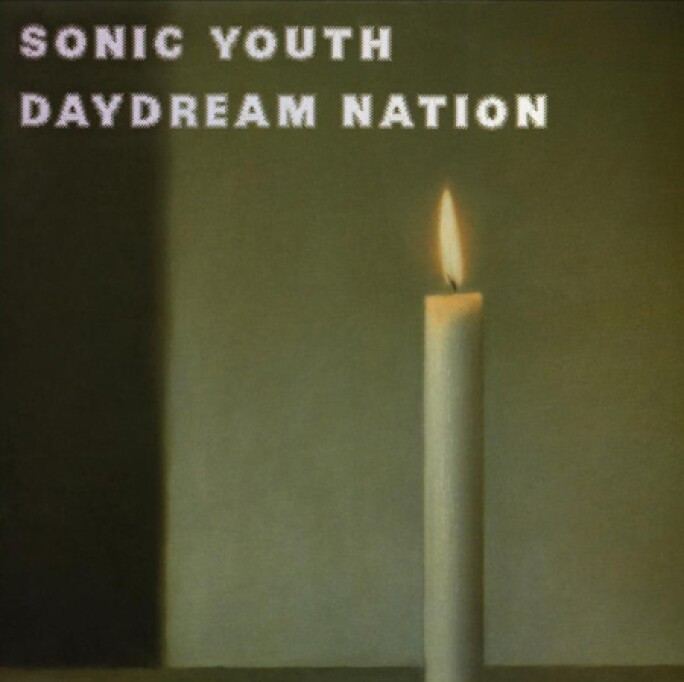
There are two ways of spreading light: to be the candle or the mirror that reflects it. - Edith Wharton
From Ellen Langer's Mindfulness:
What would happen if everyone were equally respected and encouraged to be mindful? We tested this with symphony orchestras, which are generally hierarchical. In one orchestra each player was told to make the piece of music she or he was to play new in very subtle ways that only that player would recognize. The other orchestra was to try to replicate a past performace of the same piece of music that its members felt was particularly good. The performances were taped and then played for audiences unaware of the experiment. In addition, all of the musicians were given a questionnaire asking them how much they enjoyed their performance. Audience overwhelmingly preferred the mindfully played piece, and the musicians preferred playing it mindfully. The importance of this work for group process to occurred to me only when writing up the research paper. One might think that if everyone essentially did it "their own way," teh result would be chaos. (They were playing classical music, not jazz). Nevertheless, when everyone did it their own way, making it new in very subtle ways, each person became more present in the same moment, and the result was a superior coordinated performance. (xx)
According to Cervantes, Virtue is the True Nobility.
A good yearly prompt: "____ is the True Nobility."

Flowerheads of clematis, (in Fullersburg) cutleaf coneflower (rudbeckia laciniata) or wingstem (verbesina alternifolia), goldenrod in Fullersburg), sedum in back yard slowly turning burgendy.
 |
| JMW Turner (1843) Light and Colour (Goethe's Theory) – The Morning after the Deluge – Moses Writing the Book of Genesis |
Robert Richardson, in Emerson: The Mind on Fire, claims that, "'The Poet' [by Emerson] is arguably the best piece ever written on literature as literary process, and it is the major statement of international romantic expressionism, the idea that expressing our thoughts and feelings is not only one of the fundamental and given aspects about human nature -- a basic drive, like sex -- but also one of the main purposes of human life."
To Emerson, poetry "is not an acquisition, a possession, a skill, or a trade. Its forms are nothing except as they reflect the spirit, inner fire. The forms of poetry by themselves do not matter. What matters is the source of poetry:"
For we are not pans and barrows, not even porters of the fire and torch bearers, but children of the fire, made of it.
Richardson says, "Emerson also insists that the poet is a sayer, a namer, and not a maker. A poem is the result of seeing and saying; the art is in the process. The final product marks the end, the death, of the process, the point at which fossilization sets in.... Poetry for Emerson is not a collection of finished poems but the process that produces poems.
poetry was all written before time was, and whenever we are so finely organized that we can penetrate into that region where the air is music, we hear those primal warblings, and attempts to write them down, but we lose ever and anon a word, or a verse, and substitute something of our own, and thus miswrite the poem.
Richardson: "The poetry is in the world, in people, in things. It is the poet's job to catch it and set it down. Thus originality (in the sense of novelty), so important to most romantics, is not of much interest to Emerson."
 |
| Self-Portrait, 1889, Vincent Van Gogh |
Richardson (348): "Emerson was particularly struck by two Neoplatonic teachings: the idea of the world as emanation and the idea of the ecstatic union with the One. For Plotinus everything emanates, or flows out, from the One, the ultimate power and unity of things." Emerson writes...
As the river flows, and the plant flows (or emits odors) and the sun flows (or radiates) and the mind is a stream of thoughts, so was the universe an emanation of God. Everything is an emanation, and from every emanation is a new emanation, and that from which it emanates is an emanation also. If anything could stand still, it would be instantly crushed and dissipated by the torrent which it resisted.
This makes me think of Henry David Thoreau (in "Spring" of Walden) describing the moving, responsive frozen pond which I reflected on here.
 |
| Tom Gauld "Food for Thought" September 6, 2021 |
Here's the "Cover Story" blog about this cover for the Food and Drink Issue. Gauld gives us a glimpse of the whole range of tastes that city dwellers yearn for.
He describes how he came up with this idea:
I often go for walks around London when I’m thinking over ideas for cartoons. But often, around lunchtime, I would realize that I had been thinking more about food than cartoons—there are food possibilities everywhere in the city. To capture that feeling in the cover, I made lots of rough sketches of hungry people in different city scenes, and found that these micro-stories about people and food started to emerge.
I love the idea of "micro-stories" of many people at once. Also, it reminds me of novels, like the George Perec book, where the stories of everyone in a single apartment building is told. Or a movie like "Night On Earth." All of these things tell of the simultaneous situation of people who are NOT interacting necessarily. It's "this story and this story and this story." That's typically not how narratives work!
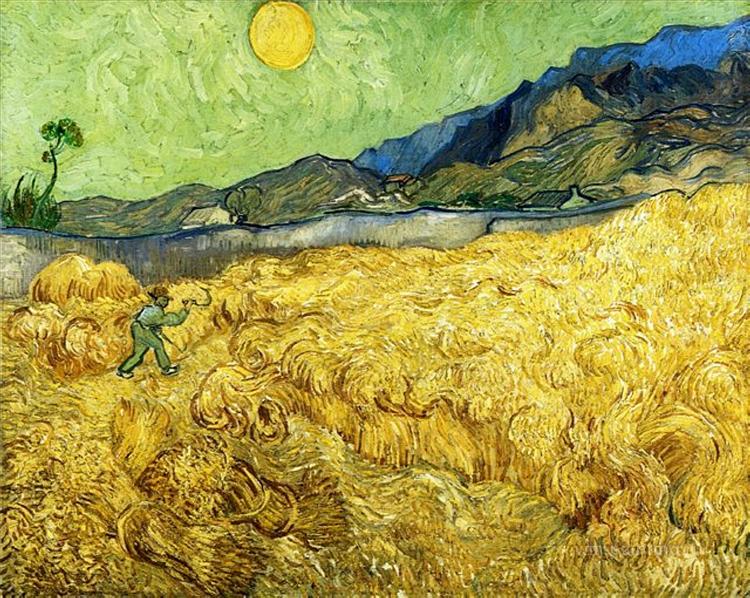 |
| Wheat Field with Reaper and Sun, 1889 - Vincent Van Gogh |
I've been feeling down lately.
Watching Never Let Me Go gave me some grist for my mill. I was thinking about how the donors don't matter to the "real world." They are, still, useful and helpful to the real world. They come to know their lack of mattering from reflection and interactions and never by someone from the outside world saying that they don't matter.
It made me think about how we are "told" we don't matter. Your feelings don't matter. Your interests don't matter. Ultimately, YOU don't matter. (This is different than "hated".) Is it directly - by evidence that we are discarded after use, that we are disposable, interchangeable? Or indirectly, by a lack of evidence that we are important? (additional thought: if we think we matter (or are useful), but it's not expressed, we feel like we are "taken for granted.")
This led me to think: has anyone shown you kindness today? has anyone shown you tenderness? compassion? interest? (does appreciation fit here? likely, but it's lower on the totem pole because it's easy to show appreciation to people we have no connections with.)
I think that these are the things that make us feel like we matter. We "matter" to someone else. We "matter" not in the abstract, but in specific relation to others.
This brings me back to my feelings of down-ness. I am unhappy because I am not often the recipient of the things above with the exception of Jennie. Either others are too busy to express these things - kindness, compassion, interest - or that really I don't matter... that I'm related to the donors in Never Let Me Go. I might be useful; I might be doing my job; I might be a good care-taker of the house... but do I feel I matter?
Ultimately, these are lessons for me: have you shown kindness to anyone? have you shown tenderness? compassion? interest?
This makes me think of "gift giving" that I thought about a year ago with this blog. Gifts, at least ones that come from compassion and interest, are evidence that we matter.
(I'm thinking that this is different than 'having purpose' and 'having a goal'.... other things that give us meaning.)
 |
| Mark Rothko - No.61, Rust and Blue, 1953 |
Ezra Klein interviews Jeff Tweedy on July 1, 2021 on his podcast. Here's the entire transcript.
Klein says, "So there’s a line in your book that I just loved. You say that, quote, “disappearing is the most sustaining part of what I do.” Tell me about that." Tweedy replies:
Yeah. I think it’s kind of what everybody wants all the time, is to be free from worry, unburdened by a sense of self. That’s what I think of as disappearing. I think people do it a lot of different ways that I don’t think are particularly creative or productive, and I would argue maybe not as good for you.
I think people disappear when they play games on their phone and do things like watch sporting events. And I think that’s good. I think everybody kind of needs to check out a little bit. But I think it’s kind of incredible when you can do that and somehow be present at the same time, which is what I think happens when you create.
We watched Never Let Me Go, which is a lot about how we disappear in different ways.
“What I'm not sure about, is if our lives have been so different from the lives of the people we save. We all complete. Maybe none of us really understand what we've lived through, or feel we've had enough time.”
“All children have to be deceived if they are to grow up without trauma.”
Lucy tells the childrend at Hailsham: “The problem, as I see it, is that you've been told and not told. You've been told, but none of you really understand, and I dare say, some people are quite happy to leave it that way.”
“When we lost something precious, and we'd looked and looked and still couldn't find it, then we didn't have to be completely heartbroken. We still had that last bit of comfort, thinking one day, when we grow up, and we were free to travel around the country, we would always go and find it in Norfolk...And that's why years and years later, that day Tommy and I found another copy of that lost tape of mine in a town on the Norfolk coast, we didn't just think it pretty funny; we both felt deep down some tug, some old wish to believe again in something that was once close to our hearts.”
“You're always in a rush, or else you're too exhausted to have a proper conversation. Soon enough, the long hours, the traveling, the broken sleep have all crept into your being and become part of you, so everyone can see it, in your posture, your gaze, the way you move and talk.”
 |
| From Tweedy's "Starship Casual" blog. |
Jeff Tweedy in an Ezra Klein interview, says, responds to Klein's question about how Tweedy's dad would get upset and go to the basement and would "sit and write a poem and then come upstairs half drunk and read a simplistic, heavily rhyming, but not entirely artless poem about the Alton & Southern Railway, or our neighbor who died, or something else that he’d been stewing about.
That’s a reminder that it can be a natural impulse. And it can have a really direct, natural function in someone’s life. And my dad just accepted that as being a part of how he coped. And I would argue that that’s probably close to how all of this stuff originated. Certainly poetry originates from storytelling and wanting to get things off of someone’s chest and make sure that people know how they’re feeling somewhere, generations to come — oversimplifying, obviously. But yeah, I think that was a really great lesson my dad taught me without trying to.
Tweedy's idea about art being natural, and an impulse just to communicate a feeling, is great. But I'm especially drawn to the idea of lessons we teach others without trying to.

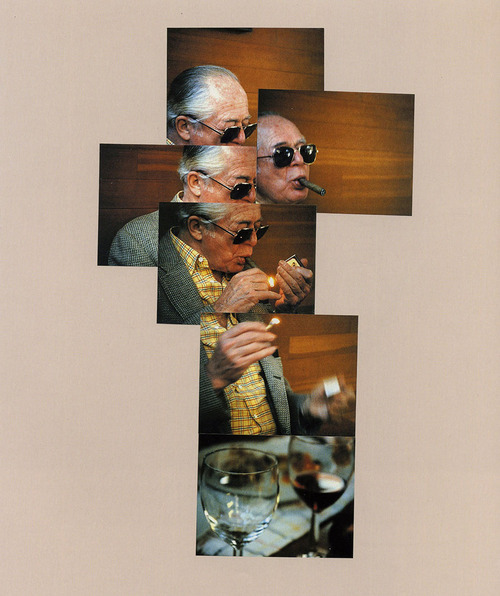
From Cameraworks by David Hockney with Laurence Weschler:
…Hockney began making what he referred to as “Joiners.”… “At first I was just going through all this because the result, the depiction of the particular subject, came out looking clearer and more true to life than a single wide-angle version of the same subject… However, fairly early on I noticed that these joiners also had more presence than ordinary photographs. With five photos, for instance, you were forced to look five times. You couldn’t help but look more carefully.”
“My main argument was that a photograph couldn’t be looked at for a long time. Have you noticed that?” Hockney led me back into the studio and picked up a magazine, thumbing through randomly to an ad, a photograph of a happy family picknicking on a hillside green “See? You can’t look at most photos for more than, say, thirty seconds. It has nothing to do with the subject matter. I first noticed this with erotic photographs, trying to find them lively: you can’t. Life is precisely what they don’t have- or rather, time, lived time. All you can do with most ordinary photographs is stare at them- they stare back, blankly- and presently your concentration begins to fade. They stare you down. I mean, photography is all right if you don’t mind looking at the world form the point of view of a paralysed cyclops- for a split second. But that’s not what it’s like to live in the world, or to convey the experience of living in the world.”

 |
| image: Hasui Kawase |
Emerson values the exhilaration that can arise sometimes from our presence in nature.
Crossing a bare common, in snow puddles, at twilight, under a clouded sky, without having in my thoughts any occurrence of special good fortune, I have enjoyed a perfect exhilaration. I am glad to the brink of fear.
Emerson, standing on top of "Dr. Ripley's hill," Emerson noted a moving sunset. (splendor, still light, radiant, a river journeying... to the green future).
And yet, the dictate of the hour is to forget all I have mislearned; to cease from man, and to cast myself again into the vast mould of nature.
See also Emerson's openness/focus on/insistence of "delight" and "gladness."
