
A tree in Bemis that fell while I was walking; the first green that I saw on a walk in WS neighborhood along south side of a house; sky in Bemis, deer poo in my front yard in WS
A tree in Bemis that fell while I was walking; the first green that I saw on a walk in WS neighborhood along south side of a house; sky in Bemis, deer poo in my front yard in WS
Nicholson Baker on keeping a notebook with you and writing out good lines you see.
One huge piece of advice came to me from Bill Whitworth, who was the editor of the Atlantic Monthly, and I was so in love with reading the Atlantic at the time. Once or twice I got a chance to work with Bill Whitworth on a piece or two – and I was just kind of struggling to support myself and, you know, life is busy and I wasn't writing that much. He just said very simply, "Are you writing every day?" and I said, "Ummmm," and I sort of mumbled because I couldn't say yes.
It was a horrible feeling, and the day after that, I started writing every day. That would have been 1984 and I tried to write every day since then. It has helped me a lot, so that was probably the most helpful piece of advice I got early on.
It's very hard to put it in practice if you're busy doing other things. For a while I was working with old newspapers; we were taking care of them in New Hampshire and people were coming to visit me as I played the role of an amateur librarian and I was asking people to help out with funding, so I had to get up very early in order to write every day. More recently, I have begun to realize that one writes in bursts. When you're in the middle of writing a book, it's very exciting and consuming and you think about nothing else, and then there are other periods where you are doing something else -- I might be trying to write a song or maybe traveling places, giving readings or something, so I fudge a lot where I think, "OK, did you write anything, did you write a text? Did you write an email? Did you write just notes on a scrap of paper? Did you write something?" So that's how I get around it sometimes, by stretching the definition.
Paul Chowder, the protagonist of my new novel, "Traveling Sprinkler," is my soul mate and most of what is going through his head is also going through my head, although in sexual situations we're a little different. But the thing that I found about writing is it's wonderfully wasteful and that's part of the usefulness of it. If you write every day, you're going to write a lot of things that aren't terribly good, but you're going to have given things a chance to have their moments of sprouting. After hearing something, you'll notice something and you'll write three lines about that and then you'll let it molder and you'll forget it. The next time you return to that, you're already at take one, and take two can expand on that and so even though it's wasteful, because I write, you know, thousands of pages of stuff that doesn't ever see the light, it helps me think and it helps me figure out what I actually do want to say in public. It makes me feel as if I'm being industrious, even if – it's really very soothing in a way to write about what's happening, and a couple of things I mean, other things that are helpful to me – some of them are bits of advice I've given myself, as if I'm my own elder brother or something and I talk about things with myself
It's been very helpful just to ask yourself, "What is the best moment of your day?" and "What is the best moment of the day you just lived through?" And if you're writing in the early morning, you don't have much to work with, but there's always something that leaps to mind. And nobody told me that, but I have a vague memory of reading a review in the TLS, and I don't remember who the reviewer was or what the book was, but it was about a writer whose method was to write only about the good things. That doesn't really work for me, but just asking myself what was the best moment of the day, which has sort of adapted from that piece of advice, has been hugely helpful.
Something that also taught me how to write that I tell people -- I've never been a writing teacher, but I say it because it was so helpful to me when I started doing it – is to buy a notebook or a spiral-bound book or something and get a ball-point pen of your choice. And sure people say, "You've got to carry around a notebook and jot down ideas" and that is OK, and I adapted that by writing on a folded-up piece of paper and carry it around in my pocket – that's one thing. But this is different; if you're reading along and you come to something that's really beautiful, that really stops you in the eye with its prose, you see it's true, then I'll stop or make a note to stop later and open the notebook and copy it out, in quotation marks, of course, and write down – copy that out word for word, with full punctuation, in handwriting
And the reason that's useful is it slows you down and helps you understand the rhythm of the prose and how a person constructed something that opened up in your mind in just that way. So copying out in a commonplace book interesting bits of writing that you find inspiring or interesting is the only piece of advice I have. It's the only secret that I have to pass on. I'm not a poet, but copy it out and you will be amazed at how much it helps you almost instantly. Instantly, it makes you a more thoughtful reader and possibly a better writer.

In the appendix of 4000 Weeks, Oliver Burkeman sets out 10 tips:
Those 10 tools are:
The haiku poet Issa represents this beautifully in one of his most famous poems:
The world of dew
Is the world of dew.
And yet, and yet …
He wrote this poem after the funeral of his baby daughter. All three of his children died before they reached their first birthday. What great sadness he had to carry in his heart. He understands that this world is impermanent. The “world of dew” is a world of birth and death. The morning dew is here in the morning and gone once it meets the rays of the sun. All things are subject to change. So Issa’s recognition of “the world of dew” is a statement of his own realization. He understands the way the world is.
But “and yet, and yet” is a statement of his pain. It is the cry of a human being. It reflects his own humanity as a father. In this very short poem, he expresses both his sadness and his wisdom. In this moment he appears to hold both his pain and the Great Eastern Sun in his tender heart.

Repairing government trucks [...] garage (1937)
Harris & Ewing, photographer
From Jenny Odell's Saving Time. P 146
Though I've associated it so far with colonialism, a version of this difference is visible in our everyday interactions with other people. Adam Waytz, Juliana Schroeder, and Nicholas Employ call it the "lesser minds problem," a cognitive bias that leads us to underestimate or overlook the emotional realities of others we perceive to be unlike ourselves, including a biased belief that those people are more biased than we are. We could interpret this to mean that we see people in these "outgroups" as being more automaton than human. The authors describe an incredible experiment in which participants were asked to consider "typically dehumanized outgroups" like drug addicts or people without housing. For someone outside them, thinking about people in these groups usually does not activate regions of the brain associated with theory of mind, the ability to imagine mental states in others. But "when [participants] are asked to engage directly with the minds of these outgroup members, such as by simply asking whether or not a homeless person would like a particular vegetable, then these neural regions become activated just as they are with higher status outgroup members."* The question abour the vegetable presumes a person with desires. And desire, an attitude toward the future and a reflection of one's past, can exist only in time-the time inhabited by that person.
And as a footnote on that same page:
*Shonda Rhimes, the writer of Grey's Anatomy and Scandal, has made a similar point in a Master Class lesson on writing realistic TV show characters. Having argued that compelling characters have fully formed hopes and desires—in other words, attitudes toward time -- Rhimes adds that the risk of stereotypical, static, and boring characters is highest when people try to write characters whom they perceive to be most different from them.
 |
| Risaku Suzuki, “Sakura” <13,4-33>, 2013. |
Read this article by Margaret Renkl in the NY Times.
Wrote this draft of a Pantoum (here are all of my drafts of 2025 10 Pantoums) in response, taking her very poetic lines and arranging them in a repeating order.
Pantoum 7 - after Margaret Renkl - Praise song for a false spring
While the rest of the world was burning up during the hottest January on record
It was unseasonably cold here in Middle Tennessee. I walked around my yard
Exulting at the sharpness in the air, at the cold blue of the daytime sky.
After a fall that lingered and lingered, winter was here at last. A real winter.
Here in Middle Tennessee It was unseasonably cold. I walked around my yard while
Winter kept trees and woody shrubs in dormancy, their fall-set buds tightly furled.
After a fall that lingered and lingered, winter was here at last. A real winter.
I rejoice when the natural world is working more or less as it ought. It happens so rarely now.
Winter keeps trees and woody shrubs in dormancy, their fall-set buds tightly furled, but
We can’t count on snow anymore. Some years it pours from the sky; some years none at all;
I rejoice when the natural world is working more or less as it ought. It happens so rarely now:
After an unseasonably cold January, February had highs 20 degrees warmer than average.
We can’t count on snow anymore. Some years it pours from the sky; some years none at all:
This boomerang weather is called false spring - a day or two of warmth bracketed by cold.
February had highs 20 degrees warmer than it ought to be, After an unseasonably cold January,
This year false spring blew in on a gust of warmth and birdsong; I dawdled in the mild light
This boomerang weather is called false spring - a day or two of warmth bracketed by cold.
I sat on my back steps and closed my eyes, listening; The birds were singing as if it were April
This year false spring blew in on a gust of warmth and birdsong; I dawdled in the mild light while
Their songs - overlapping - came from every corner of the yard: robins and crows and flickers.
I sat on my back steps and closed my eyes, listening; The birds were singing as if it were April
The birds were gobbling the insects stirring in the leaf litter. The bluebirds began to quarrel again.
Their songs - overlapping - came from every corner of the yard: robins and crows and flickers.
Historically, false springs were transitory; now they are increasing in frequency and severity
The birds were gobbling the insects stirring in the leaf litter. The bluebirds began to quarrel again.
If false spring lingers, there are sometimes disastrous effects for plants and wildlife and farms;
Historically, false springs were transitory; now they are increasing in frequency and severity
When a hard freeze comes, it takes the insects with it, leaving nothing for birds
If false spring lingers, there are sometimes disastrous effects for plants and wildlife and farms;
Worse than a false spring our wild neighbors is an actual spring that comes too early.
When a hard freeze comes, it takes the insects with it, leaving nothing for birds
Migrating birds and butterflies evolved to arrive in sync; arriving in ecosystems filled with food
For our wild neighbors, an actual spring that comes too early is worse than a false spring:
Bees evolve to wake into a world filled with flowers; Birds evolved to nest in a season filled with insects.
Migrating birds and butterflies evolved to arrive in sync; arriving in ecosystems filled with food
False spring isn’t meant to last. No matter what happens, this is not the end of the story
Bees evolve to wake into a world filled with flowers; Birds evolved to nest in a season filled with insects.
Any sign that nature is working as it ought to reminds me to keep faith in the future.
False spring isn’t meant to last. No matter what happens, this is not the end of the story
It has always been a welcome reminder, deep in winter of the promise of new life.
 |
| from flickr photocluiitk |
In an essay from Upstream titled "Swoon," Mary Oliver writes an essay that is mostly about closely an observing a spider over some weeks in her rented home. Towards the end of the essay (125), she writes;
This is the moment in an essay when the news culminates and, subtly or bluntly, the moral appears. It is a music to be played with the lightest fingers. All the questions that the spider's curious life made me ask, I know I can find answered in some book of knowledge, of which there are many. But the palace of knowledge is different from the palace of discovery, in which I am, truly, a Copernicus. The world is not what I thought, but different, and more! I have seen it with my own eyes!
There's value in discovering on your own. The discovering requires attention and patience.
Maples in a Spruce Forest
by John Updike
They live by attenuation,
Straining, vine-thin,
Up to gaps their gold leaves crowd
Like drowning faces surfacing.
Wherever dappled sun persists,
Shy leaves work photosynthesis;
Until I saw these slender doomed,
I did not know what a maple is.
The life that plumps the oval
In the open meadow full
Is beggared here, distended toward
The dying light available.
Maturity of sullen spruce
Murders these deciduous;
A little while, the fretted gloom
Is dappled with chartreuse.
(June 2, 1961)
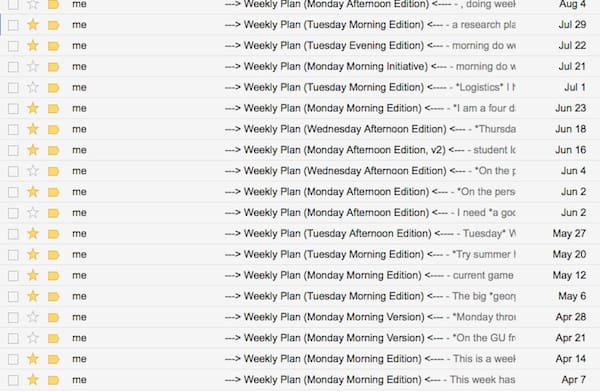
Cal Newport's Weekly Planning
On Monday mornings I plan the upcoming work week. I capture this plan in an e-mail and send it to myself so that I will be sure to see it and have access to it daily. (See the snapshot above of some recent plans in my inbox.)
This planning can take a long time; almost always longer than an hour. But the return on investment is phenomenal. To visualize your whole week at once allows you to spread out, batch, and prioritize work in a manner that significantly increases what you accomplish and goes a long way toward eliminating work pile-ups and late nights
To illustrate this point, I will show you two recent weekly plans I used (with the content scrubbed where needed for privacy reasons).
Weekly Plan #1
Monday
After weekly planning do a focused task block to get out ahead of the small things on my lists for the week. Be sure in this block to finish <specific 20-minute task that is time sensititve>
Prepare a lecture for <my fall class>
End the work day with a 1 – 2 hour writing block.
Tuesday
Today is a research day: head in the office right away to dig into <research project>.
End day with 1.5 hours in <a favorite secluded spot on campus>, where the first hour is writing and the last thirty minutes is a batched attack on tasks.
Wednesday
I have a training seminar to attend in the morning and a meeting with my student in the later afternoon. Between these two events focus on prepping another lecture.
Depending on the length of my afternoon meeting, I may be able fit in a task block before coming home.
Thursday
First thing in the morning do budget and take care of <related annoying financial task>. The goal is to finish before <doctor’s appointment near where I live>
After the doctor’s appointment find a quiet place to work deeply on <research project>.
End day somewhat early for <yard work project>
Friday
Write. Deep work on research until mental burn out. Shutdown for weekend. Finish <yard work project>
The above weekly plan represents the most common format I use: sketching my goals for each day of the week. Notice, I’m not simply listing things I want to get done each day, but instead am trying to match work to the time that actually seems available on those days. A big part of the weekly planning process is working backwards from your calendar to fill in the open time effectively. Fortunately, because this plan is for a summer week, I had lots of open time to work with.
Now consider another plan that I used a few weeks after the above example…
Weekly Plan #2
Research
Carve out three hours of deep work every day for the below research tasks. This is the core of each day’s schedule.
This week is do or die for getting to a final result for <a research project with an upcoming deadline.>
During downtime on this project (while waiting for responses from co-authors), see if I can push through <the final details of a different proof I’m working on.>
Dedicate one day’s deep work for finishing <a journal paper review>
Georgetown Teaching/Misc
Each day, outside of the deep work hours assigned above, make progress on the below non-deep tasks.
Once my new textbook arrives, I need to decide on my syllabus for <class I’m teaching this fall> and post online.
The following small tasks are time sensitive this week: (1) pick up new parking pass; (2) send back visa letter for <a researcher I know>; (3) respond to <a colleague’s> recent questions.
Writing
Use the morning block <[note: I sometimes work for an hour at home in the morning to allow traffic to die down]> and commute to plan and gather the sources I need to start writing next week.
Over weekend, write a blog post where I <reminder of post topic>
This plan adopts a different format. Because this was a summer week with no major appointments, meetings, or other scheduled obligations to break up my days (so rare, yet so wonderful), I could base my schedule around some simple heuristics: three hours a day on deep work for research, and a list of small things to schedule each day into the time that remains.
I would never get away with this approach during the height of the school year, but for a lazy week in July, it worked perfectly.
The bigger message here, however, is that I always decide in advance what I am going to do with my week. These decisions look different at different times of year, but what matters is that when it comes to my schedule, I’m in charge.
Cal Newport’s system for getting things done is based on his idea of a “pull system”, which is an alternative to traditional productivity methods like to-do lists or David Allen’s Getting Things Done (GTD) method. His approach is designed to reduce cognitive overload by keeping only essential tasks in front of you at any given moment.
Avoiding Constant Task Review
"WorkingMemory.txt" File (or equivalent)
Time-Blocking & Task Rotation
Triage System for Tasks
Cal Newport doesn’t prescribe one rigid way to structure the Master Task Repository, but based on his principles, it likely has some structure rather than just being a massive, undifferentiated list. The key is to keep it low-maintenance and review it only at designated times, rather than constantly referencing it.
While Newport hasn’t explicitly detailed every aspect, it would make sense to organize it like this:
Projects vs. One-Off Tasks
Categories or Buckets
Project Breakdown (Minimalist Style)
Scheduled Review Times
Newport's system values simplicity over complexity, so while some structure is good, the key idea is that you’re only engaging with a small, curated subset of tasks at any given moment.
Each project gets a dedicated page with:
Example:
Project: Poetry Collection
Goal: Complete 20 polished poems for submission
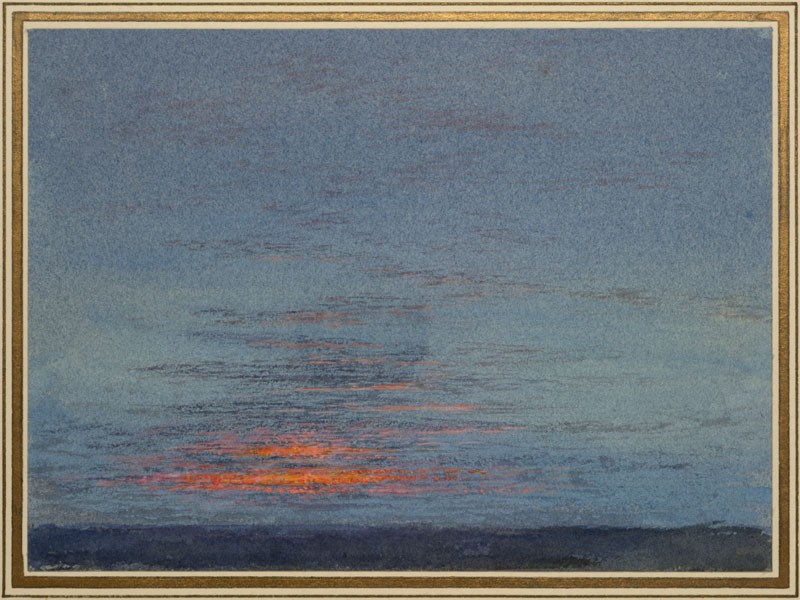 |
| John Ruskin Study of Dawn: the first Scarlet on the Clouds watercolour and bodycolour over faint graphite lines on blue-grey paper link |
From Ashmolean Museum::
Curator’s description:
Above a level band of blue-grey horizon, the pale blue sky is streaked with wispy, thin, dark clouds, which reflect the bright orange rays of the rising sun in the lower centre-left. This is the first of a group of three watercolours, of similar size on blue-grey paper, depicting early morning skies at Denmark Hill in March 1868. (The others are nos 4 and 5 in the Educational Series.)
The work was first catalogued in 1871, in the first Educational Series catalogue, as no. 3 A; it remained in the same position in the second Educational Series catalogue, and in Ruskin's 1878 reorganisation of the series.
Ruskin chose this work for its 'extreme simplicity in method of work' (first Educational catalogue, p. 27), including it as a factual record of a beautiful scene, and as a symbol of the way the light of inspiration can transform the ordinary into perfection. It was also intended as an example of a practical exercise in visual memory: speed was of the essence in achieving the desired effect, starting with a delineation of the clouds in pencil, colour then being added while the memory was fresh. It was vital to stop working the moment the mental image faded. The idea was to produce a simple reminder of the sky at that particular point in time. He advised his readers to 'Rise early, always watch the sunrise and the way the clouds break from the dawn' (The Two Paths, § 137 = XVI.371).
 |
| John Ruskin: Study of Dawn: purple Clouds |
Here's a link to the catalog itself
Ruskin's introduction:
The choice and arrangement of this Series have been determined with a view to two distinct ends; the first, to call your attention, by precision of copying, to the qualities of good Art; the second, to give you, yourselves,such power of delineation as may assist your memory of visible things, and enable you to explain them intelligibly to others. The first of these objects is, however, the primary one, and the more attainable. A short time earnestly spent in practical efforts will give you a basis of judgment in Art which cannot be afterwards disturbed, though protracted application will be necessary to enable you to draw in any wise rightly yourselves. But it isof greater importance that you should learn to distinguish what is entirely excellent, than to produce what is partially so.
There are now in your rooms twelve Cabinets of these examples, eachcontaining twenty-five drawings or engravings.
In the first of them are introductory subjects only; chiefly sketches of the flowers, or at least of the representatives of the tribes of flowers, which have had strongest influence on the human mind in all ages, and have become types of ideas which are always true, — always sources of innocent pleasure,— and therefore common to the religions of the East, of Greece, and of Christendom.
The second Cabinet contains such examples of Greek Architecture and simple design as will best enable you to discern the laws of practice under which the Hellenic nation bound themselves, or were, by their instincts, bound;and the strictness of which enabled them to lay the foundations of allsubsequent art, either existing, or conceivable.
The third Cabinet illustrates the course of the Arts in the north of Europe, from the development of their first perfect elementary school of round-arched architecture, to the consummate work of German artists in the sixteenth century.
The fourth Cabinet illustrates the Course of southern (that is to say,essentially of Italian) Art,from its first assertion of itself asa distinct style in the thirteenth century to its perfect results in the sixteenth.
The fifth and sixth Cabinets contain examples of the schools of landscape which were founded, first in Holland and then in England, on the fragmentary traditions of the figure-painting which ceased, as disciplined art, to exist after the seventeenth century: schools which in England have taken healthy root, and may, to yourselves,in early practice, be of greater use and interest than any others.
The seventh and eighth Cabinets contain illustrations of the treatment of Animal form by the higher methods of sculpture and painting.
These eight cabinets, then, give you in narrow epitome, a view of what has been done already, and may now be carried forward by your own influence, in art that is good for men. Only you are to note that the second group shows you, in Greek work, only the character of its laws, and nothing of its final achievement.
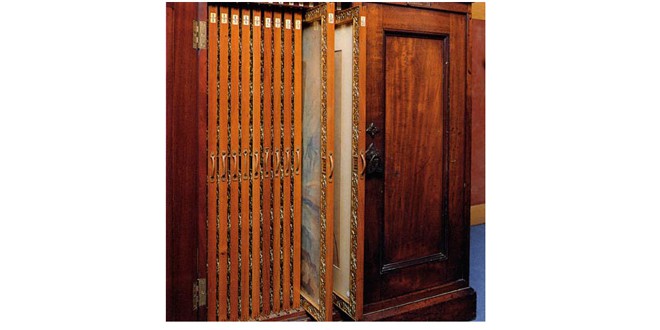 |
| John Ruskin assembled 1470 diverse works of art for use in the Drawing School he founded at Oxford in 1871. They included drawings by himself and other artists, prints and photographs. These were arranged in series and placed in special cabinets. |
An orange-red sun rises behind dark blue and purple clouds in the bottom centre-left, streaking the cloud above with orange. Above this two areas of pale blue sky show through the remaining purple clouds, which are tinged with pink in the top left of the painting. This is one of a group of three watercolours, of similar size on blue-grey paper, depicting early morning skies at Denmark Hill in March 1868. (The others are nos 3 and 4 in the Educational Series.)The work was first catalogued in 1871, in the first Educational Series catalogue, as no. 3 C; it remained in the same position, although renumbered as no. 5, in the second Educational Series catalogue, and in Ruskin's 1878 reorganisation of the series.Ruskin chose this work for its 'extreme simplicity in method of work' (first Educational catalogue, p. 27), including it as a factual record of a beautiful scene, and as a symbol of the way the light of inspiration can transform the ordinary into perfection. It was also intended as an example of a practical exercise in visual memory: speed was of the essence in achieving the desired effect, starting with a delineation of the clouds in pencil, colour then being added while the memory was fresh. It was vital to stop working the moment the mental image faded. The idea was to produce a simple reminder of the sky at that particular point in time. He advised his readers to 'Rise early, always watch the sunrise and the way the clouds break from the dawn' (The Two Paths, § 137 = XVI.371).
 |
| "Maybe it’s a drop in the ocean" |
NY Times article: "Dismayed by Trump, the Star Pianist András Schiff Boycotts the U.S." The headline "boycott" often makes me think of not purchasing stuff from a specific store. This is a different kind of boycott -- Schiff refuses to take part in performing in the US because (as the last paragraph says so well) he doesn't think it's going to inspire other musicians, but just because he has to do it for his conscience. He can't participate in and pretend that everything is okay. I would guess that he's not trying to punish his audience, or hurt American concert halls financially. He is just not going to participate and he's ready to talk about why.
I was original drawn originally to the article by the phrase in the blog title -- Trump "has brought an ugliness to the world." It makes me think that you can bring beauty or caring into the world.
András Schiff, an eminent concert pianist who has boycotted strongman rule in Russia and his native Hungary, said on Wednesday that he would no longer perform in the United States because of concerns about President Trump’s “unbelievable bullying” on the world stage.
Mr. Schiff, 71, a towering figure in classical music, said he was alarmed by Mr. Trump’s admonishments of Ukraine; his expansionist threats about Canada, Greenland and Gaza; and his support for far-right politicians in Germany. Mr. Schiff, who was born to a Jewish family in Budapest that witnessed the horrors of the Holocaust, said that Mr. Trump’s calls for mass deportation reminded him painfully of efforts to expel Jews during World War II.
“He has brought an ugliness into this world which hadn’t been there,” Mr. Schiff said in a telephone interview this week from Hong Kong, where he is performing. “I just find it impossible to go along with what is happening.”
"For there are two rules to keep at the ready—-that there is nothing good or bad outside my own reasoned choice, and that we shouldn't try to lead events but to follow them."
—EPICTETUS, DISCOURSES, 3.10.18
In the mid-twentieth century, there was an Indian Jesuit priest nam Anthony de Mello. Born in Bombay when it was still under British control, de Mello was an amalgam of many different cultures a perspectives: East, West; he even trained as a psychotherapist. Here is a quote from de Mello's book, The Way Love, that sounds almost exactly like Epictetus:
"The cause of my irritation is not in this person but in me."
Remember, each individual has a choice. You are always the on control. The cause of irritation-or our notion that something is bad that comes from us, from our labels or our expectations. Just as easily we can change those labels; we can change our entitlement and decide to accept and love what's happening around us.
From the bro Stoic book I read on Mike Palmquist's desk.
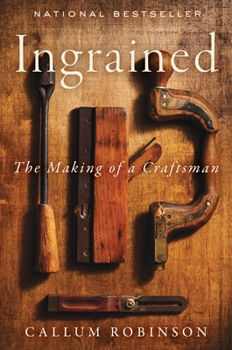
From Ingrained: the Making of a Craftsman by Callum Robinson, which I'm enjoying a lot. The phrase of the title isn't meant to be critical, but "their football" makes me take it as a disoriented, bewildered thought: I run my business and design and build furniture in my workshop (things I love)... I'm not sure what people do to spend their time.
Marisa returns and, having spread our meager profits around the high street, we nibble muffins and drink good coffee. The rest of the afternoon passes quietly. There are a few kind words, and a few really quite extreme peepers, but most must be enjoying their Sunday lunches or their football, or whatever it is that people do on weekends. I am just about to lower the blind and pull over the storm shutters, to head outside for the first time in close to seven hours, when a lady hurries past the window. Tentatively, she opens the door and leans in. "Are you still open?" she asks. "I'm sorry it's so late." She strikes me as kindly and friendly, if a little anxious.
She will not hold my gaze for long. It's a trait I know I share, and immediately I feel a connection. "Of course" I say, and welcome her inside.
The smallest act of kindness is worth more than the greatest intention.
- Khalil Gibran
Penumbrae
