
Friday, May 31, 2024

Thursday, May 30, 2024
The best kind of exercise involves adventure

Lloyd Kahn. post called “how I’ll spend my last decade”
In Plato’s Republic, Greek education consisted of three elements: grammatikē(grammar), musikē (music), and gymnastikē (gymnastics). Grammatikē meaning literacy; musikē referring to the lyrics, tunes and rhythms of music, as well as poetry; gymnastikē being fitness: keeping the body in shape.
He sets out new things he'll focus on in his last decade: He lists new ways of conditioning (below), new modes of communication (Substack newsletters)
I lost a lot of conditioning the last couple of years due to stress, and now I’m trying to get back in shape:
Surfing: I’ve finally given it up. I have trouble getting up to a standing position, there are always too many people in the water, and it’s a drag being so lame out there. BUT I’ve got a great new knee board that I’m going to try riding prone and/or on my knees. We’ll see.
Paddling: This I can still do, and love. I have a 12-foot Joe Bark racing paddleboard that weighs only 21 pounds, and skips across the water like a water skeeter. I can actually get a wake going. This morning I left my truck over at Stinson Beach; tomorrow I’m gonna paddle over there (2.75 miles), get a hamburger and milkshake at the Parkside stand, and drive the board and me back home. The best kind of exercise is that which includes adventure.
Cycling: I’m still loving my Specialized Turbo Levo pedal-assist electric bike. Each time I take it out and get that push — hey, this is fun! And off I go, usually up into the hills.
Hiking: Whenever and wherever I can, especially on Tuesday nights when I meet my running pals
Swimming: I’m starting to swim again at the Aquatic Park cove in San Francisco, hopefully once a week. I’m wimping out by wearing a sleeveless shorty wetsuit (as opposed to maybe 90% of the swimmers going wetsuit-less). But that cold water, once I get by the discomfort (i.e., pain) of the first couple of minutes, is a tonic. A chi-booster
Skateboarding: The love of my active life. I’m out of practice and kind of awkward these days, but once I get rolling on a gentle downhill slope, I can carve — the same as in surfing. EXCEPT when I fall, it’s not in the water. Gonna work on it soon.
Wednesday, May 29, 2024
Against efficiency
 |
| Full Moon and Crow, by Ohara Koson, 1900-1930 |
A line I think about more and more these days, from Taleb’s Skin In The Game: “Anything you do to optimize your work, cut some corners, or squeeze more ‘efficiency’ out of it (and out of your life) will eventually make you dislike it.”
From Jacobs
But you can’t optimize systems in a context that’s changing, especially if it’s changing in unpredictable ways. Removing inefficiencies when circumstances are as anticipated means that there isn’t much slack in the system to respond when the unanticipated happens. Optimization is intrinsically brittle, because it’s about closely matching the output to the conditions, which means it’s vulnerable if those conditions change. What we’ll need from our infrastructural systems, more and more, is for them to be resilient, able to absorb uncertainty and changing circumstances either without failing or by failing gracefully and reversibly, rather than unexpectedly or catastrophically.
Chachra, How Infrastructure Works, page 249
Mandy Brown, inspired by Deb Chachra’s brilliant new book: “Optimization presumes a kind of certainty about the circumstances one is optimizing for, but that certainty is, more often than not, illusory…. Another way to look at this is that you cannot optimize for resilience. Resilience requires a kind of elasticity, an ability to stretch and reach but then to return, to spring back into a former shape—or perhaps to shapeshift into something new if the circumstances require it. Resilience is stretchy where optimization is brittle; resilience invites change where optimization demands continuity
Tuesday, May 28, 2024
My bike is everything that I believe in
My bike is everything to me. My bike is my gym, my church, and my wheelchair. My bike is everything that I believe in…” RIP NBA Hall of Famer Bill Walton
Monday, May 27, 2024
Bach's Puzzle Canons
Found this on Kottke.org.
In this video, pianist David Bennett explains three pieces composed by Johann Sebastian Bach that show how much of a musical genius he was. Two of the compositions are puzzle canons, “a piece of music where the performer has to decode what the composer wants in order to perform the music”.
Sunday, May 26, 2024
The Mundanity of Excellence
From James Clear's newsletter:
Sociology professor Daniel Chambliss, who spent years researching the qualities of elite swimmers, on what creates excellence:
“Excellence is mundane. Superlative performance is really a confluence of dozens of small skills or activities, each one learned or stumbled upon, which have been carefully drilled into habit and then are fitted together in a synthesized whole. There is nothing extraordinary or superhuman in any one of those actions; only the fact that they are done consistently and correctly, and all together, produce excellence.
When a swimmer learns a proper flip turn in the freestyle races, she will swim the race a bit faster; then a streamlined push off from the wall, with the arms squeezed together over the head, and a little faster; then how to place the hands in the water so no air is cupped in them; then how to lift them over the water; then how to lift weights to properly build strength, and how to eat the right foods, and to wear the best suits for racing, and on and on.
Each of those tasks seems small in itself, but each allows the athlete to swim a bit faster. And having learned and consistently practiced all of them together, and many more besides, the swimmer may compete in the Olympic Games… the little things really do count.”
Source: The Mundanity of Excellence
Saturday, May 25, 2024
What would it be like to slow down?

From Leo Babauta/ Zen Habits(link)
What would it be like to slow down? To find stillness in your day, moments of rest and quietude?
The possibility of slowing down goes much deeper than just having a bit less busyness in your day …
Slowing down, if we go deeper, allows us to:
- Notice what’s coming up for us, and to attend to our emotions. This is much, much more important than people realize — most of our problems come from an inability to regulate our emotions or even recognize that they’re there.
- Make decisions from a place of choosing from the heart. If we have a decision to make, instead of overthinking it, we can slow down and sit in stillness for a few moments, and notice what our heart chooses. This makes decision-making much more effortless, once you learn to trust this.
- Make time for creating, instead of just busywork. We rush to do busywork because of fear, and because it’s easier than setting aside time to create. By slowing down, we can make the time to create, and slow down with our fears that are keeping us from doing this.
- Focus on what’s really important. What’s most important to you in your life? Spending time on loved ones, on your health, on your most important work? Whatever is most important to you, by slowing down, you can become more intentional and purposeful, and fully be with whatever you choose to do.
- Start to break up our habitual patterns. We live our lives mostly on autopilot, driven by old habitual patterns. This isn’t bad, but it means we struggle to do things the way we’d really like. We can begin break up those old patterns by slowing down, and noticing that we’re caught up in them.
- Start to get some rest and self-care into our lives. When we are rushed and busy and distracted all day long, it leads to feeling depleted and exhausted. This is a huge problem for many of us. Slowing down can create a bit of spaciousness to choose into rest and taking care of ourselves.
- Start to truly appreciate life. Rushing through our day, we barely notice the world in front of us. What if we could start to slow down and find wonder in the everyday moments?
Friday, May 24, 2024
Thursday, May 23, 2024
Launch yourself on every wave
HDT: Tou must live in the present, launch yourself on every wave, find your eternity in each moment. Fools stand on their island of opportunities and look toward another land. There is no other land; there is no other life but this.
Wednesday, May 22, 2024
Abundance and Chaos
 |
| Large plantings of Salvia in late sun in Field Park |
From Leo Babauta/ Zen Habits:
With Spring comes life springing into action, full of abundance. This is the chaos of life, full and energetic and exuberant. It’s chaotic but in the most affirming of ways.
This abundance and chaos can fill us up, if we let it. If you’re feeling drained and empty, then you can let yourself feel the nourishing abundance of life all around you. Chaos can be stressful, or restorative — depending on our attitude towards it.
Here’s the practice:
- Go outside and look at the sunlight and abundant nature all around you.
- Let yourself relax and open to this abundance, and soak it in as a way to fill up your cup.
- Imagine that seeing the abundant life and greenery can relax you, bring life into you, make your heart sing with joy and wonder.
- Soak in as much of this life energy as you’d like!
The amazing thing is that this abundant, chaotic life energy is always available to us, no matter the season. It’s the joyful play of little kids, the chaos of our lives, the energy of a crowd in a subway, the emotions of a loved one, the uncertainty in your heart. This is all the abundance and chaos of Spring, come to life, unpredictable, in transition, creative and powerful.
Can you practice being more open to receiving the abundance and chaos of life all around you, and within you?
Tuesday, May 21, 2024
Renewal by Jeffrey Harrison
audio on Writer's Almanac
Renewal
At the Department of Motor Vehicles
to renew my driver's license, I had to wait
two hours on one of those wooden benches
like pews in the church of Latter Day
Meaninglessness, where there is no
stained glass (no windows at all, in fact),
no incense other than stale cigarette smoke
emanating from the clothes of those around me,
and no sermon, just an automated female voice
calling numbers over a loudspeaker.
And one by one the members of our sorry
congregation shuffled meekly up to the pitted
altar to have our vision tested or to seek
redemption for whatever wrong turn we'd taken,
or pay indulgences, or else be turned away
as unworthy of piloting our own journey.
But when I paused to look around, using my numbered
ticket as a bookmark, it was as if the dim
fluorescent light had been transformed
to incandescence. The face of the Latino guy
in a ripped black sweatshirt glowed with health,
and I could tell that the sulking white girl
accompanied by her mother was brimming
with secret excitement to be getting her first license,
already speeding down the highway, alone,
with all the windows open, singing.
Monday, May 20, 2024
Middle Season #14 - 2024

Sunday, May 19, 2024
The manner in which something is accomplished

The manner in which something is accomplished is just as important than its result, or more so.
Norman Fischer
Saturday, May 18, 2024
May and June 2024 scrapbook
 | |||
| Postcard. 1970 | Yamazaki Tsuruko |
1. 100 days from now calculator. Link
2. Woodworking
Fan trellis. Link
Branch annd string obelisk trellis. Link
3 Paul Davids Guitar
12 levels of chord progression complexity - link
4. RunKeeper data - through 2023? - link
5. Morton Arboretum - Spring Bloom Report - link
6. HTML table generator - link
7. Poetry - Ted Kooser archive - link
8. Starling vs. Grackle - All About Birds comparison - link
9. Cool Tools doing "Tools for Possibilities" - which accumulates a series of past products - link
10. Lots of advice for writers - link
11. Meta search for used books - link
12. Recipes
Dressings -link
Breakfast Casseroles - link
13. Dew Points - link
14. Phrenology - link
15. Timetables of Dave's history - includes work history and taxes/income - link
16. Woodcraft Project
Woodcraft Mag list of plans to buy link
Ana White plans - link
Ana White router table plans - link
Ana White rollaway cart workbench link
Raised garden beds - link
17. New Years Cards - see above - AIC link - The Gutai artists utilized nengajo (年賀状) or nenga-hagaki (年賀はがき), which translates to new year’s postcards, for their mail art. The Japanese custom of sending written new year’s greetings dates back to at least the Heian era (794–1185) when the nobility began writing to people who lived too far away for face-to-face greetings. When Japan’s postal service introduced postcards in 1871, they were the perfect medium for these messages that required only the text “Happy New Year” alongside one’s name and address. The tradition has been preserved since then and has become one of the most common new year’s celebrations throughout the history of Japan.
18. Find cheap prices on furniture etc. link. From Cool Tools. I recently discovered Spoken.io, a website that reveals the practice of "white-labeling" in the furniture and home decor industry. White-labeling is when the same generic product is sold by multiple retailers under different brand names and prices. Spoken.io tracks items from over 100 stores, making it easy to compare prices for identical products across retailers like West Elm, Pottery Barn, and Crate & Barrel. The price differences can be substantial, so if you're furnishing a home, it's worth checking out to ensure you're getting the best deal.
19. Wire Stripper Tool video - link
20. Zip tie knots video - link
21. Dremel bit video - link
22. HTML - color- link
7. Classical birthdays - from Classical net - link
Jan 27 Mozart
Jan 31 Schubert
Feb 3 Mendelsohn
Feb 13 Sor
Feb 17 Corelli
Feb 20 Carulli
Feb 21 Segovia
Feb 23 Handel
Mar 1 Chopin
Mar 4 Vivaldi
Mar 21 Bach
Mar 31 Haydn
April 1 Rachmaninov
May 7 Brahms
May 7 Tchaikovsky
May 17 Satie
May 22 Wagner
June 2 Elgar
June 8 Robert Schumann
June 17 Stravinsky
July 7 Mahler
Aug 22 Debussy
Sep 4 Bruckner
Sep 8 Dvorak
Sep 25 Shotakovich
Oct 26 Scarlatti
Dec 8 Sibelius
Dec 15 Beethoven
Friday, May 17, 2024
Cicadas have arrive

I saw the first cicada in the mouth of a bird in my yard. I wrapped a few small trees in the yard. Today was the first day that I saw some emerged. I had been seeing some drill holes in my yard.
Thursday, May 16, 2024
Catalog of Possibilities
 |
| Henry Brown - 507 Mechanical Movements |
There's a website that animates many of these that is distracting in a good way.
Kevin Kelly's guest was talking about this book and website (Cool Tools #306) and said something like "It's a catalog of possiblities." I love that phrase... it's an idea book.
See also, Tools for Possibilities - which is like a weekly indexed version of the same thing: seeds and seedlings, or organizers, or puzzles. Here's the most recent index because they're sent out weekly.
As I researched that phrase a little bit, I found that it's the subtitle of his Cool Tools book. Here's the blurb on Amazon (I love the phrase "serves as an education outside the classroom":
Cool Tools is a highly curated selection of the best tools available for individuals and small groups. Tools include hand tools, maps, how-to books, vehicles, software, specialized devices, gizmos, websites -- and anything useful. Tools are selected and presented in the book if they are the best of kind, the cheapest, or the only thing available that will do the job. This is an oversized book which reviews over 1,500 different tools, explaining why each one is great, and what its benefits are. Indirectly the book illuminates the possibilities contained in such tools and the whole catalog serves an education outside the classroom. The content in this book was derived from ten years of user reviews published at the Cool Tools website, cool-tools.org.
Here's KK's own blurb about it:
Animated mechanical movements
When making toys, I refer to 507 Mechanical Movements. This old book is sort of a periodic table of known mechanical movements, first published in 1868. The book has been scanned onto the web, with many of the gears animated into looping gifs so you can see exactly how their ingenious mechanisms work and what movements they create. Just paging through this amazing 507 Movements website fills me with ideas. — KK
“Life shrinks or expands in proportion to one’s courage.” — Anaïs Nin
“Have you ever noticed that anybody driving slower than you is an idiot, and anyone going faster than you is a maniac?” — George Carlin
“You know, the matrix says, ‘Pick an identity and stick with it. Because I want to sell you some beer and shampoo and I need you to stick with what you are so I’ll know how to market it to you.’ Drag is the opposite. Drag says, ‘Identity is a joke.’” — RuPaul
“Each moment is a place you’ve never been.” — Mark Strand
“You’re under no obligation to be the same person you were 5 minutes ago.” — Alan Watts
Wednesday, May 15, 2024
Sanctuary
 |
| Mark Rothko |
During February in my Field Notes, I twice noted the feeling of "sanctuary."
One time I note, "I feel my heart, slowly slowing." Another time I write "Sanctuary again. Overcast uniform gentle hum of HVAC." (I don't know what the 'uniform' refers to -- the overcastness of the day or the gentle hum.)
The word derives from a consecrated place, a sacred place, shrine. But since medieval times, it was also a place of immunity; churches had inviolability. The non-ecclesiastical sense of the word is a place of refuge or protection and comes from a place for animals... starting with American bison in 1879.
From etomonline.com link
early 14c., seintuarie, sentwary, etc., "consecrated place, building set apart for holy worship; holy or sacred object," from Anglo-French sentuarie, Old French saintuaire "sacred relic, holy thing; reliquary, sanctuary," from Late Latin sanctuarium "a sacred place, shrine" (especially the Hebrew Holy of Holies in the temple in Jerusalem; see sanctum), also "a private room;" in Medieval Latin also "a church, cemetery; right of asylum," from Latin sanctus "holy" (see saint (n.)).
Since the time of Constantine and by medieval Church law, fugitives or debtors enjoyed immunity from arrest and ordinary operations of the law in certain churches, hence its use by mid-14. of churches or other holy places with a view to their inviolability. The transferred sense of "immunity from punishment by virtue of having taken refuge in a church or similar building" is by early 15c., also of the right to such. (Exceptions were made in England in cases of treason and sacrilege.)
The general (non-ecclesiastical) sense of "place of refuge or protection" is attested from 1560s; as "land set aside for wild plants or animals to breed and live" it is recorded by 1879 in reference to the American bison.
Tuesday, May 14, 2024
Joy, Happiness, Gladness
From ChatGPT: What's the difference between joy and happiness and gladness?
Joy, happiness, and gladness are all positive emotions, but they have slightly different nuances:
Joy: Joy is often described as a deeper, more profound feeling of delight or pleasure. It's a sense of inner contentment that is not necessarily dependent on external circumstances. Joy can be long-lasting and can permeate through difficult situations. It often arises from a sense of gratitude, fulfillment, or spiritual connection.
Happiness: Happiness is a broad term that encompasses feelings of pleasure, contentment, and satisfaction. It's often associated with positive experiences, achievements, or events. Happiness can be more transient and dependent on external factors, such as achieving a goal, spending time with loved ones, or engaging in enjoyable activities.
Gladness: Gladness is a lighter, more fleeting emotion compared to joy and happiness. It's often linked to a sense of relief or a sudden burst of pleasure in response to something pleasant or positive happening. Gladness can be more spontaneous and situational, such as feeling glad when you receive good news or when something unexpected turns out well.
In summary, joy tends to be deeper and more enduring, happiness is broader and more dependent on external circumstances, and gladness is more fleeting and situational. Each of these emotions plays a unique role in shaping our overall sense of well-being and satisfaction in life.
Monday, May 13, 2024
What dream are you being held from?
 |
| Paul Klee - Mount Niesen |
Tiim Ferriss on Twitter
Most people have a lot of trouble coming up with the defined dreams they’re being held from. In that case, consider these questions: a. What would you do, day to day, if you had $100 million in the bank? b. What would make you most excited to wake up in the morning to another day? Don’t rush—think about it for a few minutes. If still blocked, consider the following: one place to visit one thing to do before you die (a memory of a lifetime) one thing to do daily one thing to do weekly one thing you’ve always wanted to learn
Sunday, May 12, 2024
You'll have things you'll want to talk about
 |
| Paul Klee - Southern Gardens |
Fred Rogers:
“I'll be back
When the week is new. And I'll have more ideas for you. And you'll have things you'll want to talk about. I will too.”Saturday, May 11, 2024
Visitation by Jeffrey Harrison
Visitation
Walking past the open window, she is surprised
by the song of the white-throated sparrow
and stops to listen. She has been thinking of
the dead ones she loves--her father who lived
over a century, and her oldest son, suddenly gone
at forty-seven--and she can't help thinking
she has called them back, that they are calling her
in the voices of these birds passing through Ohio
on their spring migration. . . because, after years
of summers in upstate New York, the white-throat
has become something like the family bird.
Her father used to stop whatever he was doing
and point out its clear, whistling song. She hears it
again: "Poor Sam Peabody Peabody Peabody."
She tries not to think, "Poor Andy," but she
has already thought it, and now she is weeping.
But then she hears another, so clear, it's as if
the bird were in the room with her, or in her head,
telling her that everything will be all right.
She cannot see them from her second-story window--
they are hidden in the new leaves of the old maple,
or behind the white blossoms of the dogwood--
but she stands and listens, knowing they will stay
for only a few days before moving on.
Friday, May 10, 2024

Thursday, May 9, 2024
Fluxus
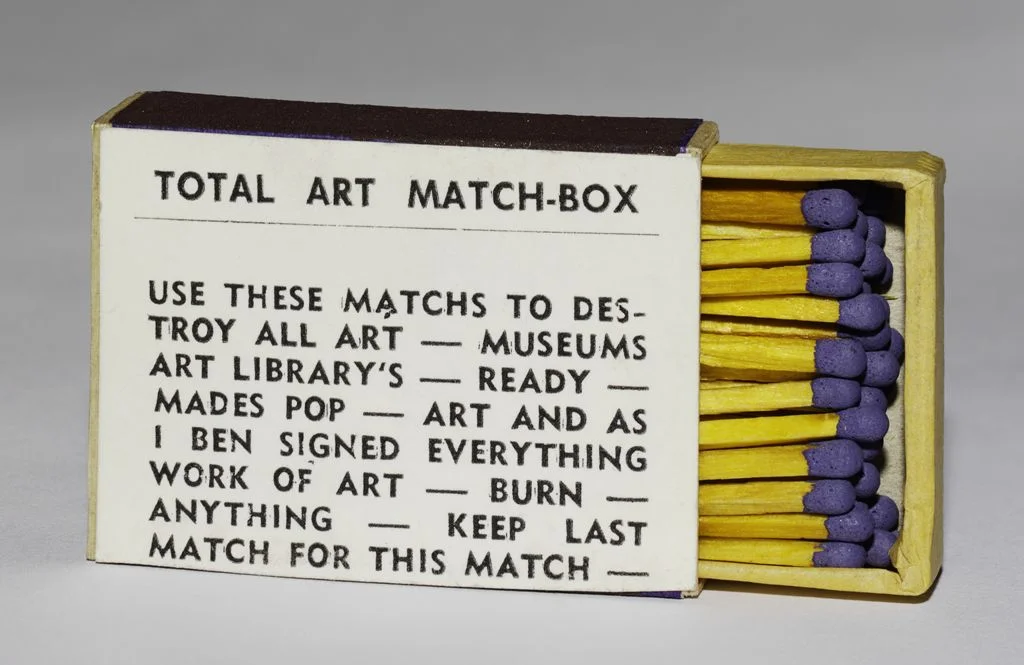 |
| Ben Vautier Total Art Matchbox (c.1965) |
From The Book of Form and Emptiness. While Benny's in the mental health floor (p. 121), Athena disrupts the other patients by putting notes for them to find in their belongings.
- Put your shoes on the table. Ask it what it wants from you
- Face a blank wall. Pretend the wall is a mirror
- Say good morning to the toilet. Thank it for taking all your shit
- Pretend you are very old. Move at half speed.
- Hug yourself and say I love you. Repeat until it's true.
- Walk like you're happy. Change directions.
- Be a pussy. Purr. Lick your beautiful fur.
- Regard the world as upside down.
- Make eye contact with your meds before you swallow them. Ask them, "Are you for real?"
- Do everything backward.
- Smile at someone you don't like. If they smile back, give yourself a point.
- Lie on your back on the floor and listen. Feel free to sing along.
We soon find out that this is "Fluxus, man. Subversive shit. They think she's a bad influence, taking the piss out of the system and not taking her own mental illness seriously."
From TheArtStory website:
Summary of Fluxus
Emerging in the 1960s and operating globally, Fluxus was an interdisciplinary and experimental approach to art that emphasized blending different artistic media and breaking down traditional boundaries between art and everyday life. Fluxus artists encouraged a playful and open-minded approach to art-making, creating a wide range of unconventional works, often using ordinary objects and actions to challenge traditional notions of art and engage audiences in interactive experiences. George Maciunas, the primary founder and organizer of the movement, described Fluxus as, "a fusion of Spike Jones, gags, games, Vaudeville, Cage and Duchamp".
While the vast majority of Fluxus artists conformed to some, if not all, of the main themes of the movement, many held contrasting ideals and different individuals viewed Fluxus in different ways, leading to significant variation. As filmmaker George Brecht stated, "In Fluxus there has never been any attempt to agree on aims or methods; individuals with something unnamable in common have simply coalesced to publish and perform their work." For some Fluxus artists, even the act of defining the movement was seen as restrictive and counterproductive to the spirit of their work. By resisting a clear definition, they maintained a commitment to challenging established norms and fostering a creative environment. This makes Fluxus difficult to define and some debate exists around which artists should be included in the movement.
Key Ideas & Accomplishments
- Unlike traditional art movements that compartmentalized different forms of artistic expression, Fluxus sought to break down these barriers and create a more interconnected and immersive artistic experience, integrating visual arts and literature with performance-based media including music, dance and theatre. In emphasizing elements of performance, they also legitimized the medium within artistic circles.
- Like the Futurists and Dadaists before them, Fluxus artists did not agree with the authority of museums to determine the value of art and they believed art was not only for the educated elite. Fluxus artists worked to dismiss and mock the elitist world of "high art" and to find ways to bring art to the masses through approachable artworks and the use of humor. Their irreverence for "high art" had an impact on the perceived authority of the museum to determine what, and who, constituted art and helped to change the balance of power in the art world.
- Fluxus works often relied on the element of chance to shape the ultimate outcome of the piece and one of the main ways this was achieved was through audience participation in artworks. This approach reflected a rejection of rigid artistic control and fostered a more interactive and open-ended experience, reflecting a broader, more inclusive approach to creativity.
Wednesday, May 8, 2024
When you read these words on a page
From The Book of Form and Emptiness.
Inside? Outside? What is the difference and how can you tell? When a sound enters your body through your ears and merges with your mind, what happens to it? Is it still a sound then, or has it become something else? When you eat a wing or an egg or a drumstick, at what point is it no longer a chicken? When you read these words on a page, what happens to them, when they become you? (51)
Tuesday, May 7, 2024
Unafraid of change

Writer and designer Edith Wharton, the first woman to win the Pulitzer Prize, on what causes old age:
“The producer of old age is habit: the deathly process of doing the same thing in the same way at the same hour day after day, first from carelessness, then from inclination, at last from cowardice or inertia.
Habit is necessary; but it is the habit of having careless habits, of turning a trail into a rut, that must be incessantly fought against if one is to remain alive… one can remain alive long past the usual date of disintegration if one is unafraid of change, insatiable in intellectual curiosity, interested in big things, and happy in small ways.”
Monday, May 6, 2024
3 Small shifts that make all the difference
 | |
| JMW Turner, anticipates Rothko |
"3 Small Shifts that Make All the Difference" - I came across that phrase while re-reading a Field Notes notebook, and it stuck with me. Underneath the phrase I listed:
- do meditation, but not guided
- conscious effort to follow through/finish
- move from complaint-based life to appreciation based
Something about it attracts my attention still. These are not "goals" or "priorities" or "new habits" (yet they're all of those things). They're not SMART goals.
Still, "all the difference" is probably right, especially for the last two.
These remind me of another idea I had recently of having a month one-word intention. The idea is that monthly there'd be another mantra. Maybe like a temporary tattoo on my forearm that I could use to remind myself. I guess I could make it appear on my lock screen. Here's my rough draft list from April 20, with no real notion of why these phrases during these months.
- Jan -
- Feb - attention
- March - kindness (clear presence)
- April - patience and determination
- May - gladness
- June - equaninity
- July - care
- Aug - east
- Sept - awake
- Oct - presence
- Nov - let it be
- Dec -
Recently I've been mouthing the words "one thing at a time" while I feel myself getting flustered. Maybe that's one, too.
Sunday, May 5, 2024
You already impose several limitations on your work
 |
| NYT Spot Illustrations on p. 3 |
NYT has spot illustrations on p. 3. Each one is part of a month-long series by an artist. This article details how the editors pick artists.
The illustrations don’t pair with articles, so aside from fixed size limitations, the only stipulation is that each “spot,” or small, free-floating illustration, features a newspaper in some way. Sometimes wholesome, often witty and whimsical and occasionally wacky (in the best kind of way), the spots inject personality into the page. Usually, the artist brings in a theme — vegetables reading the paper, characters made of thumbprints — that ties the monthlong series together. No matter the concept, the spots offer special moments of surprise and delight for our readers.
 |
| Jason Polan |
For much of the first year of the new pages, the artist Jason Polan provided the illustrations. His distinctive, intuitive line drawings included slice-of-life scenes and more silly spots, like a newspaper obscured by a quadruple-decker hamburger. Mr. Polan, who died at 37 in 2020, set the tone for what was possible with the space.
 |
| Bahij Jaroudi |
Bahij Jaroudi, who did last month’s spot illustrations, used fine and frantic line work to create a series of humorous characters. So this month, I wanted to feature an artist whose style was darker and bolder.
In the "First Draft section on page 3" there is a feature of this month's illustrator, Sophy Hollington

This month’s spot illustrator is Sophy Hollington, an artist from Brighton, England. After sketching her ideas on an iPad, Sophy creates her illustrations through a relief printmaking process called linocut. She carves her scenes in linoleum blocks, then applies a coat of ink to the block. Next, she presses a sheet of paper on the block, transferring the image to the page. I asked Sophy to shed light on her process. Our edited email exchange follows.
How long does it take you to complete a single spot illustration?
To carve one spot illustration in this series took about 20 minutes. Printing and scanning takes about 30 minutes, including getting out and putting away all the required gear. Editing takes about 5 minutes.
Why is it important to you to work this way, as opposed to achieving something similar digitally?
It’s something I’m always reckoning with to be honest … as it is a limiting and time-consuming process that feels more so as digital technology progresses. However, whenever I’ve tried other media, I find I’m not able to recreate the beautiful irregularity that this kind of printmaking creates. I think the limitations of using a medium like this also force my brain to work that much harder to figure out how to represent certain objects and portray scenes or narratives in a way that feel clear and concise. Put simply, it has completely shaped the visual language I use, and I get a huge sense of satisfaction from using an analog medium. I love that all of my work exists in the real world as both a carved object and a print.
What was the inspiration for your series?
I wanted to take the paper out of the domestic, everyday setting and in to another, slightly spooky and archaic world that also felt familiar and humorous.
You already impose several limitations on your work. Was incorporating the newspaper a welcome addition? Was there anything you found challenging about it?
I felt quite intimidated at the prospect of carving so many newspapers, which are honestly one of my least favorite things to represent in lino (fiddly, foldy, small lines etc.). Saying that, it got a lot easier as I progressed, and I really enjoyed the challenge of trying to find more unusual ways for the paper to be interacting with the illustration. Given that the rest of the spot could be about anything at all, it actually felt like one of the more liberating commissions I’ve ever worked on.
Subscribe to:
Posts (Atom)