
 |
| Gustav Klimt, Orchard, 1896 |
"Each time you do this, you're making a contribution to your well-being and health." This is Patrick Briody's closing on a guided meditation on Insight Timer.
The word "contribution" makes it sound like a bank account, a piggy bank.
It's how I've come to feel about eating, too. You eat wholesome things. Each time you do, it's a contribution to health.
I'm also beginning to feel this way about yoga, exercise (both cardio bike workouts in basement or weight lifting)
It's different than how I used to think of exercise or meditation. Rather than "contribution to..." it was something that I should do. It was an obligation, a checkbox, then a habit.
Seen in this way -- contribution -- many choices in life thru the day are seen thru this straightforward lens. Bike to work or drive? Yoga or couch after work? Chips or carrots? The chips can be seen not as a sin, a moral degradation, but simply as not a contribution.
Daily life can be seen as walking around selecting little good things (like finding $20 lying in the street). Throughout the day you select contributions as they appear in your consciousness (or calendar).
You can extend this thinking to emotional life... reacting in an angry manner to someone... not a contribution (for you or to the people around you). Do virtuous things because "they contribute to your well-being and health." Spread kindness. Be compassionate.
 |
| Kokei Kobayashi |
fallen blossoms
filling the bottom
of a garbage can
Issa
| Coach Lyndon Johnson with his Sam Houston High School debate team in Houston in 1931. Left to right: Luther E. Jones, Margaret Epley, LBJ, Evelyn Lee, and Gene Latimer. Photo courtesy LBJ Library and Museum. |
In The Path to Power, by Robert Caro
Johnson accepted a school teaching job in a Houston High School teaching public speaking and coaching debate. He "took on the task as though the future of America depended on what he taught those children."
The passage goes on to detail how he worked tirelessly and ingeniously to train a debate team that trains and travels and wins the city debate championship for the first time.
He was relentless in training students. One student said "He made you feel important just because he's nagging at you so much. He's throwing his whole self into improving you." Another student said, "He did that job as if his life depended on it."
The passage describes his techniques, like asking every student, on the first day,
to stand in front of the class and "make noises" for ten seconds... any noises. The next day it was thirty seconds and the noises had to be animal noises: roar like a lion, quack like a duck. "He was trying to get people to feel comfortable on the podium, to make the whole thing such a game that no one would feel embarrassed. He'd do it with smiling and laughter to make you feel at ease ' Everybody's going to do it, so don't worry about it-- just have fun.' And we did. Even the shy kids did. There was a feeling that we're all comrades, we're all going to be doing these silly things, so we were all together in it. And everyone would laugh." Then came speeches -- first, thirty seconds, "very short, and on so limited a topic that you wouldn't be scared." Then a minute, and then five minutes. Speech no longer extemporaneous, but prepared, and prepared thoroughly. "I have a memory of an enormous number of assignments," says one student. "And he was terribly strict about you doing them." Says another: "We had to do more reading for Mr. Johnson's courses than all the rest of my courses combined."
I love the phrases that describe LBJ's spirit -- "as though the future of America depended on what he taught the children" and "did that job as though his life depended on it."
It reminds me both of Ada Limon's poem "The Other Wish," ("what's your brilliant, glaring wattage?") and John Kabat-Zinn's regular meditation instruction to breath with intention and purpose "as though your life depended on it... because it does."
 |
| Tim Urban |
Tim Urban writes (and illustrates) in New York Times article, "How Covid Stole Our Time and How We Can Get It Back."
That’s one box for every week of a 90-year life. It often feels like we have countless weeks ahead of us. But actually, it’s just a few thousand — a small-enough number to fit neatly in a single image.
Once you visualize the human life span, it becomes clear that so many parts of life we think of as “countless” are in fact quite countable.
I love going to the American Museum of Natural History, and I’ve been three times since I moved to New York in 2009. If that rate continues, I’ll step into the museum 12 more times. For an activity I think of as “something I like to do,” that number seems shockingly low.
Urban goes on to say that this is the Depressing Math of many things, but especially about relationships. Once we move out of the house and away from high school friends, there are a very limited number of times we'll spend time with them.
However, he also shares this graphic:

We think a lot about those black lines: the roads not taken, the opportunities missed, the ones that got away. But most of us greatly underestimate the size of the lush green tree of possibilities that lie ahead of us.
We underestimate future possibilities for the same reason we overestimate the time we have left with those we love: our intuition is not very imaginative. It’s a human instinct to believe the life we’re used to is how things will always be, both the good parts and the bad.
Wallowing in regret carries an implicit assumption that we had agency in the past — that we could have had those other life paths if only we had made better decisions. When we think about the future, though, that feeling of agency often disappears, which can leave us feeling resigned and even hopeless.
He concludes:
But the life we’ll be living 10 years from now will largely be determined not by our past selves but by our present and future selves. If we imagine what we might regret down the road, it’s very much in our hands to do something about it now.
This is the good news about being a human. The time we have left with family and friends is not a law of nature like the weeks we have left to live. It’s a function of priorities and decisions.
At our current pace of 10 to 15 days per year, my parents and I have at best a couple of hundred days left to hang out. But there’s nothing stopping us from changing that equation. Agreeing upon an additional annual family week each summer would almost double our remaining time together, while moving to the same city could multiply it by 10. Getting together with my friends one weekend a year would triple our pace and leave us with 15 percent of our total hangout time ahead, instead of just 5 percent. If the thought of only 12 more Museum of Natural History visits makes me sad, I can start going once a year and magically transform that number to 50. That big green tree is a reminder that we have the power to change so much of what seems set in stone.
These two delusions — that we have countless time ahead of us and that we can’t change our course — are a recipe for complacency. Shedding them can wake us up and inspire us to live more wisely. The past couple of years has left us with a joy deficit. When we picture a post-Covid world, we imagine having our old lives back. But we can actually go a step further and make up for the missed experiences, flipping the deficit into a surplus. If Covid has given us anything, it’s a rare chance for a reset. Let’s take it.

ADULT IMPACT: you might struggle with or fear conflict. You may not know how to take responsibly for your own behavior, or become extremely emotionally activated when things don't go as planned.
When you experienced something hard or stressful, a parent always made the issue about them or how it made them feel or how it affected their own life
ADULT IMPACT: you might struggle with empathy (the ability to put yourself in another persons perspective), might center conversations around your experience, or chronically give unsolicited advice.
Your parents confided in you about their relationship problems, sex life, or work issues when you were a child because they didn't understand that wasn't appropriate developmentally.
ADULT IMPACT: you might struggle with boundaries, may overshare information, or take on a "caretaker" or "therapist" role in your relationships.
You feel very frustrated + like things are one sided when you talk to them (ex: you share something important to you + they change the subject or talk about themselves)
@the.holistic.psychologist
ADULT IMPACT: you might find yourself in relationships with people who are emotionally unavailable or dismissive because you've never had relationships with people who were able to meet your emotional needs or hold space for your own experiences.
A parent regularly invalidate your feelings or experiences "well, some people are starving" "could be worse" "that didn't actually happen.
ADULT IMPACT: because your reality has been consistently invalidated, you might struggle with trusting yourself.
Your parents have told you that you "owe them" or that you need to do things for them because they sacrificed to raise you. They regularly use guilt or shaming.
ADULT IMPACT: you might become a chronic people pleaser or feel a lot of pressure to meet your parents needs (something you've done since childhood.)
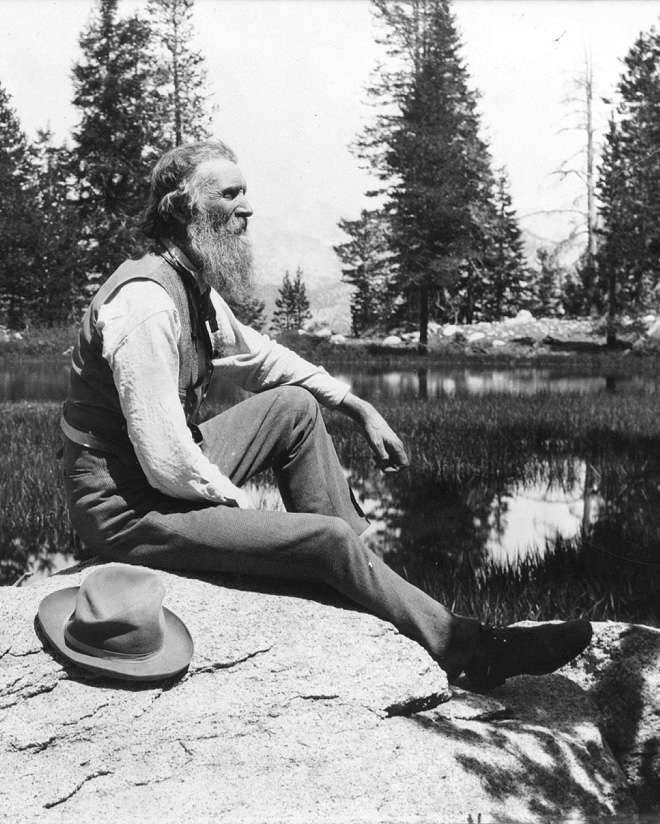
―
John Muir
b. 21 April 1838
“I bade adieu to all my mechanical inventions, determined to devote the rest of my life to the study of the inventions of God.”
—John Muir, born this day in 1838, on rejecting his technological pursuits, in which he was quite accomplished, and turning his attention to nature

I love this bit of phenology! The calendar is a diagram showing -- for lots of different trees -- there is "budburst," "first leaf," "first fruit," and "autumn tinting."
Also at this site, a calendar for a month of interacting with nature.
Rumi says:
Love is the bridge between you and everything.
What does this mean? It could mean (a) that without love, there is no bridge... we have to shout at things across the chasm. It could mean (b) that when we are connected to something/someone (curious, interested) that connection is the definition of love.
Martin Buber says:
All real living is meeting.
Martin Buber says:
Marriage, for instance, will never be given new life except by that out of which true marriage always arises, the revealing by two people of the Thou to one another. Out of this a marriage is built up by the Thou that is neither of the I’s.
Adam Grant says:
The hallmark of a caring relationship is valuing each other's success and well-being as much as your own. Interactions are guided by generosity, not reciprocity. You give without obligation and ask without hesitation. You amplify each other’s sorrow and amplify each other’s joy.

Sydney wasn't the city I remembered. But the people I loved were still there, and we celebrated birthdays, weddings and anniversaries. When the sun came out, we lay in it. I listened to the sounds of native birds, trying to bottle it up for the next year.
 |
| Gustav Klimt, Mada Primavesi, 1912 |
“As human beings, our job in life is to help people realize how rare and valuable each one of us really is, that each of us has something that no one else has – or ever will have – something inside that is unique to all time.”
~ Fred Rogers

Atlasing makes people notice more about birds.
This spring, I’m not just casually watching the birds while gardening. I am “Atlasing,” noting any breeding behaviors I observe and sharing them, as part of New York State’s third Breeding Bird Atlas. Like parallel surveys in many other states, this is a five-year-long undertaking conducted every 20 years to give conservation decision makers the information they need about bird populations and locations.
“Atlasing makes people notice more about birds,” said Dr. Schneider, the author of “Birding the Hudson Valley,” about the lives of the region’s birds and where to see them. “You have to really watch them — not, ‘Oh, it’s a robin,’ but what it does.”
To that end, there are 23 behavior codes to choose from, to qualify each entry recorded.
For example: C, for courtship behavior. That’s how I marked my cardinals and that insistent mourning dove chasing his target. A week later, I checked P, for pair (as in, they’d paired up), when I saw two doves, side by side, preening — nuzzling and almost nibbling the feathers at each other’s head and neck.
Birding with a purpose - link
Breeding atlas - link
In the Q&A session, at about the 33 minute mark, the woman says:
I just hope that one day I can share with others what I have found.
JKZ responds:
You already are. I'm not kidding around. Two or three thousand people just heard what you said and felt it and were part of this interchange between you and me.
So, your being is already doing that. And It's not a job; it's a Way (with a capital W) of being. And when you are aligned with that true nature in yourself, you are affecting people 24/7. You don't have to become a MBSR teacher or be a psychologist or have a credential.
Just remember that, don't get caught in the conventional aspiration because what you are and what you want is probably already here, at least in maximal potential and then how it manifests that partly depends on how you're seeing it.
We bow to you and thanks for raising your hand.
Three things that I'm chewing on
The Norwegians have a phrase that encapsulates the difficulty of starting a journey. Those masters of tough expeditions have put a name to the struggle of setting out from your warm, comfortable, familiar house into the cold, uncomfortable, frightening outdoors.
You are snuggled in front of the fire with your beautiful blond lover, and the prospect of leaving the comfort of your home, walking out the front door and beginning is not at all appealing. Imagine leaving all this behind and stepping out into the cold, dark, swirling snowstorms to begin a long and difficult journey. This is not an easy thing to do, and yet you know you must begin.
The Norwegians refer to this moment as the Dørstokkmila — the Doorstep Mile.
The Doorstep Mile, the Norwegians say, is the longest mile of any journey. Crossing the threshold and beginning.
And yet it is nothing more than one single step.
the Scandanivian word for ‘The Doorstep Mile’. This is a word I first came across when watching this brilliant talk by Alastair Humphreys,
The antidote to contempt is to build a culture of appreciation and respect in your relationship.
One way is by practicing Small Things Often. If you regularly express appreciation, gratitude, affection, and respect for your partner, you’ll create a positive perspective in your relationship that acts as a buffer for negative feelings.
Another way is to show and verbalize regular appreciation and admiration for your partner. Look for ways of letting the other person know that they are important and valued, focus on what you cherish in each other and share those thoughts regularly, and show affection on a regular basis.
A third way to build a culture of appreciation is by having more positive interactions in your relationship than negative ones. Dr. John Gottman terms this the “magic ratio” or “the 5:1 ratio” and uses a banking metaphor to describe it. Essentially, if you have five or more positive interactions for every one negative interaction, then you’re making regular deposits into your emotional bank account, which keeps your relationship in the green. The bottom line: focus on creating more positive interactions with your partner.
Gottman Institute:
Here’s a few ways to boost the fondness and admiration in your relationship:
Adaptation

It was, for a time, a loud twittering flight
of psychedelic-colored canaries: a cloud
of startle and get-out in the ornamental
irons of the rib cage. Nights when the moon
was wide like the great eye of a universal
beast coming close for a kill, it was a cave
of bitten bones and snake skins, eggshell dust,
and charred scraps of a frozen-over flame.
All the things it has been: kitchen knife
and the ancient carp's frown, cavern of rust
and worms in the airless tire swing,
cactus barb, cut-down tree, dead cat
in the plastic crate. Still, how the great middle
ticker marched on, and from all its four chambers
to all its forgiveness, unlocked the sternum's
door, reversed and reshaped until it was a new
bright carnal species, more accustomed to grief,
and ecstatic at the sight of you.

by Ada Limon
I love how this poem piles together a series of elaborate and starling metaphors for the heart. The range of metaphors recreates the range of things we feel in our hearts: colorful flutter of birds, an empty cave, knife, fish frown, cave filled with rust and worms, cut-down tree, dead cat in a plastic crate. The heart feels all of these things! The poem plays on the medical term of adaptation... hearts adapt to different conditions, get stronger, more able to pump oxygen. In this poem it becomes "a new/bright carnal species" that is both "accustomed to grief" and, at the same time, "ecstatic at the sight of you."
The Three Stages of Flabbiness (edited from Alastair Humphrey's newsletter)
There are three stages of flabbiness in life, I realised years ago. Each stage of flabbiness is more restricting and stifling than the one before it. They creep insidiously over me like vines until it takes one hell of a struggle to escape their clutches.
If ever I feel the saggy symptoms of flabbiness snuffling up on my life then I know it is time to hit the road. Only once I acknowledge the problems am I able to take the first small step towards fixing them and getting back on track with living adventurously.
The first stage of flabbiness, and the easiest to fix, is physical flabbiness. It begins when busy schedules, dark winter days and eating too much win the devil’s footrace against the part of me that knows that exercise isn’t a waste of time but actually makes me more efficient, alert and happy. Despite knowing this I am still at times sufficiently idle to let my standards slip and my fitness slide away. Fitness is like chasing a shoal of fish: difficult to get hold of, so easy to lose.
If I don’t go running for a few days, I feel cooped up and ratty. Leave it a few more and the habit is broken. I know I need to run. I want to run. But I just can’t be bothered. Flabbiness has begun to set in, slowly, invasively, like cataracts. Before I know it I am easing out my belt buckle and blaming my sloth on the effects of age.
The second stage is mental flabbiness. Give up exercising, stop forcing myself out the front door for a run and inevitably my mind starts to sag too. I used to feel alert and inquisitive. I used to read lots of books. But one evening I come home tired. Flopping down onto the sofa I reach for the television remote instead. Suddenly I am gripped by light entertainment. I realise how pleasant life can be if I stop thinking about it.
It is much simpler to exist than to live. I’ve got a dishwasher and a coffee percolator and I can drink at home with the TV on. I flick round and round the channels until I have frittered away enough of my life that it’s time to go to bed.
Each day brings me closer to my death. No matter how aware I am of this, it is sometimes difficult to believe my days are numbered. I burn carelessly through weeks, even months, unable to restart living fully. I don’t know when I will die, so putting important things off to an indeterminate date in an un-guaranteed future is pretty daft. There are so many places I still want to see, so many interesting people to meet, so much to do. And there is so little time. Before I know it I’ll be dead and what a bloody waste that will be if I’ve just been arsing around.
By the time I have succumbed to the debilitating onslaught of the first two stages of flabbiness, I am already well on the primrose path to moral flabbiness. Not only have I conceded my physical health and settled for candy floss in place of a brain, but I have also accepted that this is good enough for my life. This is ridiculous because I know that I am happiest when I have a sense of purpose. Instead, I have become comfortably numb.
I have decided that scrolling through social media with a Chinese takeaway is sufficient return for the privilege of being born, healthy and intelligent enough, in one of the richest, most free countries on the planet.
I have a passport to explore the world. I will always be able to find some sort of work. I will never starve to death. It’s hard really for me to come up with any decent excuses.
The choice is all mine.
Life is too brief and too rich to tiptoe through half-heartedly, rather than galloping at with whooping excitement and ambition. And so I explode with outrage just in time. I need to get back into the wild. It is time to live deeply once again.
It is time to sort my life out.
This can be done in two ways.
I either jump in the nearest cold river for a bracing swim, or I make a plan, set a start date and, come what may, begin.
 |
| Estate of Jordan Belson and Matthew Marks Gallery |
From NYT: What to see in NYC Galleries Right now:
The exhibition of Jordan Belson’s collages may be titled “Landscapes,” but its true subject is light. Best known as a filmmaker who tried to represent interior states in mandala-like shapes and strobing color, Belson, who died in 2011, has become an almost mythic figure of cinema because of the scarcity in digital formats of his experimental films from the 1960s onward. But the collages here, all made from 1970 to 1973, seize the potential of reflected rather than projected light. Belson first trained as a painter, even showing at the Guggenheim Museum in the late 1940s. For the collages on view, all untitled, Belson followed the centuries old Japanese practice of chigiri-e, using torn colored paper to create seascapes, nested hillsides and backlit dawning ridgelines. The compositions recall Etel Adnan’s lyrical paintings, but the effect, despite the humble materials used, brings to mind the California Light and Space movement of the 1960s and ’70s. (Think James Turrell in miniature.)
Cheryl Strayed, in Wild, reflects on how horrible the last days of her mother's life were. She's dying of cancer, begging for morphine, and transforming into someone she doesn't recognize. Yet, while she's reflecting on that time, she'd give anything to get back to that time of her basic presence and aliveness, despite the horrible changes and pain, rather than the reality of absence.
The war in Ukraine slogs along. The Russian position becomes weaker. Stories of atrocities of the Russian army -- from the possibly terrible (shelling of apartment buildings) to barbaric (individual soldiers binding civilians hands behind their backs and shooting them) multiply. I find myself wondering: when the war is over, how are things set straight? How will there be justice? There are sanctions, there is jail time... but how do you account for any single lost life? The basic factness of life. The basic disjunction of life or no-life.
On the internet, people trying to be helpful to the general population say things like: have one thing that you'll look forward to! Even if it's just a cup of coffee. Panda planner asks users to think of three things in their day that they look forward to or will make their day special. The truth is that I use that same technique each morning and often struggle to make a list of three things.
And that seems so pathetic... one thing? And the rest of the day is what.... misery? drudgery?
Today, Kate at work said “I keep telling myself - you can make it through the day. But for what? To make it through the next day?”
Surely, when confronted with "basic life" questions like Strayed writes about, a day of work at the office would seem like winning the lottery, a series of boons and privileges.
And I think of Thich Nhat Hahn: enjoy washing the dishes. Or the poem by X: Everything is blossoming.
Leo Babutua uses the phrase “being lit up” to describe this sense of being alive constantly. .
Recently I wrote about a few strands coming together about happiness (The Difference Between Happiness and Distraction from Sadness). Recently I also reflected on the idea of reframing.
How did we get here?
How do we get to a place where we can be lit up, activated to the basic goodness of life, of relationships, of the natural world? And be lit up constantly?
Recent Tweet:
There’s a difference between being happy and being distracted from sadness
Reminds me of Jeff Tweedy on "Disappearing."
And about the tweet I came across that was like
"What is a non-food, non-alcohol, non-weed way that you reward yourself?"
and about "the real job of artists is to know what they like"
From Adam Grant's newsletter:
When psychologists study emotion regulation, they often highlight two effective strategies: distraction and reframing. Anger is a full frontal assault on your amygdalda. You try to warn someone, “You wouldn’t like me when I’m angry,” but a split-second later you’re stomping around: “Hulk smash!” Anger makes distraction difficult. It narrows your focus to the person who’s wronged you, to the point that it’s hard to shift your attention to anything else.
Reframing isn’t a cakewalk, but it’s what I find most helpful when I start fuming. My first instinct is to ask, “How do I engage my prefrontal cortex?”
Kidding. Not even neuroscientists think like that.
Reframing begins with recognizing that although you can’t control the event, you can change your interpretation of it. When drivers cut her off on the road, emotion expert Sigal Barsade reframed it by imagining that they were on the way to the hospital for an emergency. But rethinking the other person’s behavior isn’t the only option. You can also look differently at your own response.
Anger isn’t an irrational emotion. It doesn’t stem from the absence of logic—it rises up from the presence of threat or harm. Getting mad is a signal that something important to you is at risk. Understanding what makes you angry is a prism for understanding what you value.
When the insults came in, I asked myself what principle was being threatened. There were at least three. Status: I’m sensitive to signals of social rejection, and this felt like middle school all over again. Competence: one of my core missions in life is to share knowledge, and now my judgment was being questioned. Freedom: my intellectual autonomy matters deeply to me, and there were other people trying to dictate whether I had a voice.
Suddenly I felt relieved, not mad. I should thank my lucky stars that it’s not up to them to judge my competence or decide my freedom! So why am I giving them power over how I feel?
That’s a question we could all ask more often when we get angry. Has this person earned the right to dictate my emotions? If not, it might be time to return to sender.
Once I recognized the roots of my anger, it started to melt away. Yes, I care about being respected and liked, but do I really care what someone who stoops to calling me an asshat thinks of me?
Adam Grant's newsletter:
Bob taught me a technique for dealing with assholes that I’ve adapted to people who have dramatically different views. When you find out someone holds beliefs that you see as wrong or offensive, you think of yourself as a galactic anthropologist who’s just discovered alien life. You say to yourself, “Wow, what a fascinating specimen!” Instead of pure outrage at their opinions, you start to get curious about how they arrived at those opinions—and what would motivate them to change them. Which leads to a much more open-minded conversation.
From Adam Grant newsletter:
Some of my go-to resources on asking better questions:
- You’re Not Listening by Kate Murphy
- The Right Question Institute
- A More Beautiful Question by Warren Berger
Open up opportunities for deeper connection by asking meaningful, open-ended questions. And don’t forget to listen to understand when your partner answers.
Everything is Plundered

Everything is plundered, betrayed, sold,
Death’s great black wing scrapes the air,
Misery gnaws to the bone.
Why then do we not despair?

By day, from the surrounding woods,
cherries blow summer into town;
at night the deep transparent skies
glitter with new galaxies.

And the miraculous comes so close
to the ruined, dirty houses -
something not known to anyone at all,
but wild in our breast for centuries.

~

By: Anna Akhmatova


