Sunday, August 31, 2025

Middle Season #22- 2025


 Pincushion flower that is blooming by the patio near the fireplace.  I bought it in the spring already bloomed, and this is an additional treat.  Top right: Lobelia siphilitica, the great blue lobelia,[3] or blue cardinal flower (because it's often planted next to red cardinal flower).  The name comes from the thought that it would cure syphilis.  Next, my pansies, vibrant once more.  

Saturday, August 30, 2025

Friday, August 29, 2025

I like spending time with you* Pansy in the shade*

same plant, same camera... different colors

I like spending time with you*

From James Clear: 

Don't just tell your spouse that you love them–tell them why you like them. Point out the qualities that make them fun to be around, the parts of their personality that shine, the little moments you genuinely enjoy together. ‘I love you' matters, but so does ‘I like spending time with you.'

Pansy in the Shade*

The photos at the top: the left side was taken in the morning, in the shade.  It's an alluring color.  The right side was taken a few days before in the sun.  Also a pretty color and intense.  I'm almost totally positive that it's not "faded" color... just acting differently in the sun and shade.  Curious!

Thursday, August 28, 2025

Mental Screen* Subdue and Conceal Elements of His Nature*

Marigold is currently thriving, vibrant

Mental Screen* 

I found out that the online version (not the app) of Insight Timer has a script for each meditation.  Here's Shinzen Young in Insight Timer - title: Thoughts and Emotions

Lengthen your spine and relax your shoulders and arms.

At any given instant, You may be thinking about a person,

Place, Object, Memory, Plan, Or fantasy.

If so, You'll probably notice a mental image.

Sometimes mental images can be vivid like the material world or a photograph,

But more often they appear as vague, Fleeting impressions of form.

Most people see mental images in front of or around their eyes.

We'll call this area your mental screen.

Bring your attention to your mental screen and notice if you're experiencing any mental image.

If you are, Great. Be aware you're having a visual thought. If you're not, Great.

Enjoy that as a restful experience.

Your mental screen may be quite active with images or pleasantly blank and restful.

Either is natural, Either is fine. Just keep track of whatever's happening.

If your attention wanders to other experiences,

Like mental talk, Sounds, Or body sensations, That's okay.

Just let those distractions come and go in the background and bring your attention back to your mental screen.

If you're experiencing mental images and they're pleasant,

Enjoy that. If they're stressful, Try to view them with detachment.

This will train you to watch your mind like a spectator watches a parade.

You appreciate what you're seeing,

But you aren't caught up in it.

If you're having difficulty detaching from stressful mental images,

Try taking a few deep breaths or relaxing your whole body or putting a slight smile on your face.

Now, Let go of that and bring your attention to the space where you hear mental talk.

Most people hear mental talk in their head or around their ears.

We'll call this area talk space.

At any given instant,

You may be aware that you're hearing mental talk,

Such as an inner monologue or dialogue.

Or you may be aware that there's no mental talk. Either is natural, Either is fine.

When there's mental talk, Listen with detachment.

When there's no mental talk, Enjoy that mental quiet as a restful state.

If the mental talk lasts, Continue to listen.

If it disappears as soon as you notice it,

Get interested in what comes next.

Maybe you'll hear another burst of mental talk.

Or maybe you'll hear mental quiet.

Now, Let go of that and bring your attention to your body.

We're going to explore the presence or absence of emotional sensation in your body.

By emotional sensations,

I mean things like anger, Fear, Sadness, Impatience, Joy, Humor, Love, Interest, And so forth.

Many people feel emotions in their belly, Chest, Heart, Throat, Or face.

But you may experience them anywhere in your body.

If you notice emotions, Great. That's part of the richness of life.

If you're free of emotions,

That's great too. Enjoy that as a restful state.

It's all natural. It's all good.

If you notice emotions and they're pleasant, Enjoy them.

If they're stressful, Do your best to soften around them.

You can learn to relate to emotional sensations the way you relate to the sensations of physical stretching.

If you don't fight with the stretch,

You can feel yourself developing flexibility.

In the same way, If you don't fight with emotional sensations,

You can feel yourself developing flexibility.

If you don't fight with emotional sensations,

You can feel yourself building emotional resilience.

If you're having trouble opening to stressful emotions,

See if there's a place in your body where the emotion is less intense and try opening up to that.

With time, This may lead to a spontaneous softening in the more intense areas.

If your attention wanders to other experiences like thoughts or sounds or non-emotional body sensations,

Gently return to tracking the presence or absence of emotional sensation in your body.

The next time you're stressed,

Try focusing on your mental screen or on talk space or on your emotional body,

Even if it's just for a few seconds,

And see if the stress bothers you less.


Subdue and Conceal Elements of His Nature*

LBJ

Yet, obvious as may have been the necessity for subduing these qualities, for him to subdue them must have been very difficult. They had not, after all, been eliminated from his nature. They were still there, powerful as ever—as will be seen, all too clearly, in the next volume of this work. Lyndon Johnson had grasped in an instant what needed to be done with Kennedy's men and Kennedy's legislation: his insight into the crisis and the rapidity of his response to it a glimpse of political genius almost shocking in its acuity and decisiveness. But the genius in knowing what he needed to do was no more vital in the crisis than the self-discipline and strength of will that enabled him to do it. Accomplishing what was needed required him to subdue and to conceal elements of his nature that he had never before concealed or subdued — elements so basic to his personality that they had, in fact, governed his behavior during all of his previous life.

Yet he subdued them, overcame them, in a triumph not only of genius but of Will p 603. The passage of power


Wednesday, August 27, 2025

Kiwis*


NYT - Kiwi's could be perfect snack

Kiwis*

This image looked great in black and white in the paper.  I thought it would make a nice watercolor project.  I was hoping that it would be more green.  Also learned in the article that Kiwis have as much Vitamin C as a clementine or half a grapefruit, 2 grams of fiber and 150 mg of Potassium (bananas have 400). 

Tuesday, August 26, 2025

Sunday, August 24, 2025

We can’t make it unless we do* Hypnosis with Dr. David Spiegel*


We can’t make it unless we do*

From Passage of Power by Robert Caro.  Explaining (one of the reasons) why LBJ was so firmly behind creating a "War on Poverty."  (As always in the book, he lays out a number of reasons. )

But part of the explanation was, as always with Johnson, something more, something that had to do less with strategy than with memories. The ranch, with the pathetic frame house and the road across the river, was, after all, an appropriate setting for him to be thinking about poverty. And allusions in his conversation both in person and over the telephone-sentences, phrases, reminiscences-allusions that started to be heard as he chatted on the plane ride down to Texas, and that continued to sprinkle his speech during the two weeks on the ranch, show now fresh his youth was in his mind during that time. Talking to reporters on the plane about the federal budget, he had suddenly stopped and begun talking about himself. "T've always been an early riser," he said. "My daddy used to come to my bedroom at four-thirty in the morning when I was workin' on the highway gang, right out of high school, and he'd twist my big toe, real hard so it hurt, and he'd say, 'Git up, Lyndon, every other boy in town's got a half hour's head start on you.' " Making an early-morning call to an old Hill Country ally E. Babe Smith of Marble Falls, he said he hoped he hadn't woken him up-and then said he was sure he hadn't because Smith had been "a poor boy," too, and therefore must have been getting up early all his life, as he himself did. "That's the only way we can keep up," he said. "Otherwise, they're too far ahead of us." Other old acquaintances recall similar early-morning calls from the Johnson Ranch that vacation. "We always get up early, don't we?" he told Fredericksburg attorney Arthur Stehling. "We can't make it unless we do." And at the age of nine and ten he had worked beside his cousin Ava, hauling the heavy bags of cotton, their backs stooped over in the burning sun, Ava to whom he had whispered as they worked, "Boy, there's got to be a better way to make a living than this.  There's got to be a better way." Asked by the author twelve years after that Christmas trip what she and Lyndon had talked about that Christmas, Ava said she didn't remember, except that they had reminisced about their youth, and about the cotton picking. Whenever she and Lyndon reminisced, that subject came up, she said. "We always talked about the cotton. We just [had] hated that so much."  (542-543)

I chose this because it shows both the importance of early life and memories (by this point, Johnson was a multi-millionaire).  It also shows the sense of union/affiliation he has with the poor.  And that the solution was not IQ nor craftiness but hard work, labor.  That sense of hard work overcoming problems is one of the key threads that runs through the biography. 

Hypnosis

Dr. David Spiegel - Tim Ferriss - link

First, from the end of the interview: But it’s this misunderstanding that the body is just like a broken car, you’ve just got to incision, ingestion, or injection, you’ve got to do something to the body rather than teach the person to use the control system that we’re all born with, this three-pound object at the top of our shoulders that is connected to every part of the body and helps to control it. And why on Earth shouldn’t we be able to use that better? It doesn’t come with a user’s manual, so you’ve got to figure out how to do it, but it makes a huge difference. 

Here's the hypnosis

So get as comfortable as you can. On one, please do one thing. Look up all the way up high as you can. Two, do two things slowly. Close your eyes and take a deep breath. And three, do three things. Let the breath out. Let your eyes relax, but keep them closed and let your body float. Imagine you’re floating somewhere safe and comfortable, like a bath, a lake, a hot tub, or floating in space. And then take your right hand and stroke the back of your left hand, starting with the tip of your left middle finger — 

Tim Ferriss: In my lap?

Dr. David Spiegel: Or you can put it on the table. That might be better. Now stroke the back of your left middle finger down along the back of your left hand, past your wrist to your elbow. And as you do that, develop a sense of tingling and numbness and lightness, and let your left hand float up in the air like a balloon. Feel the tingling. That’s good. And let it float up. You bend your elbow and you can rest your arm lightly on the table. And please describe what physical sensations you’re aware of now in your left hand and arm.

Dr. David Spiegel: And I’m going to give you this instruction. If you pull your hand back down to the table with your right hand and then let go, it will float right back up to the upright position to see what happens. That’s good. So you’re putting it down, now, let go. I see you smiling. What’s happening?

Tim Ferriss: Well, it feels like it’s floating. Number one. I’m also second-guessing myself because I wonder if I’m doing this to conform to the exercise, if that makes sense. But it feels like it’s floating.

Dr. David Spiegel: Okay.

Tim Ferriss: Yeah.

Dr. David Spiegel: And as you do that, let your left hand remain upright. Later, when I ask you to touch your left elbow with your right hand and let go, your usual sensation and control will return.

How would you rate the discomfort level right now on that zero to 10 scale?

Tim Ferriss: 0.5, one out of 10.

Dr. David Spiegel: One out of 10? 0.5 to one. Okay, good. So already notice how you’ve been able to change sensation, not just in a neutral part of your body, your left hand and arm, but in a part that has been problematic. Now I want you to imagine now that you’re lying on your belly, maybe with a roll under you and feel a pleasant, tingling numbness in your lower back as if it were cooler or warmer, or you were changing it from warmer to cooler. Feel a pleasant, tingling numbness and let it filter the hurt out of the pain. Each breath deeper and easier. Now again, with your eyes closed and remaining in the state of concentration, please describe how your body’s feeling right now.


Tim Ferriss: It does feel cooler.


Dr. David Spiegel: Good.


Tim Ferriss: It feels a little dissociated, if that makes sense?


Dr. David Spiegel: Can you describe that a little more?


Tim Ferriss: Feels like it’s very similar to two tequilas.


Dr. David Spiegel: There you go.


Tim Ferriss: Or a low dose of ketamine, which I don’t recommend, but I mean, as a dissociative anesthetic, I’ve always struggled to put words to the dissociative experience. There’s a lightness and there’s a conscious awareness of the body without being as identified with the body.


Dr. David Spiegel: Exactly. So you can observe it, but it feels different. And would it be fair to say that it’s not as annoying as it usually is?


Tim Ferriss: It’s not as annoying.


Dr. David Spiegel: Good. So notice how you’re able to filter a lot of the discomfort and displeasure out of the usual pain situation by detaching from it, by experiencing it differently. It’s not a sentence you have to endure, it’s a sensation your body is giving you that you can interpret in different ways.


Tim Ferriss: Now, for people who might wonder if this is compartmentalizing in a way that is long-term harmful, I’m not saying that’s what it is, but is this just taking a different vantage point? How would you encourage them to think about this?


Dr. David Spiegel: Yes, I would say it’s reinterpreting the sensations and signals that you’re getting from that part of your body and you’re uncoupling them from the usual sense of annoyance and limitation that tends to actually make it worse.


Tim Ferriss: Oh, it a hundred percent makes it worse.


Dr. David Spiegel: Yeah. And instead you’re saying, “Okay, it’s there. I don’t like it, but it’s not bad.” And that capacity to reframe, to reprocess the signal is a powerful way of better managing pain. You’re filtering the hurt out of the pain. Now please take your right hand and touch your left elbow and then let go and see what happens to your left hand and arm.


-

And as I mentioned, there are studies that show you can turn down activity in the anterior cingulate, you can turn down activity in somatosensory cortex. So the brain is saying, “This is not as bad as I initially thought it was, and I don’t have to pay as much attention to it. It doesn’t have to hurt me as much.” Because very often we amplify pain rather than diminish it by being so annoyed that it’s happening.


and it was on my pediatrics rotation at Children’s Hospital in Boston. The nurse says, “Spiegel, your patient is in room 342, she’s in status asthmaticus, she’s been hospitalized every month for three months, and she’s back again, and she hasn’t responded to epinephrine twice, and we’re going to maybe give her general anesthesia and put her on steroids.”


So I walk in the room following the sound of the wheezes down the hall, pretty 15-year-old girl bolt upright in bed struggling for breath, knuckles white, mother standing there crying. I didn’t know what to do, but I had taken a hypnosis course. So I said, “Well, would you like to learn a breathing exercise?” She nods. So I get her hypnotized and then I break into a sweat and I think, “Wait a minute, we haven’t gotten to asthma in the course.” So I said something very subtle and clever. I said, “Each breath you take will be a little deeper and a little easier.” And within five minutes, she’s lying back in bed. She’s not wheezing anymore, her mother stopped crying, nurse runs out of the room.


And if you think about the dynamic of that, I mean, it was stunning to me, I couldn’t believe it. But each time she tried to breathe and had trouble, she got more and more anxious, she thinks, “I’m going to not be able to breathe,” it’s very frightening. So you have her anxiety building like a snowball rolling downhill on top of the physical sensations. So in comes my intern, and I thought he was going to pat me on the back and say, “Good for you.” He said, “The nurse has filed a complaint with a nursing supervisor that you violated Massachusetts Law by hypnotizing a minor without parental consent.” Kid you not. And Massachusetts has a lot of dumb laws, but that is not on the list. Furthermore, her mother was standing next to me when I did it. He said, “Well, you’re going to have to stop doing this.” And I said, “Oh, really? Why?” He said, “Because it could be dangerous.” And I said, “You’re going to give her general anesthesia and put her on steroids and my talking to her is dangerous?” I don’t think so. So I said, “Tell you what, as long as she’s my patient, I’m not telling her something I know isn’t true. So take me off the case if you want.” So, he storms out of the room, he finds the chief resident and the attending and they have a council of war. And they came back with a radical solution. They said, “Let’s ask the patient.” I don’t think they’d ever thought of that before.

Saturday, August 23, 2025

Three Daily Wins* Make little tunes forevermore*

Innovative child's seat that I saw on my way to Springfield for Ben's wedding yesterday

 You need 3 daily wins:  (from James Clear on @Threads)

1. Physical win:

Walk. Swim. Lift.


2. Mental win:

Read. Write. Learn. Create. 


3. Spiritual win:

Meditate. Gratitude. Help. Teach.


Make Little Tunes Forevermore*

"I would like to sit and make little tunes forever more."
   Guitarist on Threads who "makes little tunes" with a small keystation and a guitar and a laptop.  Love this concept.  I know that is enjoyable.  It's creative, not consumsation-oriented.  Link 

Thursday, August 21, 2025

Calendar by John Updike

 Calendar

by John Updike

Toward August's end
a hard night's rain;
and the lawn is littered
with leaves again.

How the seasons blend!
So seeming still,
summer is fettered
to a solar will

which never rests.
The slanting ray
ignites migration
within the jay

and plants for nests
are hatching when
the northern nation
looks white to them.

Tuesday, August 19, 2025

A Theory of Creativity* the books that made me* 10x10 watercolors*


10x10 watercolors*

I recently finished a 10x10 learning of watercolor.  

  1. I used my old cheap watercolors.  
  2. I did exercises from a book I bought in a Cambridge bookstore/art store while we were in Boston NCTE last year, the first 10 (except for one absurd one that was the back of a bunny).  
  3. Some were just exercises to learn things -- like the blue lines and the yellow and red shapes.
  4. Many were practices water-color skills -- like wet in wet (the starlings), leaving white space for highlights (carrots, lemon)
  5. The blue was not from the book, actually.  It was just my own reproduction of a Trader Joe's greeting card that I had bought awhile back. 
  6. Each one took about 30 minutes.  There was a process of getting 3 bottles of water, finding some paper, often putting on some music.  I did them at my office desk.
  7. They were never a burden, nor did I especially look forward to them through the day, thinking "I can't wait until I get to."  But the habit, the wanting to "finishing" things (one of the main reasons for the concept of the 10x10s in the first place, was enough to pull me through.  And while I never looked forward to it, I was almost always challenged, engaged pretty fully with a new skill, and sometimes pleased.  I was pleased with the organic shapes that I sketched.  
  8. I had the sense that some parts of it were hard for me.  The leaves were not easy.  I told myself several times not to worry about the product, just continue 
  9. I thought that my "sketching skills" would be terrible and childish... and I surprised myself that they were not as terrible as I thought.  Often I was pleased that it didn't look childish.  I was frustrated a bit at my skills of doing stems, when it immediately got too thick.
  10. My biggest area of need, I think, is my color creation.  I struggled to create colors that seemed very good (with the exception of the blues and yellows that came right out of the paint tray.... I did an OK job with adding WATER to create various intensities, but the mixing was never satisfactory.  That should be the next focus of my next 10x10.


The books that made me

“I cannot remember the books I’ve read any more than the meals I have eaten; even so, they have made me.” 

— Ralph Waldo Emerson


Carl Rogers On Becoming a Person "Toward a Theory of Creativity"

In addition, it should be pointed out that our definition makes no distinction regarding the degree of creativity, since this too is a value judgment extremely variable in nature. The action of the child inventing a new game with his playmates; Einstein formulating a theory of relativity; the housewife devising a new sauce for the meat; a young author writing his first novel; all of these are, in terms of our definition, creative, and there is no attempt to set them in some order of more or less creative.


THE MOTIVATION FOR CREATIVITY

The mainspring of creativity appears to be the same tendency which we discover so deeply as the curative force in psychotherapy—man's tendency to actualize himself, to become his potentialities. 

By this I mean the directional trend which is evident in all organic and human life — the urge to expand, extend, develop, mature — the tendency to express and activate all the capacities of the organism, or the self. This tendency may become deeply buried under layer after layer of encrusted psychological defenses; it may be hidden behind elaborate façades which deny its existence; it is my belief however, based on my experience, that it exists in every individual, and awaits only the proper conditions to be released and expressed. It is this tendency which is the primary motivation for creativity as the organism forms new relationships to the environment in its endeavor most fully to be itself.


THE INNER CONDITIONS OF CONSTRUCTIVE CREATIVITY


What are the conditions within the individual which are most closely associated with a potentially constructive creative act? I see these as possibilities.


A. Openness to experience: Extensionality. This is the opposite of psychological defensiveness, when to protect the organization of the self, certain experiences are prevented from coming into awareness except in distorted fashion. In a person who is open to experience each stimulus is freely relayed through the nervous system, without being distorted by any process of defensiveness. Whether the stimulus originates in the environment, in the impact of form, color, or sound on the sensory nerves, or whether it originates in the viscera, or as a memory trace in the central nervous system, it is available to awareness. This means that instead of perceiving in predetermined categories ("trees are green," "college education is good," "modern art is silly") the individual is aware of this existential moment as it is, thus being alive to many experiences which fall outside the usual categories (this tree is lavender; this college education is damaging; this modern sculpture has a powerful effect on me).


This last suggests another way of describing openness to experience. It means lack of rigidity and permeability of boundaries in concepts, beliefs, perceptions, and hypotheses. It means a tolerance for ambiguity where ambiguity exists. It means the ability to receive much conflicting information without forcing closure upon the situation. It means what the general semanticist calls the "extensional orientation." 

This complete openness of awareness to what exists at this moment is, I believe, an important condition of constructive creativity. In an equally intense but more narrowly limited fashion it is no doubt present in all creativity. The deeply maladjusted artist who cannot recognize or be aware of the sources of unhappiness in himself, may nevertheless be sharply and sensitively aware of form and color in his experience. The tyrant (whether on a petty or grand scale) who cannot face the weaknesses in himself may nevertheless be completely alive to and aware of the chinks in the psychological armor of those with whom he deals. Because there is the openness to one phase of experience, creativity is possible; because the openness is only to one phase of experience, the product of this creativity may be potentially destructive of social values. The more the individual has available to himself a sensitive awareness of all phases of his experience, the more sure we can be that his creativity will be personally and socially constructive.


B. An internal locus of evaluation. Perhaps the most fundamental condition of creativity is that the source or locus of evaluative judgment is internal. The value of his product is, for the creative person, established not by the praise or criticism of others, but by himself.


Have I created something satisfying to me? Does it express a part of me — my feeling or my thought, my pain or my ecstasy? These are the only questions which really matter to the creative person, or to any person when he is being creative.


This does not mean that he is oblivious to, or unwilling to be aware of, the judgments of others. It is simply that the basis of evaluation lies within himself, in his own organismic reaction to and appraisal of his product. If to the person it has the "feel" of being "me in action," of being an actualization of potentialities in himself which heretofore have not existed and are now emerging into existence, then it is satisfying and creative, and no outside evaluation can change that fundamental fact.


C. The ability to toy with elements and concepts. Though this is probably less important than A or B, it seems to be a condition of creativity. Associated with the openness and lack of rigidity described under A is the ability to play spontaneously with ideas, colors, shapes, relationships — to juggle elements into impossible juxtapositions, to shape wild hypotheses, to make the given problematic, to express the ridiculous, to translate from one form to another, to transform into improbable equivalents. It is from this spontaneous toying and exploration that there arises the hunch, the creative seeing of life in a new and significant way. It is as though out of the wasteful spawning of thousands of possibilities there emerges one or two evolutionary forms with the qualities which give them a more permanent value.


Though this is as far as we can go in describing any aspect of the creative act, there are certain of its concomitants in the individual which may be mentioned. The first is what we may call the Eureka feeling — "This is it!" "I have discovered!" "This is what I wanted to express!"


Another concomitant is the anxiety of separateness. I do not believe that many significantly creative products are formed without the feeling, "I am alone. No one has ever done just this before, I have ventured into territory where no one has been. Perhaps I am foolish, or wrong, or lost, or abnormal."


Still another experience which usually accompanies creativity is the desire to communicate. It is doubtful whether a human being can create, without wishing to share his creation. It is the only way he can assuage the anxiety of separateness and assure himself that he belongs to the group. He may confide his theories only to his private diary. He may put his discoveries in some cryptic code. He may conceal his poems in a locked drawer. He may put away his paintings in a closet. Yet he desires to communicate with a group which will understand him, even if he must imagine such a group. He does not create in order to communicate, but once having created he desires to share this new aspect of himself-in-relation-to-his-environment with others.     350-356


Monday, August 18, 2025

More varied and creatively adaptive* garden report*


Garden Report*

Pretty sure that I planted on 8/1.  From the left: arugula, mesclun, radish, spinach, simpson lettuce... almost didn't sprout at all.  The top photo is from the garden box along the house... There is a different amount of sun in the front and the back of the box -- check out the arugula.

More varied and creatively adaptive* 

Carl Rogers On Becoming an  "The place of the individual"

Thus we find ourselves in fundamental agreement with John Dewey's statement: "Science has made its way by releasing, not by suppressing, the elements of variation, of invention and innovation, of novel creation in individuals." (7, p. 359) We have come to believe that progress in personal life and in group living is made in the same way, by releasing variation, freedom, creativity. 398

Exposed to these conditions, present knowledge suggests that individuals become more self-responsible, make progress in self-actualization, become more flexible, more unique and varied, more creatively adaptive. 399


Sunday, August 17, 2025

Excited to go to work*. Rogers'-inspired weekly meditation practice* .


Excited to go to work 

Entrepreneur Will Ahmed on living a well-rounded life:

“Success is being excited to go to work and being excited to come home.”

Rogers'-inspired weekly meditation practice

Version 2:

The added practice: Focusing (Eugene Gendlin)

What it is: A guided way to attend to your body’s felt sense of a situation and let words/images slowly form that match it.
Why it fits: Gendlin developed Focusing out of his collaboration with Carl Rogers; it’s basically “organismic listening” made practical—naming what’s truly there without judgment, moving toward congruence. The International Focusing Institute+1

Tiny how-to (5–15 min):

  1. Pause and sense your whole body.

  2. Invite the “feel of it all” about some issue to show up (not the thoughts, the feel).

  3. Find a handle (a word/phrase/image) that resonates with the felt sense.

  4. Go back-and-forth, adjusting the handle until it “clicks.”

  5. Ask, “What makes it feel this way?” Wait gently; note any shift/relief. The International Focusing Institute


Weekly Rogers-aligned practice plan (7 days)

Day 1 – Body Scan (clarity of inner signals, non-judgment)
10–20 min. Slowly move attention feet→head, noting sensations as “pressure, warmth, tingling, numb.” This trains noticing-before-interpreting. (Classic MBSR component.) ggia.berkeley.edu

Day 2 – Noting Practice (openness to experience)
10–15 min. Sit and label experiences softly: “thinking… hearing… tightness… sadness… planning,” then return to breath. This is “simply noting what is,” not evaluating. (Mahasi-style vipassanā.) middlewaysociety.org

Day 3 – RAIN (congruence with emotions)
8–15 min when something strong arises. Recognize → Allow → Investigate (mainly in the body) → Nurture with kindness. Builds honest naming + self-compassion. Tara BrachMindful

Day 4 – Loving-Kindness / Metta (empathy, non-judgment in relationships)
10–15 min. Repeat phrases for self → loved one → neutral person → difficult person → all beings (e.g., “May I/you be safe, healthy, at ease”). Softens the judging reflex; deepens care. mettainstitute.orgLion’s Roar

Day 5 – Open Awareness (trust in process, “good life as direction”)
10–20 min. Instead of a single anchor, let awareness rest with whatever arises—sounds, sensations, thoughts—without preference. Practice letting experience unfold. PMC+1

Day 6 – Mindful Dialogue (Rogers’ reflective listening)
10–20 min with a partner (kid, student, spouse, colleague). One speaks for 3–5 min; the other only reflects back the essence to the speaker’s satisfaction, then switch. Builds empathy and safety. Wholebeing Institute

Day 7 – Focusing (felt-sense congruence, organismic trust)
10–20 min using the steps above. Let a “right” word/image emerge that matches the body’s sense; note any easing/shift. This is Rogers in action. The International Focusing Institute+1

Version 1:

Here are a few mindfulness / meditation practices that most directly support Rogers’ vision of the “good life”:


1. Body Scan Meditation (Clarity of Inner Signals)

  • What it is: Slowly moving attention through the body, noticing sensations without judgment.

  • Why it supports Rogers: Rogers emphasized trusting one’s organismic responses. The body scan strengthens the ability to hear subtle signals—tightness in the chest, warmth in the belly—that reveal “true feelings” before the mind labels or suppresses them.

  • Practice: 10–20 minutes of lying down, scanning from toes to head, noting sensations: pressure, tingling, warmth, numbness, etc.


2. Noting Practice (Openness to Experience)

  • What it is: While sitting in meditation, label whatever arises: “thinking,” “sadness,” “hearing,” “planning,” “tightness.”

  • Why it supports Rogers: This is the opposite of judgment—it’s “simply noting what is the case.” It builds the capacity to let experiences arise and pass without clinging or repression.

  • Practice: Sit, breathe, and whenever something arises, softly label it, then return to the breath.


3. R.A.I.N. (Recognize–Allow–Investigate–Nurture)

  • What it is: A mindfulness practice for working with strong emotions.

  • Why it supports Rogers: It mirrors Rogers’ idea that “becoming himself” often starts with naming feelings as they are. R.A.I.N. creates space for congruence and self-compassion instead of defensiveness.

  • Practice:

    • Recognize: “This is anger.”

    • Allow: “It’s okay that this is here.”

    • Investigate: “Where do I feel it in my body?”

    • Nurture: “May I be kind to myself in this moment.”


4. Loving-Kindness Meditation (Empathy & Non-Judgment)

  • What it is: Repeating phrases of goodwill toward self, loved ones, strangers, and even difficult people.

  • Why it supports Rogers: It strengthens the muscles of empathy and reduces the “barrier to communication” of judgment. It helps you see others as subjects, not objects.

  • Practice: Sit and repeat: “May I be safe. May I be healthy. May I live with ease.” Then extend to others.


5. Open Awareness / Choiceless Awareness (Trust in Process)

  • What it is: Instead of focusing on breath or mantra, allow awareness to rest on whatever arises—sounds, sensations, thoughts—without preference.

  • Why it supports Rogers: It’s training in trusting the unfolding process, not controlling it. It’s the meditation version of Rogers’ “the good life is a direction, not a state.”

  • Practice: Sit quietly, eyes open or closed, and allow awareness to flow to whatever arises.


6. Mindful Dialogue / Deep Listening

  • What it is: A partner exercise where one person speaks and the other listens without judgment, then reflects back the essence of what was said.

  • Why it supports Rogers: This is Rogers—“restating to the speaker’s satisfaction” and understanding with them. It directly builds empathy and presence.

  • Practice: With a partner (child, student, spouse), set a timer: one speaks for 3 minutes, the other listens and reflects back. Switch.


Linking Rogers & Buddhism

  • Openness to experience → Body Scan / Noting

  • Congruence → R.A.I.N. (naming feelings honestly)

  • Empathy, non-judgment → Loving-kindness / Deep listening

  • Trust in process → Open awareness practice

  • The good life as direction → All of the above, since they keep us moving toward presence, rather than arriving at a fixed “calm”


Saturday, August 16, 2025

10 Things I Learned from Carl Rogers


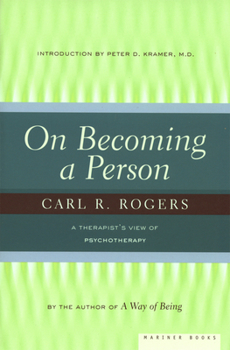
Carl Rogers' book On Becoming a Person has really been the book of the summer.  I read it during June and July, took notes on it (as blog posts) through July and August, and recently compiled a "greatest hits" of ideas below.  During my searching of my own notes, I saw that I had posted on his 19 Propositions way back in November, 2021.  That compiling of notes was a "10x10" project that I did this summer -- which involves setting a goal and breaking it into 10 steps that are about 30 minutes apiece ... and then checking off the tasks one by one.

Here's my attempt at listing 10 most important ideas

  1. A "healthy" person is one who is increasingly good (and trusting) at recognizing his own range and richness: his emotional and organismic response to the world, his own impulses, desires, opinions; this can seem like "trying to listen to himself" and his own inner reactions, his own "instrument" for encountering life; one important aspect is person's ability to identify true responses to things; true feelings
  2. A "healthy" person is less judging...  simply noting what is the case, not complaining that rocks are hard and water is wet (maslow).  This "health" is marked by "Maslow might be speaking of clients I have known when he says, “self-actualized people have a wonderful capacity to appreciate again and again, freshly and naïvely, the basic goods of life with awe, pleasure, wonder, and even ecstasy, however stale these experiences may be for other people.”  
  3. The "good life" isn't a static place, isn't contentment or bliss; it isn't homeostasis; instead it's a PROCESS, a DIRECTION, a trust in one's organism; an open state of becoming that's directed by your organism. It's marked by openness to new things, openness to others as subjects; it's "enriching, rewarding, exciting, challenging, meaningful".  He is more creative; he senses each moment is new;  He is a participant in the ongoing process of organismic experience, not in control of it
  4. Learning (in therapy or the classroom) has certain conditions: there is a problem, the student feels that therapist has congruence, empathy, is nonevaluative; learning that makes a difference is learning that changes behavior and attitudes
  5. Congruence is "realness" - I know my feelings, responses, and I don't try to hide them from you -- either on purpose or unconsciously.   Feelings match expression
  6. A barrier to interpersonal communication is tendency to judge to evaluate, approve.  “If I can sense the emotional flavor which it has for him, then I will be releasing potent forces of change in him”. First “restate the idea and feeling of the previous speaker accurately, and to that speaker’s satisfaction”... understand "with" a person, not "about" him... and this is a risk that YOU will change
  7. The concept of "cure" is inappropriate bc mostly these issues are behavioral; "becoming himself" doesn't mean solving problems, but opening new parts of life; It involves pretty simple realizations: "oh I really am angry at x"; it's marked by "stumbling around" with language: is THIS how I feel?
  8. There are "7 stages" of becoming a person.  From static, self-protective that doesn’t take responsibility to  dynamic, open organism in state of becoming (essay finds quotes to show 7 levels of this). Involves: Who am I? And how may I become myself?  Summary: a process of becoming, dropping of masks, experiences hidden aspects of himself, discovering the stranger behind the mask,    Person who emerges: openness to experience, trust in one’s organism, instead of being a “watchman” over a dangerous lot of impulses, he becomes comfortable, 
  9. Rogers not interested so much in unchanging aspects of intelligence, temperament. More interested in change.  Does behavior change, what commonalities exist, what precedes change, what’s the process of change?
  10. There is tendency for self-healing, away from things hidden - humans awant to extend, develop, become autonomous - better integrated, more able to function effectively, self-directing, more able to cope.  Defensiveness and not feeling are "normal." The experience of feeling (there are 1001 reasons for not letting ourselves experience our attitudes fully)… he gradually explores what is behind the mask... I sense the client "trying to listen to himself"… fluid, fluctuating

8/12 - Appreciate Basic goods of life - link - Carl Rogers On Becoming a Person, "'To Be That Self Which One Truly Is": A Therapist's View of Personal Goals" (1957) 

Most of this material is very similar to other material I've taken notes on in the blog, especially in his essay "What it Means to Become a Person," which I've taken notes on here.  But this section covers some different ground

  • “I sense the client is trying to listen to himself”, his own inner reactions

  • “Superior awareness of their own impulses, desires, opinions”

  • “Capacity to enjoy the basic goods of life, freshly and naively”

  • Ability to accept other individuals… simply noting and observing what is the case “doesn’t complain about rocks being hard”... this is what is human nature


8/11 - Concept of congruence link

  • Definition of congruence - “genuine, integrated”  affection and anger and contentment or fear … transparent, “all the way through”

  • Two examples of incongruence. - unconscious and between feeling and communication

  • “My experience is X”... not FACTS

  • Not only expressing what he feels; feelings match expression; we wonder if he knows what he feels; we tend to be wary and cautious of these people


8/9 - Releasing potent forces of change “Breakdowns in communication" link

  • Barrier to interpersonal communication is tendency to judge to evaluate, approve

  • Tendency to react to any emotionally meaningful statement by forming an evaluation

  • Instead, we should “see the expressed idea and attitude from other person’s POV”

  • “If I can sense the emotional flavor which it has for him, then I will be releasing potent forces of change in him”

  • Understanding “with” a person not “about” him

  • Experiment: first “restate the idea and feeling of the previous speaker accurately, and to that speaker’s satisfaction”... understand that speaker’s frame of reference

  • You run the risk of “being changed yourself”


8/8 Learning which makes a difference - “significant learning: in therapy and in education” link

  • “Difference” means the course of actions he chooses in future, attitudes, and personality

  • “Don’t be a damned ammunition wagon; be a rifle!”  I believe most educators would share this sentiment that knowledge exists primarily for use.

  • “Whatever knowledge I gained in his course has departed completely”


8/7 - Carl Rogers Q-Sort/ Chat GPT


8/6 - Persons or Science? A philosophical question. 

  • Being himself doesn’t solve problems…it opens up a new way of living in which there is more depth and more height

  • Learning is not very complex: I do feel sorry for myself, I am fearful of being dependent

  • I stumble around asking - is it sadness, anger, sorrow that I feel?


8/5 - Personality change is psychotherapy (fix “colon”

  • Concept of cure is inappropriate… bc not a disease but learned behavior

  • Introduction of Q-sort

  • Lots more about how it works and other researchers who used it


8/4 - The conditions for learning

  • Facing a problem

  • Congruence

  • Unconditional positive regard

  • Empathetic understanding

  • Client perceives the congruence, acceptance, empathy


8/2 A therapist’s view of the good life

  • It is not a state of virtue or “homeostasis” or “finished”

  • Happiness or adjustment not the good life - no fixed states of being

  • Instead, it’s a direction, selected by the organism.. A process of movement

  • Openness to experience (rather than defensiveness) 

  • Therapy is discovering by the client that he is experiencing feelings and attitudes which heretofore he has not been able to be aware of

  • Fully open to all of the sensory and memory and emotional “input” of the moment

  • Sense that each moment is new

  • Is a participant in the ongoing process of organismic experience, not in control of it

  • Increasing trust in the organism and reactions

  • Creativity, not adjusted to his culture, maybe unhappy, but moving toward becoming himself

  • Greater range, richness

  • Confidence as trustworth instruments for encountering life

  • Not “happy, contented, blissful, enjoyable” but “enriching, exciting, rewarding, challenging, meaningful”


7/30 What it means to become a person

  • Who am I? And how may I become myself? 

  • Summary: a process of becoming, dropping of masks, experiences hidden aspects of himself, discovering the stranger behind the mask, 

  • Person who emerges is more open to elements of his organic experience, trusts in his own organism as an instrument, accept locus of evaluation as withing himself, living life as participant in a fluid, ongoing process, continually discovering new aspect of himself


7/29 - Characteristics of a helping relationship

  • Congruent, non-threatening (even at physiological level), free other person from threat of evaluation, 


7/28 - What it means to become a person

  • Who am I? and how may I become myself?

  • Getting behind the mask

  • The experience of feeling (there are 1001 reasons for not letting ourselves experience our attitudes fully… he gradually explores what is behind the mask… fluid, fluctuating

  • Person who emerges: openness to experience, trust in one’s organism, instead of being a “watchman” over a dangerous lot of impulses, he becomes comfortable

  • Internal locus of evaluation

  • Willingness to be a process


7/27 - The facilitation of personal growth

  • If i can provide a certain type of relationship, the other will growth

  • Be genuine/be real (transparent, warmth, empathetic)

  • There is tendency for self-healing, away from things hidden - humans awant to extend, develop, become autonomous - better integrated, more able to function effectively, self-directing, more able to cope

  • Becomes more open to self and others; behavior less defensive


7/26 In contact with problems

  • Students must be in contact with “relevant problems of his existence”

  • Task of teacher is to create a facilitating classroom climate in which sig learning can take place (this is about acceptance, etc)


7/17 The puzzle of process

  • Rogers not interested so much in unchanging aspects of intelligence, temperament, 

  • More interested in change.  Does behavior change, what commonalities exist, what precedes change, what’s the process of change?


6/29 7 Stages of becoming

  • From static, self-protective that doesn’t take responsibility to  dynamic, orpen organism in state of becoming (essay finds quotes to show 7 levels of this)


6/24 The basic goods of life (Therapist’s view of personal goals)

  • Maslow might be speaking of clients I have known when he says, “self-actualized people have a wonderful capacity to appreciate again and again, freshly and naïvely, the basic goods of life with awe, pleasure, wonder, and even ecstasy, however stale these experiences may be for other people.”

11/23/21 Carl Rogers’ 19 Propositions

  • 5. Behavior is basically the goal-directed attempt of the organism to satisfy its needs as experienced, in the field as perceived.

  • 6. Emotion accompanies, and in general facilitates, such goal directed behavior, the kind of emotion being related to the perceived significance of the behavior for the maintenance and enhancement of the organism.


Carl Rogers personal thoughts on teaching and learning


At this juncture I took off for Mexico and one of our winter quarter trips, did some painting, writing, and photography, and immersed myself in the writings of Soren Kierkegaard. I'm sure that his honest willingness to call a spade a spade influenced me more than I realized. 273

So I sat down to write, is honestly as I could, what my experiences had been with teaching, is this term is defined in the dictionaries, and likewise my experience with learning. I was far away from psychologists, educators, cautious colleagues. I simply put down what I felt, with assurance that if I had not got it correctly, the discussion would help me to set it on the right track. (274) 


List of thoughts:

Is a consequence, I realize that I'm only interested in being a learner, preferably learning things that matter, that have some significant influence on my own behavior. 

I find it very rewarding to learn in groups in relationships with one person as in therapy, or by myself. I find that one of the best, most difficult ways for me to learn is to drop my own defensiveness, at least temporarily, and try to understand the way in which his experience seems and feels to the other person. 

I find that another way of learning for me is to State my own uncertainties, try to clarify my puzzlements, and thus get closer to the meeting that my experience actually seems to have. 276