
William Morris offers a rule for life:
“If you want a golden rule that will fit everything, this is it: Have nothing in your houses that you do not know to be useful or believe to be beautiful.”
From On Being with Krista Tippet. Guest, Sara Hendren:
Tippet: You said in adulthood when something really big happens to you, you either just kind of assimilate it into the preexisting story that you’ve been living by, or you accommodate and you make room for this experience, and your story shifts.
Hendren: My dear friend and colleague John Adler studies narrative identity in adulthood. He’s at Olin College where I worked until this year. And he taught me this kind of, that we make stories of our lives as a biological imperative. We have to see our lives as coherent. And now whether that takes on a positive cast overall or a negative one is what makes a lot of the difference. But, the coherence is really powerful. We need to tell stories that do make sense over time of how we got to where we are. And in the science it’s a feature of, really, how we exist. There’s genetic factors, and there’s nurture, environmental factors, and then there’s this story-making.
from Adler (The healing power of stories): There is a large body of scientific work supporting the theory of narrative identity, which suggests that our sense of self is best described as the integrative, internalized, evolving story we weave about our lives. While the historical facts of our lives certainly matter, the meaning we make about our experiences, captured in the stories we tell about them, is also strongly connected to our mental health. But not all stories are created equal; some of them do a better job of supporting our psychological well-being. Our work with participants in the Healing Story Sessions strives to capitalize on those aspects of personal narrative that social science has shown to be most strongly associated with mental health.
From research study by Adler:
Four themes in people’s stories were related to these different paths:
Agency: When people made sense of their lives with a sense that they were in the driver’s seat, as opposed to being batted around at the whims of external forces, they experienced positive trajectories of mental health in the following years.
Communion: When people described their lives as marked by connections with close others, they experienced positive trends in their mental health in the following years.
Redemption: When people’s stories about difficult or challenging experiences included a shift in the emotional tone towards some positivity, insight, or lesson they drew from the experience, they showed positive trajectories of mental health in the following years.
Contamination: When people’s stories had patterns wherein positive beginnings gave way to negative endings, they showed negative trajectories of mental health in the following years.
He provides one participants response:
I value that experience in that it – along with the experiences of my aunt – has given me a positive and healthy outlook . . . I’ve often said to myself through my life that if I’m ever told that I have cancer that I’m going to say to the doctor, “Okay, so what’s next? What do we do now? Because I’m not trying to die. What are we going to do to eradicate this cancer? What are my options?” That’s the position I’m going to take. It doesn’t matter what type of disease, cancer, whatever . . . I have personal experiences that I can look at that say it’s possible that I can get through that if that should ever happen in my life.
In this passage, the participant demonstrates how her highly agentic and redemptive narrative of her past health challenge has given her a foundation for approaching hypothetical future challenges that may arise. She says that she will feel empowered the next time she gets sick and values the health challenge for its ability to demonstrate how positive outcomes may result from negative experiences.
 |
| Settai Komura |
Here's a running list of "firsts" that are a sign that winter is starting.
From Hornby’s Dickens and Prince
But whether it was best Prince or average Prince, that wasn't the point. The point was that he had to do it." According to many people who've spent time with Prince, he was addicted to the creative process," says Duane Tudahl. "He was constantly looking for something that wasn't familiar to keep him interested."
"He was not a perfectionist," said Prince's engineer Susan Rogers. "He wouldn't have had that output if he'd been a perfectionist ... It just poured out of him-he couldn't wait on perfection." "Prince taught us perfection is in spontaneity," said Terry Lewis, who was fired from the Time by Prince, but who, with Jimmy Jam, went on to have an enormous career in production and songwriting. "You just do it, and whatever it is, it's perfect! Create, and don't ponder what you created."
In 1986, Prince built a studio, a proper one, in his home in Minnesota. The need for an expensive studio was an indication of both creative superabundance and, paradoxically, a lack of interest in perfection. A little four-track would have meant he was making demos, and he didn't want to do that. Demos were for laggards, for people who spend a long time making an album. Prince wanted to roll out of bed and know that whatever he recorded that day would be good enough, and then he could move on. He wanted to create, and not ponder. (81)
I'm reminded of Guided By Voices. Superabundance of ideas (maybe sustained by the forward motion of creating stuff). I like this.
I recognize the feeling of "constantly looking for something that wasn't familiar to keep him interested."
Also reminded of the meditation/mindfulness phrase: "good enough." This I associate with not wanting what you don't have and a feeling of gratitude. (Thinking back just a couple days with Kleon talking about "gratitude tense" --- starting with "I have... I have" (referencing the Oliver Sacks quote at the end of his life.)
All in contrast to wanting to revise, refine, perfect, prepare. Instead.... "make stuff."
category: inspiration to keep moving forward, staying curious
Robert Pinsky in this interview talks about the practice of making your own anthology of poetry:
AUDIENCE: How would you say somebody could best develop their talent as a writer and poet?
ROBERT PINSKY: The answer is to read the way an ambitious athlete watches excellent athletes, to read the way a cook eats, to read the way, if you’re ambitious to be a filmmaker, you would watch Kurosawa and Keaton and Scorsese, whomever you admired.
My recent book Singing School–I call it an anthology/manifesto hybrid– has a subtitle: “Learning to write poetry by studying with the masters.” Here is the most specific, practical thing I can suggest (besides buying my book!): create your own anthology. I mean actually. Type up or write out with your own hand the poems you love by, it might be, Emily Dickinson, Gerard Manley Hopkins, William Shakespeare, Constantine Cavafy. Whatever it is you love, style it up, and save it in a computer file called “anthology.” You might cut and paste, rather than typing you more distinctly notice the lines of verse and their relation to the sentences.
In other words, if you’re serious young poet or writer, keep what people used to call a daybook. I’m making that daybook or anthology exercise the central requirement of “The Art of Poetry,” the MOOC (Massive Open Online Course) that I am teaching right now. If you go to favoritepoem.org–which I recommend for the videos– a little red stripe or banner at the top of the home page sends you to the “Art of Poetry” MOOC. I’m asking all of the tens of thousands of people registered for the MOOC to do this anthology exercise. People have used the assignment with eighth graders; I used to require it of PhD students of Berkeley. The exercise combines autonomy–your taste and your choice, nursery rhymes, song lyrics, whatever you want, it’s your anthology–with the physical experience of typing the poem. Autonomy and corporeality. That’s my practical answer to your question about developing one’s talent.
In this other interview he provides more information about the daybook "assignment."
I did write a little book called The Sounds of Poetry. It's very much written for people who are serious, even fanatical, about that subject. If you just want to learn scansion or the names of metrical feet, it is not the book for you. My shortest advice would be to find poems you love and say them over and over again. That's the best assignment I gave, possibly the most useful thing I do as a teacher of writing or reading: to type out with your own hands some poems you love, let's say 35 pages. And I don't judge the content. It could be nursery rhymes, something your mom read to you, song lyrics.
In that same interview he talks about entry ways into poetry. It's NOT to begin by being smart about it.
But the first challenge of reading a poem is not to say something smart about it; a poem is something that sounds wonderful when you say it out loud. It's moving or exciting or interesting, and if you experience that feeling, you will have an appetite for poetry. An appetite for information and analysis. You will analyze and interpret poetry in a way resembling how you ponder your family and friends—for the rest of your life, even after they die, you analyze those people, interpret their words or behaviors, their manners on this occasion or that. It is pleasure and feeling that leads us to analyze poems and interpret their manners and ask what they mean. But analysis doesn't make you passionate about poems. You become attached to them through physical encounters.

Today is Thanksgiving. I've shared this Oliver Sacks quotes a couple times before. Here is Austin Kleon substack:
The neurologist Oliver Sacks published a handful of essays before his death that were collected in Gratitude. He wrote:
I cannot pretend I am without fear. But my predominant feeling is one of gratitude. I have loved and been loved; I have been given much and I have given something in return; I have read and travelled and thought and written. I have had an intercourse with the world, the special intercourse of writers and readers. Above all, I have been a sentient being, a thinking animal, on this beautiful planet, and that in itself has been an enormous privilege and adventure.
Notice that Sacks here is writing in “gratitude tense,” something you could try if you keep a diary. Start each sentence you put down with the words, “I have…”
.jpeg) |
| The Who's album WHO by Peter Blake |
Sometimes you benefit from reading a book by seeing a crystalized idea that you've been thinking about. Nick Hornby, in From Dickens and Prince (2022) does this by situating his subjects among "My People."
My People the people I have thought about a lot, over the years, the artists who have shaped me, inspired me, made me think about my own work. I have scores of people like that, influences and role models and heroes. Galton and Simpson, Donald Fagen, Preston Sturges, Barbra Streisand, Robert Altman, Pauline Kael, Kurt Vonnegut, Stephen Sondheim, Mavis Staples, Arsène Wenger, Joan Didion, Anne Tyler, Jerry Seinfeld, Rickie Lee Jones, Aretha Franklin, Thierry Henry, Elizabeth Strout, Raymond Carver, Frederick Exley, Joe Henderson, Lorrie Moore, Edward Hopper, Liam Brady, Peter Blake, Bruce Springsteen, Emmylou Harris, Duke Ellington, Elizabeth McCracken, Larry McMurtry, Roddy Doyle, Tom Verlaine, Peter Wolf, Dave Eggers, Al Green, and many, many others. I won't go into detail about what they have all meant to me: sometimes it was their taste, sometimes their thinking, or their soul, or attention to detail, or audacity, or comic timing, or arrogance, or commitment, or bravery, or the way they have lived their lives.
I like the raw listing of the names: these are people who meant something to Hornby. And then I like how Hornby names what "meant" could be: taste, thinking, soul, attention to detail, audacity, comic timing, arrogance, commitment, bravery, lifestyle.
Virginia Woolf on why different people respond differently to the same work of art. It cannot be known, or rather that to answer it your knowledge would have to be virtually infinite. It would have 'to extend over an immeasurably large range of variables, which would include not only perceptual, cognitive, emotional and other personality characteristics, but also biographical data, specific personal experiences, past encounters with art, and individual memories and associations.'
(from Nick Hornby, Dickens and Prince, p. 52, answering the question about why Prince and Dickens were so hungry for arts)
Hornby says that it's not the 10,000 hour rule of practice that counts; "maybe it's ten thousand hours of consumption."
Earlier he notes Dickens goes to the theater "nearly every night for three years. He was particularly obsessed with a performer/comedian called Charles Mathews, and Dickens saw his shows 'as often as he could, learning his performances by heart, words, songs, movements and gestures,' Claire Tomalin wrote. What kind of teenager does that?"
As for Prince (in his memoir The Beautiful Ones), he writes "We never rode past Dee's record shop without stopping in. Any song that caught my fancy was 1st purchased and then transcribed. Lyrics only, as I never learned 2 read music. Re-copying a lyric helps you to break down a lie, to see what it's made of."

https://workflowy.com/systems/para-method/
How to build a second brain. https://workflowy.com/systems/build-a-second-brain/
Distill
Distilling is where we take all that raw information and start to turn it into something much more useful. Our main tool for doing that is through progressive summarization.
Progressive summarization is the act of distilling the information we collected in our second brain down to its most essential elements. We do this by taking our notes and highlighting the main points each time we review them. After about two rounds of highlighting we can also add a summary in our own words to further consolidate what we consider most important
Daily Kanban/sunsama. Time Boxing - https://help.sunsama.com/docs/timeboxing-concepts-and-principles

Alastair Humphries suggests:
My favourite way to explore a new place is through running sightseeing.
The rules:
1. Go for a run
2. Take a photo every kilometre, on the kilometre. This rule stops me pausing to take thousands of photos which I'd otherwise be tempted to do, and therefore not run anywhere!
3. Only take one photo at each kilometre spot. Be creative to make the most of it, but accept the limitations. I use a black and white app on these runs to add a further creative constraints. No faffing about, no later editing.

I love this description (by Claude Roy) of Marguerite Duras.
She had an abrupt mind, a baroque and often droll vehemence, an infinite capacity for fury, appetite, warmth and astonishment.
Sara Hendren interviewed by Krista Tippet on On Being. talks at length about reframing disability to think about how we are all dependent.
"Alasdair MacIntyre, who’s a philosopher, famously said that the human body, the human animal, the human creature is a dependent, rational animal. So, dependence is part of a three-legged stool that makes us who we are. That’s almost like a metaphysical statement that we need each other. We could have an evolutionary biology explanation for that. “Well, we need each other as a kind of consequence. We make do when we cope by needing each other to cooperate.” But there’s something quite profound about how social we are, how frail we are, finally. How none of us escapes that kind of being in the subject position of both the giver and the receiver of help. That’s what we’re talking about."
In another part of the interview, she talks about how "interdependent" is not exactly right.
"William May. And here again, I think — so he’s talking about, yes, the unbidden as constitutive of the good. So, the unchosen features of our lives. And here again, I think at least in this country, in a contemporary way, there is a kind of romanticization of interdependence. And we say, “Well, we need each other and let’s not overdo it with the individualism, mutual aid, and so on.” But, I see people kind of hedge and say, “Well, as long as you’re choosing the people to be interdependent with.” And I always think that’s not how it works. Obligation, in other words, is seen as diminishment."
(from Google Books)
In Dependent Rational Animals, Alasdair MacIntyre compares humans to other intelligent animals, ultimately drawing remarkable conclusions about human social life and our treatment of those whom he argues we should no longer call "disabled." MacIntyre argues that human beings are independent, practical reasoners, but they are also dependent animals who must learn from each other in order to remain largely independent. To flourish, humans must acknowledge the importance of dependence and independence, both of which are developed in and through social relationships. This requires the development of a local community in which individuals discover their own "goods" through the discovery of a common Good.
Sara Hendren interviewed by Krista Tippet on On Being.
Because to be vulnerable in time, that is Graham’s chief vulnerability and disability, that he is not pacing through school in a way that makes him into an economic citizen. That really is what we’re talking about. It’s quickness and speed in order to be recognizably productive and therefore valuable as a taxpayer and a worker. The disability is needfulness on the state and also needfulness on other people in a distinctive way.
And so, that time, that atypical way of maneuvering through time, yes, has helped all of us in our family to see what are we attached to in our worth and what will we do? How will we build the kind of lives that we want? Not just for ourselves, but in our communities where economic worth is one piece of who many of us are, but where the human family is a much bigger thing.
“Crip time” is this term of art in disability studies that I learned from other disability scholars. And it is that acknowledgment, the kind of slowness that comes with a lot of conditions — aging, but also maybe maneuvering with gear. And again, making friends with that slowness and trying to ask ourselves, “Well, what is the hurry about? Do we want our lives subsumed by our economic worth?” Again, none of this is to say that we don’t, in a realistic way, live in a time in which we work for money. Yes, I get it. But, the invitation is also to ask what are our lives about.
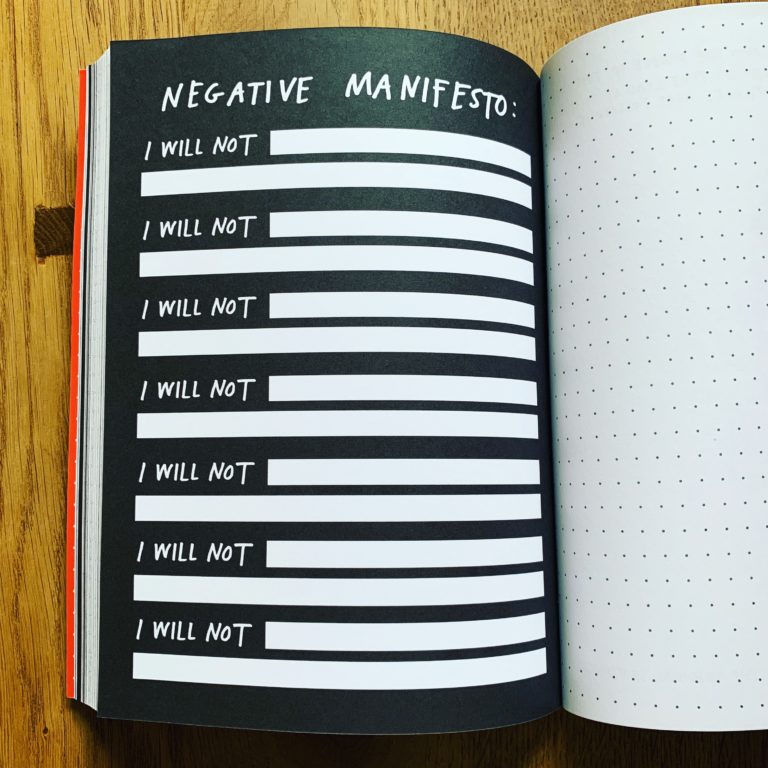
From Austin Kleon:
From Wilson Neate’s 33 1/3 book on Wire’s Pink Flag:
Natural minimalists, Wire pursued a negative sensibility, defining themselves in terms of what they were not…
“The only things we could agree on were the things we didn’t like,” observes Bruce Gilbert. “That’s what held it together and made life much simpler.” Recalling some unofficial Wire rules, Graham Lewis summarizes this negative self-definition: “No solos; no decoration; when the words run out, it stops; we don’t chorus out; no rocking out; keep it to the point; no Americanisms.”
Mitzvot is the plural form of mitzvah, a Hebrew word that roughly translates to “commandment.” Still, folks commonly interpret it as “a good deed.” The term mitzvah comes from the root word tzavta, which means “connection.” What makes a mitzvah a mitzvah is its emphasis on action. A mitzvah is a decisive act that embodies empathy and kindness while bringing us closer to others. Positive thoughts and wishes, while always welcome, are not mitzvot. Mitzvot are more than a creed—they’re about doing deeds
AT YOUR AGE, I WORE A DARKNESS
several sizes too big. It hung on me
like a mother’s dress. Even now,
as we speak, I am stitching
a darkness you’ll need to unravel,
unraveling another you’ll need
to restitch. What can I give you
that you can keep? Once you asked,
Does the sky stop? It doesn’t stop,
it just stops being one thing
and starts being another.
Sometimes we hold hands
and tip our heads way back
so the blue fills our whole field
of vision, so we feel like
we’re in it. We don’t stop,
we just stop being what we are
and start being what?
Where? What can I give you
to carry there? These shadows
of leaves—the lace in solace?
This soft, hand-me-down
darkness? What can I give you
that will be of use in your next life,
the one you will live without me?
MAGGIE SMITH
According to bird feeder hub.com
Juncos are often thought of by people in the U.S as winter birds, since they spend their summers up in Canada. They have blackish gray heads and are overall a dark slate-gray on top, but a lighter grayish white on their bottom half, and a light pink beak. Females and immatures can appear more of a buffy brown color. They are most common in forests and wooded areas where they can often be seen hopping around on the ground.
Dark-eyed Juncos are found in Illinois only during the winter months.
Brad Stulberg on Twitter:
If I had to feel motivated to start a workout I would have done 23 workouts last year, not 230. If I had to feel inspired to start writing there’d be hardly any writing. Want to stop 20 minutes in, fine. But give yourself a chance.
I love this. Bill Bryson on cricket
Imagine a form of baseball in which the pitcher, after each delivery, collects the ball from the catcher and walks slowly with it out to center field; and that there, after a minute’s pause to collect himself, he turns and runs full tilt toward the pitcher’s mound before hurling the ball at the ankles of a man who stands before him wearing a riding hat, heavy gloves of the sort used to handle radioactive isotopes, and a mattress strapped to each leg. Imagine moreover that if this batsman fails to hit the ball in a way that heartens him sufficiently to try to waddle forty feet with mattresses strapped to his legs, he is under no formal compunction to run; he may stand there all day, and, as a rule, does. If by some miracle he is coaxed into making a misstroke that leads to his being put out, all the fielders throw up their arms in triumph and have a hug. Then tea is called and everyone retires happily to a distant pavilion to fortify for the next siege. Now imagine all this going on for so long that by the time the match concludes autumn has crept in and all your library books are overdue. There you have cricket.


