
 |
Walking Agatha, her basset hound, involves a lot of waiting around while Agatha sniffs. And Richards has learned to make this an opportunity: “While I wait, I notice things,” from morning dew to full-moon shadows to acorns to falling leaves. She ends with the message: Take a walk and see what you notice.
I’ll add an additional message to build on hers:
Convert an everyday annoyance or chore (waiting while the dog sniffs everything) into an opportunity to engage with the world.
In London Review of Books, in a review of The Complete Works of Epictetus, author Emily Wilson writes about the selfish and conservative view that Stoicism embodies. I'm quoting at length because there's so much to dig into. On first read, it makes me see it as a privileged and disengaged philosophy which doesn't address injustice or an ethics that aims at making things better for others. In the places that it seems related to Buddhism.... it pricks my conscience.
Stoicism was a well-established philosophical system by Epictetus’ time. Founded in the third century bce in Athens by Zeno of Citium, and developed by Chrysippus, Stoicism included logic and physics as well as ‘ethics’ – a set of teachings about the disposition and behaviour needed to attain well-being. The modern term ‘ethics’ may be a little misleading as a descriptor of the ancient field: Stoic ethics was concerned not with establishing a rational basis for moral judgments, but with the way an individual – usually imagined as a male, relatively privileged individual – could attain the best possible life, through making himself immune to the vicissitudes of fortune. The goal was ‘well-being’ – eudaimonia – a term that is sometimes misleadingly translated as ‘happiness’: for a Stoic, as for an Epicurean or a Cynic, well-being is not about feeling cheerful, but about control. The philosopher seeks ataraxia: a state of being untroubled, which could be attained by ridding yourself of false beliefs and aligning yourself with what truly matters.
According to the Epicureans, the true good is pleasure, of a moderate, balanced kind. For the Stoics, by contrast, the true good is individual human excellence or virtue – aretē in Greek, or virtus in Latin. Such excellence, for the Stoics, could be attained only by aligning your own will with the universe, nature or God (the Stoics often spoke of a singular deity). The central theme in the teaching of Epictetus is that we can and must choose to stop paying attention to things we have no control over. ‘Some things are up to us and some are not,’ the Handbook begins – foreshadowing the teachings of modern recovery programmes and the Serenity Prayer, with its distinction between the things we can change and the things we cannot.
For Epictetus, nothing is up to us except our own purpose, attitude or ‘will’, as Robin Waterfield translates it (the Greek is prohairesis): ‘wealth, health, status – these things aren’t up to us.’ Rhetorically, it’s no coincidence that these lists of unimportant things – there are many of them in the teachings of Epictetus – tend to focus on individual privileges that most people would agree are overvalued. An ancient Roman student or reader wouldn’t be surprised to learn that it is undignified to be too concerned with money or prestige, or that the bravest, most noble man will show courage in the face of physical danger. Epictetus presents a version of Stoicism that often aligns with traditional Roman social norms, even if his expression of those ideals is often wonderfully vigorous. ‘I’ll cut off your head,’ a tyrant threatens. ‘Well,’ the insouciant Stoic replies, ‘have you ever heard me suggest that I’m unique in having a non-detachable head?’ (Waterfield’s clear, readable translation brings out Epictetus’ humour and conversational tone as well as his philosophical vision. A preening man at one point comforts himself with the thought: ‘I have gorgeous hair.’)
In terms of behaviour, too, Epictetus’ version of Stoicism posed no threat to existing social norms. Diogenes the Cynic had shown his contempt for convention by living in a barrel, wearing rags and defecating in public, but Epictetus recommends that his students adapt themselves with dignity to perform whatever social role they happen to find themselves inhabiting. This is not a philosophy to inspire a slave revolt, or a revolution. All anger – including righteous rage at collective injustice – is to be eradicated for the individual’s peace of mind. The followers of Epictetus are supposed to do what is ‘appropriate’ (kathēkon), and he doesn’t worry about what that is. Convention and tradition are good enough guides. According to Epictetus, the Epicurean ideal of a quiet life focused on friendship and moderate pleasure is ‘subversive of the state, destructive of households and unsuitable even for women’, but Stoicism will allow an elite Roman man eager to advance in his political career to perform his normal ‘duties’.
The fundamental conservatism of Epictetus’ teaching can be seen in many of his favourite metaphors: life is an inn at which we make only a brief stop; our station in life is a role in a play. Presumably, most of his students were privileged men; as Waterfield observes, the anonymous addressee is always imagined as masculine. The assumed student is usually a wealthy, privileged enslaver, whose problems include such trivialities as ‘the slave’ bringing water that isn’t hot enough. Epictetus advises the student who has been ‘assigned a somewhat higher station’ in life to be ‘just’ and ‘decent’ in his response (qualities that are viewed as quite compatible with enslaving others). At the same time, however, he pushes back against the idea, present in ancient philosophical thought since at least the time of Aristotle, that some human beings are naturally slavish. The enslaved are the enslaver’s kinsmen, Epictetus says, and they, too, are the offspring of Zeus; their subjugation is not justified by their supposed inferiority. The only real ‘slaves’ are those who have failed to follow Stoic teaching – including the philosopher’s ostensibly free students. He hammers this point home by addressing the reader who is subject to the whims of passion as ‘Slave!’
The central distinction between what is and what is not ‘up to us’ (eph’hēmin) relies, in Epictetus’ work, on an individualistic idea of human motivations and values. What is ‘up to us’ tends to mean ‘what is up to me’. There is no discussion of the possibilities of collective action. Some Roman Stoics and Stoic-sympathisers were closely associated with opposition to imperial rule and a desire to return to the old days of the Republic. Political revolution can be ‘up to us’ only collectively: it takes more than one person to topple an emperor, or to end slavery. But Epictetus takes no interest in such goals. ‘It’s not poverty that we need to get rid of,’ he says, ‘but our judgment of poverty’ – he’s not talking about poverty as a social evil here, but giving advice to a young man who wants his father to give him a larger allowance.
This is the kind of problem that Epictetus’ version of Stoicism is designed to address: a privileged man is disturbed by the idea that he does not have complete control over every element of his existence. Epictetus’ teaching intervenes from two different directions. It knocks the egotistical student down a peg or two (‘Slave!’), while providing a philosophically authorised justification for his fantasies of power, permanence and autonomy. Other philosophical and religious traditions encourage their followers to aspire to an emptiness of the self, echoing the emptiness of reality (in Sanskrit, sūnyatā) or the self-emptying of God (in Greek, kenōsis). In Epictetus’ version of Stoicism, the self is always the focus, even for the most enlightened philosopher. The wise Stoic never gives up his desire for power and possessions, goals that can be achieved through control over the will. It isn’t a coincidence that Stoicism, in a watered-down form, is currently so popular with wealthy white men in Silicon Valley or Wall Street; Ryan Holiday and Stephen Hanselman’s The Daily Stoic (2016), for example, has been a bestseller in the Business Motivation, Success Self-Help and Greek and Roman Philosophy categories.
How useful is Epictetus’ version of Stoicism as a tool for getting through life, especially for those of us who are neither ancient Roman citizens nor entrepreneurs? It may be helpful for coping with the annoyance, frustration and boredom of daily life. ‘If you’re going out to bathe,’ Epictetus says, ‘rehearse in your mind what typically happens in a bathhouse – getting splashed and jostled and abused and robbed.’ This is a useful principle to bear in mind if your train or plane is delayed by several hours and then cancelled. It can be soothing to remember that there is nothing unusual about such occurrences, which are beyond your control, allowing you to stay calm and align your will with that of the universe.
Stoicism can help with physical pain, too. During a recent bout of searing back pain that left me unable to walk, I found it genuinely helpful to remember that I had a choice about how to respond to my pain and my physical immobility: I could choose not to ‘consider my body to be mine’, not to be sorry for myself, or frightened, or angry, and to think of myself, or at least of my ‘command centre’ (as Waterfield translates the ‘leading element’ of the self, to hēgemonikon), as both free and powerful, even when I could barely move.
The teachings of Epictetus are rather less useful when it comes to interactions with other people. ‘If you kiss a child of yours,’ he says, ‘or your wife, tell yourself that you’re kissing a human being, because then you won’t be upset if they die.’ This must have been a common piece of Stoic advice; the line is quoted admiringly by Marcus Aurelius. Such mantras aren’t much good if you consider your children’s well-being more important than your own tranquillity. Epictetus discusses the case of a man who leaves home when his child is sick because he can’t bear to contemplate her suffering or the possibility of her death. He concedes that this is not the most ‘affectionate’ thing to do: if the mother and enslaved caregivers had done the same, the child would have been left entirely alone. He doesn’t explain why these people stay to take care of the child, although one possibility might be that they are more focused on her needs than their own feelings.
The story of the sick child is one of many vivid anecdotes in the Discourses that give us glimpses of the realia of daily life in the first century ce. There are also evocations of children using shards of pottery as counters in a game, and a discussion of the unmanliness of tweezing body hair. (Waterfield’s translation is illustrated with black and white images of people playing ball, Hephaestus as a blacksmith, a bronze liver marked to show how the organ was used in divination.) The Discourses are also full of references to Homer and Greek tragedy, and provide a fascinating insight into the way these works were interpreted by at least one ancient reader. Epictetus tells us a great deal about Achilles’ intense and – from a Stoic perspective – excessive suffering after the death of Patroclus, and suggests that such pain can be soothed only by a more rational attitude. He says nothing about the way egotistical rage and grief might be modified, as in the final books of the Iliad, through collective rituals of mourning and memorialisation, which can help us to understand and accept the inevitability of loss, and to abandon the fantasy of being all-powerful and entirely free from pain
 |
| For Fun by Kitano Tsunetomi, 1929 |
 |
| Two Doves on a Maple Branch, by Ohara Koson, 1912-1926 |
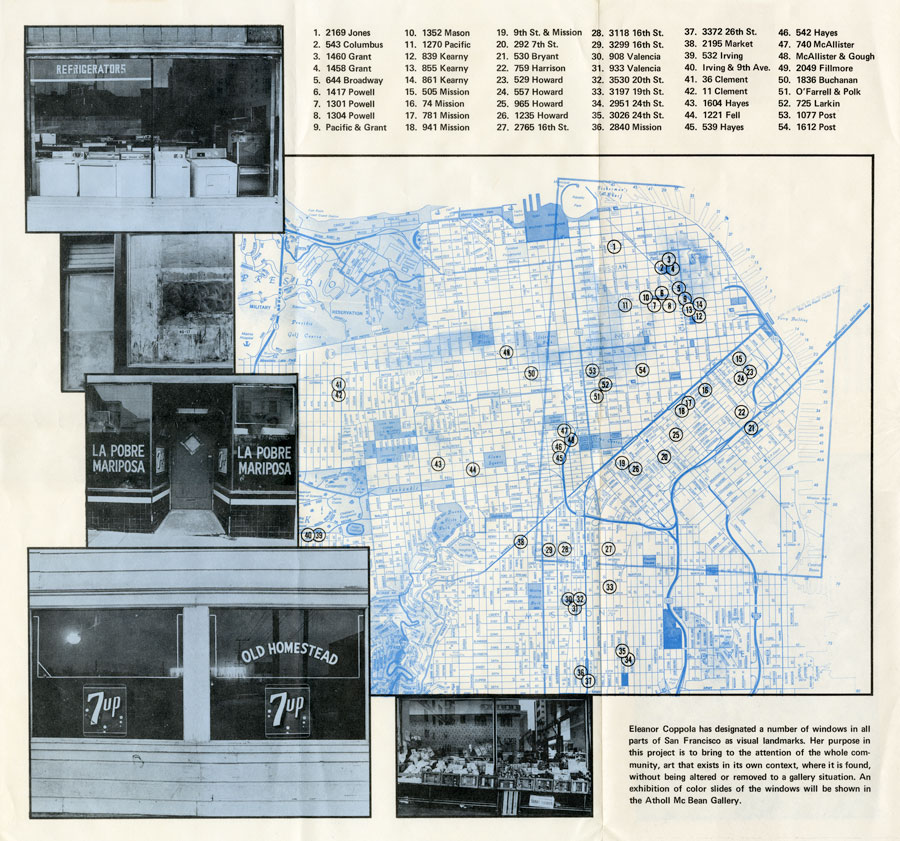 |
| Eleanor Coppola, Windows, February 16–March 17, 1973; take-away folded map for visitors; photos: Rita Mandelman, printed: San Francisco Art Institute; 14 x 20 in. (35.56 x 50.8 cm) |
In Jenny Odell's How to Do Nothing (5)
In 1973, Eleanor Coppola carried out a public art project called Windows, which materially speaking consisted only of a map with a date and a list of locations in San Francisco. . . . Coppola's map reads:
Eleanor Coppola has designated a number of windows in all parts of San Francisco as visual landmarks. Her purpose in this project is to bring to the attention of the whole community, art that exists in its own context, where it is found, without being altered or removed to a gallery situation.
Odell says that Coppola "casts a subtle frame over the whole of the city itself, a light but meaningful touch that recognizes art that exists where it already is."
A more recent project that acts in a similar spirit is Scott Polach's Applause Encouraged which happened at Cabrillo National Monument in San Diego in 2015. On a cliff overlooking the sea, forty-five minutes before the sunset, a greeter checked guests in to an area of foldout seats formally cordoned off with red rope. They were ushered to their seats and reminded not to take photos. They watched the sunset, and when it finished, they applauded. Refreshments were served afterward.
Odell writes that these artists "create a structure that holds open a contemplative space against the pressures of habit, familiarity, and distraction that constantly threaten to close it."
Over at SFMOMA website, there's more details about her project:
In Eleanor Coppola’s participatory Windows (1973), she proposed that visitors pick up a map and go out into the streets of San Francisco to complete the experience of the exhibition. The windows that were designated by the artist as rich visual pieces for the duration of the show varied considerably in type and neighborhood. Only the street addresses were provided. The viewer was left to discover each storefront or home, with its existing interior composition and changing reflections. There were no stated criteria for how she chose the particular windows, only the sense of her interest in framing the found elements as equivalents to art objects. Instead of making an intervention into the window displays or inserting the artist’s own presence, this conceptually-driven work underscored the role of the author in creating a system for observation.
 |
This graphic, which is pretty cool, looking like a river continually diverted, shows where the water from the Colorado River goes. What's missing from the graphic is the bottom legend which shows that the left section, representing 54%, goes to sustaining cattle. The middle section, 24%, represents other crops, the right, 21%, everything else.
To put it in perspective, it could take more than 38 gallons of water, by some estimates, to produce one quarter-pound beef patty. That includes the water to grow all the feed like alfalfa and hay that the cattle themselves eat. In comparison, you need about five gallons of water to get the same amount of protein from tofu.
Dairy products like milk and cheese are even more water-intensive per gram of protein than beef because dairy cows require more energy to produce milk. They’re often fed alfalfa, in part because it’s higher in calories and protein.
also...
Although agriculture dominates water consumption in the West, most of the new demand for water comes from growing cities, Ms. Cooley said, and there are a lot of opportunities to conserve water at the tap.
Fewer lawns could make a difference. But experts say what we eat remains the biggest driver of water use along the Colorado.
“We have to be thinking about dietary changes,” said Brian Richter, lead author of the 2020 study and president of the education organization Sustainable Waters.
That doesn’t necessarily mean quitting meat entirely. Instead, it might look like a mind-set shift: Those products might need to become more of a specialty item in our diets, he said, “rather than something we consume every day.”
Water and climate and growing debt ("by 2050, approximately 50% of federal revenues will go towards interest only") seem to be enormous issues that are time bombs.
They seem to be society's blind spots... something related to the psychological concept of denial.
 |
| (not listed... from Twitter) |
— Everyone gets a double major: engineering and history. That’s it. That’s all we offer. There are some required history survey courses that you take in a sequence, and then a bunch of electives. The capstone is probably a history of technology course, but it comes after and in addition to the macro- and micro-histories you’ve been studying all along. You wouldn’t have to do a bunch of integrated “context and ethics” in a technology course if you just said: Everybody studies these two things, period. There’s no complementary “rounding out” in some vague hand-wavey form. You just don’t get prepared unless you have history, full stop.— Everyone does a 2 + 1 + 2. Instead of students cycling out from liberal arts colleges to engineering programs for a year, it’s the opposite: You come to engineering school, spin out for a deep immersion in a liberal arts environment, maybe one that also serves as your study abroad, then come back and finish.
— Everyone gets an engineering degree, but the other requirement is a Cultural Life Program, such as the one at Furman. Over four years you attend lectures, concerts, and museum exhibitions, a lot of which are your choosing, but they add up to something like 60 hours of cultural education and a required thesis course.Everyone does a 2 + 1 + 2. Instead of students cycling out from liberal arts colleges to engineering programs for a year, it’s the opposite: You come to engineering school, spin out for a deep immersion in a liberal arts environment, maybe one that also serves as your study abroad, then come back and finish.
— Everyone gets an engineering degree, but the other requirement is a Cultural Life Program, such as the one at Furman. Over four years you attend lectures, concerts, and museum exhibitions, a lot of which are your choosing, but they add up to something like 60 hours of cultural education and a required thesis course.

I noticed a very bright "star" by the crescent moon last night just after 8 pm. The image is wobbly... but in person, it was a sharp slash of brightness and an intense ball.
Online I find this image at EarthSky.org:

Two thoughts; If you look closely at the image above, you can see Venus, too, below and to the left of the moon.I wouldn't have seen Venus without this diagram from EarthSky.org. In that way, the diagram is like Merlin the bird-sound identifying app that I'm liking so much. The diagram/app helps point out things to discriminate in nature. Is it like a filter? It is like a positive discriminator.
Second thought: Both Merlin and this strike me as moments when I realize there are more things in heaven and earth... it's a sense that we are surrounded, enveloped in complex, interesting, dynamic things. That's level one of realization. Level two is that we always have been surrounded, enveloped in this complex reality, but we've been missing it.
 |
| R. Kikuo Johnson - Perennial |
In New Yorker Cover Story feature.
Part of the inspiration is about the punchline—the plastic bags that end up in city trees. There’s a painter’s drop cloth that has been stuck high in a tree on my block in Bed-Stuy for the past year. I ignored it for months, mentally filing it with the rest of the litter on the street. But, over time, the colorful splatters of paint on the olive-green fabric began to look intentional. Now, every time I step out of my building, I look up to check how the canvas is hung. As the spring foliage fills in, our Jackson Pollock is slowly becoming an Andy Goldsworthy.
Here's another blog post on a previous NYer cover called "Double-Parked" by Kikuo Johnson.
Their Lonely Betters
As I listened from a beach-chair in the shade
To all the noises that my garden made,
It seemed to me only proper that words
Should be withheld from vegetables and birds.
A robin with no Christian name ran through
The Robin-Anthem which was all it knew,
And rustling flowers for some third party
To say which pairs, if any, should get waited mated.
No one of them was capable of lying,
There was not one which knew that it was dying
Or could have with a rhythm or a rhyme
Assumed responsibility for time.
Let them leave language to their lonely betters
Who count some days and long for certain letters;
We, too, make noises when we laugh or weep:
Words are for those with promises to keep.
 |
| Crow and the Moon, by Kawanabe Kyōsai, ca. 1887 |
The natural tendency of attention when left to itself is to wander to ever new things; and so soon as the interest of tits object is over, so soon as nothing new is to be noticed there, it passes, in spite of our will, to something else. If we wish to keep it upon one and the same object, we must seek constantly to find out something new about the latter, especially if other powerful impressions are attracting us away.
attention is a state of openness that assumes there is something new to be seen, it is also true that this state must resist our tendency to declare our observations finished -- to be done. For James as for von Helmholtz, this means that there is no such thing as voluntary sustained attention. Instead, what passes for sustained attention is actually a series of successive efforts to bring attention back to the same thing, considering it again and again with unwavering consistency. Furthermore, if attention attaches to what is new, we must be finding ever new angles on the object of our sustained attention -- no small task. James thus makes explicit the role of will in attention:
Though the spontaneous drift of thought is all the other way, the attention must be kept strained on that one object until at last it grows, so as to maintain itself before the kind with ease. This strain of attention is the fundamental act of will.
 |
| Crow in Rain, by Kawanabe Kyosai, ca. 1880-1889 |
 |
| Two Crows on a Pine Branch, by Kawanabe Kyōsai, ca. ca 1887 |
If we think about what it means to "concentrate" or "pay attention" at an individual level, it implies alignment: different parts of the mind and even the body acting in concert and oriented toward the same thing. To pay attention to one thing is to resist paying attention to other things; it means constantly denying and thwarting provocations outside the sphere of one's attention. We contrast this with distraction, in which the mind is disassembled, pointing in many different directions at once and preventing meaningful action. It seems the same on a collective level. Just as it takes alignment for someone to concentrate and act with intention, it requires alignment for a "movement" to move. Importantly, this is not a top-down formation, but rather a mutual agreement among individuals who pay intense attention to the same things and to each other. (81)
This "schizoid" collective brain cannot act, only react blindly in misaligned ways to a barrage of stimuli, mostly out of fear and anger. That's bad news for sustained refusal. While it may seem at first like refusal is a reaction, the decision to actually refuse -- not once, not twice, but perpetually until things have changed -- means the development of and adherence to individual and collective commitments from which our actions proceed.
 |
| Crow on a Tree by Shinso Yogetsu, ca. 1485 |
doing so allows one to transcend the self. Practices of attention and curiosity are inherently open-ended, oriented toward something outside of ourselves. Through attention and curiosity, we can suspend our tendency toward instrumental understanding -- seeing things or people one-dimensionally as the products of their functions -- and instead sit with the unfathomable fact of their existence, which opens up toward us but can never be fully grasped or known.
He can "accept it as a picture," describe its visual elements; he can consider an instance of a species, an expression of natural law, or a pure relation of numbers. "Throughout all of this the tree remains my object and has its place and its time span, its kind and condition," he says. But then there is the I-Thou option: "it can also happen, if will and grace are joined, that as I contemplate the tree I am drawn into a relation, and the tree ceases to be an It. The power of exclusiveness has seized me." [my emphasis]
 |
| Crow and Reeds by a Stream, by Kawanabe Kyōsai, ca. 1887 |
Instead of the customary rows of musicians dressed in all black, the people onstage were dressed in plain clothes, moving about various props and devices like a typewriter, a set of cards, or a blender. Three vocalists made strange and haunting sounds while someone shuffled cards into a microphone and another walked into the audience to give someoneone a present -- all, in some way, part of the score... [laughter from the audience erupts when] Michael Tilson Thomas, the conductor of the SanFrancisco Symphony, used the blender to make a smoothie....More than just the conventions of the symphony hall were broken open that night. I walked out of the symphony hall down Grove Street to catch the MUNI, and heard every sound with a new clarity -- the cars, the footsteps, the wind, the electric buses. Actually, it wasn't so much that I heard these clearly as that I heard them at all. How was it, I wondered, that I could have lived in a city for four years already -- even having walked down this street after a symphony performance so many times -- and never have actually heard anything? (102)
 |
| Koson Ohara |
"Even with insects ― some can sing, some can't." ― Issa Kobayashi (tr. Robert Hass)
"Everyone is asleep There is nothing to come between The moon and me." Seifu Enomoto
 |
| A Thousand Grasses, by Kamisaka Sekka, 1900 |
Notes from Insight Hour Podcast #163: The Tao and the Rhythm of Experience
Begins with the story of a monk seeing a flower and smiling. JG says that it contains every important lesson.
It "contains" beauty and decay, which correspond to attachment (holding on) and suffering (maybe: wanting things to be different)
It "contains" emptiness and suchness. Emptiness is the "coming together of forms" (there is no basic thing that is a flower) and suchness which is the Zen teaching of the "is"ness that is free from description.
JG says the point of meditation is to allow us to experience the "endless expression of things as they are"... "allow the process to unfold without pushing the river"
Then, "we can be part of the rhythm... it carries the experience (like in music) when it's not interfered with".... there is balance and harmony in this.
These are the 10,000 joy and sorrows.
We are not involved with our conditioned liking and not liking things.
JG then takes time to differentiate between non-action (good) and inaction, between equanimity and indifference. The former is being energized and responsive. He presents a story where you can even hit someone over the head with an umbrella (with love). It's not inaction.
We are dealing with whatever is arising (not "reacting"); we are not experiencing either expectation or resistance. Instead of resisting, we say "let me feel this too).

The app takes a sonogram of what you're hearing and then begins listing the birds it identifies. If it identifies a previously identified bird again, it highlights the bird in yellow. You can relisten to the recording and what it identify the bird again and again. You can also "research" the recordings of the birds recorded in the past... So... great learning tool.
Let's call the recording a "soundshot" like a snapshot. I do two more of them in Bemis, once towards the parking lot closest to I-294 after I hear a ptyreodactyl like sound. It identifies a large number of birds at once, remarkable number: 10? warblers and cowbirds and vireos and osprey!
Since then, it's been my constant companion. This morning's spring chorus at home was a relatively staid list of robin, red-wing blackbird, and cardinal.
Taking the soundshots is a cool, eye-opening thing, it adds to your sense of what's around you, the sense of richness of your surroundings. You are not alone! You are surrounded by 10 different bird species, some of which are marked as semi-rare!
As Hamlet says, "There are more things in heaven and earth, Horatio, than are dreamt of in your philosophy."
All at Once by Clint Smith
The redwoods are on fire in California. A flood submerges a neighborhood that sat quiet on the coast for three centuries. A child takes their first steps and tumbles into a father's arms. Two people in New Orleans fall in love under an oak tree whose branches bend like sorrow. A forest of seeds are planted in new soil. A glacier melts into the ocean and the sea climbs closer to the land.
A man comes home from war and holds his son for the first time. A man is killed by a drone that thinks his jug of water is a bomb. Your best friend relapses and isn't picking up the phone. Your son's teacher calls to say he stood up for another boy in class. A country below the equator ends a 20-year civil war. A soldier across the Atlantic fires the shot that begins another.
The scientists find a vaccine that will save millions of people's lives. Your mother's cancer has returned, and doctors say there is nothing else they can do. There is a funeral procession in the morning and a wedding in the afternoon. The river that gives us water to drink is the same one that might wash us away.

I sat on the bench by the Community Center, and began to notice the simultaneousness of things. I was getting more and more "in the frame." a couple is walking along a sidewalk; school kids are chasing each other up a hill, a plane leaves a sound cone through the air, the slow crescendo of wind sounding in the new leaves, birds chipping, calling...
As I reflect on it now (a week at least later) I get the impression that this "building up" of a complex world then "crowds out" or "short circuits" the normal planning and rumination.
I develop an altered, diminished sense of myself. When I'm writing "diminished," I mean not less important but less "central," I'm thinking words like... bracketed, less prominent, not "centered." Normally, there are "lines of connection"... me to calling bird, me to wind in the tree branches, me to sound of tennis ball being hit. I'm the spider at the center of this web.
But during this "altered" time... I'm off-center... one figure in the diorama.
It's also affectively positive and interesting. I'm curious, following along the developing "soundtrack."
 |
| Shinsui Ito |

Kevin Kelly's publishing his book about advice now. The quote above is from that book. He's on a bunch of podcasts. I'm learning more and more about him, and he's become something of a North Star for me. Here is an old This American Life Transcript. This relates the story of how is reborn, twice -- once while he has been locked out of a hostel in Jerusalem. Then again after a bike trip across the United States to see his family. The story is about transformation.
And as the sun was coming up on that Easter morning, I was staring at empty tombs. And for a reason that I can not comprehend, as I sat on that chair contemplating this view of the early sun morning coming into the empty tombs, all that I had been wrestling with for the past many, many years in thinking about religion sort of became resolved in my mind. And at that very moment, I believed that Jesus Christ had, indeed, risen from those tombs.
In an instant, the tension of trying to figure things out was resolved, because now, suddenly, everything was figured out. It was as if you had been working on a problem for a long time and suddenly the answer was there. And it was very clear that was the answer. And although there were many things that were still not clear to you, you were very certain that you were on the right path.
Did that mean that I had to immediately renounce all that I had, and get into sackcloths and ashes, and march out into the desert? All that was left unopened. And that is, in fact, what occupied my mind as I went back to my hostel to lay down and think about. Because I had no clue what it really meant to me ultimately, and that's what I was pondering when I was laying there napping. And I wouldn't say it was a voice, but there was an idea that came into my mind that just would not go away, and that was that I should live as if I would die in six months, that I should really, truly live. And that I could not tell for certain whether I would really die, but that either way, I should live as if I was going to die. And so that was the assignment.
The next couple days, I had the joyous experience of saying to myself, "OK, what do I do for six months if I have only six months to live?" And the answers to that surprised me as much as the assignment, because after thinking that through and contemplating it, the conclusion that I came to was that what I wanted to do for six months was to go home and be ordinary, to go back to my parents, to help them take out the trash, and trim the hedges, and move furniture around, and to be with them. And I was really shocked by that, because I thought that with six months to live, I would climb Mount Everest, or I would go scuba diving to the depths of the ocean, or get in a speedboat and see how fast I could go. But instead, I wanted to go back home and be with my family for that time.
I got back to where my parents live in New Jersey, and things were unbelievably ordinary. And yet, I found myself relishing the ordinariness and finding it in some ways as exotic as anything that I had traveled to see. I helped around the house. I dug up shrubs. I worked on a deck. I moved furniture, washed dishes.
And I was intending to spend my last remaining six months at home getting to know my parents better and myself, hopefully. But about three months into that, my travel urges, I guess, got the better of me. And what I was most concerned about was I wanted to see my brothers and sisters. I had four brothers and sisters. And they were scattered all across the country. And so I felt very strongly that I wanted to see them before I died. And I got the idea that the way to see them was to ride my bicycle across the country and visit them on bicycle.
But before I did that, I made up a will to dispose of the little things that I had. And I had some money left over. And one of the things I did with that money was I went to the bank and got some cashier's checks for $500 and $1,000. And I mailed the money to various people anonymously as gifts. And I think giving away those thousands of dollars was the first true act of charity I had ever done. Because there was absolutely no way for any kind of gratitude or elevated feelings to come back to me, because the people had no idea who had sent them that money.
It was really remarkable to see the consequences of getting an anonymous gift like that. Because when you get a check for $1,000 in the mail, you immediately become suspicious of all your friends of having given that to you. And so there's this suspicion of charity, suspicion of goodness that starts to infect the people that are around you. And you look at someone, you think, "Hm, I wonder if he gave me that $1,000?"
I had enough money left over to basically pay for food and whatnot on my bicycle journey across America. And the path that I had to visit all my brothers and sisters was not a direct route, going from San Francisco to New York. I actually had to go up to Idaho, and back down to Texas, and then back up through Indiana. So it was a 5,000 mile trip. The day which, coincidentally, was exactly six months from when I had this assignment, was October 31. It was Halloween. And so the plan would be that I would ride back home, so that I would come back to die on the day after Halloween.
I think there are a lot of people who have trouble staying in the present. There are some people who like to slip into the past as a means to perhaps fantasize or escape. And they find that the past is the place that they retreat to. And I often retreat to the future. I was not a person who planned or had a career staged out, or who had a particular woman he wanted to marry some day, or some vision of a house. The future that I found so hard to give up was a much more insidious type.
It was that of I'd like to buy this record because, in the future, I want to hear this song again and again. Or I will read this book, and there are some cool ideas in it because someday I may write an article about this. And it's good to know that. There was a sense in which my entire life was shifted to the future. And the thought of doing something now for the enjoyment, or the pleasures, or the principle of the function of just right now, without any sense at all that it would ever be used again or that it could ever be brought forward, was extremely difficult and disconcerting. And I fought it day by day and tooth by tooth.
One of the ways I dealt with this was that I was actually able, by the last weeks, to not think about my life beyond Halloween. There was a way which I had just-- each time a thought came up about something that was beyond this horizon, I just said, "Nope, can't think about it. It doesn't work. We have to dwell in the present."
And at the same time I was doing that, and I was able to do that, I also decided that it was an entirely unnatural and inhumane way to live. And that having a future is part of what being human is about. And that when you take away the future for humans, you take away a lot of their humanness. And that it's not actually a very good thing to live entirely in the present. That one needs to have a past, and one needs to have a future to be fully human.
And I came in to their house on Halloween day. And I was so filled with ideas, and things, and emotions, that I didn't really say very much. And again, I couldn't say very much. I think we had a wonderful dinner. They were, of course, glad to see me because they hadn't seen me in a long time. They knew I was coming back, and we had a wonderful dinner.
We had baskets of candy, which I gave out to the kids. And we had a discussion that night which was about nothing in particular. It was not about the future. It was just about, I think, talking about our family and my brothers and sisters. And I was telling them all that I had learned about them. And so it was a very together and, again, not a very dramatic evening, but just a pleasant one, one that you might have a memory about as you were dying, which was not a special evening, but just an ordinary evening.
And I went to bed that night, which was a very difficult thing to do because I was fully prepared at that point never to wake up again. I had been praying. I had gotten everything arranged. I had fully gone through in my own mind, in my own soul, all the things that I might have regretted. And I had righted as many of those as I thought I could through letters. And I was prepared, as much as anybody could be prepared to die.
And so I went to bed while the kids were still ringing doorbells. And I went to sleep, because I was very tired after that long trip. And I didn't know what was going to happen the next day. I thought I had done all that I could. And the next morning, I woke up. And the next morning, I woke up, and it was as if-- The next morning I woke up, and it was as if I had the entire-- my entire life again.
The next morning, I woke up, and I had my entire life again. I had my future again. There was nothing special about the day. It was another ordinary day. I was reborn into ordinariness. But what more could one ask for?

It's important for me to link my critique of the attention economy to the promise of bioregional awareness because I believe that capitalism, colonialist thinking, loneliness, and an abusive stance toward the environment all coproduce one another. It's also important because of the parallels between what the economy does to an ecological system and what the attention economy does to our attention. In both cases, there's a tendency toward an aggressive monoculture, where those components that are seen as "not useful" and which cannot e appropriated (by loggers or by Facebook) are the first to go. Because it proceeds from a false understanding of life as atomized and optimizable, this view of usefulness fails to recognize the ecosystem as a living whole that in fact needs all of its parts to function. Just as practices like logging and large-scale farming decimate the land, an overemphasis on performance turns what was once a dense and thriving landscape of individual and communal thought into a Monsanto farm whose "production" slowly destroys the soil until nothing more can grow. As it extinguishes one species of thought after another, it hastens the erosion of attention.
***
One thing I have learned about attention is that certain forms of it are contagious. When you spend enough time with someone who pays close attention to something (if you were hanging out with me, it would be birds), you inevitably start to pay attention to some of the same things. I've also learned that patterns of attention -- what we choose to notice and what we do not -- are how we render reality of for ourselves, and thus have a direct bearing on what we feel is possible at any given time. These aspects, taken together, suggest to me the revolutionary potential of taking back our attention. To capitalist logic, which thrives on myopia and dissatisfaction, there may indeed be something dangerous about something as pedestrian as doing nothing: escaping laterally toward each other, we might just find that everything we wanted is already here.
 |
| portrait of Margaret (Ludwig Wittgenstein's sister) by Gustav Klimt |
Kevin Kelly: Tim, it’s always a pleasure and just seeing you makes me happy.
Tim Ferriss: Likewise.
Kevin Kelly: So glad to be here.
There are many ways to say hello to someone. "How's it goin'?" "What's up?" "Hey." "How are you?"
These are simple culturally-specific social moves to NOT ignore someone in the same space as you are. I recall reading that there's one African tribe where the greeting literally means "I smell you."
Jennie says that I sound weird when I say "greetings."
I have been trying to improve my game of saying things like "it's been really nice catching up with you," or "I enjoyed our conversation." Kevin Kelly, in a podcast with Tyler someone I listened to yesterday while doing yardwork, said, "I always enjoy our time together. You always ask me questions that make me think."
Kevin Kelly, in this interaction with Ferriss, does three moves: first the socially "typical" "It's always a pleasure" (though it's way warmer than most greetings). Then the very nontypical, "just seeing you makes me happy" -- which is a great compliment in the form of a statement.
Ferriss fumbles the "likewise" (he'll recover in a minute and basically repeat what kelly says back to him in a second). And then Kelly says "So glad to be here". -- while the typical comment is "great to be here"... glad is another mood word -- irrefutable.
These phrases must set the voyage of conversation on a positive track.
And they must be sincere. And it fits Kelly's general demeanor in all conversations I've heard -- never defensive, always positive and assuming the best.
I can't imagine saying those things to someone unless it was my all-time best friend that I hadn't seen in years (or some international hero).
The goal of being a better human, I think, is to be able to "lower the bar" of expectations.
Article in WaPo: Why Birds and Their Songs are Good for our Mental Health. There are links to bird songs throughout the article.
Everyday encounters with the bird kind are associated with better mental helth.
In one study, researchers asked about 1,300 participants to collect information about their environment and well-being three times a day using a smartphone app called Urban Mind.
The participants were not explicitly told that the researchers were looking at birds — the app was also collecting data about other vitals such as sleep quality, subjective assessment of air quality, and location details. But the 26,856 assessments offered a rich data set of what is associated with mental well-being in real time in the real world.
By analyzing the data, the researchers found a significant positive association between seeing or hearing birds and improved mental well-being, even when accounting for other possible explanations such as education, occupation, or the presence of greenery and water, which have themselves been associated with positive mental health.
The benefits persisted well beyond the bird encounter. If a participant reported seeing or hearing birds at one point, their mental well-being was higher, on average, hours later even if they did not encounter birds at the next check-in.
Participants who listened to more diverse birdsongs (featuring the acoustic acrobatics of eight species) reported a decrease in depressive symptoms in addition to significant decreases in feelings of anxiety and paranoia. And those who listened to less diverse birdsongs (two bird species) also reported a significant decrease in feelings of anxiety and paranoia.
By contrast, listening to more or less diverse traffic noise worsened symptoms of depressive states.
Why nature and birds may benefit us
Birds help us feel more connected with nature and its health effects, Stobbe said, and the more connected we are to nature, the more we can benefit from those effects.
One hypothesis on nature’s salubrious effects, known as the attention restoration theory, posits that being in nature is good for improving concentration and decreasing the mental fatigue associated with living in stressful urban environments. Natural stimuli, such as birdsong, may allow us to engage in “soft fascination,” which holds our attention but also allows it to replenish.
 |
| Claude Monet, Impression, Sunrise, 1872, oil on canvas. |
The title itself is beguiling. And it makes me think of "projects" to assign to my students.
ARTnews asked five curators to each select a significant work by Monet and discuss its importance—art historically and personally.
 |
| Claude Monet, Branch of the Seine near Giverny (Mist), from the series “Mornings on the Seine,” 1897, oil on canvas. |
 | |||||
| Pattern 118: | "Golden Lily", c. 1899 | Wallpaper | J.H. Dearle |
I've been collecting my favorite haiku here.
And I wrote a haiku every morning of April here.
Here are a few new ones from Twitter:
this little garden is my universe summer butterfly Ogawa
open the door let the moonlight enter your temple Basho
First, learn to read the love letters sent by the wind, the rain, the snow and the moon. Ikkyu
when this seedling grows to flower who will be here? Issa
locusts making love in the withered fields Issa
behind my sweetheart's house a field of flowers Issa


