
Early spring. Leaves on bushes on 2/29. Red Maple blossoms same Lenten roses on 2/23. Tulips 2/21
Daffodils blooming on a facing wall in WS by spring rock on 2/22
Daffodils blooming on a facing wall in WS by spring rock on 2/22
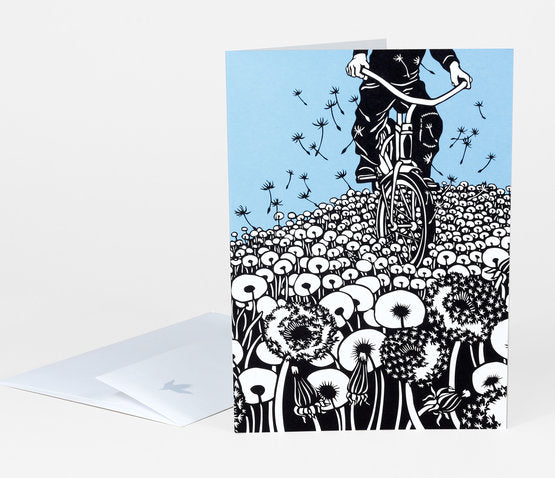 |
| Persist |
PBS Newshour Canvas segment on Nikki McClure, paper cutter.
She makes a yearly calendar. Each calendar month has a verb on it.
From her website:
In 1996 I made my first papercut for my first book, Apple. I have been cutting ever since. I now split my time between making a yearly calendar and making children’s books. I become a full-time berry picker in the summer. That is, when I’m not watching birds, hanging out with moss, and swimming in the Salish Sea. I show my artwork and sometimes teach and I am always trying to learn how to do everything better.

"So he will be here," she thought. "What a good thing I told him all!"
She glanced at her watch. She had still three hours to wait, and the memories of their last meeting set her blood in flame.
"My God, how light it is! It's dreadful, but I do love to see his face, and I do love this fantastic light....
Anna Karenina, Part 2, Chapter 29
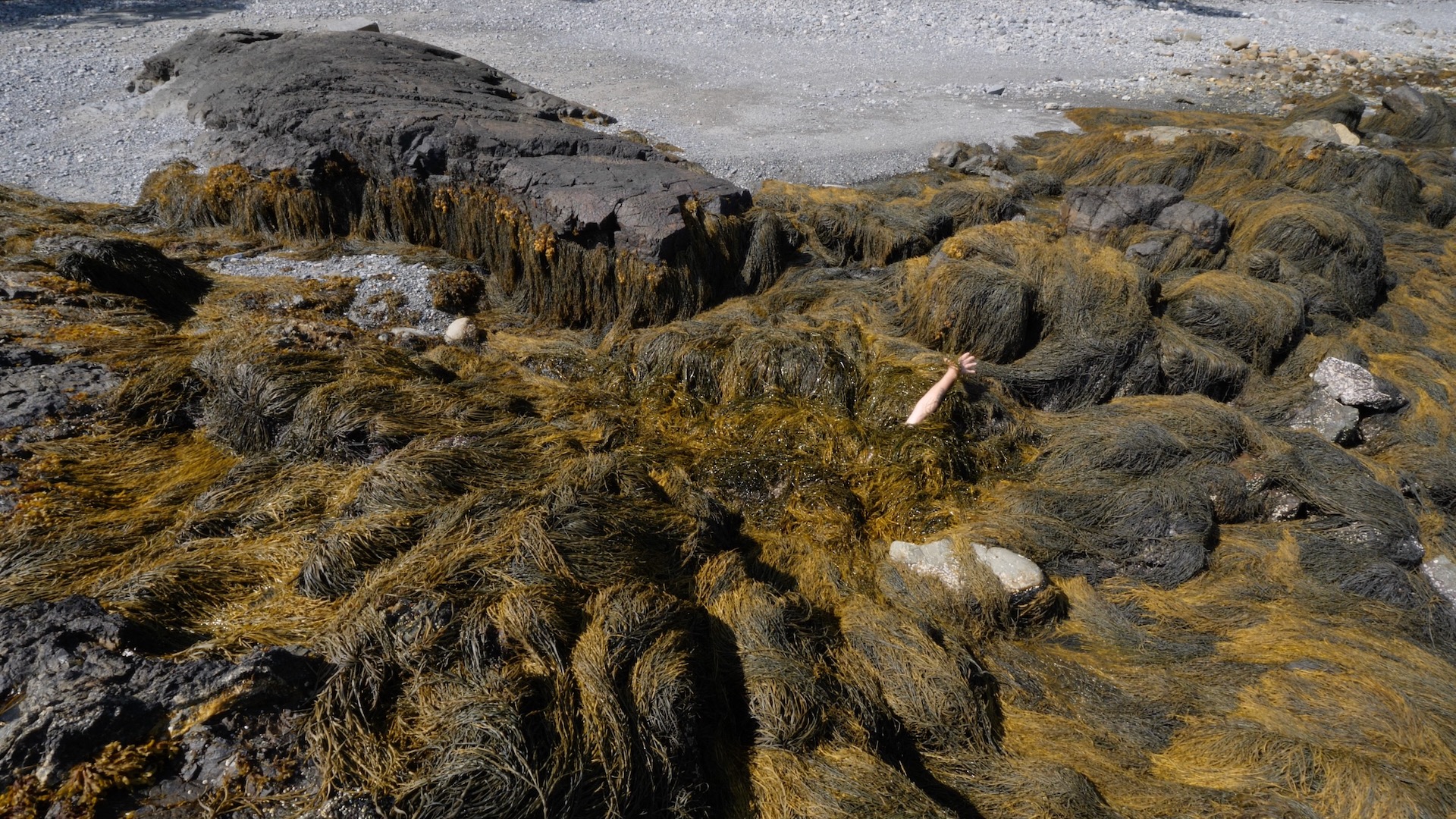 |
| From Goldsworthy's website |
Lying in rockweed
Compass Harbour, Maine
August, September 2023During the making of Road Line, I would, whenever possible, go to the shore, cover myself in rockweed and disappear. I would look at the sky through a lattice-work of rockweed that covered my face, listen to it crackle, be nibbled at by crabs, breathing heavily after the exertion of pulling rockweed over me. As the tide rose my breathing subsidised – the cold-water ebbing and flowing, in and out, as if taking over from where my breathing had left off. My body gently lifted by the sea until I began to float – carried back and forth by the tide.
When you're dealing with other at work, remember that other people are at different life stages than you currently are.... like you yourself used to be at a different life stage.
And you yourself will look at your current self (and your attitude towards the co-worker) as short tempered, naive, unwise, etc*. You and your work-mate are just two people in story that continues to change. The story in this book will, in the future, seem quaint, dated, slightly irrelevant to the new contingencies and alarms.
So, it helps to be patient when dealing with others... and to remember that we, too, the one trying to be wise and patient, is also changing. It might be your future self has a wiser way of working with the co-worker... would give you some good advice.
(*but also (and this is a different story) healthy, strong, vibrant, filled with ideas)

In my favorite things of 2023, I noted:
90. In November, December, the accumulating "first signs" of winter -- the first puddle freezes, the first frost, the first snowflake, etc.
Yesterday (Feb 23) I took this photo of a maple tree by school. The tiny tendrils are bursting out of the bud -- looking pretty alien.
Also yesterday, sandhill cranes overhead.
On a walk in neighborhood with Jennie on Feb 21 - Lenten Rose emerging both leaves and blossom. Also, first time I notice 4" high tulips along the back patio.
A couple years ago, I noted this Thoreau quote about how the pond knows changes in the season before he does (As surely as the spring)
Awhile ago, winter aconite.
Show Love Every Day
Love isn't confined to one day on the calendar—it's a daily commitment.
In line with the Gottman principle of "small things often," it's the consistent, everyday acts of love that truly nurture relationships.
Whether it's a warm smile, a heartfelt compliment, or lending a helping hand, these small gestures accumulate and contribute to deeper connection and intimacy over time.
By prioritizing these moments of tenderness and appreciation in your daily life, you can cultivate a deeper sense of closeness and strengthen the bond with your partner.
So, show love every day by doing the little things, because it's these small acts of kindness that fuel the flame and keep love alive year-round.
What will you do to show your partner love today?
To Mark Anthony in Heaven
by: William Carlos Williams (1883-1963)
 HIS quiet morning light

From the Telegraph article " The unbelievable discoveries I made studying a page of an OS map for a year"
Over the course of my roaming years, I realised that much of what I was searching for on my expeditions lay inside my head and heart, rather than beyond the next horizon. I wondered, therefore, whether I could find challenge and intrigue closer to home. So I walked a lap of the M25 to search for adventure even in mundane surroundings. It turned out to be a surprisingly interesting journey that set me searching for short, simple, affordable escapades – microadventures – that were compatible with busy daily life.
These weekend rides, wild camps and wild swims are not “better” adventures than cycling across a continent with a tent strapped to the back of a bike (nothing is), but nor are they “worse”. Microadventures are simply a way to maximise the opportunities in your life, rather than bemoaning the barriers getting in the way of your dream escapades. They are about being excited about the possibilities for the weekend, rather than feeling regretful you don’t have months to spare.
I decided to spend an entire year exploring the single Ordnance Survey map I live on. The country is covered by their Explorer series of maps, each covering approximately 20km x 20km, and divided into one kilometre individual grid squares. My map lies in an unremarkable corner of the country, on the outskirts of a city, with the steady hum of traffic and the orange glow of streetlights. But you don’t have to live in the beautiful South Downs or Lake District to enjoy spending time outdoors and discovering new places. I committed to visit a single grid square per week and to try my best to explore it thoroughly. I wanted to build a habit of curiosity, and so concentrated on taking photographs during the walks and bike rides as a way to remind myself to slow down and pay attention.
I worried at first that the project would be boring. That the area of my map was too small and claustrophobic. That the landscape was too built-up, with not enough streams and hills. That a single map was certainly not enough exploration for an entire year.
The very first week dissuaded me of those worries. I headed to an unremarkable expanse of marshland that I’d never bothered to visit before. Reminding myself to operate on the principle of what Sir Terry Pratchett described as “The Importance of Being Amazed about Absolutely Everything”, I began snapping photos and scribbling down notes of things to learn more about when I got home. The closer I looked, the more I saw. The more I saw, the more there was to see.
I noticed how much I usually missed when out running or cycling. My phone became my trusty professor – point the Seek app at a plant or creature and it identifies it for you; the Merlin app listens to birdsong and tells you what bird is singing away. I learned more about nature than I ever managed while studying for my A-Levels or university degree.
Both the randomness and the determination to be curious were important. I anticipated at the outset that I would enjoy the rural grid squares and tolerate the concrete ones. But, in fact, my favourite weeks were those spent poking around forgotten landscapes behind industrial estates, where saplings pushed through cracked concrete and butterflies enjoyed the pesticide-free wildflowers. I loved the silence of the forgotten edgelands outside towns, the surprising wildness of strips of woodland alongside busy roads, and the solitude I often felt in these unloved, ignored places.

The Dharma Seal of Plum Village is “I have arrived, I am home.” It means happiness is possible. Freedom is possible. Right now. Right here.
THICH NHAT HANH

Seth Godin blog lists infrastructure that supports him this relates to Gregg Krech
I’m lucky to have access to things like:
 |
| Mark Rothko |
As I'm reviewing old blog posts, one thing that's ringing true is the importance/necessity of not complaining and being grateful. Right now, it seems like it's not just being aware of thing or recognizing that we are interrelated, but also, how to take pleasure in things.
I'm thinking that there's a ladder of these things:
How to “take pleasure in”...
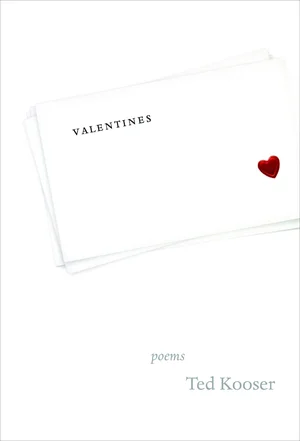
A couple years ago I posted on Mail Art (link). Here's another kind of mail art...
Browsing at the Thomas Ford Library I came upon this Ted Kooser book called Valentines. This from the LOC site, where Kooser was named the 13th Poet Laureate Consultant in Poetry to the Library of Congress:
I’ve always thought of Valentine’s Day as the Poets’ Holiday, because it’s our one special day celebrating the unembarrassed communication of feelings, which of course is what poetry is all about. And of course verses and Valentine’s Day have been joined in greeting cards for as long as most of us can remember.
I began writing Valentine’s Day poems in 1986. I’d have them printed on postcard-sized stock, put a small heart sticker in a corner, and mail them to friends. Several times I had them mailed from Valentine, NE, so they’d have a Valentine postmark. Over the course of the next twenty-one years—as my list of recipients ballooned from 50 to 2,500—the costs of my quirky hobby got out of hand and I had to stop. Thank goodness the University of Nebraska Press collected all the valentines, commissioned my friend Bob Hanna to do pen and ink illustrations, and created a book, Valentines.
 |
| Chuck Close, “Fred/Diptych,” 2017-2018, oil on canvas, 36” x 30.” The subject is Fred Wilson, the artist; the works were shown briefly in Hong Kong but not in New York.Chuck Close, via Pace Gallery |
NY Times article "Gallery Shows Last Works by chuck Close. Will it Repair a Reputation?"
Asked if the National Gallery would do a Close show now, its director, Kaywin Feldman, said: “Close will always be an important artist in our collection and we will continue to show his work in perpetuity, but because we haven’t talked about a show, I can’t say what we’d do.”
The National Portrait Gallery adjusted its wall labels to note the allegations, but kept its Close portrait of President Bill Clinton hanging. “At the Portrait Gallery, we try to be fairly transparent about a person’s life,” said Kim Sajet, the director. “But there’s no moral test to be here, or nobody would be here at all.”
 |
| from: https://www.ruthozeki.com/about-ruth |
5 Things I Learned from Ruth Ozeki's interview with Ezra Klein
1. Meditation. 2. Emptiness. 3. Beginner's Mind. 4. Marie Kondo. 5. Capitalism.
Meditation and Returning. [V]ery often meditation is something that we think of as being done with the mind. And I actually experience it somewhat differently. I experience it as something that starts in the body and is really rooted in the body....
When we sit to meditate, our minds are very distractible and they get caught on thoughts and they start to drift away. And so at that point, the instruction usually is to return to the body, return to the breath.
And so this practice of return is something, I think, that’s very useful for writers to cultivate, because that’s exactly what we do on the page. We’re writing something and very often a self-critical thought will come in and suddenly we’re distracted. And then the instruction there is to sort of relax, relax the body, relax the mind, and just return.
The more we can accept that indeed the practice is just simply returning, as long as you continue to return, you’re doing the work. It sort of takes some of the pressure off. And it also gives you the resilience to continue to practice. I wish that I had been taught some of this when I was college age because I think I would have started writing a lot sooner.
Emptiness. Emptiness is one of those Buddhist terms that is so hard to define and translate into English. Emptiness really refers to reality as it is, that everything in the world is empty of a fixed, permanent, abiding self. In other words, everything is impermanent. Everything changes.
And at the same time, everything is also completely interconnected and coexist with everything else and cannot exist without everything else. And so it’s just simply describing the nature of things to materialize, to constellate, to come into being, to come into form, and then to fall apart again.
And one metaphor that I tend to like is the metaphor of a wave.
And so if you imagine the ocean as this vast expanse of emptiness, just this vast still ocean. And then the planets shift, and the tides pull, and the moon waxes and wanes. And suddenly from this emptiness, a wave starts to form. And it starts to poke its little head up from the ocean, and it looks around and it’s sort of like, wow, look at me. I’m a wave. I’m pretty great. I’m really something.
And then, of course, the planet continues to turn and the tides continue to pull. And then the wave starts to recede and it’s like, oh, no, help. And it disappears back into the ocean again.
And so this is kind of the relationship I see between form and emptiness. The wave is this temporary form that pops up and thinks it’s really something, just like us. And then time works on us, and the form that we’re in now starts to recede again. And the wave becomes part of the ocean, and we become part of the planet.
And it’s this constant flux, this ebb and flow, which is completely about impermanence. And it’s also completely about interbeing, or in Buddhism, we call it dependent co-arising. That we’re entirely dependent on our context, and within that context, we arise and then we fall. So it’s this notion of interbeing, I think, is really at the heart of the word emptiness.
Beginner's Mind. There’s a phrase in Zen Buddhism that comes from a koan, which is, not knowing is most intimate.
And that it’s when we don’t know something and when we can sit in that state of not knowing is when there’s a kind of an intimacy with the world around us. And this is something that Shunryu Suzuki, who is the founder of the San Francisco Zen Center — he talks about beginner’s mind. This is another iteration of beginner’s mind.
And what he says about beginner’s mind is that in the beginner’s mind, possibilities are endless, and in the expert’s mind, they’re few. And so this idea that in this state of not knowing, curiosity and engagement with the world arises, for lack of a better word. And that engagement, that curiosity is intimate and very, very alive.
And this really pertains, I think, to the process of any kind of creation, music, art, certainly literature, is the ability to sit in that state of not knowing and somehow find some way to rest there, somehow find some way to be comfortable there. Because it’s a very uncomfortable feeling as a novelist. When I start writing a novel, I know nothing about it. And what I really want is to know something. I want to know everything about it, about this fictional world.
And so there’s a kind of tension between the state of not knowing and then the state of knowing. And so somehow through meditation, I’m trying to cultivate the ability to sit in a relaxed state in that generative tension between knowing and not knowing until some kind of answers start to arise.
Marie Kondo. so when Marie Kondo started her laudable campaign of world domination, she was telling us to care for our objects, to exercise some sort of recognition and care, and recognize that we have a relationship with our objects, right? That they’re not just things that come into our life and that we throw away. That there’s a real connection there, or that there should be.
And so when she talks about how, for example, you have a pair of socks that have worn themselves out taking care of your feet. They’ve worn themselves out to the point where they are threadbare and have holes in them. You don’t just throw them away.
You take a moment, and it can just be a brief moment, to hold them and look at them and appreciate them. And then you throw them away. That sounds fanciful, I understand. And she also talks about how socks don’t like to be rolled up and turned inside out into a ball because it stretches them, right? And it makes them uncomfortable. They like to be folded.
OK, so she has very prescriptive ideas about what objects prefer. And of course, you could look at that as being sort of extreme anthropomorphism or just simply craziness. But there’s a long tradition of this in other cultures, certainly in Japan.
And so when I read Marie Kondo’s book for the first time, I thought, oh, she’s introducing a very Japanese sensibility to a Western audience. And it’s a very traditional sensibility, and it comes from the Shinto religion, which is an animistic religion, where things do have agency. They have spirits.
Trees have spirits in them. Scissors have spirits. Umbrellas, shoes, prayer beads have spirits. And they are taken care of as though they are sentient, OK?
Capitalism. I mean, at its root, this is what capitalism does best, right? I mean, it first of all creates this enormous appetite for things, and then it tells us that whatever we have is not enough. So it’s no wonder — I mean, I think that is a form of madness. It seems to me there’s no question about that.
But how do we navigate that madness? I think the reason that there are so many clutter clearing shows and this whole genre of self-help has sprung up, because we have such a fraught relationship with objects, and we want objects because of some sense of insufficiency in ourselves. But then once the object becomes part of our self, in other words, once we own it, it’s no longer enough because that insufficiency is perpetual. So I think we are all mad in that sense.
Books: Norman Fisher’s book called “When You Greet Me I Bow: Notes and Reflections From a Life in Zen.” the third book is actually Jane Bennett’s “Vibrant Matter: A Political Ecology of Things.” “The Aleph and Other Stories.” And that collection includes the eponymous story “The Aleph,” which figures really heavily in this last novel of mine. And there’s also an essay in it, which I love, called “Borges and I.”
 Wassily Kandinsky - Lyrisch (Lyrical) |
The curriculum we have developed takes on a challenge that so many of us face: how to create, beyond the confines of our personalized digital universes, something resembling a shared world.It starts with experience, both individual and collective, with a focus on students’ self-conscious and self-aware experiences of reading, observing, reflecting and problem-solving. Consider a simple exercise known as “Attention in Place,” inspired by the work of the experimental writer Georges Perec. For his short work, “An Attempt at Exhausting a Place in Paris,” Mr. Perec sat at a corner cafe in his beloved city and over the course of three days recorded everything he saw, with particular attention to the supposedly mundane (what he called “infra-ordinary”) events that might under normal circumstances have gone unnoted.In our much shorter exercise, after reading an excerpt from Mr. Perec’s work, participants head out into the neighborhood and spend 30 minutes jotting down their observations of absolutely whatever unfolds in the world around them. Upon returning to the group, we sit in a circle and read one line each, consecutively, from these newfound observations.Sounds so simple! But the results are very close to miraculous: A common ground is rediscovered in the weave of collective attention. What I saw, you heard; the breeze that you felt passed my corner as well. A joint song of place unfolds, and with it a giddy, collective sense that the world is ours. The first-person plural becomes real, and the dynamics of attention are revealed as the choreography of our individual beings in shared time and space.
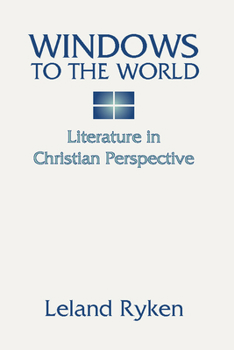
I stumbled across this blog post by someone named Tony Reinke. Two important things. First, he wrote this post which gives a simple and well-said "Christian" viewpoint about the value of literature.
"One of the best little summaries of the value of literature in the Christian life comes from Leland Ryken’s book Windows To the World: Literature in Christian Perspective (Wipf and Stock, 2000). Here’s what Ryken writes on page 34:"
“Literature is life. If you want to know what, deep down, people feel and experience, you can do no better than read the stories and poems of the human race. Writers of literature have the gift of observing and then expressing in words the essential experiences of people.
The rewards of reading literature are significant. Literature helps to humanize us. It expands our range of experiences. It fosters awareness of ourselves and the world. It enlarges our compassion for people. It awakens our imaginations. It expresses our feelings and insights about God, nature, and life. It enlivens our sense of beauty. And it is a constructive form of entertainment.
Christians should neither undervalue nor overvalue literature. It is not the ultimate source of truth. But it clarifies the human situation to which the Christian faith speaks. It does not replace the need for the facts that science and economics and history give us. But it gives us an experiential knowledge of life that we need just as much as those facts.
Literature does not always lead us to the City of God. But it makes our sojourn on earth much more a thing of beauty and joy and insight and humanity.”

I've recently written about one blog post of Tony Reinke which was about a conception of literature in a book that he wrote.
I'm also interested in his own life project.
Second, the blog author's background. He has a life trajectory is sports writing, blogging, ministry. podcasting. He names his "research interests" which turn into "book projects." Many of the book projects are free eBooks. I admire the purpose-filled life. He's a writer and devote Christian. So, he makes money doing Cristian stuff. He has side projects in addition to his social media money making. He writes blog posts like the one above which lifts an important passage from a book -- which I'm guessing that he might fit into a future project.
My name is Tony Reinke, an author, non-profit journalist, and host and producer of John Piper’s podcast now entering its second decade (Ask Pastor John). The bulk of my current work centers on how we best flourish in the tech age saturated by innovation, media, and enough on-demand video to fill our eyes for 100 lifetimes.
My research interests are reflected in my seven book projects to date:
Lit! A Christian Guide to Reading Books (Crossway, 2011) — a theology of literature and literacy, and packed with a bunch of realistic tips for getting more reading done in our digitally-busy lives.
Newton on the Christian Life: To Live Is Christ (Crossway, 2015) — a detailed study of the timeless pastoral counsel from the personal letters of John Newton (1725–1807), a slave trader turned gentle pastor.
12 Ways Your Phone Is Changing You (Crossway, 2017) — a deep look into the pros and cons of our new digital lives . . . lives that are never offline.
The Joy Project: An Introduction to Calvinism (with Study Guide) (DG & Cruciform, 2018) — an introduction to how we are saved, why we are saved, and why happiness is at the center of God’s plan.
Competing Spectacles: Treasuring Christ in the Digital Age (Crossway, 2019) — an essay to help Christians thrive in the age of digital eye candy.
God, Technology, and the Christian Life (Crossway, 2022) — a biblical study to explain where technology came from, where it’s headed, and how we should relate to it now.
Ask Pastor John: 750 Bible Answers to Life’s Most Important Questions (Crossway; March 5, 2024) — a CliffsNotes compendium of the 750 most popular episodes from our podcast’s first decade.
Officially I serve as a Senior Teacher for Desiring God, and produce and host the Ask Pastor John podcast, dedicated to questions of Christian theology and ethics. For fun, I manage a tribute site to my favorite Dutch theologian (hermanbavinck.org).
My Background
I’m a Christian, more specifically, an evangelical, reformed, credo-baptist, complementarian, continuationist, Christian hedonist. I believe the glorious and profound biblical truth that God is most glorified in us when we are most satisfied in him, and I was happy to sign this document.
Married for 25 years to the wife of my youth and my best friend, we have three precious kids, mostly named after dead preachers.
My career in sports journalism launched just as newsprint was declining. I left the industry in the late 1990s and entered the digital world of blogging and social media in 2006. Writing online for fun eventually led to my first full-time ministry gig, serving on the web to assist C.J. Mahaney (2008–11) and now John Piper (2012–present). My work mixes theological research, content curating, writing, editing, interviewing, audio broadcasting, and social media.
Today I consider myself an investigative journalist of practical theology, leveraging key resources from the greatest thinkers in church history to address the perplexing questions facing Christians today. I use no research assistants or ghostwriters.
Thanks for reading!
Tony

According the Wikipedia:
The Proust Questionnaire is a set of questions answered by the French writer Marcel Proust, and often used by modern interviewers.[1]
Proust answered the questionnaire in a confession album—a form of parlor game popular among Victorians.
Your idea of happiness
To live in contact with those I love, with the beauties of nature, with a quantity of books and music, and to have, within easy distance, a French theater
Your main fault
Not knowing, not being able to "want".


I owe this framing to the late, great Ursula Franklin, and to a speech she gave in 1986, in which she said:
We cannot be part of a discussion on whatrisks a certain technology has without asking whose risks. It makes an awful lot of difference. Assume you are talking about video display terminals, for example; the great discussion is “Are they or are they not putting the operator’s health or eyes at risk?” You don’t discuss whether there are risks; you discuss whose risks. Who is it that is at risk? It’s quite pointless to talk about risk-benefit without saying “Are those who are at risk also getting the benefits, or are those who are getting the benefits very far removed from the risk?”…The questions to ask are “Whose benefits? Whose risks?” rather than “What benefits? What risks?”
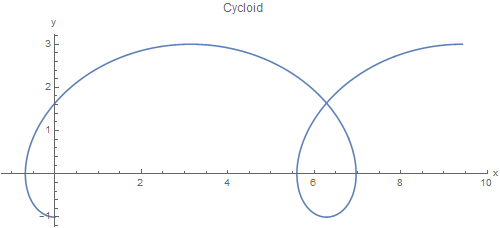 |
| A cycloid is the curve traced by a point on the rim of a circular wheel, of radius 𝑎 rolling along a straight line |
You may crave order and stability, but that stability is a moving target, it's always somewhere new. Stability doesn't come from resisting change. It comes from learning to work with it. The latest findings from psychology, biology, sociology, philosophy, and neuroscience all demonstrate that change itself is neutral. It becomes negative or positive based on how you view it—and more importantly, what you do with it. Life is an ongoing and oscillating series of ebbs and flows. The average person undergoes more than 30 significant life changes. Marriage. Divorce. Kids. School. Graduation. Moving. Illness. Recovery. Starting jobs. Leaving jobs. Promotions. The list goes on and on. Old models represent change as a cycle of order, disorder, order. Change is something that happens to you. The goal is to get back to where you were. But this is neither accurate nor how change, which is to say life, actually works. Change and disorder are not the exceptions. They are the rules. Look closely and you'll see that everything is always changing, including you. Life is flux. The only time something is static is when it's dead. A better and more accurate way to view change is as a continuous cycle of order, disorder, reorder, a phrase first coined by Richard Rohr. Yet our models for change are old and outdated. Here's a better way: Developing a strong, enduring, and cohesive sense of self means learning to ride the waves.
It requires equal parts ruggedness and flexibility.
To be rugged is to be tough, determined and durable.
To be flexible is to consciously respond to altered conditions, to adapt and bend without breaking.
Put them together and you get a gritty endurance, an anti-fragility that not only withstands change but thrives in its midst.
without looking back
leaving one home for the next BashoOh strong-ridged and deeply hollowed
nose of mine! what will you not be smelling?


