Thursday, June 29, 2023

Seek out discomfort

  • What if instead of tolerating discomfort (e.g. feeling awkward or uncomfortable), people actively sought it out? 
  • We suggest that seeking discomfort as a signal of growth can increase motivation...

from Tweet by Ethan Mollick, who says:

Great paper for teaching & learning. Tell students: “Your goal is to feel awkward and uncomfortable.” Giving an explicit goal of aiming to feel uncomfortable in order to grow makes folks persist in classes, write better, seek out more info & learn more from political opponents.

***

In The Pocket Pema Chodron, in Chapter 3, "The path of the bodhisattva-warrior"....'

Wherever we are, we can train as a warrior. The practices of meditation, loving kindness, compassion, joy, and equanimity are our tools.  With the help of these practices, we can uncover the soft spot of bodhichitta, the tenderness of the awakened heart. We will find that tenderness in sorrow and in gratitude. We will find it behind the hardness of rage in in the shakiness of fear. It is available in loneliness as well as in kindness.  

Many of us prefer practices that will not cause discomfort, yet at the same time we want to be healed.  But bodhichitta  training doesn't work that way. A warrior accepts that we can never know what will happen to us next. We can try to control the uncontrollable by looking for security and predictability, always hoping to be comfortalbe and safe.  But the truth is that we can never avoid uncertainty. This not knowing is part of the adventure, and it's also what makes us afraid.

Bodhichitta training offers no promise of happy endings. Rather, this "I" who wants to find security - who wants something to hold on to -- can finally learn to grow up. The central question of a warrior's training is not how we avoid uncertainty and fear but how we relate to discomfort. How do we practice with difficulty, with our emotions, with the unpredictable encounters of an ordinary day? 

***

Jim Collins, in Good to Great, also says we must "confront the most brutal facts of our reality." 

Wednesday, June 28, 2023

The Donation Stand or Garbage Amnesty Scrum


In a nearby neighborhood I jogged past a mom and daughter sitting at a folding table along the street.  As I approached, I thought "lemonade stand.... cute!"  As I got closer, I saw that the table was covered not with lemonade fixings, but stuffed animals.  I registered as I passed that there was a sign that said "Free. Donations to [charity name] appreciated."  Or something like that.  

Right on, parent!  I don't know whose idea it was to not "sell" used stuff, but to give it away and to ask for donations to worthy cause.  More normally, when we get the new stuff, the old stuff gets garage-saled or donated (with the intention of tax write-off).  

At the same time, I seem to be getting sacked by tons of references to making money, selling, being entrepreneurial (meaning, selling shit to people).  I've been thinking about how living in Western Springs is a constant reminder of other families' affluence ... and USE of money.  

Recently, there was a trash amnesty day in Western Springs.  All afternoon and into the evening people drove by in cars and trucks to find some treasure in other peoples' trash.  My memory was that this was mostly "scrapers" looking for metal or usable appliances.  But this year it was a much bigger crowd.  Families in cars, dispersing at the curb to root through piles.  It was young couples.  It was single young men.  It was a family with kids pulling a wagon.  In all honesty, people were throwing away a lot of usable shit.  But the general melee.  The traffic jam of cars -- 3 wide sometimes.  In the photo above, you can see a large van with a huge rack on top and in the back.  In the foreground, a young woman who, with her boyfriend/husband, looked to be setting up an entire apartment.  

As the van went by, the man in the passenger side shouted to all, "we're winning!"

And I've been reading "How to Do Nothing" by Jenny Odell.  

It makes me think of Arnel and his "we can do a trade" for hand-made things.

Tuesday, June 27, 2023

TV Buddha


TV Buddha, 1974

American Masters episode on Nam June Paik references Buddhism throughout.  There's an article about his fraught relationship on American Masters here.

If the Buddha were here today, what would he do with television?

Nam June Paik answers with his famous TV Buddha installation of 1974: a statue of Buddha sits in meditation facing a television set; on top of the set, a closed-circuit camera points at the Buddha and feeds a live image of it into the screen. The work is simple and funny, yet, like Paik’s best work, allows multiple and contradicting interpretations

Is the Buddha lost in its own image, entranced as we are by the magic of the closed circuit, a forerunner to the selfie?

***

Is the piece a joke, cutting the gravitas attached to Buddhism? Or is it a reverential update to Buddhist art, Paik’s answer to the brush masters and sculptors of the past?

***

One of the main questions of Buddhism is how to face the suffering of the world. Paik seemed to live with that question in every moment, driving himself into endless experiments and collaborations, generating countless works in many media. His answer, unlike many artists, was not in beauty— “newness is more important than beauty,” he said, and it’s hard to call many of his works beautiful, or even pleasant. Experimentation was his art; his relentless, optimistic quest to expand the limits and definition of communication were his answer to suffering.

Paik’s landmark Good Morning Mr. Orwell, a live variety show of avant-garde art that featured friends like Merce Cunningham and Laurie Anderson, broadcast on New Year’s Day of 1984 and reached an estimated 25 million people across America and South Korea, Europe and the Eastern Bloc. Despite technical issues, Paik considered the project a success. If only artists, rather than nations and corporations, could harness the TV’s power, perhaps we could use it not to control, but to astonish, to show us new possibilities.

If the Buddha were here today, what would he do with television? Paik’s TV Buddha shows us that he’s already here, both watching and broadcasting into the screen. What to make of this broadcast Buddha, and how to use that screen to face our suffering—Paik leaves that for us to figure out.

In the main page about the episode: "Avant-garde artist Nam June Paik saw a future in which “everybody will have his own TV channel.” With the advent of social media and the rise of platforms like YouTube and TikTok, Paik’s vision of the future looks startlingly like the present." 

Monday, June 26, 2023

Information Superhighway


Nam June Paik, Electronic Superhighway: Continental U.S., Alaska, Hawaii, 1995, fifty-one channel video installation (including one closed-circuit television feed), custom electronics, neon lighting, steel and wood; color, sound, approx. 15 x 40 x 4 ft., Smithsonian American Art Museum, 

I learned about this from the American Masters episode on Nam June Paik, "Moon is the Oldest TV."  According to Smithsonian: 

When Nam June Paik came to the United States in 1964, the interstate highway system was only nine years old, and superhighways offered everyone the freedom to "see the U.S.A. in your Chevrolet." Walking along the entire length of this installation suggests the enormous scale of the nation that confronted the young Korean artist when he arrived. Neon outlines the monitors, recalling the multicolored maps and glowing enticements of motels and restaurants that beckoned Americans to the open road. The different colors remind us that individual states still have distinct identities and cultures, even in today's information age.
Paik augmented the flashing images "seen as though from a passing car" with audio clips from The Wizard of Oz, Oklahoma, and other screen gems, suggesting that our picture of America has always been influenced by film and television. Today, the Internet and twenty-four-hour broadcasting tend to homogenize the customs and accents of what was once a more diverse nation. Paik was the first to use the phrase "electronic superhighway," and this installation proposes that electronic media provide us with what we used to leave home to discover. But Electronic Superhighway is real. It is an enormous physical object that occupies a middle ground between the virtual reality of the media and the sprawling country beyond our doors.


Sunday, June 25, 2023

Will, desire, and training

Crows in an Old Tree, by Yosa Buson, 18th century

From "How to Do Nothing," by Jenny Odell: (72)

Margaret Y. Henry writes about Cicero:

He freely admits that antecedent and natural causes gives men a tendency in one direction or another. But he insists that men are nevertheless free to perform specific acts independent of such tendencies and even in defiance of them... Thus a man may build a character quite at variance with his natural disposition.

Cicero cites the example of Stilp and Socrates: "It was said that Stilpo was drunken and Socrates was dull, and that both were given to sensual indulgence. But these natural faults they uprooted and wholly overcame by will, desire, and training (voluntate, studio, disciplina).  

If we believed that everything were merly a product of fate or disposition, Cicero reasons, no one would be accountable for anything and therefore there could be no justice. In today's term, we'd all just be algorithms. Furthermore, we'd have no reason to try to make ourselves better or different from our natural inclination.


Saturday, June 24, 2023

Sparrow Sound Map of the Neighborhood


Icon Perched on a Tree, Isoda Koryusai, 1785

I've just finished Means of Ascent and am back to David George Haskell's "Sounds Wild and Broken."  I'm learning (156) about how bird songs -- the incredible diversity that individual birds sing as well as how songs change over time.

Other bird species learn not just one but multiple song variants.  Song sparrows, common suburban and rural birds across North America, sing eight to ten different variants of their jaunty song of accented notes and trills, repeating each variant several times before switching to another.  Every bird has its own repertoire. By listening carefully, we humans can build a sparrow-sound map of the neighborhood, drawn in air by ephemeral ink of birdsong. Their repertoires are just rich enough to challenge human memory.  From one spot in a garden in Tennessee I can hear five males and about forty song variants, a delight as I try to notice and keep each songster's collection in mind.

That would be beyond my ability!  But I'm intrigued by that sparrow sound map.

The brown thrasher, though, defeats human ears.  Each singer has up to two thousand phrases in its quiver.  These it shoots out for hours in volleyed pairs. . . . Some of the sonic variants are mimicked versions of other species, suggesting that learning continues throughout life, but most are the birds' creations.

Friday, June 23, 2023

Living out the programming of your ancestors

 I had this image of myself yesterday of behaving like, acting like Uncle Mike.  It's like I'm (unknowingly) living out the programming of my "ancestors."  This is an idea that I encountered in Thich Nhat Hahn before, an appreciation of unknown constraints on your behavior that come to you from "ancestors."  

The constraints could be DNA, a way of perceiving things.

The constraints could also be the trauma/support you recieved from your parents -- the things passed down, the phrases, the behaviors, the idea of what to pay attention to...

Also, I recently thought of a line chart of a life (my life) where the Y-axis is "interestingness" and the X-axis is years.  There must be peaks and valleys in the line chart.  There must be spikes and flat lines.  

And if you think... well, maybe one peak was my year spent abroad.  OK... well, then, how did THAT come to be?  I got that idea from somewhere, I went to a school that made study abroad pretty cheap, I was "allowed" to go.  But I was also conditioned somewhere/somehow to value doing something like that.  

It's not hard to considered my 20-year old self as "constrained" or "conditioned."  Why would I be different now?  

I'm thinking now of a teacher at work, middle age has tightened, hardened her.  The extraneous, the soft has fallen away, leaving a skeleton of things that were already there.  I'm imagining that that's her genetic/familial destiny coming through.  

Thursday, June 22, 2023

To behold is to become beholden to


Sparrows and plum blossoms, by Hishida Shunso, 1910
Jenny Odell, in How to Do Nothing:

Once, when I was giving a talk on my research for this book at a Stanford urban studies working group, somebody asked whether using iNaturalist wasn't alienating me from the landscape, since it represented an itemizing, scientific view. I answered that while I had to admit it looked that way, the app was a necessary step the remediation of my ignorance, a temporary, crutch. Learning the names of things was my first step in perceiving not just "land" or "greenery," but living bodies instead.  And, at least at home, it wasn't as thought I stopped paying attention once I learned their names.  Instead I remained observant over the seasons, learning not just their names but what they did, or rather, who they were.  And at some point, this led to something in excess of disinterested observation -- not just with Crow and Crowson or the local night herons, but with everything, the plants and the rocks and the fungus. Eventually, to behold is to become beholden to. (145)


Wednesday, June 21, 2023

Branch Library by Edward Hirsch

 Branch Library 

I wish I could find that skinny, long-beaked boy
who perched in the branches of the old branch library.

He spent the Sabbath flying between the wobbly stacks
and the flimsy wooden tables on the second floor,   

pecking at nuts, nesting in broken spines, scratching
notes under his own corner patch of sky.

I'd give anything to find that birdy boy again
bursting out into the dusky blue afternoon

with his satchel of scrawls and scribbles,
radiating heat, singing with joy.

Tuesday, June 20, 2023

Middle Season #17

In the yard and neighborhood: Rose Campion, front yard hydrangea filling out, echinacea reaching out its petals, and basswood (linden?) that are filling the neighborhood with thick perfume... peak around 18th

Bemis walk: several pretty weeds: morning glory, clover, a fern with clover-like pink flower, foxglove, wild strawberries (?), a barn swallow on its mud-daubed nest.


Monday, June 19, 2023

Book Notes on The Pocket Thich Nhat Hanh


Notebook Export
The Pocket Thich Nhat Hanh (Shambhala Pocket Classics)
Thich Nhat Hanh

1. Mindfulness
A Life of Miracles > Page 3
Around us, life bursts forth with miracles—a glass of water, a ray of sunshine, a leaf, a caterpillar, a flower, laughter, raindrops. If you live in awareness, it is easy to see miracles everywhere. Each human being is a multiplicity of miracles. Eyes that see thousands of colors, shapes, and forms; ears that hear a bee flying or a thunderclap; a brain that ponders a speck of dust as easily as the entire cosmos; a heart that beats in rhythm with the heartbeat of all beings. When we are tired and feel discouraged by life’s daily struggles, we may not notice these miracles, but they are always there.
Freedom > Page 10
Every one of us has the tendency to run. We have run all of our lives, and we continue to run into the future where we think that some happiness may be waiting. We have received the habit of running from our parents and ancestors. When we learn to recognize our habit of running, we can use mindful breathing, and simply smile at this habit and say, “Hello, my dear old friend, I know you are there.” And then you are free from this habit energy. You don’t have to fight it. There is no fighting in this practice. There is only recognition and awareness of what is going on. When the habit energy of running manifests itself, you just smile and come back to your mindful breathing.
Resting > Page 13 
We do not sit in order to struggle to get enlightenment. No. Sitting first of all is for the pleasure of sitting. Walking first of all is for the pleasure of walking. And eating is for the pleasure of eating. And the art is to be there 100 percent.
Loving Presence > Page 14
Some people live as though they are already dead. There are people moving around us who are consumed by their past, terrified of their future, and stuck in their anger and jealousy. They are not alive; they are just walking corpses. If you look around yourself with mindfulness, you will see people going around like zombies. Have a great deal of compassion for the people around you who are living like this. They do not know that life is accessible only in the here and now.
Mindfulness of Breath > Page 16 
As you breathe in, you can say to yourself, “Breathing in, I know that I am breathing in.” When you do this, the energy of mindfulness embraces your in-breath, just like sunlight touching the leaves and branches of a tree. The light of mindfulness is content just to be there and embrace the breath, without doing it any violence, without intervening directly. As you breathe out, you can gently say, “Breathing out, I know that I am breathing out.”
Touching the Earth > Page 22 
In the Buddhist tradition I am part of, we do a practice called “Touching the Earth” every day. It helps us in many ways. You too could be helped by doing this practice. When you feel restless or lack confidence in yourself, or when you feel angry or unhappy, you can kneel down and touch the ground deeply with your hand. Touch the Earth as if it were your favorite thing or your best friend.
Mindful Living > Page 24
When I hold a piece of bread, I look at it, and sometimes I smile at it. The piece of bread is an ambassador of the cosmos offering nourishment and support. Looking deeply into the piece of bread, I see the sunshine, the clouds, the great earth. Without the sunshine, no wheat can grow. Without the clouds, there is no rain for the wheat to grow. Without the great earth, nothing can grow. That is why the piece of bread that I hold in my hand is a wonder of life. It is there for all of us. We have to be there for it.
Ruling the Five Skandhas > Page 27 
Whenever we have fifteen “free” minutes, or an hour or two, we have the habit of using television, newspapers, music, conversation, or the telephone to forget and to run away from the reality of the elements that make up our being.
Ruling the Five Skandhas > Page 28 
few days practicing like this can increase the energy of mindfulness in you, and that energy will help you, protect you, and give you courage to go back to yourself, to see and embrace what is there in your territory.
Habit Energy > Page 30 
We have to learn the art of stopping—stopping our thinking, our habit energies, our forgetfulness, the strong emotions that rule us. When an emotion rushes through us like a storm, we have no peace. We turn on the TV and then we turn it off. We pick up a book and then we put it down. How can we stop this state of agitation? How can we stop our fear, despair, anger, and craving? We can stop by practicing mindful breathing, mindful...
A Day of Mindfulness > Page 35 
calm and relaxing way, each movement done in mindfulness. Follow your breath, take hold of it, and don’t let your thoughts scatter. Each movement should be done calmly. Measure your steps with quiet, long breaths. Maintain a half smile. Spend at least a half hour taking a bath. Bathe slowly and mindfully, so that by the time you have finished, you feel light and refreshed. Afterward, you might do household work such as washing dishes, dusting and wiping off tables, scrubbing the kitchen floor, or arranging books on their shelves. Whatever the tasks, ... Don’t do any task in order to get it over with. Resolve to do each job in a relaxed way, with all your attention. Enjoy and be one with your work. Without this, the day of mindfulness will be of no value at all. The feeling that any task is a nuisance will soon disappear if it is done in mindfulness. Take the example of the Zen masters. No matter what task or motion they undertake, they do it slowly and evenly, without reluctance.
A Day of Mindfulness > Page 36 ·
Drink your tea slowly and reverently, as if it is the axis on which the whole earth revolves—slowly, evenly, without rushing toward the future. Live the actual moment. Only this moment is life. Don’t be attached to the future. Don’t worry about things you have to do.
Highlight(orange) - A Day of Mindfulness > Page 38 · Location 536
Such a day of mindfulness is crucial. Its effect on the other days of the week is immeasurable. After only three months of observing such a day of mindfulness once a week, I know that you will see a significant change in your life. The day of mindfulness will begin to penetrate the other days of the week,
2. Enlightenment
Highlight(orange) - Interbeing > Page 41 · Location 544
you are a poet, you will see clearly that there is a cloud floating in this sheet of paper. Without a cloud, there will be no rain; without rain, the trees cannot grow; and without trees, we cannot make paper. The cloud is essential for the paper to exist. If the cloud is not here, the sheet of paper cannot be here either. So we can say that the cloud and the paper “inter-are.” “Interbeing” is a word that is not in the dictionary yet, but if we combine the prefix “inter-” with the verb “to be,” we have a new verb, “inter-be.” If we look into this sheet of paper even more deeply, we can see the sunshine in it. If the sunshine is not there, the forest cannot grow. In fact, nothing can grow. Even we cannot grow without sunshine. And so, we know that the sunshine is also in this sheet of paper. The paper and the sunshine inter-are. And if we continue to look, we can see the logger who cut the tree and brought it to the mill to be transformed into paper.
Highlight(orange) - Impermanence > Page 46 · Location 591
Buddha taught that everything is impermanent—flowers, tables, mountains, political regimes, bodies, feelings, perceptions, mental formations, and consciousness. We cannot find anything that is permanent. Flowers decompose, but knowing this does not prevent us from loving flowers. In fact, we are able to love them more because we know how to treasure them while they are still alive. If we learn to look at a flower in a way that impermanence is revealed to us, when it dies, we will not suffer. Impermanence is more than an idea. It is a practice to help us touch reality.
Highlight(orange) - Impermanence > Page 47 · Location 608
What makes us suffer is wanting things to be permanent when they are not.
Highlight(orange) - Nothing to Attain > Page 52 · Location 647
There is nothing to do, nothing to realize, no program, no agenda. This is the Buddhist teaching about eschatology. Does the rose have to do something? No, the purpose of a rose it to be a rose. Your purpose is to be yourself. You don’t have to run anywhere to become someone else. You are wonderful just as you are. This teaching of the Buddha allows us to enjoy ourselves, the blue sky, and everything
Highlight(orange) - Nothing to Attain > Page 52 · Location 654
Most people cannot believe that just walking as though you have nowhere to go is enough. They think that striving and competing are normal and necessary. Try practicing aimlessness for just five minutes, and you will see how happy you are during those five minutes.
Highlight(orange) - Beyond Birth and Death > Page 54 · Location 667
The Buddha said, “When conditions are sufficient, the thing manifests, and when they are not sufficient, the thing remains hidden.”
Highlight(orange) - Beyond Birth and Death > Page 54 · Location 670
The word “suchness” describes reality as it is. Concepts and ideas are incapable of expressing reality as it is. Nirvana, the ultimate reality, cannot be described, because it is free of all concepts and ideas. Nirvana is the extinction of all concepts. It is total freedom. Most of our suffering arises from our ideas and concepts.
Highlight(orange) - Pure Land > Page 57 · Location 696
The fact is that the Pure Land is always available. The question remains: are we available to the Pure Land? To make ourselves available to the Pure Land is not difficult at all. Become mindful while you look, while you touch, while you touch the earth with your feet. It is possible for us to stay in the Pure Land twenty-four hours a day, with the condition that we keep mindfulness alive in us.
Highlight(orange) - Pure Land > Page 59 · Location 715
wonders of life are there, right in the present moment inside of us and around us. Our brain is a wonder. Our eyes are a wonder. Our heart is a wonder. Every cell of our body is a wonder. And around us everything is a wonder.
Highlight(orange) - No Fear > Page 65 · Location 760
NO FEAR When we look deeply into our fear, we see the desire for permanence.
Highlight(orange) - Three Doors of Liberation > Page 70 · Location 800
The first door is emptiness. Everything is empty. Empty of what? Empty of a separate self. A flower is full of everything in the cosmos—sunshine, clouds, air, and space. It is empty of only one thing, a separate existence. That is the meaning of emptiness. We can use this as a key to unlock the door to reality. The second door is signlessness. If you see a flower only as a flower and don’t see the sunshine, clouds, earth, time, and space in it, you are caught in the sign of the flower. But when you have touched the nature of interbeing of the flower, you truly see the flower. If you see a person and don’t also see his society, education, ancestors, culture, and environment,
Highlight(orange) - Three Doors of Liberation > Page 70 · Location 807
The third door is aimlessness. We already are what we want to become. We don’t have to become someone else. All we have to do is be ourselves, fully and authentically. We don’t have to run after anything. We already contain the whole cosmos. We simply return to ourselves through mindfulness and touch the peace and joy that are already present within us and all around us. I have arrived. I am already home. There is nothing to do. This is the third key for unlocking reality. Aimlessness, non-attainment, is a wonderful practice.
Highlight(orange) - The Businessless Person > Page 72 · Location 820
“businessless person,”
Highlight(orange) - The Businessless Person > Page 72 · Location 825
This is the essential teaching of Master Linji. When we learn to stop and be truly alive in the present moment, we are in touch with what’s going on within and around us. We aren’t carried away by the past, the future, our thinking, ideas, emotions, and projects.
Highlight(orange) - The Businessless Person > Page 73 · Location 833
medicine for our ills. Buddhist teachings are skillful means to cure our ignorance, craving, and anger, as well as our habit of seeking things outside and not having confidence in ourselves.
Highlight(orange) - Smile of the Bodhisattva > Page 75 · Location 852
Non-fear is the greatest gift we can offer to those we love. Nothing is more precious. But we cannot offer that gift unless we ourselves have it. If we have practiced and have touched the ultimate dimension of reality, we too can smile the bodhisattvas’ smile of non-fear. Like them, we don’t need to run away from our afflictions. We don’t need to go somewhere else to attain enlightenment.
Highlight(orange) - Right Path > Page 78 · Location 870
RIGHT PATH Happiness means feeling you are on the right path every moment. You don’t need to arrive at the end of the path in order to be happy. The right path refers to the very concrete ways you live your life in every moment. In
Highlight(orange) - Right Path > Page 80 · Location 886
You don’t need to be someone else; you’re already a wonder of life.
3. Emotions and Relationships
Highlight(orange) - The Wounded Child Inside > Page 84 · Location 902
The first function of mindfulness is to recognize and not to fight.
Highlight(orange) - Seeds > Page 91 · Location 964
Once we become aware of our actions, we can decide whether or not something is beneficial; if it’s not, we can decide not to repeat that action. If we’re aware of the habit energies in us and can become more intentional in our thoughts, speech, and actions, then we can transform not only
Highlight(orange) - Blocks and Knots > Page 93 · Location 976
Every time we acknowledge a feeling of pain and make its acquaintance, we come in close contact with ourselves. Bit by bit we look deeply into the substance and the roots of that pain. Fear, insecurity, anger, sadness, jealousy, and attachment form blocks of feelings and thoughts within us (Sanskrit: samyojana, “internal formation”), and we need time and opportunity to acknowledge them and to look into them. The mindfulness of breathing does the work of making painful feelings bearable. Mindfulness recognizes the presence of the feelings, acknowledges them, soothes them, and enables the work of observation to continue until the substance of the block is seen. Mindfulness is the only way to transform it.
Highlight(orange) - Blocks and Knots > Page 94 · Location 983
“knots” of suffering deep in our consciousness. The knots are created when we react emotionally to what others say and do, and also when we repeatedly suppress our awareness of both pleasant and unpleasant feelings and thoughts. The fetters that bind us can be identified as any painful feeling or addictive pleasant feeling, such as anger, hatred, pride, doubt, sorrow, or attachment. They are forged by confusion and a lack of understanding, by our misperceptions regarding our selves and our reality. By practicing mindfulness, we are able to recognize and transform unpleasant feelings and emotions when they first arise, so they do not become fetters.
Highlight(orange) - Mindfulness of Consumption > Page 99 · Location 1026
In order to forget that we have blocks of pain,
Highlight(orange) - Mindfulness of Consumption > Page 99 · Location 1026
sorrow, fear, and violence, we lose ourselves in the practice of consumption. Why do we turn on the television? Why do we continue to watch, even if the programs are not interesting at all? We watch because we want something to cover up
Highlight(orange) - Mindfulness of Consumption > Page 99 · Location 1028
our pain, sorrow, fear, and anger. We don’t want those feelings to come up, so we suppress them by consuming. There is some feeling of loneliness, fear, or depression inside that we don’t want, so we pick up the newspaper, we turn on the radio, we turn on the television, we pick up the phone, we go for a drive. We do everything we can to avoid confronting our true selves. This kind of consumption is a practice of running away, and the items we consume continue to bring the toxins of violence, fear, and anger into us. By practicing an embargo on our negative feelings, we create a situation of bad circulation in our psyche, suppressing our unwanted thought patterns and not allowing them to circulate. When we create a situation of bad circulation in our consciousness, it causes symptoms of depression and mental illness. When the blood in our body does not circulate well, we experience physical pain—we have a headache, a backache, sometimes there is pain everywhere.
Highlight(orange) - Four Mantras > Page 107 · Location 1098
The first mantra is “Dear one, I am here for you.” Perhaps this evening you will try for a few minutes to practice mindful breathing in order to bring your body and mind together. You will approach the person you love and with this mindfulness, with this concentration, you will look into his or her eyes, and you will begin to utter this formula: “Dear one, I am really here for you.” You must say that with your body and with your mind at the same time, and then you will see the transformation. To be there is the first step, and recognizing the presence of the other is the second step. To love is to recognize; to be loved is to be recognized by the other. If you love someone and you continue to ignore his or her presence, this is not true love. Perhaps your intention is not to ignore this person, but the way you act, look, and speak does not manifest
Highlight(orange) - Four Mantras > Page 108 · Location 1108
second mantra: “Dear one, I know that you are here, and it makes me very happy.” If you practice in this way, with a lot of concentration and mindfulness, you will see that this person will open immediately, like a flower blossoming.
Highlight(orange) - Mindful Communication > Page 112 · Location 1147
The same is true about our ability to listen deeply. If we have not been able to embrace and transform our own hurt and anger, it will be difficult to listen to another person’s suffering, especially if the other person’s speech is full of negative judgments, misperceptions, and blaming.
Highlight(orange) - Your True Person > Page 115 · Location 1167
The true person doesn’t go looking for an outside master. We are in charge of our own destiny and we have to be responsible for each of our words, thoughts, and actions. Mindfulness will help. Then we realize, “I’m thinking like this, I’m responsible for these thoughts. I’ve spoken like that, I’m responsible for my words. I’m doing this, and I’m responsible for this action.” We have to know that each word, each thought, each of our actions carries our signature. We are responsible for it and that is called being in charge of ourselves. Wherever we stand, wherever we sit, we are the true person. We are masters of ourselves and wherever we are, we are ourselves.
Highlight(orange) - Letting Go > Page 118 · Location 1203
Say you have a notion of happiness, an idea about what will make you happy. That idea has its roots in you and your environment. The idea tells you what conditions you need in order to be happy. You’ve entertained the idea for ten or twenty years, and now you realize that your idea of happiness is making you suffer. There may be an element of delusion, anger, or craving in it. These elements are the substance of suffering. On the other hand, you know that you have other kinds of experiences: moments of joy, release, or true love. You recognize these as moments of real happiness. When you have had a moment of real happiness, it becomes easier to release the objects of your craving, because you are developing the insight that these objects will not make you happy. Many people have the desire to let go, but they’re not able to do so because they don’t yet have enough insight; they haven’t seen other alternatives, other doorways to peace and happiness. Fear
Highlight(orange) - Letting Go > Page 119 · Location 1210
an element that prevents us from letting go. We’re fearful that if we let go we’ll have nothing else to cling to. Letting go is a practice; it’s an art. One day, when you’re strong enough and determined enough, you’ll let go of the afflictions that make you suffer.
4. Peace
Highlight(orange) - The Thousand Arms of the Bodhisattva > Page 138 · Location 1358
In many Asian Buddhist temples, there is a statue of Avalokiteshvara Bodhisattva with a thousand arms. Each arm holds an instrument or object that represents a different sphere of activity in which the bodhisattva can manifest compassion and understanding. In one hand he holds a book—it might be a sutra text or a book on political science. Another hand holds a ritual instrument, such as a bell. Another holds a musical instrument. A modern version of the thousand-armed bodhisattva might hold a computer in one hand.
Highlight(orange) - Inclusiveness > Page 145 · Location 1435
We know that if the other side does not have peace and safety, then it will not be possible for us to have peace and safety. That is the nature of interbeing. With this insight we’ll be able to open our heart and embrace the other side.
Highlight(orange) - Peace Work > Page 153 · Location 1506

We are so busy we hardly have time to look at the people we love, even in our own household, and to look at ourselves. Society is organized in a way that even when we have some leisure time, we don’t know how to use it to get back in touch with ourselves. 

Sunday, June 18, 2023

Take your vacation where you can find it

Walking at Bemis. I see a family sitting at the edge of the long open, rolling meadow at the farthest end of parking lot. One kid, maybe 8 years old, is juggling a soccer ball. The younger one is throwing balls be lacrosse balls some game. Two parents are sitting in collapsible bag chairs at the edge of a blanket, just enjoying the 79°. Nice breezy weather. 

I’m thinking about how you can make a vacation anywhere anytime. Vacations don’t have to involve long trips, plane rides. It could be in the nearby forest preserve, if you position yourself wisely.

I'm not saying that you should take your vacation at any random place, or "your backyard could be your vacation."  Actually, backyards can often be noisy and so close to important tasks that need to be done.  


Instead, the place they chose was a little bit special.  The vista that they were watching was pretty good. Rolling. The breeze was pretty good. They had positioned themselves so they couldn't see the parking lot, the bathroom structure, even the shelter that had another family in it.


Take your vacation where you can find it.  


What does vacation mean? "Time away from....". Period. What? 

Saturday, June 17, 2023

Robots Don't Freak Out

 This playful Ten Percent Happier meditation led by Jeff Warren.  On the podcast, it's called 

According to the website: Be like a robot and try this light-hearted noting practice. Give your anxiety a break by immersing yourself fully in your external senses.

Warren starts with a couple calming breaths - in slow, then out on the count of four.  Keep your eyes open.  Then, at a rhythm of your own choosing, begin noting sights, sounds, thoughts.  Say: "Hear" or "See" or "Feel."  Make your voice a bit robotic.  You are calm, noting like a metronome. 

Initiate your noting sequence.  It's like you're pouring your attention outward.  Go at a pace that works for you.  Long exhales. Yoke your noting to the end of your breath.

Robots don't get rushed.  Keep the rhythm going.

Warren thanks his teacher Shinzen Young, a very skillful robot.

(I just thought of the connection between "noting" practice and "noticing.")

Friday, June 16, 2023

It's About Coming Back

 From Mandy Brown's A Working Library

Fifteen years of any practice is notable. There’s so much out there about habits and “streaks” and how life is just some number of days that are counting down more rapidly than you’d care to admit so you’d better spend it well—as if you could know the full measure of your life and so budget accordingly. But if there’s anything I know about practicing it’s that it isn’t about rules or consistency or scarcity or god forbid optimizing: it’s about coming back. A practice is built on the movement of return.

Thursday, June 15, 2023

Cage Piece


Astronaut Bruce McCandless II became the first human being to do a spacewalk without a safety tether linked to a spacecraft. In 1984, he floated completely untethered in space with nothing but his Manned Maneuvering Unit keeping him alive.

Jenny Odell, in How to Do Nothing, writes about Diogene's and how much discipline and effort it takes to be a refuseniks... people who refuse the normal trappings of the current world.  (Earlier she writes about Bartleby).  She talks about performance artist Tehching Hsieh.
In 1978, he built a roughly nine-foot-square cage in his studio for Cage Piece, a performance in which he would remain inside the cage for exactly a year.  Every day, a friend would visit to bring food and remove waste.  Beyond that, Hsieh drew up some draconian terms for himself: He was not allowed to talk, read, or write (except for marking each day on the wall); no television or radio was allowed. In fact, the only other thing in the cell besides the bed and the sink was a clock. The performance was open to the public once or twice a month; otherwise, he was alone.  Asked later how he spent his time, Hsieh said that he had kept himself alive and thought about his art.
In a 2012 interview, "Hsieh, who was preoccupied with time and survival, described the process by which people fill up their time in an atempt to fill their lives with meaning.  He was earnestly interested in the opposite: What would happen if he emptied everything out."

Wednesday, June 14, 2023

Moving from ego-center to zero-center

Sparrows and plum blossoms, by Hishida Shunso, 1910

 On Insight Hour Podcast #167, "Self and Self Loss," Joseph Goldstein talks about 3 levels of "dualism."  The talk is structured around these 3 levels of dualism/ dualistic thinking.  He references Ken Wilbur's book: Spectrum of Consciousness.

The three levels are: our separation from ALL things (the universe), the separation between ego and body, and, even within the I, the separation between personae and shadow.

Through mindfulness practice, we can explore our shadow side -- and it's necessary to welcome it, not hide it; we can think of the mind and body as a Centaur -- it's not like the mind (human rider) is on/controlling the body (horse), the two are united; and we can move from "ego-center" to "zero-center."  He says that we are not machines that are waiting for sounds to come.  Instead, "experience shows" that there is just hearing at that moment.  Our bodies and the environment create something together -- we "are" the hearing (or thinking, etc).  We don't have to do anything to hear.  It's always already happening.  

This is the clearest understanding that I've had about this important Buddhist concept (psychological concept? reality concept?)

The third level references the ego from our whole self. Goldstein talks at length about Jung's idea of the shadow. 

There are so many parts of our experience which we don’t like, we don’t want to be there. We condemn, we judge, we push away—it can be difficult feelings in the body, difficult emotions, feelings of hatred, rage, unworthiness, loneliness, profound alienation. It can be so many things, so many parts of the mind that are the shadow side. The process of healing, the process of integration, is a willingness to open to all of those sides, to see the shadow in all its manifestation.

In this episode, Joseph dives into:
  • How we create the concept of duality/separation (self and other, inside and outside, persona and shadow, etc.)
  • Understanding our practice of Dharma as reintegrating and unifying
  • Using mindfulness to shine light on our shadow by making the subconscious conscious
  • Moving from the ‘ego-center’ to the ‘zero-center’ using the intermediate space of love (a very deep appreciation, respect, and openness for every moment’s experience)
  • Carlos Castaneda and the relationship between impeccability and emptiness


Tuesday, June 13, 2023

Waiting for our senses to grow sharper

Yamabuki by Sakai Hōitsu, late 18th-early 19th century

 "The world is full of magic things, patiently waiting for our senses to grow sharper."                             ―W.B.Yeats

Monday, June 12, 2023

Buzz & Skuttle


On Twitter, @Hill_Marion writes this:

I’ve been illustrating the insects I spot in our tiny city garden. I’m astonished by the species diversity in such a small space (this is just a selection). We avoid mowing & digging, encourage ground cover, nurture weeds, created a small pond and log pile.

Here's her cool website: Buzz & Skuttle. Here are a lot of printable bug illustration resources.


Sunday, June 11, 2023

One Day by Robert Creeley

 One Day

One day after another—
Perfect.
They all fit.

Cotton Candy by Edward Hirsch

Cotton Candy

by Edward Hirsch

We walked on the bridge over the Chicago River
for what turned out to be the last time,
and I ate cotton candy, that sugary air,
that sweet blue light spun out of nothingness.
It was just a moment, really, nothing more,
but I remember marveling at the sturdy cables
of the bridge that held us up
and threading my fingers through the long
and slender fingers of my grandfather,
an old man from the Old World
who long ago disappeared into the nether regions.
And I remember that eight-year-old boy
who had tasted the sweetness of air,
which still clings to my mouth
and disappears when I breathe.

Friday, June 9, 2023

Re-charging our battery


I found in my mailbox a postcard from NCTE that had a line of images that looked like the icons of a computer battery charging.  I think the aim of the postcard was to ask teachers to recharge through subscribing to NCTE.  

I think I'll borrow that image to my year-end "thanks" email to the department.  

Two years ago I recall thinking about whether teachers knew how to re-charge.  I'm under the impression that the socially-designated ways that we are supposed to recharge (cocktails, Florida beaches, Netflix binging) may or may not actually work.  And that we should all investigate what things really do recharge our batteries -- sleeping? new experiences, new places, being in woods, making things, getting stronger, more flexible, checking in with friends, (re)newing.

The images in a line make me remember that re-charging takes time... There are roughly the same number of battery images as weeks off.  
Thursday, June 8, 2023

Training Apparatuses for Attention


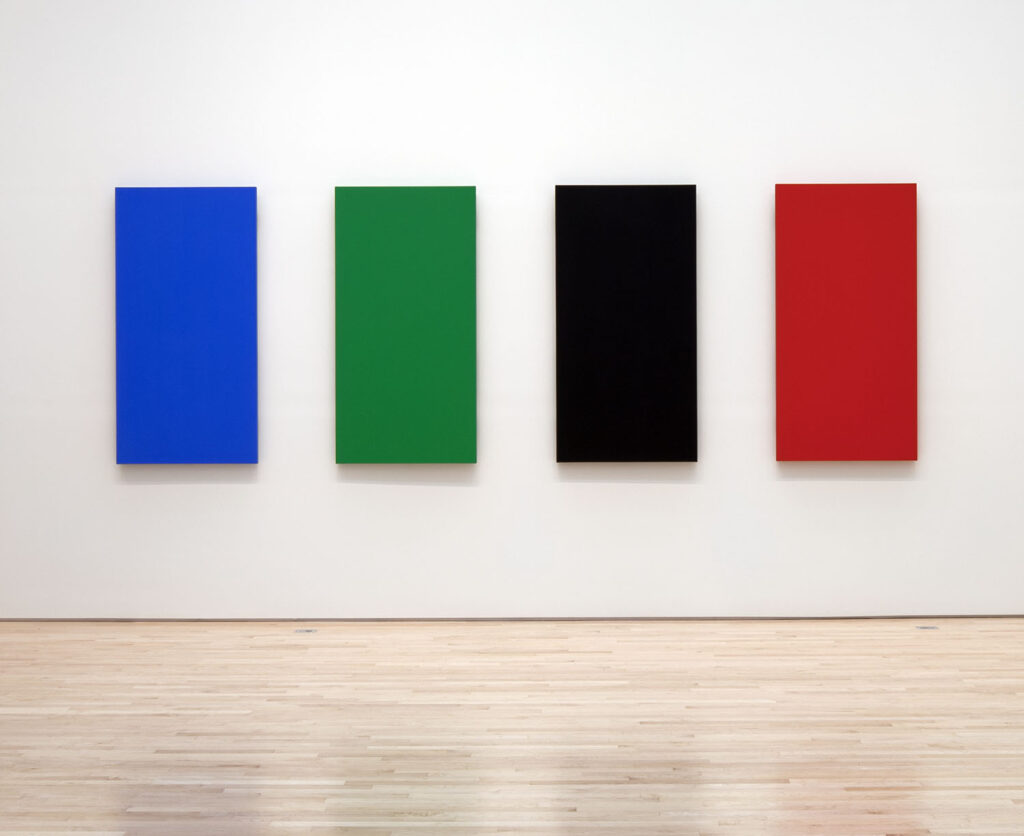
Ellsworth Kelly, Blue Green Black Red

In How to Do Nothing, Jenny Odell writes about an experience with Ellsworth Kelly's Blue Green Black Red.

For lack of a better description, the painting seemed active. I can't stress enough that this was a bodily feeling -- like Buber's tree, the painting "bodied" across from me.  I realized I needed to look at every single panel, spending the same amount of time on each one, since each color vibrated differently, or rather, my perception of the the color did.  Strange as it sounds to call a flat, monochromatic painting a "time-based medium," there was actually something to find out in each one -- or rather, between me and each one -- and the longer time I spent, the more I found out.  Somewhat sheepishly, I thought about how someone across the room, too far away to understand, would see me: a person matter-of-factly staring at one after another of panels with "nothing" on them.

These paintings taught me about attention and duration, and that what I'll see depends on how I look, and for how long.  It's. a lot like breathing. Some kind of attention will always be present, but when we take hold of it, we have the ability to consciously direct, expand, and contract it. I'm often surprised at how shallow bth my attention and my breathing are by default. As much as breathing deeply and well requires training and reminders, all of the artworks I've described so far could be thought of as training apparatuses for attention.  By inviting us to perceive at different scales and tempos than we're used to, they teach us not only how to sustain attention but how to move it back and forth between different registers.  As always, this is enjoyable in of itself. But if we allow that what we see forms the basis of how we can act, then the importance of directing our attention becomes all too clear.

Wednesday, June 7, 2023

To want what we want to want

 From Odell, How to Do Nothing

Odell cites James Williams, on U of Oxford's Practical Ethics blog.  The blog title is something like "why it's ok to block ads."

We experience the externalities of the attention economy in little drips, so we tend to describe them with words of mild bemusement like "annoying" or "distracting."  But this is a grave misreading of their nature.  In the short term, distractions can keep us from doing the things we want to do. In the longer term, however, they can accumulate and keep us from the living the lives we want to live, or even worse, undermine our capacities for reflection and self-regulation, making it harder, in the words of Harry Frankfurt, to "want what we want to want." Thus there are deep ethical implications lurking here for freedom, wellbeing, and even the integrity of the self.