
 |
| Silena Lambertini A month ago Charlotte asked me to go to senior night for band so that she wouldn't feel embarrassed that she lives in a single parent house. (or something similar). I was hesitant to say yes for a number of reasons - to begin with...Karrie hates me, won't agree to speak to me about co-parenting (etc.), Charlotte has contempt for me, will only text when she wants something from me. A few days ago, there was a sign up sheet for parent night. Kids wrote who was coming. Charlotte was one of the last blank names. This morning, after a challenging day at school/ half-day lockdown after a threat of violence, I see that it has been filled in: Accompanied by her mother, Karrie Lange. I could have expected nothing else. There has been no change. It still leaves me feeling bereft. |

Recently found a request on Twitter from Chicago Bird Collision Monitors about turning off lights at night to help migrating birds navigate around Chicago.
We encourage building management and the public to support light reduction in downtown and lakefront areas by turning off all bright display lighting on the top of your building in the downtown area or along the lakefront from 11:00 p.m. until sunrise during spring migration (March 15 to June 15) and fall migration (August 15 to November 15).
The image above is from Birdcast.info. It's call the Bird Migration Forecast Map.
NBC Chicago interviewed CBCM and reports:
According to the group, 50% of the birds that use the Mississippi River Valley migratory path from the Midwest and down to the Gulf Coast are expected to make their way through or around the Chicago area over a period of just nine select nights, depending on breed and departure time.
For example, more than 437 million birds are expected to be in the skies overnight on Sept. 24, with the Midwest seeing the highest concentration of activity.
I find it poetic and exciting that overhead at night the skies are filled with hundreds of millions of birds.
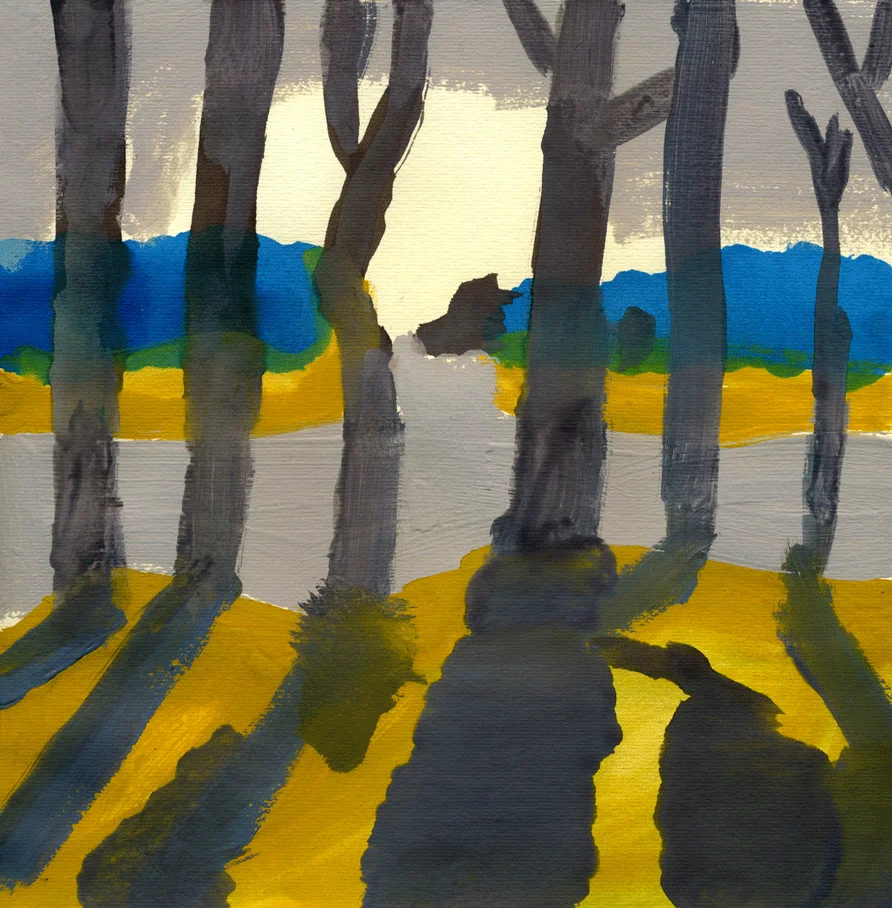
I've recently gotten interested in Leanne Shapton's work as an illustrator. I think I owned, and was bewildered by, a book of hers years ago. I especially like her watercolors.
Here's her work in the NYT called "A Month of".... Sunday Walks, Friday Swims, etc. You can see the series also on her webpage here. Here's "Sunday Walks."
She's art editor for NY Review of Books. And a journalist. Here she interviews Jon Klassen who did the cover of an issue.
Here's a "newsletter" from 'Telluride.
Here's a paragraph from an article about her from 2009
She phoned the legendary illustrator James McMullan, famous for his Broadway and Lincoln Center Theater watercolours, and landed an internship in his studio. She called the celebrated designer Milton Glaser for career advice. She interned at Saturday Night Live – "just a dogsbody and set design" – and reasoned her way into an art internship at Harper's Magazine – "you have editorial interns, why not an art intern?" All unpaid.
George Saunders in "A Swim in a Pond in the Rain," writes about one way that he produces text (rough drafts here). He considers a story to be a black box that a reader goes into and leaves in a different state. "What happens there has to be thrilling and non-trivial."
This approach might be called "following the voice."
An idea for a voice appears, and off you go. You just "feel like" doing that voice. (And you find that you can.) Sometimes the inspiration for that voice might be a real person. Sometimes it's a tendency in myself that I'll exaggerate (in a story called "The Falls," for example, I gave my main character, Morse, a ratcheted-up version of my own neurotic. worry-prone monkey mind). Sometimes it's a fragment of language that came from elsewhere (like that line from the student paper). The main thing I'd like to say about this mode of writing is that it's fun. When I do it, I'm giving almost no thought to anything but sustaining the voice--not thinking of the story's themes or what needs to happen next or any of that. In the early stages, I might not even be clear about why the person is talking the way he is. My only goal is to keep the energy of the voice high, to keep the character sounding like himself, which means, I've found, that the voice has to keep expanding. Having grasped the approximate "rules" of the voice, the reader will get restless if subjected to a series of sentences that (merely) abide by those rules. So I have to keep finding new ways to make the person sound like himself. The best way to do this is to keep putting new events in front of him, events that are escalatory (new to him), so that he has to find new registers in his voice with which to respond. (If a character, talking along in a certain voice, has never seen a horse before, and I show him one, his voice has to expand, to accommodate the horse.)
In the story mentioned above ("Jon"), what I found myself doing as I sat down to write every day, approximately, was giving myself permission to turn up a certain dial in my head labeled "Level of Inarticulateness:" That is, letting myself be (even) more inarticulate than usual easing up on the self-correction-before-speech we all normally do. I was just, you know, letting it rip, telling myself something like "Okay, do will surfer, part corporate wonk." I was aiming to make sentences that would be funny because of their defective syntax but that would also feel oddly efficient. ("Then came the final straw that broke the back of me saying no to my gonads.")
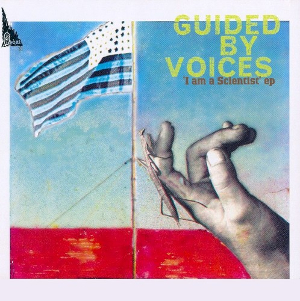
This form of writing reminds me of GBV's (purported) style of writing music by going through yearbooks and writing songs they thought THAT group of people would write.
 |
| Bees, from the Aberdeen Bestiary, England, ca. 1200 (Rabih A. tweet) |

North American Butterflies is a T-Magazine (NYT) feature from 2015. Check out the whole series.
From a series for T in which the artist Leanne Shapton makes new artworks from pictures in old books.
These works are inspired by “The Butterfly Guide” by W. J. Holland, published by Doubleday Page & Company, 1925. (The link goes to a Project Gutenburg version of the book.)
Appreciation is a wonderful thing. It makes what is excellent in others belong to us as well.
-Voltaire
I have been feeling down, sad. I notice that when I'm in that mode, I am often thinking about the "not enough" of things: time, money, love, appreciation. I'm thinking about the difference of Thubten Chodron's "It is Enough."
Abandoned Farmhouse
BY Ted Kooser

He was a big man, says the size of his shoes
on a pile of broken dishes by the house;
a tall man too, says the length of the bed
in an upstairs room; and a good, God-fearing man,
says the Bible with a broken back
on the floor below the window, dusty with sun;
but not a man for farming, say the fields
cluttered with boulders and the leaky barn.

A woman lived with him, says the bedroom wall
papered with lilacs and the kitchen shelves
covered with oilcloth, and they had a child,
says the sandbox made from a tractor tire.
Money was scarce, say the jars of plum preserves
and canned tomatoes sealed in the cellar hole.
And the winters cold, say the rags in the window frames.
It was lonely here, says the narrow country road.

Something went wrong, says the empty house
in the weed-choked yard. Stones in the fields
say he was not a farmer; the still-sealed jars
in the cellar say she left in a nervous haste.
And the child? Its toys are strewn in the yard
like branches after a storm—a rubber cow,
a rusty tractor with a broken plow,
a doll in overalls. Something went wrong, they say.

Ted Kooser, "Abandoned Farmhouse" from Sure Signs: New and Selected Poems. Copyright © 1980 by Ted Kooser.  Reprinted by permission of University of Pittsburgh Press.

Sunflower, flower of the hour (sidewalk weed by school), monarch on goldenrod
Hibiscus trionum, commonly called flower-of-an-hour, bladder hibiscus, bladder ketmia, bladder weed, modesty, puarangi, shoofly, and venice mallow, is a short-lived perennial or semi-seen annual plant that flowers for only one day a year. The flower has white or yellow petals with a brightly-colored center. It is considered a weed by some while being cultivated as a garden plant by others.
Hibiscus trionum, commonly known as flower of an hour, is an annual flowering plant that blooms from June to October. It grows 1.5 to 2 feet tall and can be found in various types of soil. The flower is a white to pale yellow with dark centers. This plant earned its name “flower of an hour” because it only blooms for a few hours before wilting
 |
| Alma Thomas. "Autumn Leaves Fluttering in the Breeze" (1973) |
In other words, voice is not just an embellishment; it's an essential part of the truth. In "The Nose," we feel the narrator to be from that world of functionaries and petty official and we hear that in his voice, and the story benefits from this; told in this way, the story has an extra dimension of truth, and of joy.
It may be possible that, when all is said and done, that's what we're really looking for -- in a sentence, in a book: joy (overflow, ecstasy, intensity). An acknowledgment, in the prose, that all of this is too big to be spoken of, but also that death begins the moment we give up on trying to speak of it. (309)
A couple thoughts: first, the notion that "joy (overflow)" is what sparks life. Second, that life is complex, messy and joyful, and it's "too big to be spoken of." Third, that our choice is to speak of that thing that's too big to be spoken of, or else "death begins" that moment we give up trying.

Tucker Nichols, a California artist, wrote and illustrated this "article" in the New Yorker. I love the artwork, the layout, and the text. In the online version, the format is different. Some of the images are bigger; there are two more paintings.
Last year, the Caldor wildfire burned through a wide swath of California’s Eldorado National Forest, an area in the central Sierra Nevada that I hike every summer. I returned in August, exactly one year after the fire started, and found a Pompeiian landscape: charred stumps, sooty ponds, thick drifts of ash. A firefighter told me that clifftops a thousand feet high had glowed red from the light of the flames. In a meadow, I gathered pieces of burned willow to use as charcoal for drawing. A clear creek cut through fresh growth. From behind the branches of a thicket, a deer stared at me, unmoving. Birds sang from blackened trees; the wind scattered seeds. The sky was as blue as ever.

In the 1970s, Edward Deci and colleagues gave what appeared to be wooden three-dimensional Tetris pieces [I later find these to be Soma cube puzzles, above] to a group of twenty-four college students and told them to build a shape out of the blocks. For three days, the students who returned to the lab were shown a new shape and went to work on the blocks sitting in front of them. For half of the participants, day two brought a pleasant surprise. For each puzzle that they solved in the allotted time, they’d receive a monetary reward. Motivated by something beyond simply killing time for the fun of it, the participants upped their work ethic, spending longer stretches on solving the puzzle.
But when the participants returned for day three, the monetary reward was gone. It was back to making the shapes for the sake of making shapes. Not surprisingly, with an external incentive gone, their motivation dropped. Participants spent less time attempting to create new shapes and were more apt to quit playing with the
blocks and simply sit there. The phenomenon we now know as extrinsic versus intrinsic motivation was born. Other scientists soon repeated the experiment in a range of different tasks and ape groups. Before too long, researchers had replicated the effect in schoolchildren drawing and athletes playing sports. When some external reward or punishment was introduced, it shifted people's motivational habits.
Deci, along with another psychologist, Richard Ryan, had a radical idea. 'Their findings on what motivated people didn't apply just to doing homework or solving a problem, but to something far greater; their well-being, Deci and Ryan expanded their work on intrinsic motivation, declaring that we all have three basic and innate psychological needs. If we satisfy these needs, our well-being will improve, and we'll be self-motivated for growth and development. Self-determination theory (SDI) was born. It include the need for autonomy, competence, and relatedness. Or said another way, to feel in control, like you can make progress, and to belong
Since the introduction of SDT, it has been investigated and applied to everything from parenting to teaching to substance abuse. And supporting Deci and Ryan's original hypothesis, net satisfaction is linked to better health, ratings of well-being, and performance in a variety of domains. Autonomy, competence, and relatedness serve as our basic psychological needs. And fulfi our basic needs helps not only with well-being, but also with to ability to persist.
 |
| Koson Ohara |
This is from Kleon: playwright Sarah Ruhl’s terrific book, 100 Essays I Don’t Have Time To Write.
Here is the essay in full:
Recently, my son said to me after seeing a ballet on television: “It’s beautiful but I don’t like it.” And I thought, Are many grown-ups capable of such a distinction? It’s beautiful, but I don’t like it. Usually, our grown-up thinking is more along the lines of: I don’t like it, so it’s not beautiful. What would it meant to separate those two impressions for art making and for art criticism
 |
| Repentance, depicted in a 15th cent Russian Orthodox painting, possibly from a Siberian cathedral, featuring Jonah and the Whale (from tweet by Rabih A.) |
They all looked, to him, anxious. He had often seen that anxiety before in the faces of Urrasti, and wondered about it. Was it because, no matter how much money they had, they always had to worry about making more, lest they die poor? Was it guilt, because no matter how little money they had, there was always somebody who had less? Whatever the cause, it gave all the faces a certain sameness, and he felt very much alone among them.
While he wants to find some good people to talk to in the city, perhaps some unwealthy people, he's unable to.
He had vaguely imagined wandering about the city and getting into conversation with people, members of the unpropertied class, if there still was such a thing, or the working classes, as they called them. But all these people hurried along, on business, wanting no idle talk, no waste of their valuable time. Their hurry infected him.
It's like anxiety, worry are first-order effects of capitalism. But there are second-order effects, too, like "sameness" and "hurry." It affects/infects them. It dulls them.
The dulling is a kind of imprisoning. The pursuit of needing money, wanting more money pursues them. And the possessions possess them. The main character contrasts the Anares world with his world saying that people on his world have happier, spirit-filled faces.
"We have nothing but that, nothing but each other. Here you see the jewels, there you see the eyes. And in the eyes you see the splendor, the splendor of the human spirit. Because our men and women are free—possessing nothing, they are free. And you the possessors are possessed. You are all in jail. Each alone, solitary, with a heap of what he owns. You live in prison, die in prison. It is all I can see in your eyes—the wall, the wall!"
There Are Birds Here BY Jamaal MayFor Detroit There are birds here, so many birds here is what I was trying to say when they said those birds were metaphors for what is trapped between buildings and buildings. No. The birds are here to root around for bread the girl’s hands tear and toss like confetti. No, I don’t mean the bread is torn like cotton, I said confetti, and no not the confetti a tank can make of a building. I mean the confetti a boy can’t stop smiling about and no his smile isn’t much like a skeleton at all. And no his neighborhood is not like a war zone. I am trying to say his neighborhood is as tattered and feathered as anything else, as shadow pierced by sun and light parted by shadow-dance as anything else, but they won’t stop saying how lovely the ruins, how ruined the lovely children must be in that birdless city. Jamaal May, "There Are Birds Here" from The Big Book of Exit Strategies. Copyright © 2016 by Jamaal May. Reprinted by permission of Alice James Books. Source: The Big Book of Exit Strategies (Alice James Books, 2016)

 |
| Hoitsu Sakai |
 |
| Marcella Giulia Pace, Italian astrophotographer who took ten years to capture 48 colours of the moon |
He had not been free from anything [on his own world]: only free to do anything. Here, it was the other way around.
things: things to buy, things for sale. Coats, dresses, gowns, robes, trousers, breeches, shirts, blouses, hats, shoes, stockings, scarves, shawls, vests, capes, umbrellas, clothes to wear while sleeping, while swimming, while playing games, while at an afternoon party, while at an evening party, while at a party in the country, while traveling, while at the theater, while riding horses, gardening, receiving guests, boating, dining, hunting—all different, all in hundreds of different cuts, styles, colors, textures, materials. Perfumes, clocks, lamps, statues, cosmetics, candles, pictures, cameras, games, vases, sofas, kettles, puzzles, pillows, dolls, colanders, hassocks, jewels, carpets, toothpicks, calendars, a baby’s teething rattle of platinum with a handle of rock crystal, an electrical machine to sharpen pencils, a wristwatch with diamond numerals; figurines and souvenirs and kickshaws and mementos and gewgaws and bric-a-brac, everything either useless to begin with or ornamented so as to disguise its use; acres of luxuries, acres of excrement.
And the strangest thing about the nightmare street was that none of the millions of things for sale were made there. They were only sold there. Where were the workshops, the factories, where were the farmers, the craftsmen, the miners, the weavers, the chemists, the carvers, the dyers, the designers, the machinists, where were the hands, the people who made? Out of sight, somewhere else. Behind walls. All the people in all the shops were either buyers or sellers. They had no relation to the things but that of possession.
“No. It is not wonderful. It is an ugly world. Not like this one. Anarres is all dusty and dry hills. All meager, all dry. And the people aren’t beautiful. They have big hands and feet, like me and the waiter there. But not big bellies. They get very dirty, and take baths together, nobody here does that. The towns are very small and dull, they are dreary. No palaces. Life is dull, and hard work. You can’t always have what you want, or even what you need, because there isn’t enough. You Urrasti have enough. Enough air, enough rain, grass, oceans, food, music, buildings, factories, machines, books, clothes, history. You are rich, you own. We are poor, we lack. You have, we do not have. Everything is beautiful here. Only not the faces. On Anarres nothing is beautiful, nothing but the faces. The other faces, the men and women. We have nothing but that, nothing but each other. Here you see the jewels, there you see the eyes. And in the eyes you see the splendor, the splendor of the human spirit. Because our men and women are free—possessing nothing, they are free. And you the possessors are possessed. You are all in jail. Each alone, solitary, with a heap of what he owns. You live in prison, die in prison. It is all I can see in your eyes—the wall, the wall!”
“Because there is nothing, nothing on Urras that we Anarresti need! We left with empty hands, a hundred and seventy years ago, and we were right. We took nothing. Because there is nothing here but States and their weapons, the rich and their lies, and the poor and their misery. There is no way to act rightly, with a clear heart, on Urras. There is nothing you can do that profit does not enter into, and fear of loss, and the wish for power. You cannot say good morning without knowing which of you is ‘superior’ to the other, or trying to prove it. You cannot act like a brother to other people, you must manipulate them, or command them, or obey them, or trick them. You cannot touch another person, yet they will not leave you alone. There is no freedom. It is a box—Urras is a box, a package, with all the beautiful wrapping of blue sky and meadows and forests and great cities. And you open the box, and what is inside it? A black cellar full of dust, and a dead man. A man whose hand was shot off because he held it out to others.
They all looked, to him, anxious. He had often seen that anxiety before in the faces of Urrasti, and wondered about it. Was it because, no matter how much money they had, they always had to worry about making more, lest they die poor? Was it guilt, because no matter how little money they had, there was always somebody who had less? Whatever the cause, it gave all the faces a certain sameness, and he felt very much alone among them.He had vaguely imagined wandering about the city and getting into conversation with people, members of the unpropertied class, if there still was such a thing, or the working classes, as they called them. But all these people hurried along, on business, wanting no idle talk, no waste of their valuable time. Their hurry infected him.
 |
| Hasui Kawase |
 |
| Angie Lewin, British printmaker working in linocut, wood engraving, lithography and screen printing |
 |
| Koson Ohara |
Serenely
gazing up at the mountain -
a toad
Issa Kobayashi

Making plans to share time together as a family, and being intentional about it, can help you grow closer to your loved ones.
Rituals can help us to process our feelings as we move through life’s transitions and to stay connected despite the pressures of everyday life. If you neglect to come together in a regular way, you may miss out on the feeling of being emotionally connected.
With the autumn season almost upon us, it's time to make new memories and share rituals of connection. Give these fall activities a try or come up with your own ways to celebrate this season together.

(from Van Gogh Museum tweet)
The places that Vincent van Gogh visited were not always attractive. And yet he tried to find beauty wherever he was. In a letter to his brother Theo, he wrote: ‘find things beautiful as much as you can, most people find too little beautiful’.
Where do you find beauty?
 |
| From French artist Helena Hauss' contemporary ceramics series ‘Hell Hath No Fury’ |
by Maya Angelou
I've got the children to tend
The clothes to mend
The floor to mop
The food to shop
Then the chicken to fry
The baby to dry
I got company to feed
The garden to weed
I've got shirts to press
The tots to dress
The cane to be cut
I gotta clean up this hut
Then see about the sick
And the cotton to pick.

Shine on me, sunshine
Rain on me, rain
Fall softly, dewdrops
And cool my brow again.

Storm, blow me from here
With your fiercest wind
Let me float across the sky
'Til I can rest again.

Fall gently, snowflakes
Cover me with white
Cold icy kisses and
Let me rest tonight.

Sun, rain, curving sky
Mountain, oceans, leaf and stone
Star shine, moon glow
You're all that I can call my own.


