Wednesday, March 31, 2021

Middle season #9


Top left:  Helleborus orientalis, also known as the Lenten rose, is a perennial flowering plant and species of hellebore in the buttercup family, Ranunculaceae, native to Greece and Turkey

Bottom left: clematis along the driveway beginning to extrude tiny leaves, as are other shrubs.  

Top right: tree is in field park.  Google lens says that it might be cornus officianalis, japanese cornel or Japanese cornelian cherry.  It's part of the dogwood family cornaceae.

Tuesday, March 30, 2021

My Father's Coat by Marc Smith


MY FATHER’S COAT

by Marc Kelley Smith
 
I’m wearing my father’s coat.
He has died. I didn’t like him,
But I wear the coat.

I’m wearing the coat of my father,
Who is dead. I didn’t like him,
But I wear the coat just the same.

A younger man, stopping me on the street,
Has asked,
“Where did you get a coat like that?”

I answer that it was my father’s
Who is now gone, passed away.
The younger man shuts up.

It’s not that I’m trying now
To be proud of my father.
I didn’t like him.
He was a narrow man.

There was more of everything he should have done.
More of what he should have tried to understand.

The coat fit him well.
It fits me now.
I didn’t love him,
But I wear the coat.

Most of us show off to one another
Fashions of who we are.
Sometimes buttoned to the neck
Sometimes overpriced.
Sometimes surprising even ourselves
In garments we would have never dreamed of wearing.

I wear my father’s coat,
And it seems to me
That this is the way that most of us
Make each other’s acquaintance—
In coats we have taken
To be our own.
 
After reading Ada Limon's poem, I thought of this darker poem that I recall hearing Smith recite at the Green Mill in Chicago during a Sunday night poetry slam. 

I just Googled Smith and found that he ran afoul of the Spoken Word Poetry movement.

Monday, March 29, 2021

The Raincoat by Ada Limon

The Raincoat

by Ada Limon

When the doctor suggested surgery
and a brace for all my youngest years,
my parents scrambled to take me
to massage therapy, deep tissue work,
osteopathy, and soon my crooked spine
unspooled a bit, I could breathe again,
and move more in a body unclouded
by pain. My mom would tell me to sing
songs to her the whole forty-five minute
drive to Middle Two Rock Road and forty-
five minutes back from physical therapy.
She’d say, even my voice sounded unfettered
by my spine afterward. So I sang and sang,
because I thought she liked it. I never
asked her what she gave up to drive me,
or how her day was before this chore. Today,
at her age, I was driving myself home from yet
another spine appointment, singing along
to some maudlin but solid song on the radio,
and I saw a mom take her raincoat off
and give it to her young daughter when
a storm took over the afternoon. My god,
I thought, my whole life I’ve been under her
raincoat thinking it was somehow a marvel
that I never got wet.

Sunday, March 28, 2021

Golden shovel poetry


From the NYT Magazine.

Poetry is very much about play. That is the joy of writing a poem and of being a poet. As Brooks herself once said: “Words can do wonderful things. They pound, purr. They can urge, they can wheedle, whip, whine. They can sing, sass, singe.”


So, what exactly is the golden shovel?

It’s a poem that takes a line from another poem or text (often a Gwendolyn Brooks’ poem, but not always) and uses each word in that line as the end of a line in the poem. For this poem, you will be using a headline from the newspaper as your line.

In honor of this poetic form, think about focusing your poem on the notion of “celebration” or “honor.” What do you celebrate in your life? What do you honor?


Here’s how to do it:

Be Picky. Search the paper for a headline of five or more words that speaks to you; you might cut out a few, so that you have options. Each word in the headline will be the final word of a line in your poem, so the length of your composition is dictated by the headline you choose.


Examine. Spread your headlines out before you and examine them. Which ones have the most potential? When you look at them, can you already imagine where those end words might take you? Pick one.

Credit. Be sure to write down the author of the article your headline came from, as well as the date of the issue. You will need to give credit to that writer at the bottom of your poem. (The poem above is drawn from an article by Jason Zinoman in the March 14 print edition of The New York Times.) 

Layout. Cut out your words and place them on a piece of paper at the end of each line in the order in which they originally appeared, following the pattern in the poem above.

Write. You are ready to write or type your poem (you might want to do this on scratch paper). Each line must end with your end word, but your actual sentence can flow over into the next line, though the final word of each line should feel like some kind of ending. In the poem above, for example, the first line ends with “aching,” which corresponds to the first word of the selected headline. See if you can include a simile, a metaphor or maybe some imagery to evoke the five senses. Do you want your poem to “pound” or “purr” on the page? Then, focus on sound and musicality. Have fun with this


NYT article link. https://www.google.com/amp/s/www.nytimes.com/2021/03/27/at-home/golden-shovel-poetry.amp.html%3f0p19G=2103


Saturday, March 27, 2021

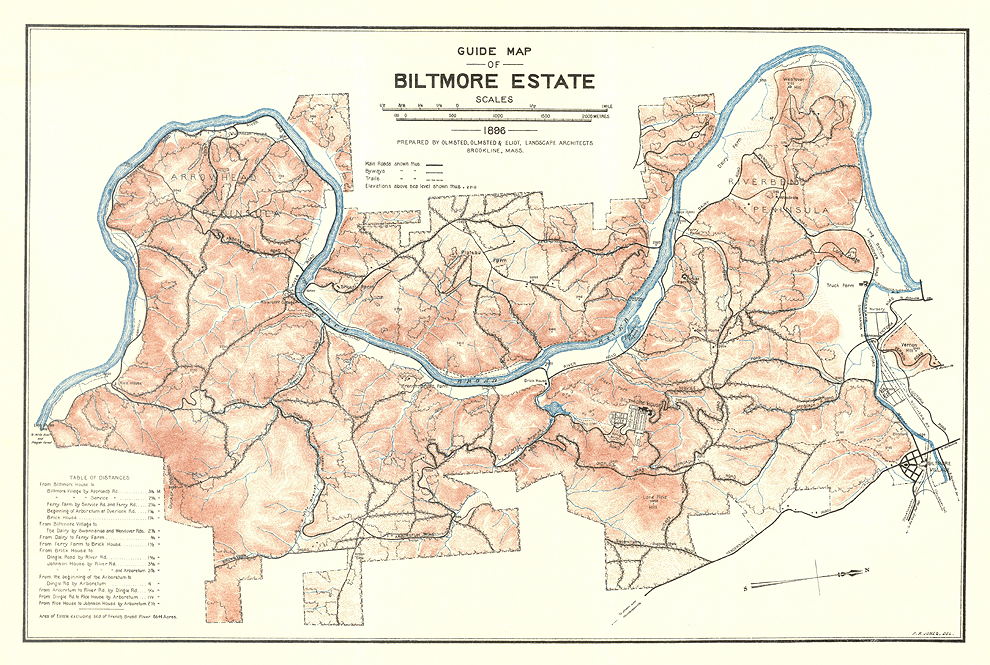
Olmsted and the Birth of Parks


The Library of Congress has released 24,000 items (47,300 images) of Frederick Law Olmsted's papers - mostly from 1838-1903.  

Harvard Graduate School in Architecture has 11 images of the construction of the Biltmore gardens here.

"When Parks Were Radical" from The Atlantic by Nathaniel Rich

 But it was a trip by foot through England in 1850 that awoke him to the value of public pleasure grounds. In a suburb of Liverpool, he visited Birkenhead Park at the urging of a local baker and was flabbergasted:

Five minutes of admiration, and a few more spent in studying the manner in which art had been employed to obtain from nature so much beauty, and I was ready to admit that in democratic America, there was nothing to be thought of as comparable with this People’s Garden.

Olmsted was especially excited to discover that Birkenhead’s beauty was shared “about equally by all classes”: men, women, children, sheep. This was novel at a time when most parks tended to be located within private estates or, as in the case of New York City’s Gramercy Park, locked behind gates, the keys reserved for wealthy neighbors. Birkenhead, not yet five years old, was the first park in England to be publicly funded.

An unmistakable irony creeps vinelike through Olmsted’s landscape theory: It takes a lot of artifice to create convincing “natural” scenery. Everything in Central Park is man-made; the same is true of most of Olmsted’s designs. They are not imitations of nature so much as idealizations, like the landscape paintings of the Hudson River School. Each Olmsted creation was the product of painstaking sleight of hand, requiring enormous amounts of labor and expense. In his notes on Central Park, Olmsted called for thinning forests, creating artificially winding and uneven paths, and clearing away “indifferent plants,” ugly rocks, and inconvenient hillocks and depressions—all in order to “induce the formation … of natural landscape scenery.” He complained to his superintendents when his parks appeared “too gardenlike” and constantly demanded that they “be made more natural.”

From WNC magazine, there's background on Biltmore and Olmsted's design.

Visiting Biltmore’s manicured and breathtaking grounds today, it’s shocking to think of what the place looked like when Olmsted initially laid eyes on it. Vanderbilt, the scion of one of the country’s wealthiest families, purchased a staggering 125,000 acres of land in and around Asheville. Much of it was thick with foliage and ruggedly beautiful, but the planned homesite was mostly deforested, flat, and scraggly.

“I was at my first visit greatly disappointed with its apparent barrenness and the miserable character of its woods,” Olmsted informed a colleague in one letter. In another, he complained of the “extremely poor and intractable” soil and declared that the estate would have to be built “out of the whole cloth.” According to Olmsted, he asked Vanderbilt, “What do you plan to do with all this land?” “Make a park of it, I suppose,” was the reply.

Olmsted tried to steer Vanderbilt down a different path. “Such land in Europe would be made a forest, partly, if it belonged to a gentleman of large means, as a preserve for game, mainly with a view toward crops of timber,” he argued. “That would be a suitable and dignified business for a man like you to engage in.”

In essence, Olmsted made a case not only for exquisite landscaping to showcase what would become a 250-room château (to be designed by renowned architect Richard Morris Hunt, whom Olmsted often collaborated with), but for a kind of forest management never before seen in the United States. Vanderbilt was persuaded, and took Olmsted’s advice to hire other specialists who would greatly impact the project: the pioneering foresters Gifford Pinchot and Carl A. Schenck. The efforts of those men to cultivate the nation’s first model forest would ultimately earn Western North Carolina the title “Cradle of American Forestry.”


Friday, March 26, 2021

Happiness that's not too big

unknown early flower I saw on an afternoon neighborhood walk

 “Some people want to feel happiness that’s too big,” Takei Moore said. “But for me, every day, I just look for something small.” 

This is from a NYT article about cooking with a traditional Japanese clay pot, called a donabe.  

There's so much research about the benefits of being grateful.  It's hard to find a daily planner with day spreads that don't begin with three lines for recording what you're grateful for.

But maybe there should be some instructions to get the best benefit from being grateful: be grateful for small things.

Or, to be specific to the quotation, find one small thing per day... and be grateful.


Thursday, March 25, 2021

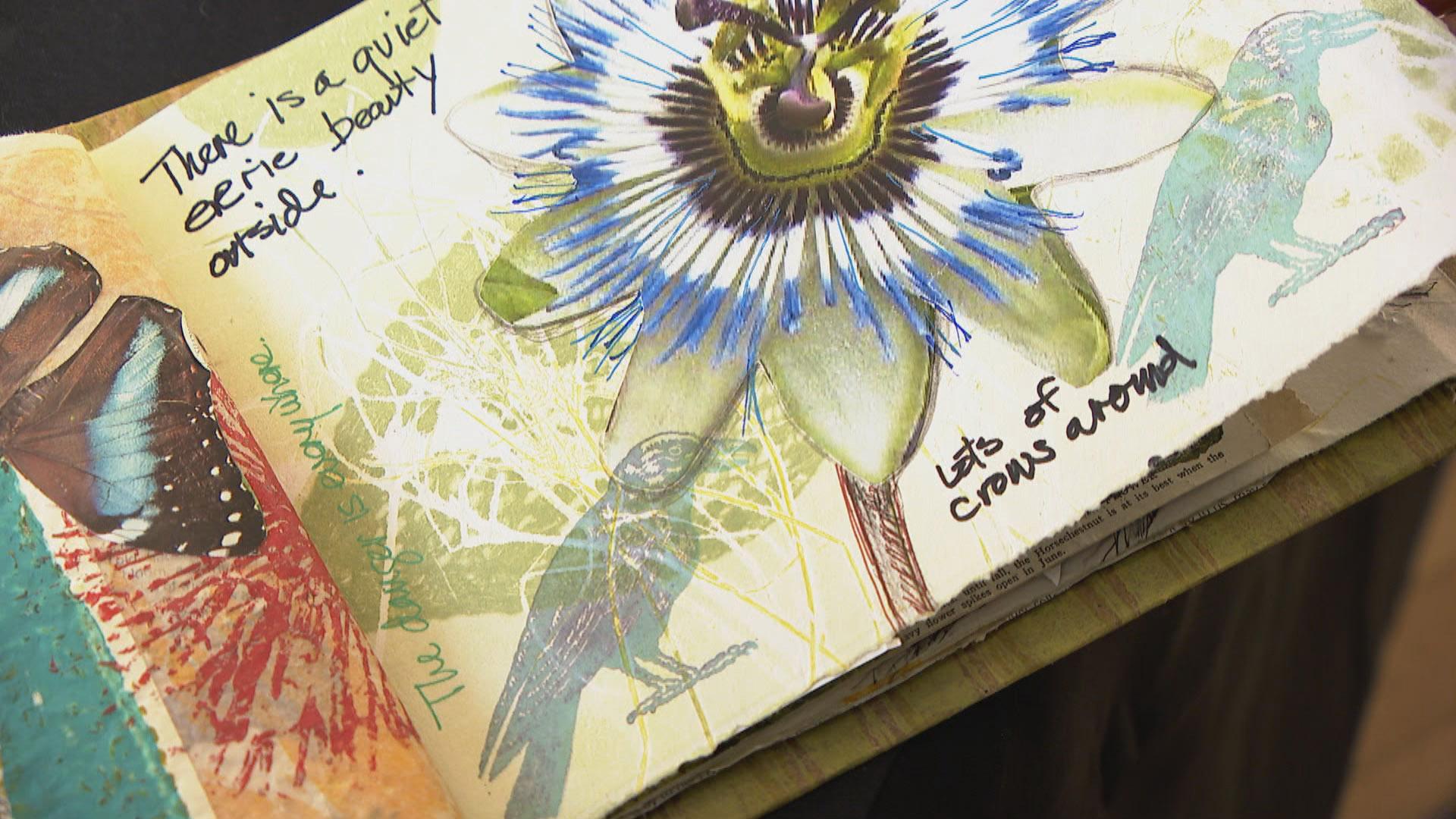
COVID Year Collage Study


This WTTW video features printmaker Beth Adler who created a collage per day during the COVID lockdown.  Then she began making monthly "COVID home" sculptures.  The video shows the striking collages which are bound accordian-like.  It's part of the Open Studio Project in Evanston, Illinois.


Wednesday, March 24, 2021

Site specific Sound Walk


Meander is a site-specific sound walk created for Brooklyn Botanic Garden that guides listeners on a meditative stroll into the natural landscape.

Created by Joseph White and HERE Arts Residency Program artist Gelsey Bell, the composers who brought you Cairns (included on the New York Times “Best Theater of 2020” list),  Meander encourages listeners to watch, listen, and reset their clocks to pastoral temporality, inviting them to sink into the complex patterns and fine details of the natural environment. Listen and explore at the Garden or see the virtual audio walk below while you listen from home.

The recording refers to blooming cherry trees, which, according to the BBG cherry map website, are not yet blooming.

 This reminds me of David Hockney's Road Trip with Audio 

Here's a NYT article about another sound-walk by Bell called "Cairns" (also set in Brooklyn, in the Green-Wood Cemetery).   

Here's a link to "Cairns." 

Tuesday, March 23, 2021

This, and also this, and over here, this


 Nothing to do; no one to be right now. - Christiane Wolf in Insight Timer guided meditation

The vast majority of the time we are aware of nothing outside our head* -- it's all plan and stew, shift body to become less uncomfortable (crack, stretch, jiggle).  Being slightly miserable -- cold, hot, noise, smells... wanting that to change.

In times of "altered perception" (like after particular long or fast runs) you might become aware of the contemporariness of things -- train making it's way methodically and clangily around a bend in the tracks, birds swooping in unison overhead, a young mom pushing a fancy stroller through the gravel. What follows is a feeling of expansiveness.

When I'm in that mode, the simple sensation of those things is pleasant in itself.  There's a quickening of attention as those things change.  It's a small shock to realize that "all this is happening... and I've been ignorant of it."

But I haven't really been ignorant of it.  These things had shown up serially... or just as "objects" to negotiate my body around while jogging around the park. (this, then this, then this).  But the awareness of these things is fundamentally different.  

Maybe it's the fragmentary nature of the observations.... (this, this, this, this).  Instead, during the altered perception, it's "this, and also this, and over here, this."  Maybe it's whether the consciousness sees these things as having some importance or not.  In the "just jogging" perception, nothing has much importance -- objects to avoid, things that appear in consciousness very briefly and judged to be threat or no threat, then discarded.  

But in the altered perception, these things linger and each thing is perceived "in relationship" to others ("Listen to that lumbering train...  oh, and these birds are carving their way through the air towards the train... and just underneath, the woman kicks up dust as she pushes through the gravel path with her fancy stroller.")

I notice now as I write this that each of the details is "non cliche" (it's not "I heard a train and saw a bird and a lady with stroller"... there are details (swooping, fancy stroller, 'making its way methodically') and when I wrote it again in the paragraph just above, all of the details involve (a) movement, (b) movement through something, (c) a kind of mini narrative.  

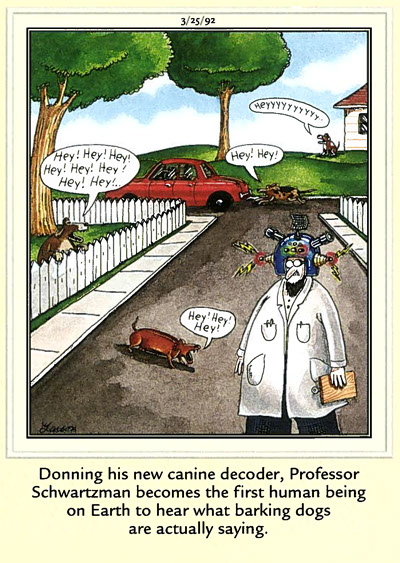
In perception A, I am noticing objects.  These objects are important or not as they appear in my consciousness (or below consciousness) as threats or simply physical items to be avoided (this feels to me like "dog consciousness"... a simple flow chart of "friend or foe or nothing?" then simply to not run into the thing.  (This gives me the opportunity to include my favorite "Far Side" cartoon!)

In perception B, I am noticing the relationship of beings moving through the world in a complex way ("through" something, negotiating a tight corner of track, a resistant gravel path, doing high speed aerial maneuvers  timed to other birds to get dinner).  It feels like the difference between a static image and an iPhone  Live photo image, which captures a second or two of movement.  

In perception A, you notice a bird with a big clump of grass in its mouth; in perception B, you notice a bird struggling to bring a big clump of grass through the wind back to its beginning nest.... at the same time as two or three other things are struggling or crafting or racing... and you recognize that you're in a little diarama of simultaneous movement and striving and (in general) things aiming to do their own purpose, likely oblivious to others. 

I recall the feeling of loss or slight disappointment when the birds go out of view. 

ADDITIONAL NOTES that I found on July 18, 2014 journal:

 After my run, I got that peculair vision thing again looking at mulch. I am absored into it... it seems very 3D, ver spatious. It "slips" back into normal, "flat" vision from time to time -- is distinguished from the "pictorial" 2D view.  I don't move my eyes much, I "absorb."

Monday, March 22, 2021

The virtuous cycle of being intentionally grateful

Jordan S. came up to me at work today and said, "I'm done being negative.  There's just so much right now.  I'm doing the best I can, and it's so easy to think that I didn't reach kids; but I am making connections and that's got to be good enough."

I reassured her and validated that the hybrid situation makes it so hard to teach well and get the kind of feedback that we need as high school teachers.  

Meanwhile, Jennie recently was given the task at work to contact parents for four hours to make up for contractual parent teacher conference time.  She was frustrated by the task, and the big brotherish request to record the parent contacts to the minute.  She said that she had already contacted the parents who were missing work and often it was frustrating because parents often made excuses for kids, or were caught between teacher and untruthful kid.  

I quipped that she should only send emails saying good things.  And that's what she did -- contacted parents not just about good grades, but kindness and humor and good conversation.  The effect was immediate:  many many appreciative emails back FROM parents in response.

So, I suggested to Jordan that she do the same.  She liked the idea and said that it would make her feel good to remember the small good things and that maybe she'd hear back from parents.  I added that it would also be a virtuous circle:  you'd feel good writing it, parents would feel good and probably send a nice note back (which would make Jordan feel appreciated), and the parents would probably say something to their kid, which might very well make the kid more engaged or attentive.  Lots of little bursts of endorphins. 

Sure enough, Jordan too reported back to me (in a little thank you email!) that it worked -- she felt good writing them and she had immediate positive responses from parents.

Sunday, March 21, 2021

Thorns... yet Blossoms


Omoda Seiju "Night Dew"

this world

is full of needles and thorns...

yet lotus blooms... 

           ― Issa Kobayashi (tr. Gabi Greve)


The world is prickly yet beautiful.  Yet.  One of the biggest reasons we suffer, according to the Buddhists, is that we are always forgetting about the other half.  Either we are focused on the blooms, and we get disappointed with the thorns; or we are dealing with the thorns and we have aversion to them.


The other thing is that needles and thorns are interesting and beautiful despite their prickly nature.


These are hard things to remember right now.  My relationship with Henry was strained.  He broke it off completely, blocking me.  I was straining to help Charlotte seek some help and address some mental health needs.  She resisted, began living with her mom, became prickly and resistant.  All thorns.  


I've tried repeatedly to address things head on and have met with increasing disdain and aversion.  I've also been waiting for a change.  I've also encouraged her mom to nudge her to build a relationship.  All needles and thorns.