Wednesday, September 30, 2020

Soundtrack to your crappy life


Typically, when we encounter talk about "the soundtrack of our life," it's accompanied by images of convertibles, winding roads, excitement.  But, really, as we know from The Perks of Being a Wallflower, soundtracks can be things that get us through not just a beautiful road trip, but the darkest challenges in our life.  

During  Maya Salam's first day of school in Kentucky in 5th grade, she became -- literally -- the poster child of bullying and a teacher's indifference.  In this NYT piece, she relates how she found validation, then inspiration and permission to rebel against her tormentors in a Nine Inch Nails' "Closer" song and video.  

So many great sections in the piece.

The music — a kind of mechanical cacophony I’d never heard before — landed in my life with no context, a meteor from the sky. But instead of it creating a crater in my life, it slipped perfectly into the one already there.

 and

On the surface, a bleak concept album about a man spiraling toward suicide, packed with explicitly sexual and violent lyrics — even if it’s regarded as one of the greatest albums of all time — might seem like an unlikely, even dangerous, salve for a sad girl paralyzed with anxiety. But instead, it threw me a line. Its themes of religious alienation, loss, loneliness, fear, anger and maybe most important, NIN’s signature theme, control — which I was desperate for — resonated deeply. To break free, I had to see my pain reflected and swim across that dark pool. That grinding, banging, cranking scream of industrial sounds transformed my shame to rage.

and

We’re taught that risk-taking, thrill-seeking and fearlessness are the domain of boys and men. And that girls are flowers — precious, vulnerable and evanescent, to be protected from perceived forces of destruction. To me at 14, dark industrial music that flouted boundaries was the embodiment of courage and the antithesis of fear. Maybe that was part of the point: This music, and the identity that went along with it, was not intended for me (or so I thought), which only made me want it more.

The essay is a short memoir that follows this pattern: I found myself in this crappy place, I found a piece of music that resonated with me and gave me solace and energy and purpose, and looking back from my current perspective, it still helps define me.  That's a form of writing to use myself and to teach to students.  I am inspired to write a piece that follows the same pattern.  What would be my album?  The Replacements' Pleased to Meet Me? 


Tuesday, September 29, 2020

What the author gets right

Why do we read books?  Why do we read poetry? or see plays?


Reading I am Not Your Perfect Mexican Daughter by Erika L. Sanchez, I am thinking about literature. Often it's about 'rightness' -- that the author captures something in a way that rings true.  Maybe they've said something in a way that you've never considered, or maybe they've just said something that you've never put so well.  There are a lot of things that, to me, Sanchez "gets right."  Here are a few.

Being embarrassed about being poor.  Being poor gives her the ability to see the world.  The main character, Julia Reyes, lives in an apartment in Chicago.  She's embarrassed about where she lives when she gets a boyfriend from Evanston.  She is worried that a cockroach will come out when she takes off her shoe... which happened when she's younger.  Being poor, being conscious of it, and embarrassed about it, is the fabric of her life.  This is important in the plot, too.

Casual sexism.  Just about everywhere in the book, there is some male - sometimes older, sometimes younger - is shouting to Julia out of car doors or sidewalks - about her boobs or other degrading.  The fact that it's "casual" for Julia, normal, part of her everyday life, is especially the part that is sad and seems to be accurate.

The therapeutic setting.  Julia is able to get some mental health help in both individual settings and group therapy.  So much of the individual settings seem to ring true to me.  Here's a page spread at the heart of her first session.

Adolescent Sexuality.  Julia is 16.  She's trying to figure out her own sexuality.  She's bombarded with ideas of how young people should be sexual.  Thoughts of sensuality overcome her.  Like literally, she seems to observe her attraction to a boy happening to her, almost as an outsider.

What do I mean about literature that an author "gets right"?  I mean that I find myself nodding my head while reading.  That's how it "really is" from how I've experienced the world.  Sometimes, it's about stuff that I've experienced; sometimes, it's something that I'm not directly experiencing. 


Monday, September 28, 2020

How Little Can I Realize All the Life

 After a hard fall run, I sometimes am able to slide into a different state of awareness.  That sounds trippy, and is probably aided by some happy chemical that's in my blood because of the hard run, but it's true: I have an altered amount of awareness of what's around me.  Sometimes I can get transfixed by mulch.  How rich it is!  How varied!  How infinitely interesting!  Typically, after five minutes, the feeling fades.  At other times, instead of being transfixed by a sight.  I am aware of the fact that a number of things are happening around me at once, like my awareness, usually a small circle, enclosed a larger and larger circle of events that are occurring.  Birds are swooping! The train is clanging! And still the kids are shouting while swinging on the playground!  

I'm using so many exclamation marks because there's this sense of more than contentment.  There's no judging; it's like the ability to judge is short circuited because so much information is coming in and being apprehended.   There's a sense of the ecstatic realness of things that is always happening right beneath our self-absorbed noses.  

I noticed something similar to this while reading this quote from Henry David Thoreau (1817-1862) in The Daily Henry David Thoreau: A Year of Quotes.  Thoreau wrote in his journal on September 27, 1852

As I look northwestward to that summit from a Concord cornfield, how little can I realize all the life that is passing between me and it, -- the retired upcountry farmhouses, the lonely mills, wooded vales, wild rocky pastures, and new clearing on stark mountain-sides, and rivers gurgling through primitive woods!  All these, and how much more, I overlook.  I see the very peak, -- there can be no mistake, -- but how much I do not see, that is between me and it!

Both the concreteness of the description, the ecstatic punctuation, and the line "how little can I realize all the life that is passing between me and it" all suggest to me that Thoreau is enraptured in a similar trippy way.  The sense that there is so much going on... all the time, and it's all alive.  

I like this passage and the temporary low grade ecstatic thrum.  It makes me think about some of my favorite poems of Gerard Manly Hopkins (1844-1889), like "God's Granduer," or "Pied Beauty.

 Image from The New Republic

Sunday, September 27, 2020

Tantalizing Temporariness


Mozart Piano Concerto #20 in D min

Mozart toured Europe in 1762.  Sometimes I think about being in the audience, listening with a sense of the rarity of the event.  Each movement of a piece, each phrase, comes, exists for a time, then fades.  Without the knowledge that you could re-listen to something on an MP3, the listener would be on the edge of her seat, rapt.  Of course the piece that you're listening to might be played again in a few seasons.  Perhaps you could purchase a piano version of the piece and play it for yourself.  But still, a tantalizing phrase would haunt you, a melody would float up unexpectedly, pieces would come back to you when you dream.  

Maybe there's something of this same kind of tantalizing temporariness when modern day drama.  I saw a Zoom version of a play, "Zero Cost House," that I'd never heard of and that probably can't be found in Amazon.  I can't go back and re-read certain phrases or compare my memory with the actual text.  The play exists for me only now in memory.

I'm wondering if recordings of things that are designed to be verbal -- plays, speeches, poems -- become less valuable because they're often easily able to be re-read.  (I know that most poetry now might be "designed" to be read.  This is just for argument.)  Maybe the fact of being reproduced, or the capability of being reproduced, makes them easier to glance over, with partial attention, because it's easy to think that we'll go back to it later (which we rarely do!).

I'm not saying that the spoken word is more primary, just that when a listener thinks that this is the only chance to hear it, they will attend more.

Phonocentricsm is the belief that the spoken word is superior to the written word.  I myself was attentive enough in graduate school to know that such a belief is held to be passe and laughable.  (The sense that some things were passe and laughable might have been the main 'learning' that I did in graduate school.  A learning that spoiled a great number of ideas for me.)

But maybe the fact of temporariness makes things more valuable.  I'm thinking again about The Sheltering Sky quote I can't get out of my head:

“Death is always on the way, but the fact that you don't know when it will arrive seems to take away from the finiteness of life. It's that terrible precision that we hate so much. But because we don't know, we get to think of life as an inexhaustible well. Yet everything happens a certain number of times, and a very small number, really. How many more times will you remember a certain afternoon of your childhood, some afternoon that's so deeply a part of your being that you can't even conceive of your life without it? Perhaps four or five times more. Perhaps not even. How many more times will you watch the full moon rise? Perhaps twenty. And yet it all seems limitless.”

In class, what if students never got to READ a play?  What if it was only watched?

What if students never got to READ poetry, but could only hear it?  I wonder how that would change student's appreciation of it.  As a teacher, you could still ask students to comment on it, choose favorite lines, etc.  But the primary ability to apprehend the work would be through the ear (or eye for hard-of-hearing students!).  

Maybe the experience for them (and I'm thinking about for me and you) would be better if it happened only once, a time that is made more precious by it's rarity.  What happens if I read a book of poems to Jennie, and she read a different book to me?  I could ask her to read it again, but not to show me the page.  How would that change the experience?  Would it be better?

Saturday, September 26, 2020

"Zero Cost House" Zoom theater

NYT review

Earlier this week I read a review about "Zero Cost House," a play by Toshiki Okada, that's been newly "staged" for Zoom by the Philadelphia-based Pig Iron Theater Company.  I was intrigued and bought a ticket for this live streamed theater.  In the play, the character named Okada realizes that he is no longer as entranced by Walden and Henry David Thoreau as he used to be.  He feels like the younger Okada is somewhat naive.  At the same time, the younger Thoreau can look forward to a time when the older Thoreau will lose a sense of the vitality of Walden and be "arrogant."  The theme of arrogance and naiveté runs throughout the play -- some characters are always feeling like they are not able to be understood by others because of naivete or arrogance. The arrogant Okada feels that the younger Okada (and Thoreau) is childlike and naive, just like Thoreau felt that way about some "locals" he wrote about in Walden.  As characters become more sophisticated, they judge others and they lose the sense of enthrallment.   Pretty interesting!

Three take-aways:

1. How would a work of "theater" work online?  Really good.  I'm not sure how much more I would have gotten from this play if I saw it in person.  

2. It was good "lemonade" made with the lemons of the pandemic.  There were new and captivating things that this adaptation could do ONLY BECAUSE of the limitations of being on Zoom.  For instance, all the actors, from different homes, filled the screens with different visual "elements" during the transition to the intermission.  It was 6 screens happening at once. Some were actions (a wind-up toy spinning on a table), some were YouTube videos, some were screens made by putting different colored paper in front of the camera.  In the background, a "cover band" was play a Bjork song.  This resolves into one of the actors singing in her room.  There were clever elements ("passing" of a book between screens for instance) that helped create the illusion that it was a shared space.

3. I didn't know a single Japanese playwright.  Now I know one!  I didn't know that actors could change roles throughout the play.  This made me pay attention to how the character changed and to the skill of the actors as the main character evolved.

Friday, September 25, 2020

On Middle Seasons (on the Autumnal Equinox)


The summer heat has broken in Chicago.  At least for now.  It's no longer blast-oven summer and it doesn't seem fully fall yet.  There are signs all around that we're in some middle season.  Here are four photos that seem to belong to the middle season between summer and fall.  Sea oats in a planter outside work, an early red branch of a sumac at the Morton Arboretum, a single leaf from a maple that I've been watching on my bike ride home, and a Kentucky coffeetree pod from a neighborhood parkway street.

Ferris Jabr (@ferrissjabr) Tweeted in this thread that many cultures have a different number of seasons.  For instance...
In ancient Japan the year was divided into 24 seasonal stages and 72 microseasons, each lasting a few days, with names like, "mist starts to linger," "wild geese fly north," "first lotus blossoms," and "deer shed antlers"
"Shubun" is the Japanese season of the autumnal equinox.  Our season -- in other ways -- seems to align with Japan's season called "Shosho," "The season in which heat stops."  Here's more information about the 24 Japanese seasons (or "Sekki").  

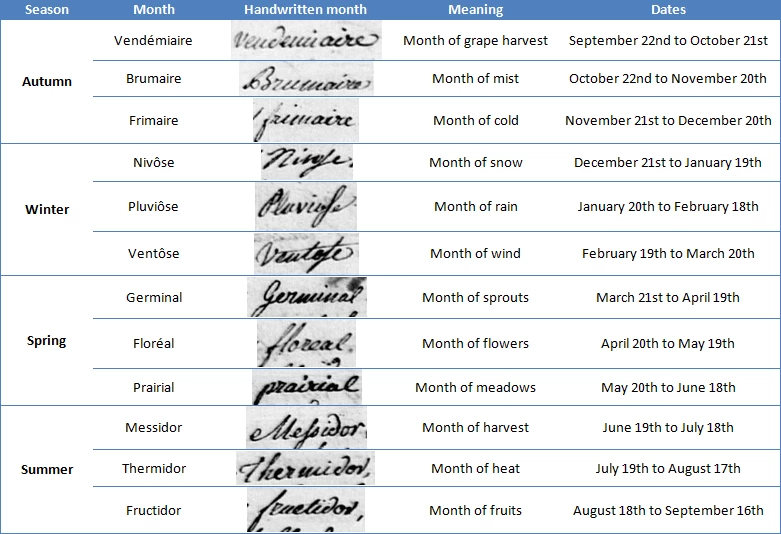
Update:  I just learned that during the French Revolution, a new calendar was created.  10-day weeks, "months" pretty much named after seasons named similarly to the Japanese calendar.
 
 
Months that look like "middle seasons" of the French Revolutionary Calendar (link)


Thursday, September 24, 2020

Mundane Love


In this Outside magazine piece, Pam Houston writes about falling in love, "all the way.. without walls" for the first time at 55.  She was taken aback when he asked if she "could love all the way, really give and receive, drop the ego, drop the walls, and take the leap."  I can understand why she was taken aback!  That seems like some monumental, Stanley Kowlaski love.

Yet she praises him not for the big, demonstrative, IG-worthy spectacles of love, but for the mundane signs of caring.

Mike called when he said he would, showed up on time, bought me gluten-free crackers and Smokey Bear earrings and offered to go to the feed store with me before I’d even said I was due for a restock. Every time I tried to whirl up some kind of trouble to see if I could shake him (no, I’m not proud of that), he would tell me not to water the weeds of unhappiness, and when that made me even madder, he’d say, “Pam, I’m patient, I’m happy, and I’m present,” and who could ask for more than that?

Mike is able to deal with her doubt and self sabotage down  because he has more mundane attributes - patience, contentment, the ability to listen.

When Mike asks how I know I won’t get tired of him, I say, “I’ve been looking at Red Mountain out my kitchen window for a quarter century and have never loved it more than I do right now.” It’s taken me a lifetime to understand that my limitation is an old tale I no longer need to tell myself.

How do you know if you love someone? They make you more responsive and receptive to the things of the world you’ve always loved. They make you more alive outwards - to the world. Who wouldn’t want that kind of love?