link: https://ww2.kqed.org/mindshift/2015/08/26/rethinking-data-how-to-create-a-holistic-view-of-students/
THE HACK: COLLECT DATA ON THE WHOLE CHILD
Most teachers make an effort to get to know their
students, and many regularly distribute surveys at the start of each
school year to speed up that process. The problem is, most teachers read
these surveys once, then file them away. Sure, they might have every
intention of returning to the surveys and reviewing them later, but far
too often, that time never comes. We rely on our day-to-day interactions
for relationship building, and although we get to know some
students quite well this way, others just fade into the background.
A 360 Spreadsheet is a place for teachers to store and
access the “other” data we collect on our students, giving us a more
complete, 360-degree view of each student. It’s a single chart that
organizes it all and lets us see, at a glance, things we might otherwise
forget. Many teachers already keep track of students’ birthdays. Think
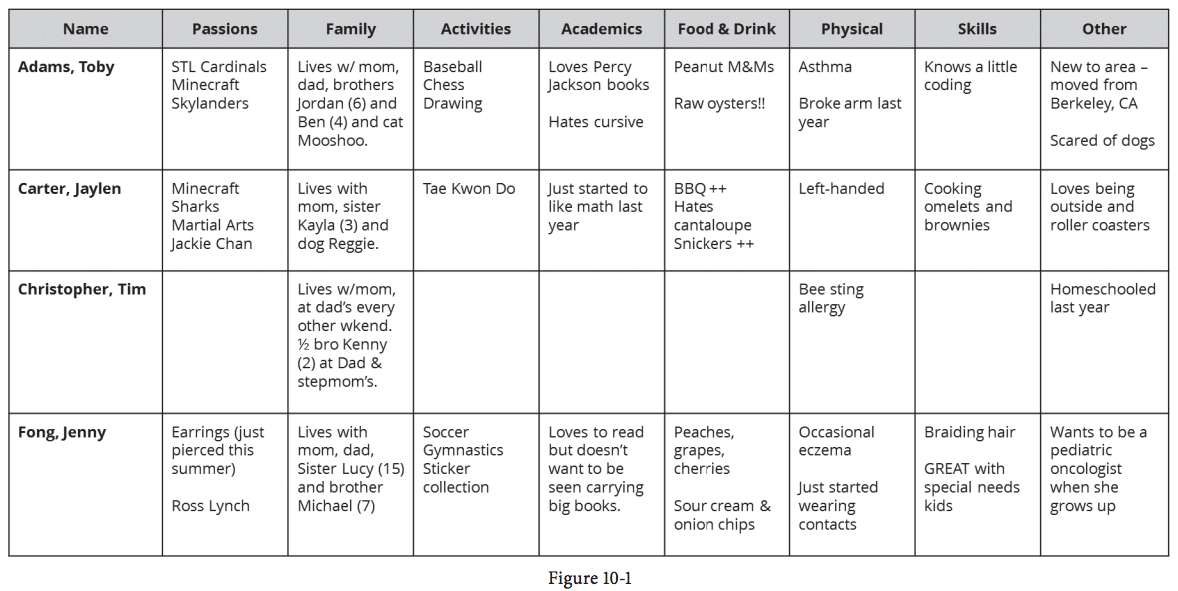
of this as a birthday chart on steroids. Figure 10-1 is just one
possible version of a 360 Spreadsheet:
Because the 360 Spreadsheet is a single document, teachers
can access it much more easily than they could a whole folder of
surveys. Having the information formatted this way also makes it
immediately clear which students a teacher needs to get to know better.
The chart in Figure 10-1 sorts student information into the following suggested categories:
• Passions: What is the student really
into? Keeping track of things like hobbies, collections, and other
hard-to categorize obsessions will help you connect with your students.
This information will boost your ability to help students select books
for independent reading, choose topics for writing or research projects,
or even better understand math or history concepts by placing them in
the context of things they are just crazy about.
• Family: The home environment plays a
major role in how well a student performs academically. This
category can include information about whether a student lives in one
home or travels between the homes of two parents.
It might ask about the number of people who live in
the household. It can also include other family-related facts, like
whether anyone at home is dealing with an illness, is currently
incarcerated, has special needs, travels frequently, or has a noteworthy
profession or skill set (Mom is a circus performer? Probably worth
noting.)
• Activities: This category will help you
better understand what outside activities fill up a student’s schedule
when they are not in school. Are they on a sports team? Do they have a
part-time job? Will they be busier on certain days of the week or at
certain times of the year? Not only will this information give you a
more complete picture of who your students are, it will build your
awareness of the other demands placed on their time.
• Academics: Here’s where you can put
things a standardized test won’t tell you about a student’s
academic needs and preferences: If a student struggles with
handwriting, expresses a strong desire to work alone, has a strong
interest in a particular subject area, or lights up during certain types
of activities, record this information; it will help you individualize
instruction later.
• Food & Drink: No, you are not a
caterer. But why not keep a list of each child’s favorite candy or
snack? While you’re at it, record food allergies on this chart
as well—the information is probably in the school paperwork already;
might as well add it here.
• Physical: Along with conditions that
are already listed on students’ official paperwork, this category
can include others that are not, but are still important, like needing
to use the restroom frequently or the tendency to get cold easily.
• Skills: Our students bring with them
talents and skills we may not even be aware of if we don’t ask, so
when you find these things out, include them in your chart. Has a
student been taking violin lessons for years? Add that. Do they know a
lot about dairy farming? Origami? Photography? Put it all in there. Not
only will knowing about these skills further develop your knowledge of
the student, they may also come in handy when you need help or
information about an area where you lack expertise.
• Other: This seems like it could be a
throw-away category, but making room for miscellaneous information is a
good idea. Things like sensitivities to loud noises, religious
practices, or random facts about student histories (e.g., “Lived in
China”) should also be recorded, even if they don’t necessarily fit into
any broad category. Although these categories offer vital information,
they are just suggestions.
Teachers can and should collect whatever information
is most relevant to them, information that will help you connect to
your students as whole people and build strong relationships with them.