 |
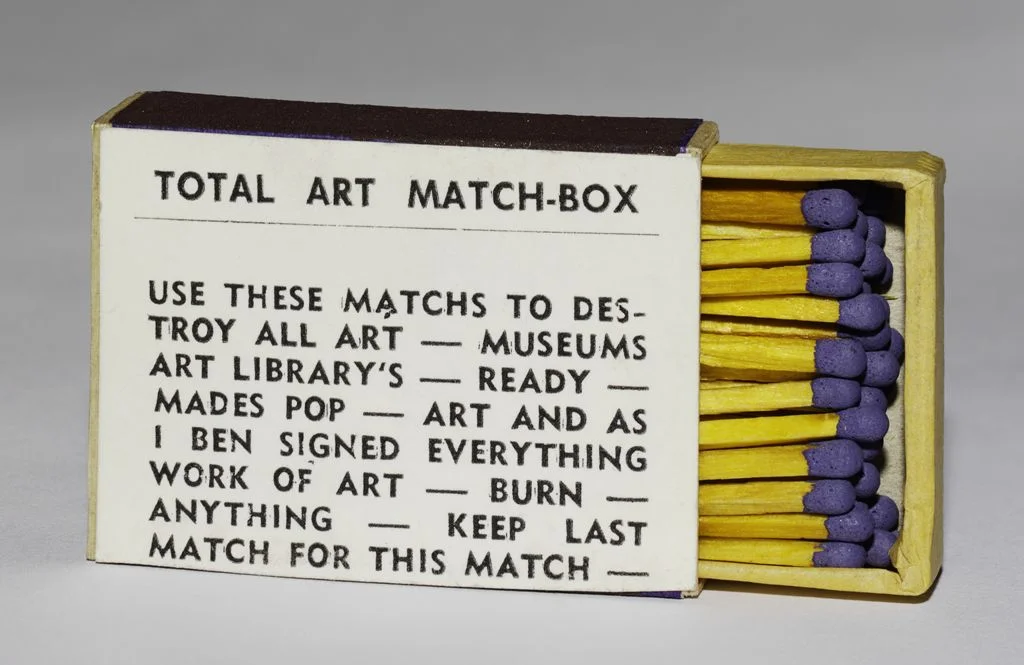
| Ben Vautier Total Art Matchbox (c.1965) |
From The Book of Form and Emptiness. While Benny's in the mental health floor (p. 121), Athena disrupts the other patients by putting notes for them to find in their belongings.
- Put your shoes on the table. Ask it what it wants from you
- Face a blank wall. Pretend the wall is a mirror
- Say good morning to the toilet. Thank it for taking all your shit
- Pretend you are very old. Move at half speed.
- Hug yourself and say I love you. Repeat until it's true.
- Walk like you're happy. Change directions.
- Be a pussy. Purr. Lick your beautiful fur.
- Regard the world as upside down.
- Make eye contact with your meds before you swallow them. Ask them, "Are you for real?"
- Do everything backward.
- Smile at someone you don't like. If they smile back, give yourself a point.
- Lie on your back on the floor and listen. Feel free to sing along.
Summary of Fluxus
Emerging in the 1960s and operating globally, Fluxus was an interdisciplinary and experimental approach to art that emphasized blending different artistic media and breaking down traditional boundaries between art and everyday life. Fluxus artists encouraged a playful and open-minded approach to art-making, creating a wide range of unconventional works, often using ordinary objects and actions to challenge traditional notions of art and engage audiences in interactive experiences. George Maciunas, the primary founder and organizer of the movement, described Fluxus as, "a fusion of Spike Jones, gags, games, Vaudeville, Cage and Duchamp".
While the vast majority of Fluxus artists conformed to some, if not all, of the main themes of the movement, many held contrasting ideals and different individuals viewed Fluxus in different ways, leading to significant variation. As filmmaker George Brecht stated, "In Fluxus there has never been any attempt to agree on aims or methods; individuals with something unnamable in common have simply coalesced to publish and perform their work." For some Fluxus artists, even the act of defining the movement was seen as restrictive and counterproductive to the spirit of their work. By resisting a clear definition, they maintained a commitment to challenging established norms and fostering a creative environment. This makes Fluxus difficult to define and some debate exists around which artists should be included in the movement.
Key Ideas & Accomplishments
- Unlike traditional art movements that compartmentalized different forms of artistic expression, Fluxus sought to break down these barriers and create a more interconnected and immersive artistic experience, integrating visual arts and literature with performance-based media including music, dance and theatre. In emphasizing elements of performance, they also legitimized the medium within artistic circles.
- Like the Futurists and Dadaists before them, Fluxus artists did not agree with the authority of museums to determine the value of art and they believed art was not only for the educated elite. Fluxus artists worked to dismiss and mock the elitist world of "high art" and to find ways to bring art to the masses through approachable artworks and the use of humor. Their irreverence for "high art" had an impact on the perceived authority of the museum to determine what, and who, constituted art and helped to change the balance of power in the art world.
- Fluxus works often relied on the element of chance to shape the ultimate outcome of the piece and one of the main ways this was achieved was through audience participation in artworks. This approach reflected a rejection of rigid artistic control and fostered a more interactive and open-ended experience, reflecting a broader, more inclusive approach to creativity.

No comments:
Post a Comment