 |
| John Ruskin: Study of Dawn: purple Clouds |
Here's a link to the catalog itself
Ruskin's introduction:
The choice and arrangement of this Series have been determined with a view to two distinct ends; the first, to call your attention, by precision of copying, to the qualities of good Art; the second, to give you, yourselves,such power of delineation as may assist your memory of visible things, and enable you to explain them intelligibly to others. The first of these objects is, however, the primary one, and the more attainable. A short time earnestly spent in practical efforts will give you a basis of judgment in Art which cannot be afterwards disturbed, though protracted application will be necessary to enable you to draw in any wise rightly yourselves. But it isof greater importance that you should learn to distinguish what is entirely excellent, than to produce what is partially so.
There are now in your rooms twelve Cabinets of these examples, eachcontaining twenty-five drawings or engravings.
In the first of them are introductory subjects only; chiefly sketches of the flowers, or at least of the representatives of the tribes of flowers, which have had strongest influence on the human mind in all ages, and have become types of ideas which are always true, — always sources of innocent pleasure,— and therefore common to the religions of the East, of Greece, and of Christendom.
The second Cabinet contains such examples of Greek Architecture and simple design as will best enable you to discern the laws of practice under which the Hellenic nation bound themselves, or were, by their instincts, bound;and the strictness of which enabled them to lay the foundations of allsubsequent art, either existing, or conceivable.
The third Cabinet illustrates the course of the Arts in the north of Europe, from the development of their first perfect elementary school of round-arched architecture, to the consummate work of German artists in the sixteenth century.
The fourth Cabinet illustrates the Course of southern (that is to say,essentially of Italian) Art,from its first assertion of itself asa distinct style in the thirteenth century to its perfect results in the sixteenth.
The fifth and sixth Cabinets contain examples of the schools of landscape which were founded, first in Holland and then in England, on the fragmentary traditions of the figure-painting which ceased, as disciplined art, to exist after the seventeenth century: schools which in England have taken healthy root, and may, to yourselves,in early practice, be of greater use and interest than any others.
The seventh and eighth Cabinets contain illustrations of the treatment of Animal form by the higher methods of sculpture and painting.
These eight cabinets, then, give you in narrow epitome, a view of what has been done already, and may now be carried forward by your own influence, in art that is good for men. Only you are to note that the second group shows you, in Greek work, only the character of its laws, and nothing of its final achievement.
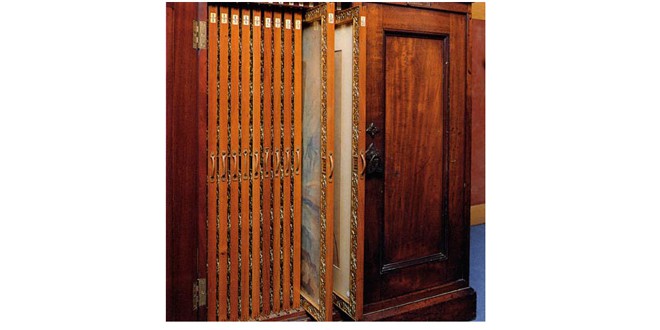 |
| John Ruskin assembled 1470 diverse works of art for use in the Drawing School he founded at Oxford in 1871. They included drawings by himself and other artists, prints and photographs. These were arranged in series and placed in special cabinets. |
An orange-red sun rises behind dark blue and purple clouds in the bottom centre-left, streaking the cloud above with orange. Above this two areas of pale blue sky show through the remaining purple clouds, which are tinged with pink in the top left of the painting. This is one of a group of three watercolours, of similar size on blue-grey paper, depicting early morning skies at Denmark Hill in March 1868. (The others are nos 3 and 4 in the Educational Series.)The work was first catalogued in 1871, in the first Educational Series catalogue, as no. 3 C; it remained in the same position, although renumbered as no. 5, in the second Educational Series catalogue, and in Ruskin's 1878 reorganisation of the series.Ruskin chose this work for its 'extreme simplicity in method of work' (first Educational catalogue, p. 27), including it as a factual record of a beautiful scene, and as a symbol of the way the light of inspiration can transform the ordinary into perfection. It was also intended as an example of a practical exercise in visual memory: speed was of the essence in achieving the desired effect, starting with a delineation of the clouds in pencil, colour then being added while the memory was fresh. It was vital to stop working the moment the mental image faded. The idea was to produce a simple reminder of the sky at that particular point in time. He advised his readers to 'Rise early, always watch the sunrise and the way the clouds break from the dawn' (The Two Paths, § 137 = XVI.371).

No comments:
Post a Comment