 |
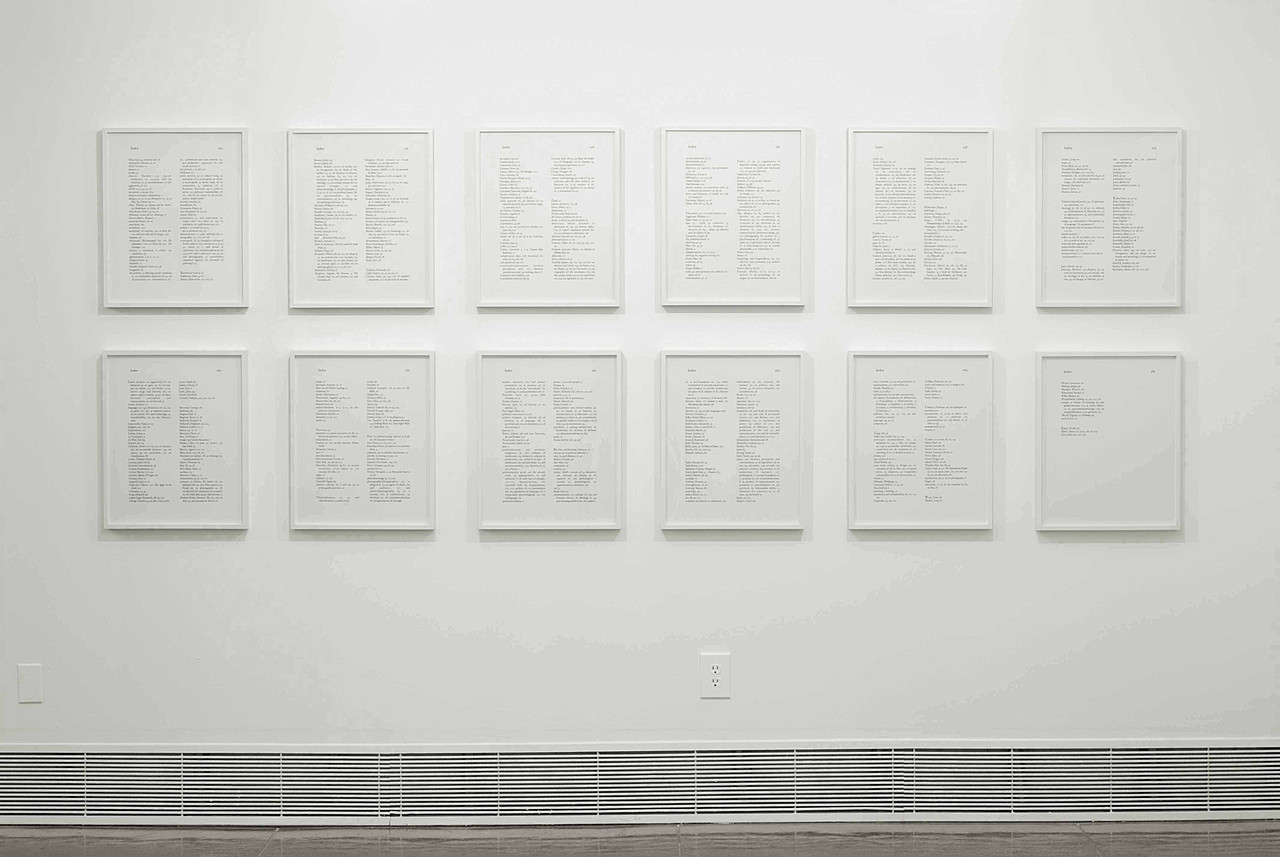
| "Index" Alexander Cesarco. Solomon R. Guggenheim Museum, New York Guggenheim UBS MAP Purchase Fund, 2014 |
From Guggenheim website:
The first of a series of indices for imaginary books, this alphabetical list invites the reader to mentally write a text in reverse, forging links between already-cited references to European, Latin American, and North American architecture, art, film, literature, music, and philosophy. Index also functions as a portrait of its maker as a young artist by detailing his aspirations, influences, and interests. The text could also act as a guide to many of the cultural allusions found elsewhere in the exhibition Under the Same Sun.
From Dennis Duncan's Index, A History of the
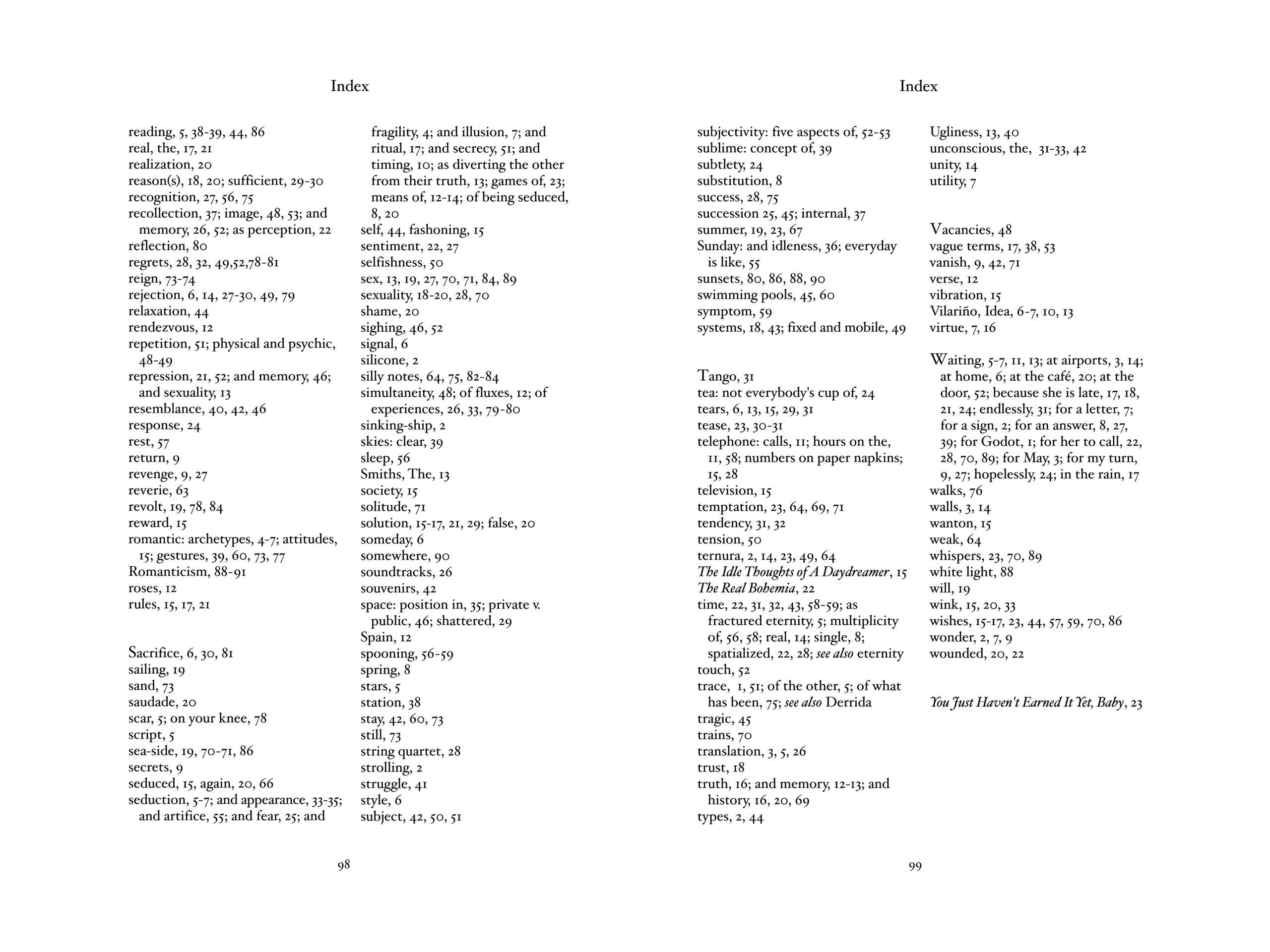
The indexes on the walls of the gallery offer up several types of pleasure, which come through in different stages like the courses of a meal. Most immediately, we can enjoy the juxtapositions. Like Zembla in Nabokov's Pale Fire index, the arrangement of these indexes is design posing as arbitrariness. Belle and Sebastian next to Being and Time, punk next to Proust, these are discreet rebellions, cultural levelling on a microscopic scale. Or, with a little more effort, we can read against the alphabet, matching entries that have the same locator, triangulating concepts to picture the hypothetical page on which they are all united. Bossanova, chocolate, dates, desperateness: how we read dates here - as fruit or as hook-ups - will determine how we read desperateness. Or crying, endings, fragility, bolding-hands, all on an imaginary page 2. What sequence do they play out in when alphabetical order is removed?
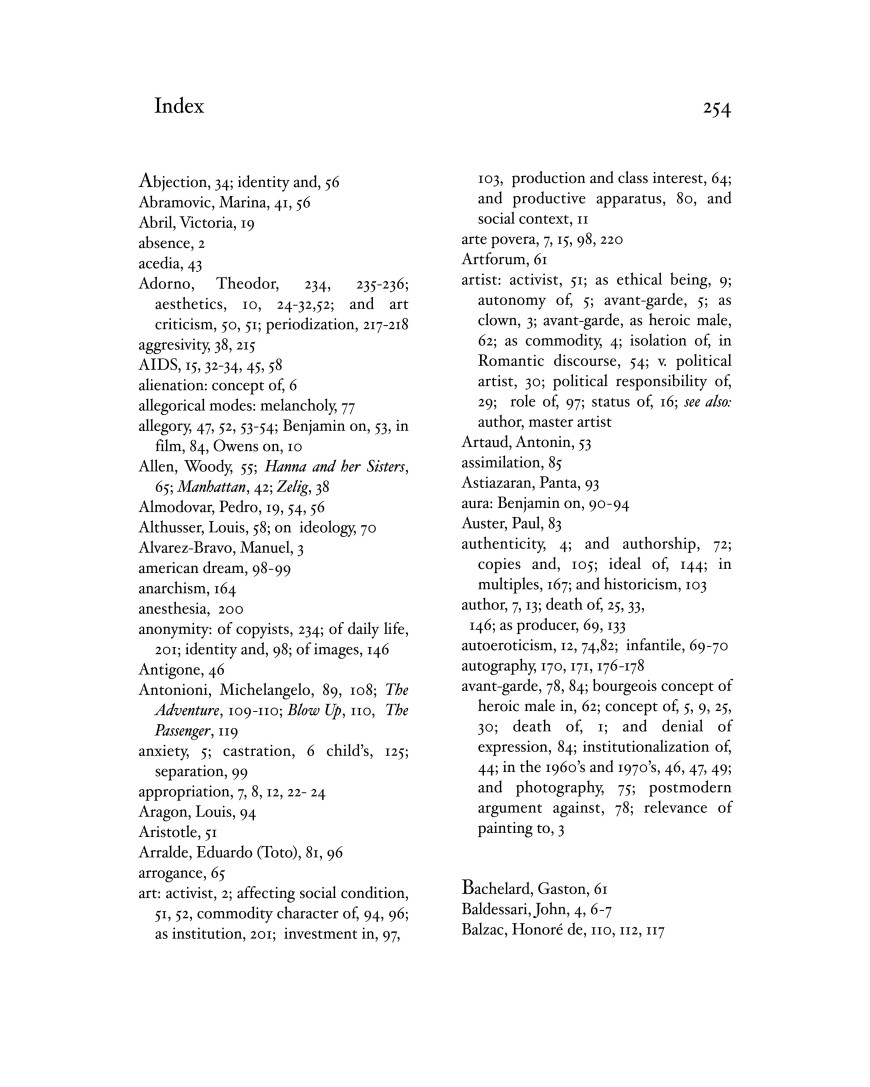
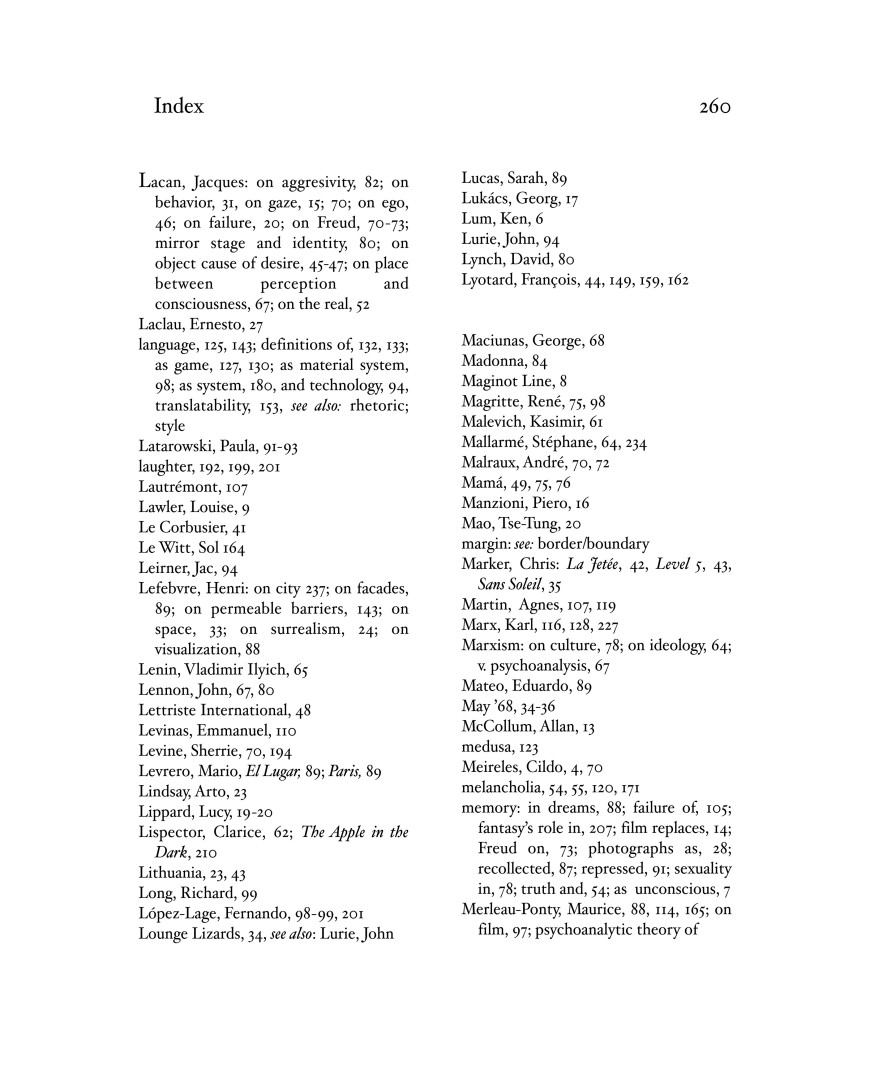
Then there are the general impressions that the indexes leave us with. A preponderance of twentieth-century thinkers-just trawling through the Ls in one frame throws up Lacan, Laclau, Le Corbusier, Lefebvre, Lenin, Levinas, Lukács, Lyotard ... - but also a concern with emotion, sometimes but not always framed in the language of therapy. One run of entries yields up:
direction: and decisions, 1-8
discipline, 16
disclosure, $2
discontinuity, 37
displacement, 20, 69 dissatisfaction, s$
doors: slammed, 13, 1 5, 20
doubts, 19, 23, 26-29, 31, 33, 61, 72
dreams 17, 26
Cesarco's indexes track his own interests, the culture - books, films, art - that he consumes over time: 'an archive of my reading', as he puts it? But the focus on affect is similarly reflexive. Cesarco calls his indexes 'a form of self-portraiture that unfolds over time'. The phoney locators, pointing offstage to the pages of non-existent texts, might be dissimulations but that is not to say that the indexes do not ultimately have a real referent. Like the Christ Church attack on Richard Bentley, these are the indexes not to a book but a personality, A Short Account of the Artist by Way of Index, Naturally, then, a recurtent figure is Freud. One entry runs:
Freud, Sigmund, 62; A Special Type of Choice of Object Made by Men, 10; on delusion, 7; on ego, 9; on fetishism, 26; and identity and identification, 34; on narcissism, 29; on sexuality, 5, 28, 73.
It is hard not to read this as a reflection on Cesarco's curious process, a mode of autobiography that makes a fetish of the index, filtering identity - observations, memories - through headwords, backwards syntax, alphabetical order.
 |
| link |
From Guggenheim:

No comments:
Post a Comment