 |
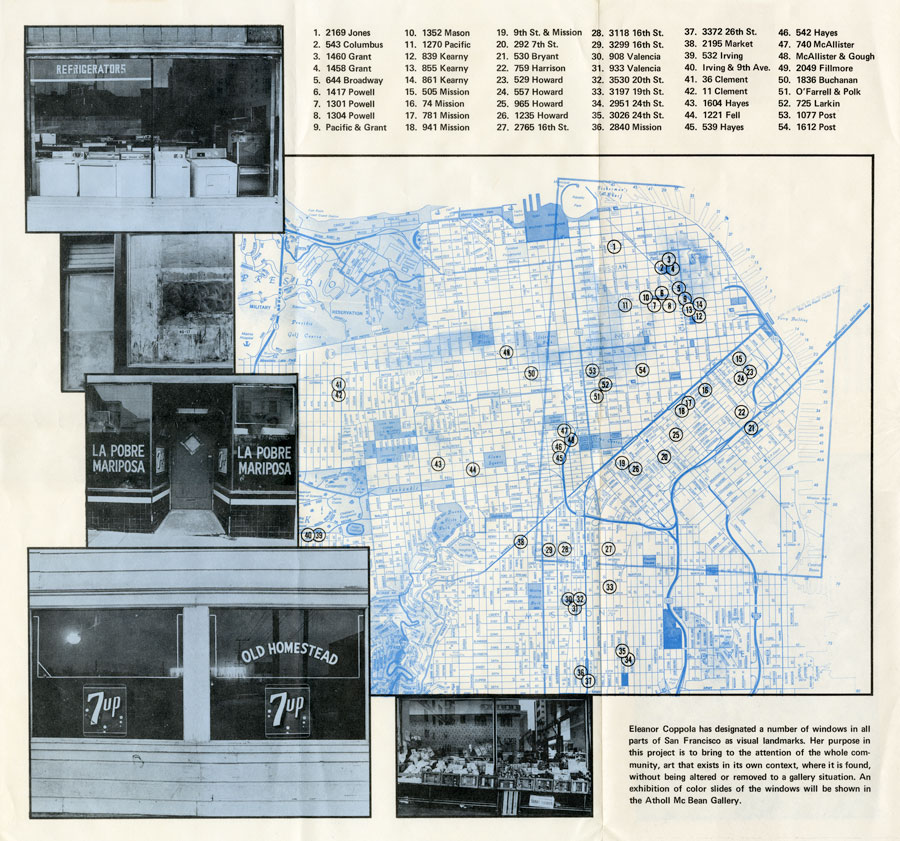
| Eleanor Coppola, Windows, February 16–March 17, 1973; take-away folded map for visitors; photos: Rita Mandelman, printed: San Francisco Art Institute; 14 x 20 in. (35.56 x 50.8 cm) |
In Jenny Odell's How to Do Nothing (5)
In 1973, Eleanor Coppola carried out a public art project called Windows, which materially speaking consisted only of a map with a date and a list of locations in San Francisco. . . . Coppola's map reads:
Eleanor Coppola has designated a number of windows in all parts of San Francisco as visual landmarks. Her purpose in this project is to bring to the attention of the whole community, art that exists in its own context, where it is found, without being altered or removed to a gallery situation.
Odell says that Coppola "casts a subtle frame over the whole of the city itself, a light but meaningful touch that recognizes art that exists where it already is."
A more recent project that acts in a similar spirit is Scott Polach's Applause Encouraged which happened at Cabrillo National Monument in San Diego in 2015. On a cliff overlooking the sea, forty-five minutes before the sunset, a greeter checked guests in to an area of foldout seats formally cordoned off with red rope. They were ushered to their seats and reminded not to take photos. They watched the sunset, and when it finished, they applauded. Refreshments were served afterward.
Odell writes that these artists "create a structure that holds open a contemplative space against the pressures of habit, familiarity, and distraction that constantly threaten to close it."
Over at SFMOMA website, there's more details about her project:
In Eleanor Coppola’s participatory Windows (1973), she proposed that visitors pick up a map and go out into the streets of San Francisco to complete the experience of the exhibition. The windows that were designated by the artist as rich visual pieces for the duration of the show varied considerably in type and neighborhood. Only the street addresses were provided. The viewer was left to discover each storefront or home, with its existing interior composition and changing reflections. There were no stated criteria for how she chose the particular windows, only the sense of her interest in framing the found elements as equivalents to art objects. Instead of making an intervention into the window displays or inserting the artist’s own presence, this conceptually-driven work underscored the role of the author in creating a system for observation.

No comments:
Post a Comment