 |
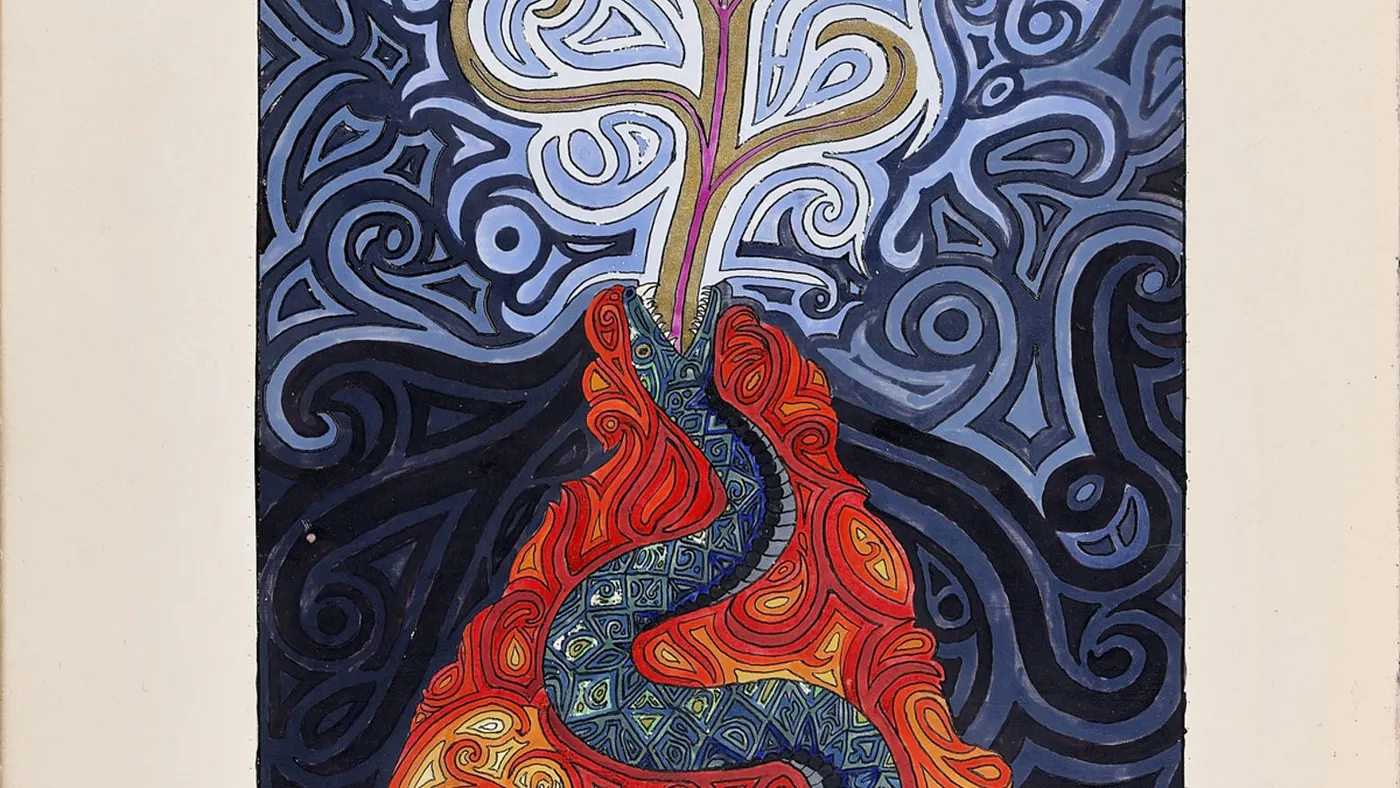
| Carl Jung artwork |
Notes:
On "the only beautiful thing"
Here all the furniture was good, and old paintings hung on the walls. I particularly remember an Italian painting of David and Coliath. It was a mirror copy from the workshop of Guido Reni; the original hangs in the Louvre. How it came into our family I do not know. There was another old painting in that room which now hangs in my son's house: a landscape of Basel dating from the early nineteenth century. Often I would steal into that dark, sequestered room and sit for hours in front of the pictures, gazing at all this beauty. It was the only beautiful thing I knew.
My self-assurance was increased and diminished at the same time
about his parents] She always seemed to me the stronger of the two. Nevertheless I always felt on her side when my father gave vent to his moody irritability. This necessity for taking sides was not exactly favorable to the formation of my character. In order to liberate myself from these conflicts I fell into the role of the superior arbitrator who willy-nilly had to judge his parents. That caused a certain inflatedness in me; my unstable self-assurance was increased and diminished at the same time.
On "Why, then, I must get to work!" 31
But when I returned home everything was as before. One doctor thought I had epilepsy. I knew what epileptic fits were like and I inwardly laughed at such nonsense. My parents became more worried than ever. Then one day a friend called on my father. They were sitting in the garden and I hid behind a shrub, for I was possessed of an insatiable curiosity. I heard the visitor saying to my father, "And how is your son?" "Ah, that's a sad business," my father replied. "The doctors no longer know what is wrong with him. They think it may be epilepsy. It would be dreadful if he were incurable. I have lost what little I had, and what will become of the boy if he cannot earn his own living?" I was thunderstruck. This was the collision with reality.
"Why, then, I must get to work!" I thought suddenly.
From that moment on I became a serious child. I crept away, went to my father's study, took out my Latin grammar, and began to cram with intense concentration. After ten minutes of this I had the finest of fainting fits. I almost fell off the chair, but after a few minutes I felt better and went on working.
"Devil take it, I'm not going to faint," I told myself, and persisted in my purpose. This time it took about fifteen minutes before the second attack came. That, too, passed like the first.
"And now you must really get to work!" I stuck it out, and after an hour came the third attack. Still I did not give up, and worked for another hour, until I had the feeling that I had overcome the attacks. Suddenly I felt better than I had in all the months before. And in fact the attacks did not recur. From that day on I worked over my grammar and other schoolbooks every day. A few weeks later I returned to school, and never suffered another attack, even there. The whol bag of tricks was over and done with! That was when I learned what a neurosis is.
33 top
I had another important experience at about this time.... suddenly, for a single moment I had the overwhelming impression of having just emerged froma dense cloud. I knew all at once: now I am myself! It was as if a wall of mist were at my back, and behind that wall there was not yet an "I." But at this moment I came upon myself. Previously I had existed, too, but everything had merely happened to me. Now I happened to myself. Now I knew.: I am myself now, now I exist. Previously I had been willed to do this and that; now I willed. This expereinece seemed to me tremendously important and new: there was "authoirity" in me.
44 bottom
Somehere deep in the background I always knew that I was two persons. One was the son of my parents, who went to school and was less intelligent, attentive, hard-working, decent, and clean than many other boys. The other was grown up -- old in fact -- skeptical, mistrustful, remote from the world of men, but close to nature, the earth, the sun, the moon, the weather, all living creatures, and aboe all close to the night, to dreams, and to whatever "God" worked directly in him. I put "God" in quotation marks here. For nature seemed, like myself, to hae been set aside by God as non-divine, although created by Him as an expression of Himself. Nothing could persuade me that "in the image of God" applied only to man. In fact it seemd to me that the high mountains, the rivers, lakes, trees, flowers, and animals far better exemplified the essence of God than men with their ridiculous clothes, their meanness, vanity, mendacity, and abhorrent egotism -- all qualities with which I was only too familiar from myself, that is, from personality No,. !, the schooolboy of 1890. Beside his world there existed another realm, like a temple in which anyone who entered was transformed and suddenly overpowered by a vision of the whole cosmos, so that he could only marvel and admire, forgetful of himself. Here lived the "Other," who knew God as a hidden, personal, and at the same time surpa personal secret. Here nothing separated man from God; indeed, it was though the human mind looked down upon Creation simultaneously with God.
88 the birth of the shadow
100 brick wall of traditional views.
101 I was able to study Kant on Sundays. Also Nietzsche
112:
With my work at Burghölzli, life took on an undivided reality-all intention, consciousness, duty, and responsibility. It was an entry into the monastery of the world, a submission to the vow to believe only in what was probable, average, commonplace, barren of meaning, to renounce everything strange and signifi-cant, and reduce anything extraordinary to the banal. Henceforth there were only surfaces that hid nothing, only beginnings without continuations, accidents without coherence, knowledge that shrank to ever smaller circles, failures that claimed to be problems, oppressively narrow horizons, and the unending desert of routine. For six months I locked myself within the monastic walls in order to get accustomed to the life and spirit of the asylum, and I read through the fifty volumes of the Allgemeine Zeitschrift für Psychiatrie from its very beginnings, in order to acquaint myself with the psychiatric mentality. I wanted to know how the human mind reacted to the sight of its own destruction, for psychiatry seemed to me an articulate expression of that biological reaction which seizes upon the so-called healthy mind in the presence of mental illness. My pro-tessional colleagues seemed to me no less interesting than the patients. In the years that followed I secretly compiled statistics on the hereditary background of my Swiss colleagues, and Gained much instruction. I did this for my personal edification as well as for the sake of understanding the psychiatric mentality .

No comments:
Post a Comment