 |
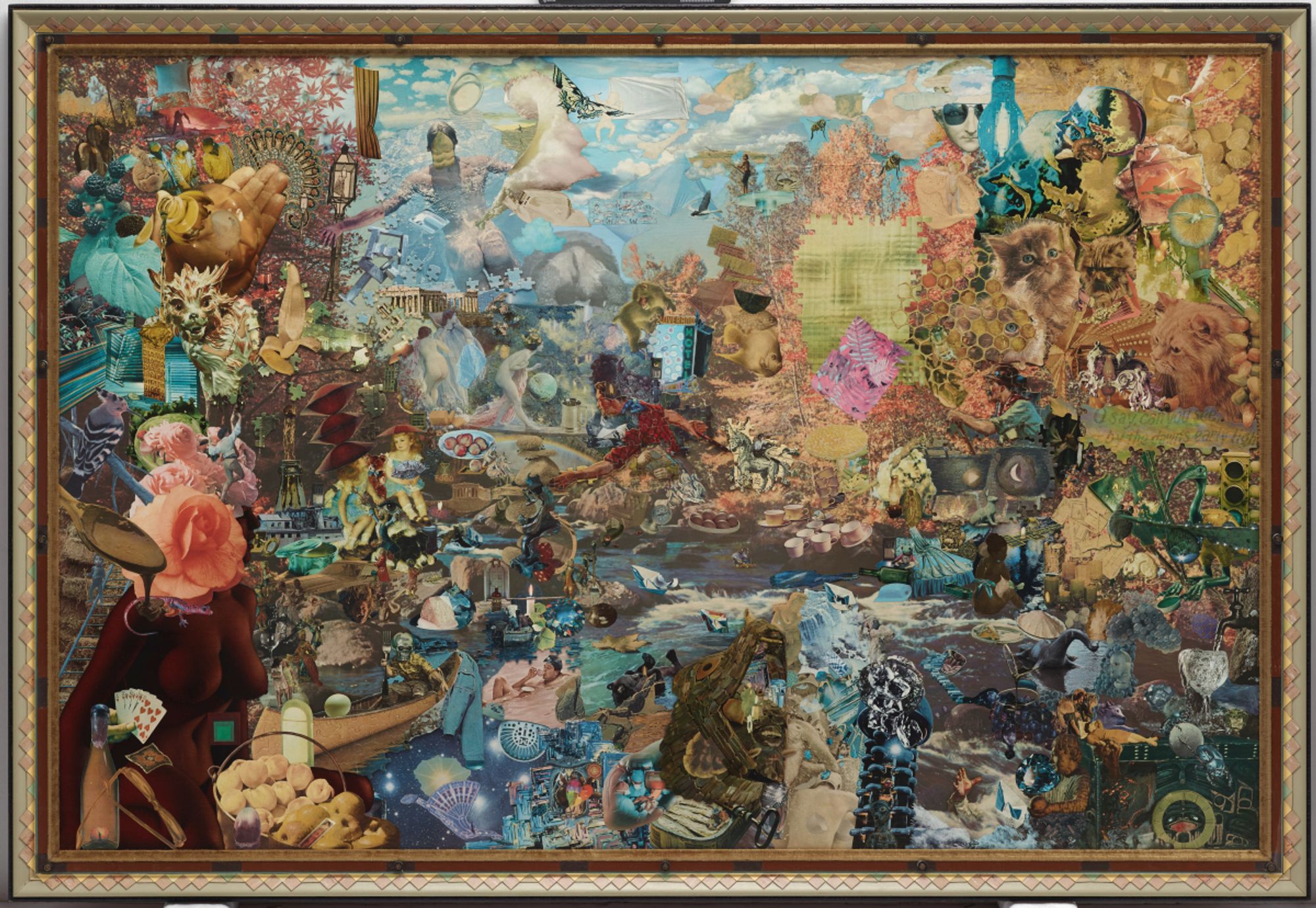
| Jess, Arkadia’s Last Resort; or, Fête Champêtre Up Mnemosyne Creek, 1976. Magazine cutouts and puzzle pieces, 47 × 71 in. Dallas Museum of Art, |
Jenny Odell in an article about collage artist Jess: article-https://pioneerworks.org/broadcast/13-ways-jenny-odell?utm_source=substack&utm_medium=email
The day I spent hunched over the two Jess books in the Berkeley library (before they would be re-shelved to their separate homes in art and poetry), I emerged from the building only to find myself in a different collage. The paved walkway was straight, but the campus was made out of fractal paths of noticing, each with its own surprising details: the perfectly constructed beehive outside the library, the man in a skeleton costume posing for a photo in front of the science building, the peregrine falcon shrieking overhead while he did. Every oak leaf, edges backlit by the afternoon sun; every tired shoe crossing Oxford Street; every menu item outside the Persian restaurant; every metal pipe along the ceiling of the BART station; every plastic curve of the AC Transit bus; every scratch on the window through which I saw every stucco wall and peeling billboard. In the visual frame left to me by Jess, the meaning was to be found not in the things themselves, but in the dialogue of their presences. It’s a language I’m still learning how to see and write in
Later:
Searching, finding, and filing—especially in seclusion, as Jess often worked—are what sense-making looks like to me. I grew up in a time of grotesquely proliferating information, easier than ever to access and with a seemingly total lack of structuring narrative. For me, collection and arrangement were a response, a necessary adaptation: you could give up and live in a senseless world, or you could set about building sense from whatever scraps you could find. But this arrangement could be a pleasure in and of itself, full of devotion to each little piece and to the kind of complexity that needs only finding, not making. In a short text collaged into an announcement for Jess’s 1989 show at Dilexi Gallery, Duncan calls Jess’s art “not impression, not expression, but an involvement in what is.” It is this assumption that meaning is to be found among what[already] is that I relate to most in Jess’s work.

No comments:
Post a Comment