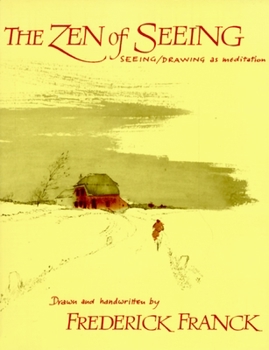
The Zen of Seeing: Seeing/Drawing as Meditation by Frederick Franck
The Instructions: I asked the participants to sit down somewhere on the lawn. . . leave at least six fix of space between one another. Don't talk, just sit and relax. Let your yes fall on whatever happens to be in front of you. It may be a plant or. a bush or a tree, or perhaps just some grass. Close your eyes for the next five minutes. Now open your eyes and focus on whatever you observed before -- that plant or leaf or dandelion. Look it in the eye, until you feel it looking back at you.Feel that you are alone with it on Earth! That is the most important thing in the universe, that it contains all the riddles of life and death. It does!
You are no longer looking, you are SEEING...
Now take your pencil loosely in your hand, and while you keep your eyes focused allowed the pencil to follow on the paper what the eye perceives. Feel as if with the point of your pencil you are caressing the contours, the whole circumference of that leaf, that spring of grass. Just let your hand move! Don't check what gets onto the paper, it does not matter at all. If your pencil runs off the paper, that's fine too! Only don't let your eye wander from what it is seeing and don't lift your pencil from your paper! And above all don't try too hard, don't "think" about what you are drawing, just let the hand follow what the eye sees. Let it caress. (xiv)
[one student said] "I have gown geraniums for thirty years, but, believe it or not, I never knew what a geranium looked like, how it was made, until I drew one today." (the drawing had very little resemblance to any geranium, past or presetn, but then we were not out to make "art" but to experiment with seeing.) (xix)
Looking and seeing both sart with sense perception, but there the similarity ends. When I 'look' at the world and label its phenomena, I make immediate choices in that appraisall - I like or I dislike, I accept or reject, what I look at, according to its usefulness to the "ME"... THIS ME THAT I IMAGINE MYSELF TO BE, and that I try to impose on others.
The purpose of 'looking' is to survive, to cope, to manipulate, to discern what is useful, agreeable, or threatening to the Me, what enhances or what diminishes the Me. This we are trained to do from our first day. (5)
When, on the other hand, I SEE -- sudeenly I am all eyes, I forget this Me, am liberated from it and dive into the reality of what confronts me, become part of it, participate in it. I no longer label, no longer choose.
It is in order to reaaly SEE, to SEE ever deeper, ever more intensely, hence to be fully aware and alive, that I draw what the Chinese call "The Ten Thousand Things" around me. Drawing is the discipline by which I constantly rediscover the world. (6)
I have learned that what I have not drawn I have never really seen, and that when I start drawing an ordinary thing I realize how extraordinary it is, sheer miracle: the branching of a tree, the structure of a dandelion's seed puff. "A mouse is a miracle enough to stagger sextillions of infidels," says Walt Whitman. I discover that among the The Ten Thousand Things there is no ordinary thing. All that is, is worthy of being seen, obf being drawn. (6)
What really happens when seeing and drawing become SEEING/DRAWING is that awareness and attention become constant and undivided, become contemplation. S?D is not a self-indulgence, a "pleasant hobby," but a discipline of awareness, of UNWAVERING ATTENTION to a world which is fully alive. It is not the pursuit of happiness, but stopping the pursuit and experiencing the awareness o, the happiness, of being ALL THERE It is a discipline that costs nothing, that needs no gadgets, All I carry is a pen in my pocket, a sketchbook under my arm. This is my lens. This eye is the lens of the heart, open to the world. My hand follows its seeing. (8)
Authentic personal experience is both aim and method of Zen. (13)
The Zen experience is the overcoming of the hallucination that the ME is the valid center of observation of the universe. It is a momentary, radical turn-about, A DIRECT PERCEPTION OF THE AND ISIGHT INTO THE PRESENCE, INTO THE TRANSIENCY, THE FINITUDE THAT I SHARE WITH ALL BEINGS. It is a fleetingness that makes this very moment infinitely precious. (14)
SEEING/DRAWING as a technique of contemplation is, I believe, a way particularly suited to that "Western temperament" which may be no more than a habitually overstimulated nervous system, an "overloaded switchboard." It is the discipline through which I extricate myself from the habitual, the mechanical, the predigested and acquisitive automatisms of our society. I stand face to face with a hill, a bird, a human face -- with myself, in unwavering attention. (16)
Chuang Tzu said, in the 4th century BC
The perfect man uses his mind as a mirror. It grasps nothing, it refuses nothing. It receives but does not keep.
12th century Baso: When tired I sleep, when hungry I eat.
Doesn't everybody do that?
No. When others eat they do not eat with their whole being. They talk, they plan, they think, while eating and they dream and worry while asleep.

No comments:
Post a Comment