 |
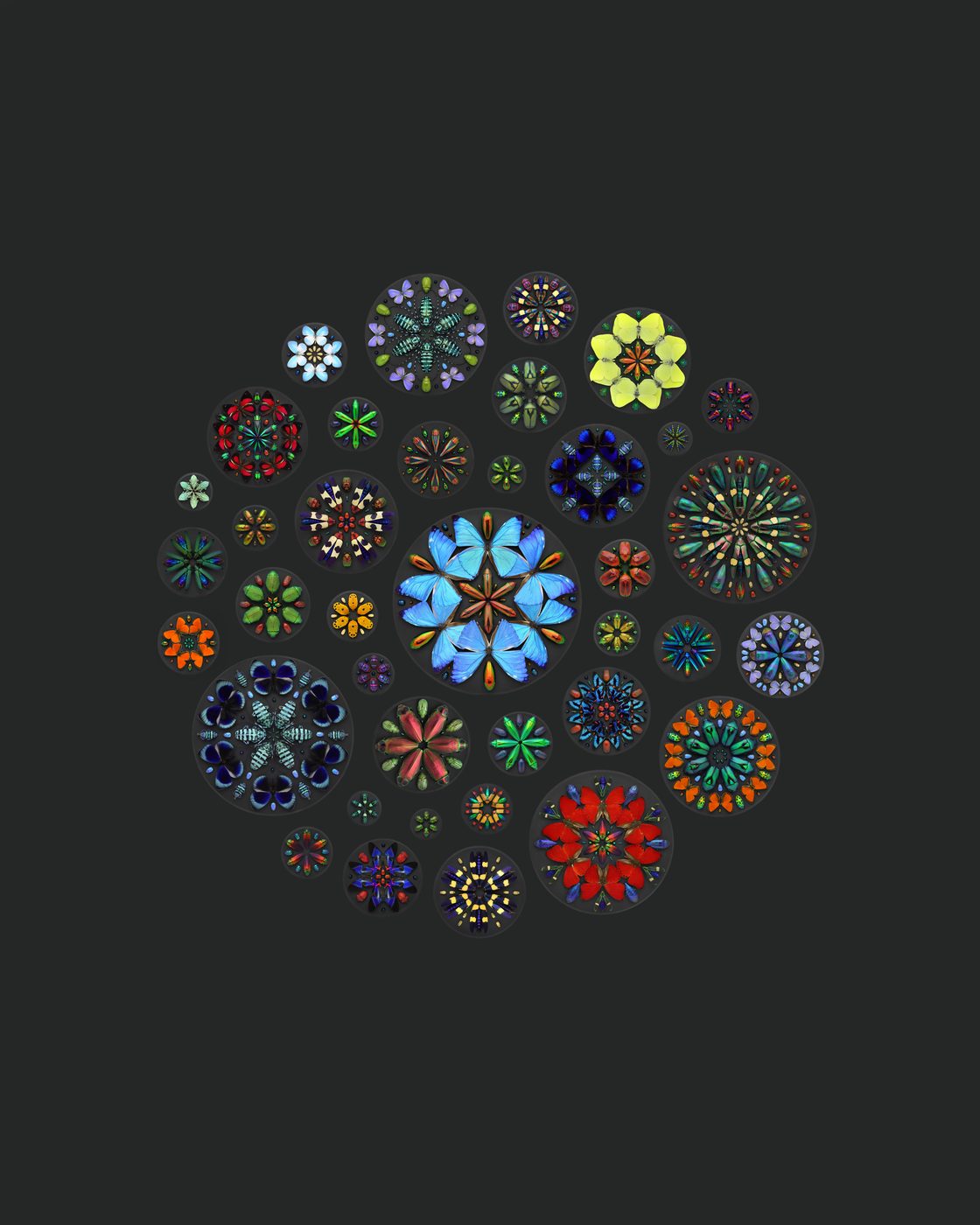
| Christopher Marley, Continuum II, 2022, Coleoptera spp, Scutelleridae spp, Lepidoptera spp. 40 in. x 40 in. |
There are several studies, starting with the first one in the nursing home, where we gave people control — made people mindful. People need to understand when I’m talking about mindfulness, it has nothing to do with meditation. Meditation is a practice that you engage in, presumably to result in post-meditative mindfulness. Mindfulness, as I study it, is more immediate. It’s the very simple process of noticing. And as you notice, the neurons are firing. And the study that you suggested and several others shows that it’s literally and figuratively enlivening. If you ask somebody how much of the day are you noticing, aware of what’s around you and so on, people would think virtually all the time. Sadly, much of the research has shown me that virtually all of us, much of the time, are mindless. We’re not there. And, Steve, when you’re not there, you don’t know you’re not there. And it’s because of those absolutes that I mentioned a moment ago that leads us not to be there. If you knew what I was going to say next, why would you listen to me? And when we’re not paying attention, the system more or less is turning itself off. And being there is so easy. You sit up and you pay attention. And when you do that, you’re engaged and it’s exciting. And we have so many findings of the advantages of being mindful. The neurons are firing, you end up happier, healthier. In some sense you light up. People find you more appealing, more charismatic, more authentic, and trustworthy. We even find that it leaves its imprint on the things that you’re doing. If you do something mindfully versus mindlessly, people tend to prefer the mindful version of it. Everything seems to change. I’ve been doing this for, gosh, 45 years — it’s just better for us. We come alive when we’re engaged. And becoming engaged follows from our knowing that we don’t know and the fun in finding out.
Short introduction...
LEVITT: One of the things I’ve heard you say about mindlessness is that people, when they’re in a mindless state, they’re typically in error, but rarely in doubt.
LANGER: Yeah, no, that’s very important because when you’re mindless, it’s not even that you’re saying to yourself that you’re certain. You just proceed without any doubt. And people have run away from doubt without recognizing: if you don’t have doubt, then you don’t have choice. People don’t want doubt, but they want choice. The most important way, from a top down perspective, to become mindful is to appreciate uncertainty — that with everything changing, everything looking different from different perspectives, you can’t know. Now what happens is, individually, when we don’t know, sometimes we’re afraid. I think I’m supposed to know. I don’t know. I don’t want anyone to know I don’t know. So then I pretend or I avoid. And I’m here to free everybody to say nobody knows. I think that the most powerful position one should assume is one of being confident but uncertain.
* * *
When I started to paint — I’m 50 years old — prior to that, if you had asked me what color are leaves, I would have said — mindlessly forgetting about the fall when leaves change color — I would have said they’re green. Then I start painting, and I start seeing more. You look at trees, and there are hundreds of different color greens that change as the sun changes in the sky, changes in the seasons and so on. Once you wake up, there’s just so much more. Everything feels new and potentially exciting.
***
LEVITT: In your studies, you teach people to have a mindful approach. What’s the process of opening people up to that state of being?
LANGER: There are three things. The first was for people to respect uncertainty and to make a universal attribution for not knowing, rather than a personal attribution. Nobody knows. So then everything is there to be found out. And that will necessarily make you mindful. So the respect for uncertainty. The second is: ask yourself, you walk out your door and notice three new things. Notice three new things about the person you may be living with; three different ways of doing whatever you’re doing. Look for multiple answers to any question that you’re asked and so on. And the third way is, when we’re learning something, not to learn it the way most of us have sadly learned most of the things we know, with absolutes. The best way to learn is to learn conditionally. Rather than “is,” you should learn “could be,” “would be,” “possibly,” “it would seem that,” “might be.” And when you know that it could be, you’re open to possibilities that otherwise won’t occur to you.
***
So basically, really the question you’re asking is, why are you so stressed? And we have a culture that says, well, everybody’s stressed. Work has to be stressful. And I don’t agree with any of that. What people need to understand is that events don’t cause stress. What causes stress are the views you take of the event. If you open it up and take a more mindful view, knowing that things can be understood in multiple ways, you’re not likely to choose the one that’s driving you crazy. This is one thing I say frequently now, for which I don’t have data, but I believe that stress is our biggest killer. If you took people who were given some dread diagnosis, and you let them get used to it after a few weeks and then you start measuring their level of stress, that would predict the course of the disease over and above genetics, nutrition, and dare I say, even treatment. That’s how important I think stress is to our well being. And again, given that stress is psychological, that suggests that we can control it. And I think that there are lots of ways that are not very hard for people to do. Ask yourself the next time you’re stressed, is it a tragedy or an inconvenience? I missed the bus, or I burnt the roast, or I didn’t finish the project — so what? You become wiser to these as you get older, but this is the sort of thing I try to teach my students in their early years in college. Why do we have to wait to learn this? Another thing we might recognize is that most of the things we’re stressed about never occur. So we should use the rule: no stress before it’s time. We should not accept that things have to be stressful. And again, an example I’ve probably overused, but Steve, you and I go out to dinner and the food is great. Wonderful. It’s a win. You and I go out to dinner, and the food is awful. Wonderful. I’ll eat less, that’ll be better for my waistline. For me, I have a very clear understanding that events are neither good nor bad, but that the way I understand them will make them so. It’s just a matter of recognizing that nothing is important in and of itself. We give it the importance, and sometimes that works to our disadvantage.
***
there’s something that I came up with that doesn’t sound as big, but that was probably, for me, the most important thing that I came to in my career. And that was the very simple understanding that behavior makes sense from the actor’s perspective or else the actor wouldn’t do it. So, for example, I’m very gullible. I am. If you say to me, “Ellen, for a woman of your age and your experience, it’s pathetic.” And so I’ll look back at my behavior and I’ll say, “You’re right. I’m going to try to not be so gullible.” But I’m always going to fail. Because from my perspective, I’m not intending to be gullible. I’m trusting. And as long as I’m trusting, I’m going to be gullible. So then I realized that every single negative characteristic we have to describe ourselves or anybody else has an equally strong but oppositely valenced alternative. For every negative thing, there’s a positive version of it. And that if you want to change people, what you need to do is speak to them from the perspective from which the action is originating. You want me to stop being gullible? You have to get me to stop valuing being trusting. And my guess is you would probably like the fact that I’m trusting now that you see it that way. Or try to get me not to value it, in which case I’d be able to change. But as long as I value being trusting, I’m going to be gullible. We did this in a study forever ago where we had people — we gave them behavior descriptions and said, “Circle those things that you keep trying to change about yourself and you fail.” So for me, I’d circle gullible, I’d circle impetuous, impulsive. I won’t tell you the others. And then you turn the page over, and in a mixed up order of the positive versions of each of these. And then we say to people, “Circle those things you really value about yourself.” I value my being trusting and spontaneous. Well as long as I do, I’m going to be vulnerable to the insults on the other side of the page.
***
we have lots of things that sound good that have another side to them. When you say to somebody, “Try.” You don’t try to eat an ice cream cone. You just eat it. Now, trying is better than giving up. But there’s an even better way of being, which is just to presume everything is going to be fine, presume you can do it, and go forward and don’t waste your time. We did a little research on trying versus doing, and even with the doing of things, people get themselves crazed. People think they want perfection. And you can either do things perfectly mindlessly, or imperfectly mindfully. Let’s say you’re a golfer, and oh, wouldn’t it be wonderful if you could get a hole in one each time you swung the club? Well, no! After the first couple of times, you’d see there’s no game there. What makes the game is the imperfect performance. If we recognize that it’s the challenge, that’s exciting for us, we’d possibly enjoy the so-called challenges more.
***
But if we go back to chronic illnesses, mindfulness is the best thing for our health. And so all the while we have this chronic illness, we increase our mindfulness, our enjoyment, our engagement with the world, we’re going to be affecting our health. Then, the last thing in this I call it attention to symptom variability. So when you are diagnosed with a chronic illness, people think that your symptoms are going to stay the same or just get worse. But it turns out nothing moves in only one direction. There are always little blips. Imagine the stock market is increasing. It doesn’t go up in a straight line. It’ll go up, it’ll go down a tiny bit, go up. So when it’s a little better, what’s happening? Why is that? So all we do is we have people, we call them periodically throughout the day, throughout the week, and we ask them, “How is the symptom now? Is it better or worse than the last time we called, and why?” The “and why” is the important question. Well, this procedure works. There are four things that happen. The first: when many people have chronic illnesses, they feel helpless, which is bad for their health, and certainly for their happiness. So now you’re doing something for yourself. Second, as soon as you notice that there are times where you feel a little better, wow, that’s good because I thought I was always in maximum pain. Third, when you ask the question “why” and you start paying attention to when it hurts, when it doesn’t, what might be different today or this hour from two hours ago and so on, you’re being mindful. I believe that you’re more likely to find a solution if you’re looking for one than if you’re not. We went ahead and did this with all sorts of disorders. We have multiple sclerosis, Parkinson’s, chronic pain, stroke, and across all of them, we’re getting positive findings. What’s nice about this and what I like about all of the so-called medical treatments and the way that we come up with is that there are no negative side effects. And also that you can be doing this while you’re waiting for the results from the doctor. I’m not suggesting that we don’t seek out medical help when needed. The suggestion I’m making that we partner, at the least, in our own health care.
***
I think lots of people in today’s world are doing all sorts of things to extend their lives. And I think that rather than spend time trying to add more years to our lives, what we should be doing is adding more life to our years. And by doing that I think it will have the surprising effect of having us live longer.

No comments:
Post a Comment