 |
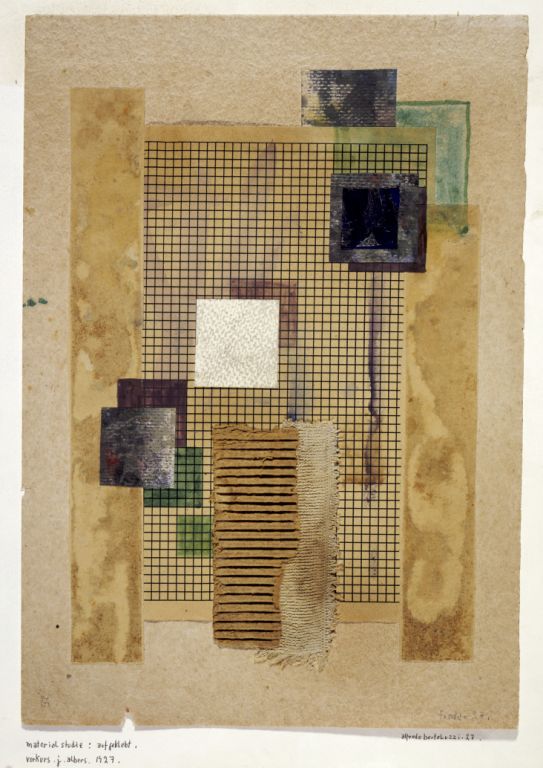
| Material study from the preliminary course of Josef Albers, Bauhaus Dessau, author: Alfredo Bortoluzzi, 1927. |
Johannes Itten, the Swiss painter who designed the mandatory “preliminary course
Here's a Bauhaus website that provides info about the 3 different directors of the course:
After Johannes Itten’s departure, Walter Gropius commissioned Josef Albers and the Hungarian artist László Moholy-Nagy to teach the preliminary course together. When the latter left the Bauhaus with Walter Gropius in 1928, Albers became the official head of the preliminary course. Albers taught material studies during the first semester, which he extended to up to 18 hours per week in the preliminary course workshop. In his classes, he had the students use simple tools to explore the properties of various materials such as metal, wood and paper. The focus was on the development of spatial structures where the correlation of material, construction, function and production technology was to lead to optimal performance with a minimum input of material, energy and time: a school of invention.
Moholy-Nagy adopted Itten’s teaching method in the preliminary course by asking students to carry out independent studies of material. He did not want to promote the pure individuality of his students, but to systematically introduce them, through a synthesis of the senses, to the technical foundations of statics, dynamics and equilibrium. Moholy-Nagy’s lessons on the surface, or the plane, focused on the medium of collage.
When I ask Claude:
The "preliminary course" (also known as the "Vorkurs" in German) was a foundational element of the Bauhaus curriculum and had a profound influence on modern design education.
The course was first introduced by Johannes Itten, a Swiss expressionist painter and educator, when the Bauhaus was founded in Weimar, Germany in 1919. Itten's preliminary course lasted six months and was mandatory for all incoming students regardless of their intended specialization.
Key aspects of the preliminary course under Itten included:
- Exploration of basic materials and textures
- Studies of contrasts and form
- Color theory and composition
- Rhythmic drawing exercises
- Analysis of old masters' works
- Physical exercises and breathing techniques intended to free students' creative potential
When Itten left the Bauhaus in 1923, László Moholy-Nagy and Josef Albers took over the preliminary course. They shifted the focus away from Itten's more spiritually-oriented approach toward a more objective, materials-based methodology. Moholy-Nagy emphasized technology and industrial materials, while Albers focused on economy of form and material studies.
The preliminary course was revolutionary in art education because it:
- Broke down traditional hierarchies between fine and applied arts
- Focused on experimentation rather than technical mastery
- Taught fundamental design principles applicable across disciplines
- Encouraged students to approach materials without preconceptions
This educational model has been enormously influential, and versions of the preliminary course are still found in art and design schools worldwide today. It represents one of the Bauhaus's most enduring legacies in design education.
Yes, the Bauhaus preliminary course did have a structured curriculum with specific assignments and exercises. Here's what a typical class might have looked like:
Under Johannes Itten (1919-1923), a typical class might include:
- Morning sessions often began with physical exercises, breathing techniques, and meditative practices to help students relax and open their minds creatively
- Material studies where students would create contrast studies examining opposing qualities (rough/smooth, light/heavy, transparent/opaque)
- Students worked with basic materials like paper, wood, glass, metal, and textiles to understand their inherent properties
- Specific assignments included creating collages of contrasting textures, analyzing Old Master paintings for their composition and rhythm, and constructing three-dimensional forms from simple materials
Under László Moholy-Nagy (1923-1928):
- Classes focused more on technical aspects, photograms, light studies, and kinetic art
- Students conducted material experiments emphasizing the relationship between form and function
- Assignments often involved creating constructions that demonstrated balance, tension, and spatial relationships
- Photography and typography became important components of the curriculum
Under Josef Albers (1923-1933):
- Classes centered on material economy and inventiveness with limited resources
- Famous paper exercises where students had to transform flat paper into three-dimensional forms with minimal waste
- "Materialgerechtigkeit" (material justice) was emphasized—understanding what each material can and cannot do
- Students created furniture and household objects with an emphasis on functionality and economic use of materials
A typical assignment might be:
- Creating a stable structure using only folded paper without cutting or gluing
- Producing a series of textures using a single material but different manipulations
- Designing color studies showing the relative nature of color perception
- Constructing a functional object from standardized parts
The preliminary course was notable for its hands-on approach. Instead of lectures, instructors would provide brief demonstrations or explanations, and students would spend most of their time experimenting independently. Critique sessions were held regularly where students would present their work, and both teachers and peers would discuss the results.
Although structured, the course emphasized process over product, encouraging students to develop their own problem-solving abilities rather than follow prescribed solutions. This innovative pedagogical approach helped students break free from conventional thinking and develop a foundation for creative work in any medium.

No comments:
Post a Comment