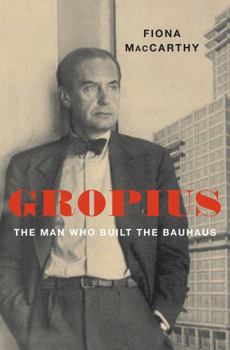
Walter Gropius:
For my part, I'm increasingly interested in the big questions of urban planning. I'm just not interested anymore in whether this or that building is balanced within itself, unless, that is, it is intended as part of a larger whole.
Author Fiona McCarthy continues: "Teamwork was the new mantra. Team was the great principle that motivated TAC" (Gropius' later life architecture collective.)
NYer review: Later in his life, bantering with Frank Lloyd Wright about the importance of collaboration, Gropius was asked by Wright, ever the solo operator, whether he would enlist a neighbor’s help in making a baby. Gropius, channelling both sides of his nature, answered that he might, if his neighbor was a woman.
Similar idea about the point of total architecture (from NYER)
In 1924, a new provincial government threatened to cut off the school’s subsidies. Nazi factions in the region supposed that all those foreign-looking students were Jews or Jewish sympathizers. The following year, Gropius moved the school to Dessau, an engineering and manufacturing center, southwest of Berlin. There, for the first time, the Bauhaus built itself a campus. Gropius, now one of the most famous architects in the country, oversaw the design of the main buildings and the masters’ houses. The workshops, which he also designed, provided everything: textiles, fittings, door handles, murals, and tableware. The furniture was produced in the joinery of Marcel Breuer, one of the first and youngest students at the Bauhaus.
ddf
The evolution of a single design gives a sense of how the Bauhaus grew. For his Model B3 chair—also called the Wassily chair, in honor of Kandinsky, who expressed admiration for its prototype—Breuer took inspiration from the elegant handlebars of a milkman’s bicycle, made of seamless tubular steel, a new material. He created an industrial-age club chair that, reduced to its metal frame, seemed to levitate in space. You could see through it to other, equally beautiful Bauhaus objects in the background. Like all the furniture Breuer designed for the school, it was also a collaboration: the school’s textile workshop contributed the seats, woven from Eisengarn, a strong cotton thread. And, as with many great Bauhaus designs, it is an example of materialized reasoning. It solves the formal problem of creating a substantial piece of furniture that is both there and not there. It is interesting from every angle, and especially beautiful from the back.
dsa

No comments:
Post a Comment