 |
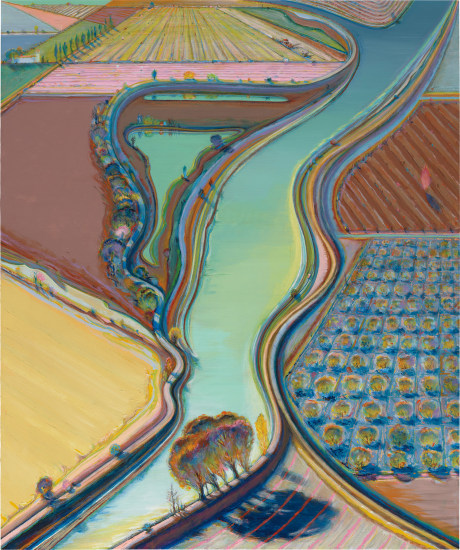
| Winding River by Wayne Thiebaud, 2002 link |
Robert Macfarlane in Emergence Magazine about his new book
RMYeah, yeah. Stories. I’ve come to realize in just the last few days that we need new stories for rivers and some of those new stories are very old stories. And there are places in the world where they have never stopped being told. But I guess a writer’s work— I’m not a policymaker, I’m not a politician. I don’t have the direct ear of government. But a writer’s job is to tell stories and in that way to reimagine relations with, in this case, rivers. And I wanted to ask myself, and I did so by speaking with rivers and with river people, what happens when you reimagine a river as alive? As having a life, having a death, and even having rights? And it’s a hard work. It’s hard work, that reimagining. Right? It’s unlearning, I think. That’s because we are— I mean, you are different in this respect, Emmanuel. I think you’ve thought your way around these thought structures, these dams of, these conceptual dams, better than I have. But we are creatures of rationalism in many ways. And rationalism sees a river as what Isaac Newton calls “inanimate brute matter.”
... E.O. Wilson's phrase... the Eremocene. The age of loneliness. The epoch of loneliness. The loneliness that comes not from isolating oneself in a busy world and seeking temporary refuge, but actually from silencing the whole of the rest of the world. And the terrible solitude that will strike us, that is striking at us. [And [in response, you] urge for “new ways of being that will leave us less alone in the world, less the desolate lords of Tacitus’ victory field,” for “our aliveness, as well as all life that lies beyond the human, is at stake.” ]
...There’s a wonderful kind of community leader and legal pioneer in Australia called Anne Poelina. She’s a Nyikina Warrwa scholar activist, and she’s really led the recognition of the rights of the Martuwarra Fitzroy River in Australia. And she has a wonderful line I quote in the book: she says, “The law is being used creatively to train human beings to listen, pay attention to, and learn from, rivers.” And that idea of rivers as lawmakers, as well as imagination shapers, as well as co-authors of the book that I wrote—absolutely they were my co-authors—is incredibly exciting to me. Because if we can allow rivers to make power, then we have a glimpse of an alternative possible future, a way of imagining both water and law otherwise.
....EVLAnd he spoke about how, to be we have to be related, and that before we can know a river to be alive, we must first widen our understanding of the ways we are connected with it; because a river doesn’t exist in isolation.
RMYeah, Yuvan is extraordinary. If people read the book for only one reason, it would be to make his acquaintance, and that of Giuliana, Cosmo, César, Rita, Wayne.
...you write, “A river is not a human person, nor vice versa. Each withholds from the other in different ways. To call a river alive is not to personify a river, but instead further to deepen and widen the category of ‘life,’ and in so doing—how had George Eliot put it?— ‘enlarge the imagined range for self to move in.’” I wonder if you could speak to this a little.
RMYeah, I will try. It’s very hard, because, necessarily, we lack the language for it. And I find that that lack, that fundamental eventual ultimate futility of articulation, not a reason to desist, but a reason to keep trying. Once one dispenses with the idea that one will be able to generate a correspondence theory of language, which allows us to articulate the life of water, in any sense, in its fullness, and instead thinks, well, let us do the best we can, let us do the best we can, then you start to move into possibility. And actually that’s when artifice, when metaphor, when rhythm, when sound pattern of language become your kind of collaborators in this attempt to speak with water, to think with water.
... I mean, bio-regionalism, as you know, was a key concept in early modern American environmental thought: Gary Snyder, among others, big, big proponent of watershed thinking. And I still think that is a beautiful phrase, a really, really helpful phrase. What would the world look like if it was divided into watersheds? Everyone lives in a watershed, even me here in flat Cambridge; even the Dutch in seemingly purely horizontal Netherlands. Everyone lives in a watershed.
...César Rodríguez-Garavito, who of course has been a guest on the Emergence podcast before, when we discussed Song of the Cedars.
...C.W. Bryan poem where exactly this happens. I found it after I’d finished writing the book. And he says, “but I ask away, if only / to remind myself that the river / is just alive as I claim to be.”
...I’ve spent twenty years putting my body in the way of places. And when I finished writing Underland, lots of people would come up and say, “Oh God, I could never do, you know … and you were crawling through this catacomb chamber.” And I felt like getting a business card that said, I do these things so you don’t have to. But I mean, to speak philosophically of it, I do believe that primary encounter generates metaphysics much in the way that a river generates mist as it meets atmosphere. That there are forms of aura, very literally put, of conversation, of sensation that are simply unavailable at distance. Remote sensing technologies, let’s say, will never pick them up, will never gather them and braid them. And I have also absolutely consistently found that going to a place, being in a place, particularly for a time, somewhat chronically, will result in surprise.
... I came to realize that one of the consequences of, let’s say, the rise of rationalism in our relationship with water is that—I paraphrase Herbert Marcuse—we now live with one-dimensional water. Water is service provider, in effect. And in so doing we have deterritorialized, homogenized, and flowed all waters together, such that they have no source, they have no origin. They merely exist insofar as they meet our needs. And the meeting of our needs is vital. The damming of rivers has led to the flourishing of millions, the slaking of the thirst of millions; has led to vast amounts of theoretically renewable power. These are not easy accounts of bad tech, good-natured dreams of purity. We know the way those dreams go. They’re bad dreams. Everything is complex, everything is turbid, the water is turbid. But to me, a step towards a return to a political honoring of rivers, which may be something as simple as allowing them to flow, restoring them to cleanliness, restoring them to swimmability. Let’s just start with that easy baseline. If all the rivers in England could be swam in without falling sick, we would be in a transformed landscape. Let alone drink—let’s make drinkability the goal thereafter. We’ll make them swimmable, then we’ll make them drinkable again. That sounds amazing. And to do that, we recognize rivers as interflowing collaborators with one another, but we also recognize them as having their own distinct personalities, cultures, watersheds, regions, biotas, and this—we are a long way from one-dimensional water if we can do that.
And that’s where story comes back in. It flows back in at a great, great rate. The crisis is one of imagination as well as legislation. And that’s why I feel great hope, actually. I feel we know what we need to do.
...And, yeah, he constellates; let’s put it like that, to use that phrase beloved of, or that verb, beloved of Walter Benjamin and Theodor Adorno. He places things in relation, and he helps me to do that a little better.

No comments:
Post a Comment