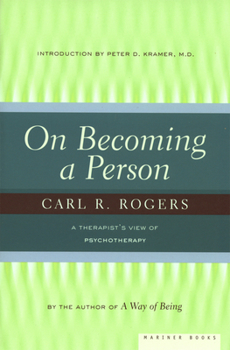
Carl Rogers' book On Becoming a Person has really been the book of the summer. I read it during June and July, took notes on it (as blog posts) through July and August, and recently compiled a "greatest hits" of ideas below. During my searching of my own notes, I saw that I had posted on his 19 Propositions way back in November, 2021. That compiling of notes was a "10x10" project that I did this summer -- which involves setting a goal and breaking it into 10 steps that are about 30 minutes apiece ... and then checking off the tasks one by one.
Here's my attempt at listing 10 most important ideas
- A "healthy" person is one who is increasingly good (and trusting) at recognizing his own range and richness: his emotional and organismic response to the world, his own impulses, desires, opinions; this can seem like "trying to listen to himself" and his own inner reactions, his own "instrument" for encountering life; one important aspect is person's ability to identify true responses to things; true feelings
- A "healthy" person is less judging... simply noting what is the case, not complaining that rocks are hard and water is wet (maslow). This "health" is marked by "Maslow might be speaking of clients I have known when he says, “self-actualized people have a wonderful capacity to appreciate again and again, freshly and naïvely, the basic goods of life with awe, pleasure, wonder, and even ecstasy, however stale these experiences may be for other people.”
- The "good life" isn't a static place, isn't contentment or bliss; it isn't homeostasis; instead it's a PROCESS, a DIRECTION, a trust in one's organism; an open state of becoming that's directed by your organism. It's marked by openness to new things, openness to others as subjects; it's "enriching, rewarding, exciting, challenging, meaningful". He is more creative; he senses each moment is new; He is a participant in the ongoing process of organismic experience, not in control of it
- Learning (in therapy or the classroom) has certain conditions: there is a problem, the student feels that therapist has congruence, empathy, is nonevaluative; learning that makes a difference is learning that changes behavior and attitudes
- Congruence is "realness" - I know my feelings, responses, and I don't try to hide them from you -- either on purpose or unconsciously. Feelings match expression
- A barrier to interpersonal communication is tendency to judge to evaluate, approve. “If I can sense the emotional flavor which it has for him, then I will be releasing potent forces of change in him”. First “restate the idea and feeling of the previous speaker accurately, and to that speaker’s satisfaction”... understand "with" a person, not "about" him... and this is a risk that YOU will change
- The concept of "cure" is inappropriate bc mostly these issues are behavioral; "becoming himself" doesn't mean solving problems, but opening new parts of life; It involves pretty simple realizations: "oh I really am angry at x"; it's marked by "stumbling around" with language: is THIS how I feel?
- There are "7 stages" of becoming a person. From static, self-protective that doesn’t take responsibility to dynamic, open organism in state of becoming (essay finds quotes to show 7 levels of this). Involves: Who am I? And how may I become myself? Summary: a process of becoming, dropping of masks, experiences hidden aspects of himself, discovering the stranger behind the mask, Person who emerges: openness to experience, trust in one’s organism, instead of being a “watchman” over a dangerous lot of impulses, he becomes comfortable,
- Rogers not interested so much in unchanging aspects of intelligence, temperament. More interested in change. Does behavior change, what commonalities exist, what precedes change, what’s the process of change?
- There is tendency for self-healing, away from things hidden - humans awant to extend, develop, become autonomous - better integrated, more able to function effectively, self-directing, more able to cope. Defensiveness and not feeling are "normal." The experience of feeling (there are 1001 reasons for not letting ourselves experience our attitudes fully)… he gradually explores what is behind the mask... I sense the client "trying to listen to himself"… fluid, fluctuating
8/12 - Appreciate Basic goods of life - link - Carl Rogers On Becoming a Person, "'To Be That Self Which One Truly Is": A Therapist's View of Personal Goals" (1957)
Most of this material is very similar to other material I've taken notes on in the blog, especially in his essay "What it Means to Become a Person," which I've taken notes on here. But this section covers some different ground
“I sense the client is trying to listen to himself”, his own inner reactions
“Superior awareness of their own impulses, desires, opinions”
“Capacity to enjoy the basic goods of life, freshly and naively”
Ability to accept other individuals… simply noting and observing what is the case “doesn’t complain about rocks being hard”... this is what is human nature
8/11 - Concept of congruence link
Definition of congruence - “genuine, integrated” affection and anger and contentment or fear … transparent, “all the way through”
Two examples of incongruence. - unconscious and between feeling and communication
“My experience is X”... not FACTS
Not only expressing what he feels; feelings match expression; we wonder if he knows what he feels; we tend to be wary and cautious of these people
8/9 - Releasing potent forces of change “Breakdowns in communication" link
Barrier to interpersonal communication is tendency to judge to evaluate, approve
Tendency to react to any emotionally meaningful statement by forming an evaluation
Instead, we should “see the expressed idea and attitude from other person’s POV”
“If I can sense the emotional flavor which it has for him, then I will be releasing potent forces of change in him”
Understanding “with” a person not “about” him
Experiment: first “restate the idea and feeling of the previous speaker accurately, and to that speaker’s satisfaction”... understand that speaker’s frame of reference
You run the risk of “being changed yourself”
8/8 Learning which makes a difference - “significant learning: in therapy and in education” link
“Difference” means the course of actions he chooses in future, attitudes, and personality
“Don’t be a damned ammunition wagon; be a rifle!” I believe most educators would share this sentiment that knowledge exists primarily for use.
“Whatever knowledge I gained in his course has departed completely”
8/7 - Carl Rogers Q-Sort/ Chat GPT
8/6 - Persons or Science? A philosophical question.
Being himself doesn’t solve problems…it opens up a new way of living in which there is more depth and more height
Learning is not very complex: I do feel sorry for myself, I am fearful of being dependent
I stumble around asking - is it sadness, anger, sorrow that I feel?
8/5 - Personality change is psychotherapy (fix “colon”
Concept of cure is inappropriate… bc not a disease but learned behavior
Introduction of Q-sort
Lots more about how it works and other researchers who used it
8/4 - The conditions for learning
Facing a problem
Congruence
Unconditional positive regard
Empathetic understanding
Client perceives the congruence, acceptance, empathy
8/2 A therapist’s view of the good life
It is not a state of virtue or “homeostasis” or “finished”
Happiness or adjustment not the good life - no fixed states of being
Instead, it’s a direction, selected by the organism.. A process of movement
Openness to experience (rather than defensiveness)
Therapy is discovering by the client that he is experiencing feelings and attitudes which heretofore he has not been able to be aware of
Fully open to all of the sensory and memory and emotional “input” of the moment
Sense that each moment is new
Is a participant in the ongoing process of organismic experience, not in control of it
Increasing trust in the organism and reactions
Creativity, not adjusted to his culture, maybe unhappy, but moving toward becoming himself
Greater range, richness
Confidence as trustworth instruments for encountering life
Not “happy, contented, blissful, enjoyable” but “enriching, exciting, rewarding, challenging, meaningful”
7/30 What it means to become a person
Who am I? And how may I become myself?
Summary: a process of becoming, dropping of masks, experiences hidden aspects of himself, discovering the stranger behind the mask,
Person who emerges is more open to elements of his organic experience, trusts in his own organism as an instrument, accept locus of evaluation as withing himself, living life as participant in a fluid, ongoing process, continually discovering new aspect of himself
7/29 - Characteristics of a helping relationship
Congruent, non-threatening (even at physiological level), free other person from threat of evaluation,
7/28 - What it means to become a person
Who am I? and how may I become myself?
Getting behind the mask
The experience of feeling (there are 1001 reasons for not letting ourselves experience our attitudes fully… he gradually explores what is behind the mask… fluid, fluctuating
Person who emerges: openness to experience, trust in one’s organism, instead of being a “watchman” over a dangerous lot of impulses, he becomes comfortable
Internal locus of evaluation
Willingness to be a process
7/27 - The facilitation of personal growth
If i can provide a certain type of relationship, the other will growth
Be genuine/be real (transparent, warmth, empathetic)
There is tendency for self-healing, away from things hidden - humans awant to extend, develop, become autonomous - better integrated, more able to function effectively, self-directing, more able to cope
Becomes more open to self and others; behavior less defensive
7/26 In contact with problems
Students must be in contact with “relevant problems of his existence”
Task of teacher is to create a facilitating classroom climate in which sig learning can take place (this is about acceptance, etc)
7/17 The puzzle of process
Rogers not interested so much in unchanging aspects of intelligence, temperament,
More interested in change. Does behavior change, what commonalities exist, what precedes change, what’s the process of change?
6/29 7 Stages of becoming
From static, self-protective that doesn’t take responsibility to dynamic, orpen organism in state of becoming (essay finds quotes to show 7 levels of this)
6/24 The basic goods of life (Therapist’s view of personal goals)
Maslow might be speaking of clients I have known when he says, “self-actualized people have a wonderful capacity to appreciate again and again, freshly and naïvely, the basic goods of life with awe, pleasure, wonder, and even ecstasy, however stale these experiences may be for other people.”
11/23/21 Carl Rogers’ 19 Propositions
5. Behavior is basically the goal-directed attempt of the organism to satisfy its needs as experienced, in the field as perceived.
6. Emotion accompanies, and in general facilitates, such goal directed behavior, the kind of emotion being related to the perceived significance of the behavior for the maintenance and enhancement of the organism.
Carl Rogers personal thoughts on teaching and learning
At this juncture I took off for Mexico and one of our winter quarter trips, did some painting, writing, and photography, and immersed myself in the writings of Soren Kierkegaard. I'm sure that his honest willingness to call a spade a spade influenced me more than I realized. 273
So I sat down to write, is honestly as I could, what my experiences had been with teaching, is this term is defined in the dictionaries, and likewise my experience with learning. I was far away from psychologists, educators, cautious colleagues. I simply put down what I felt, with assurance that if I had not got it correctly, the discussion would help me to set it on the right track. (274)
List of thoughts:
Is a consequence, I realize that I'm only interested in being a learner, preferably learning things that matter, that have some significant influence on my own behavior.
I find it very rewarding to learn in groups in relationships with one person as in therapy, or by myself. I find that one of the best, most difficult ways for me to learn is to drop my own defensiveness, at least temporarily, and try to understand the way in which his experience seems and feels to the other person.
I find that another way of learning for me is to State my own uncertainties, try to clarify my puzzlements, and thus get closer to the meeting that my experience actually seems to have. 276

No comments:
Post a Comment