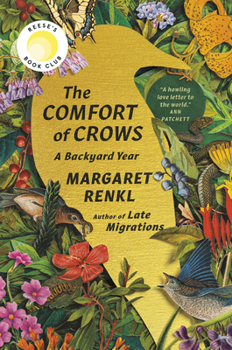
Comfort of crows
Many cultures have associated crows with death. Their uniformly black coloring, their harsh cries, their taste for roadkill all may have contributed to that most famous of collective names among birds, a murder of crows. Crows have been observed conducting "funerals" for fallen flock mates, and this somber ritual may account for the gloomy associations, too.
But other cultures have associated the birds with intelligence and adaptability, even transformation, and these are the connections I'll rely on as the year unfolds. I have entered my sixties now, a time of change—to my body, to my family, to the way I think about my future—and I cling to the crow's promise of metamorphosis. What more could anyone ask from a new year than the promise—or just the hope-of renewal. (7)
Two hours later, after helping with a unit on the Harlem Renaissance, I was humming as I walked back to my car. I wasn't thinking about the cataclysmic state of my country. I was thinking about the bright, funny students I'd met in a class for English language learners. I was thinking about Bessie Smith singing "St.
Louis Blues." But when I started my car, the radio came on, offering the usual news summary that opens each hour's programming.
Two red lights later, my happiness was gone.
That's how my vow of resistance finally yielded to the appeal
of retreat.
When I came to the third light, I turned left instead of continuing through it, and I drove to a little park in the woods where I often walk. There wasn't time before work to take the lake trail, my favorite path, but I walked as far as the dam and sat for a bit to watch a great blue heron fishing in the clear water. I listened to the invisible songbirds high in the treetops, and I watched the cold turtles climbing slowly onto fallen branches to warm themselves in the grace of a sunny day in January. For a few minutes, it was enough. (27)
But a creature lurking inside was not what singled this knothole out among the hundreds, even thousands, I passed in the park that day. What caught my eye was a cluster of chickweed seedlings colored the new green of springtime, so bright they seemed to glow. They were growing in the loam inside the knothole. Far above the ground, a hole made by decay in a living tree had become a cold frame, a natural greenhouse that let in light and kept out frost. Life in death in life.
On the way home I thought about that mundane miracle, that commonplace resurrection. Even now, with the natural world in so much trouble even now, with the patterns of my daily life changing in ways I don't always welcome or understand-radiant things are bursting forth in the darkest places, in the smallest nooks and deepest cracks of the hidden world. I mean to keep looking every single day until I find them. (53)
The world does not proceed according to our plans. The world is an old dog, following us around the kitchen with its eyes.
The world understands us. We understand nothing, control less.
Today it is springtime. Every green thing has grown greener as the pines send out new growth. Every brown thing is taking on green as the hardwoods wake into warmth. But tonight the black sky is spitting out ice, and the green sap rising will likewise turn to ice in the dark. Some of these frail green things will be blasted forever, but most will live. Life is what life does.
We, too, will live. In the morning we will wake and rejoice, for we are once more among the living. (65)
The world will always be beautiful to those who look for beauty.
Throats will always catch when the fleeing clouds part fleetingly and the golden moon flashes into existence and then winks out again. Tears will always spring up at the wood thrush singing through the echoing trees, at the wild geese crying as they fly. A soul touched by the scent of turned soil or sun-warmed grass, a spirit moved by crickets singing in the grass, will spend a lifetime surrounded by wonder even as songbirds drop one by one from the poisoned sky and crickets fall silent in the poisoned grass.
Apocalyptic stories always get the apocalypse wrong. The tragedy is not the failed world's barren ugliness. The tragedy is its clinging beauty even as it fails. Until the very last cricket falls silent, the beauty-besotted will find a reason to love the world.(70)
Here is the world I need, a world that exists far beyond the impulse to scroll and scroll. The bluebird bringing pine straw to the nest box in a sunny spot of the yard, like the chickadee bringing moss to the box under the trees, is doing her work with the urgency of the ages. She has no care for me. Even her watchful mate ignores me as I dig in the flower bed beside our driveway.
The natural world's perfect indifference has always been the best cure for my own anxieties. Every living thing— every bird and mammal and reptile and amphibian, every tree and shrub and flower and moss— is pursuing its own vital purpose, a purpose that sets my human concerns in a larger context. The dramas and worries and pain that are the warp of my life, woven tightly through the light and love and joy that are its weft, don't register on the blue jay at all. The earthworms beneath the soil haven't the least idea of the frets that pluck at my heart. In their rest, I find rest. 78-79
Monarchs are the only butterfly known to conduct an extravagant multigenerational migration, flying thousands of miles north in the springtime and thousands of miles south in the fall.
Somehow, butterflies that hatch in Minnesota and New York know how to get to their wintering grounds in Mexico without ever having left Minnesota or New York before. Along the way, there are many deadly assaults on the monarch population— herbicides, development, extreme weather—but the only one I have any power over is loss of habitat. I can't change Americans' love affair with poison, and I can't solve the problems of climate change, but I can plant a garden.
It takes the monarch four generations, sometimes more, to complete its annual migration. Each generation flies farther north to lay its eggs before the "Methuselah" generation turns south again and heads to Mexico. What those northbound butterflies need is milkweed, the only plant monarch caterpillars can eat. So I filled my garden with milkweed—more and more and more milkweed— and waited.
But years passed and not a single monarch arrived. Short of cutting down all our trees and replacing them with an entire field of milkweed, there was nothing more I could do. I finally decided to take the same approach to my pollinator garden that I had once adopted for my vegetables: I watered and I weeded, after a fashion, but mostly I let it go its own way. (123)
In July, there's hardly a reason to feed the birds in this yard that is well stocked with bugs and seeds, but I sometimes feed them even so, just to see them up close, their colors as bright as any summer flower. The red wasps, too, have babies to feed and help themselves when I set out mealworms for the bluebirds. I used to shoo them away bluebirds respect the dagger of a red wasp as much as I do and won't come near any feeder a wasp has claimed-but i don't do that anymore. The world is fertile. In this yard, for now, there's enough to go around. (158)
This kind of circular structure is what I love best about nature, even in its most violent reality. Outdoors, my spider's web might have been destroyed by hummingbirds, who build their nests partly of spider silk, and the spider herself might have been fed to the baby hummingbirds. Everything goes to some crucial use; nothing goes to waste. It makes sense. And things that make sense are particularly reassuring when the human world has turned itself upside down.
There is only so much information a person can take in during an emergency. There is only so much active resistance a person can engage in without succumbing to despair. Sometimes a body needs to rest. I have friends who pray more now, friends who drink more now, friends who read more novels or watch more television, friends who have taken up yoga or needlework or gardening. I have friends who wanted to adopt a kitten and then found that so many people had the same idea they had to get on a waiting list. A waiting list for rescue kittens!
I have tried some of these distractions myself, but I am taking my greatest comfort in a plastic bin full of earthworms turning garbage into food for flowers, in one spider crouching among a hundred silken strands that gleam like silver in the sunlight, in a cloud of fruit flies on their way to becoming a baby hummingbird's wings. (173-174)
It was just one flower on just one ordinary day in September. It would be gone by morning, not to return for another year. Its arrival did nothing to mitigate the drought gripping the land. It did nothing to feed a native pollinator or shelter a tree frog. You could insist that it didn't matter in any way, and I would not think to argue with you.
But it was also not nothing. That night-blooming cereus brought my grandmother back to me in her halo of white hair. It brought back, too, her plum tree, long since cut down, and the feeling of red dirt between my toes. For an hour, just this once, it made me remember what it feels like when the world is exactly as it must be, and I am exactly where I belong. (210)
The commandments don't identify by name which day of the week should be the Sabbath. They don't even mention the need to attend church. "Remember the sabbath day, to keep it holy," reads Mother Ollie's Bible. "Six days shalt thou labor, and do all thy work: But the seventh day is the sabbath of the Lord thy God: in it thou shalt not do any work."
Reading those verses again made me wonder: What if resting, all by itself, is the real act of holiness? What if honoring the gift of our only life in this gorgeous world means taking time every week to slow down? To sleep? To breathe? The natural world has never needed us more than it needs us now, but we can't be of much use to it if we remain in a perpetual state of exhaustion and despair.
It's hard not to work on Sunday, but I do try. I take a walk around my favorite lake, the best possible way to celebrate a day of rest in autumn, when the temperatures have finally dropped, the rains have finally come, and Middle Tennessee is serving up one fine day after another. (226)
On This Day (11/24):

No comments:
Post a Comment