.jpg?format=1500w)
From article.
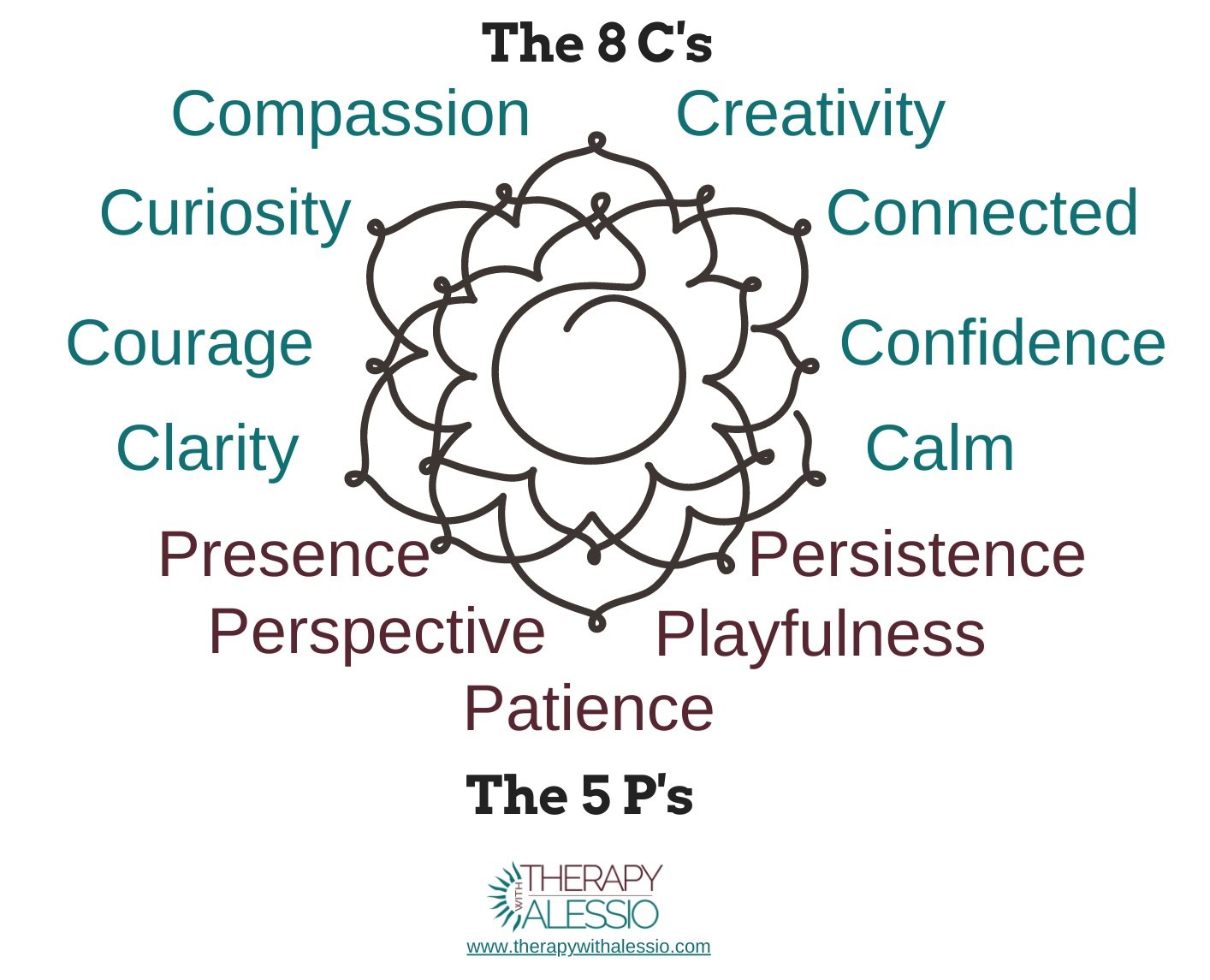
The 8 C’s and 5 P’s of Self
Richard Schwartz found that, no matter what parts came up in a session with a client, when they all agreed to step back, clients would start to show certain qualities. For starters, with sufficient unblending, clients felt less fear and started to feel calmer (1C). This usually had an embodied element of "feeling more space”.
Also, the attitude shown towards parts started to change remarkably. Parts that, at first, were attacked (by other parts) with judgement, started to be addressed with more patience (1P) and confidence (2C).
From this state, clients were able to relate to parts in a very different way, showing an ability to connect (3C) that was not available before. First of all, there was more curiosity (4C) towards parts (rather than fear, judgement, or desire to get rid of them) and parts started to spontaneously open up as they felt the presence (2P) of the client’s Self.
Once parts started to open up, the client could start to appreciate why parts were doing, behaving and feeling in certain ways. The increased understanding of the reasons behind a part’s behaviour led to more clarity (5C), and, once parts started to share the difficult situations that caused (and perhaps still cause) their responses, a sense of compassion (6C) developed.
From a place of compassion, the Self spontaneously showed the courage (7C) to help the parts in the way they wanted to be helped. Thanks to the Self’s creativity (8C), new ways could be found to give the parts exactly what they needed to unburden, change, heal and assume new roles in the system. Even when the process was not smooth, Self showed persistence (3P) and perspective (4P) by staying with the parts for a long as they needed and at the pace that was most beneficial.
Often, once parts healed, the Self showed features of playfulness (5P) when engaging with parts.

No comments:
Post a Comment