 |
| Amanda McGee Art Studio |
Cal Newport creates an analogy between ultra-processed foods and the new landscape of social media -- and how we should treat both similarly. (I have almost totally cut out all social media since our trip to New Buffallo at the end of December. We've also stopped watching the News Hour.)
To elaborate this claim, I want to be more specific in analogizing food to media content. To start, we can connect passive text-based media, such as books and articles, to minimally processed whole foods. Linguistic encoding was the first information-bearing media our species developed; something we’ve been working with for over 5,000 years.
This timeframe, of course, is too short for evolutionary forces to apply, but it’s plenty long for us to have culturally adapted to this format. As with whole foods, consuming writing tends to make us feel better, and we rarely hear concerns about reading too much.
We can next compare twentieth-century electronic mass media — that is, radio and television — to moderately-processed food like white bread, dry pasta, and canned soups. As with processed foods, we weren’t prepared for the arrival of new mass media forms that where much easier to consume and much more superficially palatable.
As a result, for the first time in our species’s interaction with media, over-consumption became a problem. (In the 1960s, the average household television viewing jumped past five hours per day.) Many social critics and educators began to rightly lament this sudden intrusion of electronic media into our cultural landscape (see, for example, this and this and this).
Many of the new media forms built on the consumer internet that subsequently emerged in the late 1990s can be similarly classified as moderately-processed. These include podcasts, newsletters, and blog posts. As with television and radio, the content itself can be valuable, but often times it’s not, and the ease of its delivery requires vigilance to protect against over-consumption.
This then brings us back to ultra-processed foods, which as the twentieth century gave way to the twenty-first, began to increasingly dominate our diets with their lab-optimized hyper-palatability. The clear analogy here is to digital information offered through the social media platforms that vaulted into cultural supremacy in the 2010s.
As described, ultra-processed foods are created by first breaking down cheap stock foods into their basic elements, and then recombining these ingredients into something unnatural but irresistible. Something similar happens with social media content. Whereas the stock ingredients for ultra-processed food are found in vast fields of cheap corn and soy, social media content draws on vast databases of user-generated information — posts, reactions, videos, quips, and memes. Recommendation algorithms then sift through this monumental collection of proto-content to find new, hard to resist combinations that will appeal to users.
A feedback loop soon develops in which the producers of this stock content (that is, those posting to social media) adapt to what seems to better please the platforms, simplifying and purifying their output to more efficiently feed the algorithms’ goal of hijacking the human desire mechanisms.
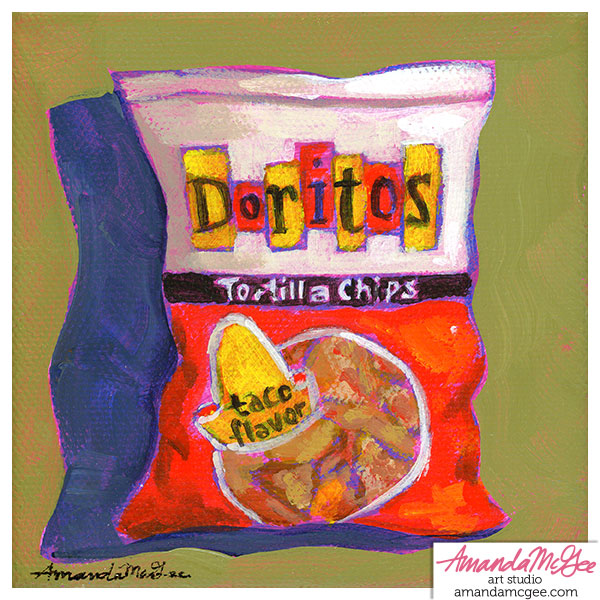
In this way, the users of social media platforms simulate something like the food scientist’s ability to break down corn and reconstitute it into a hyper-palatable edible food-like substances. What is a TikTok dance mash up if not a digital Dorito?
—
This analogy between food and media is useful because it helps us better understand responses to the latter. In the context of nutrition, we’re comfortable deciding to largely avoid ultra-processed food for health reasons. In making this choice, we do not worry about being labelled “anti-food,” or accused of a quixotic attempt to reject “inevitable progress” in food technology.
On the contrary, we can see ultra-processed good as its own thing — a bid for food companies to increase market share and profitability. We recognize it might be hard to avoid these products, as they’re easy and taste so good, but we’ll likely receive nothing but encouragement in our attempts to clean up our diets.
This is how we should think about the ultra-processed content delivered so relentlessly through our screens. To bypass these media for less processed alternatives should no longer be seen as bold, or radical, or somehow reactionary. It’s just a move toward a self-evidently more healthy relationship with information.
This mindset shift might seem subtle but I’m convinced that it’s a critical first step toward sustainably changing our interactions with digital distraction. Outraged tweets, aspirational Instagram posts, and aggressively arresting TikToks need not be seen as some unavoidable component of the twenty-first century media landscape to which we must all, with an exasperated sigh, adapt.
They’re instead digital Oreos; delicious, but something we should have no problem pushing aside while saying, “I don’t consume that junk."

No comments:
Post a Comment