 |
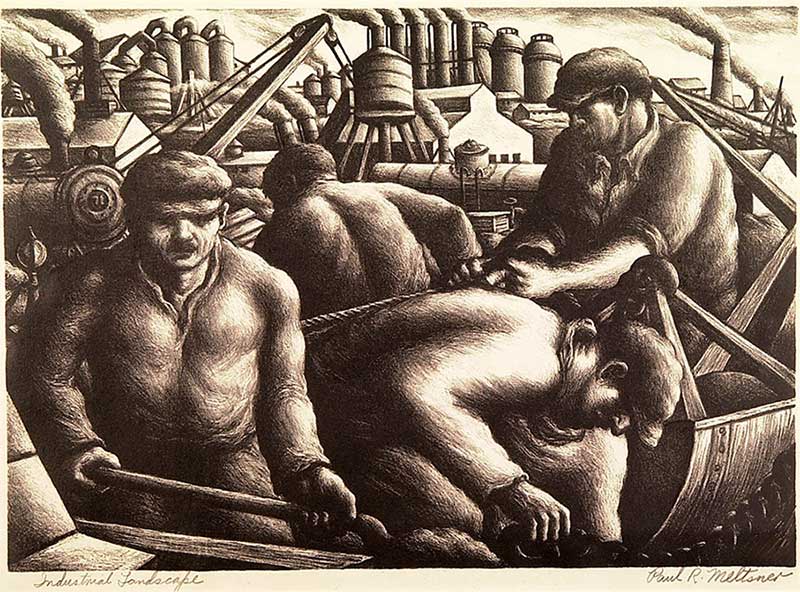
| Paul Raphael Meltsner, American (1905–1966). Industrial Landscape, ca. 1935. Lithograph on paper, Overall: 10 1/4 x 14 1/2 inches. link |
From Sarah Bakewell's At the Existentialist Cafe, Referencing Simone de Beauvior's essay 'Pyrrhus and Cineas."
The Greek general Pyrrhus is busying himself winning a series of great victories, knowing that there will be many more battles to come. His adviser, Cineas, ask him what he intends to do when he has won them all and taken control of the whole world. Well, says Pyrrhus, then I will rest. To this, Cineas asks: why not just rest now?
This sounds like a sensible proposal, but for Beauvoir's essay tells us to think again. For her, a man who wants to stop and navel-gaze is not as good a model as the one who commits himself to keep going. Why do we imagine that wisdom lies in inactivity and detachment, she asks? If a child says, 'I don't care about anything,' that is not a sign of a wise child but of a troubled and depressed one. Similarly, adults who widthdraw from the world soon get bored. Even lovers, if they retreat to their private love nest for too long, lose interest in each other. We do not thrive in satiety and rest. Human existence means 'transcend-ence', or going beyond, not 'immanence, or reposing passively inside oneself. It means constant action until the day one runs out of things to do — a day that is unlikely to come as long as you have breath. For Beauvoir and Sartre, this was the big lesson of the war years: the art of life lies in getting things done.
A related but different message emerges from Camus' resistance novel', again published only after the war in 1947: The Plague. It is set in the Algerian town of Oran during an outbreak of that disease; the bacillus suggests the Occupation and all its ills. Everyone in the town reacts differently, as quarantine is imposed and claustrophobia and fear increase. Some panic and try to flee; some exploit the situation for personal gain. Others fight the disease, with varying degrees of effec-tiveness. The hero, Dr. Bernard Rieux, pragmatically gets down to the work of treating patients and minimising infection by enforcing quarantine regulations, even when these seem cruel. Dr. Rieux is under no illusion that humanity can overcome deadly epidemics in the long term. The note of submission to fate is still there, as in Camus' other novels — a note never heard in Beauvoir or Sartre. But Dr. Rieux concentrates on damage limitation and on pursuing strategies to ensure a victory, if only a local and temporary one.
Camus' novel gives us a deliberately understated vision of heroism and decisive action compared to those of Sartre and Beauvoir. One can only do so much. It can look like defeatism, but it shows a more realistic perception of what it takes to actually accomplish difficult tasks like liberating one's country.

No comments:
Post a Comment