Eudaimonia Definition (from: this source)
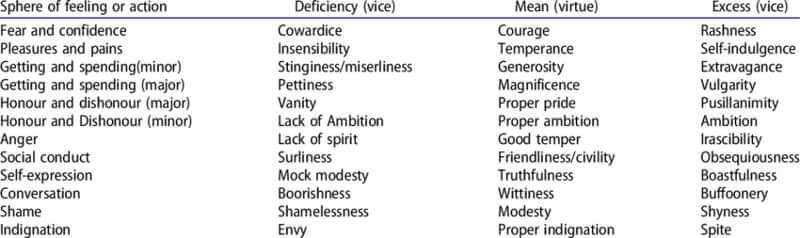
In its simplest (translated) form, eudaimonia is often taken to mean happiness (Deci & Ryan, 2006; Huta & Waterman, 2014; Heintzelman, 2018). Sometimes it is translated from the original ancient Greek as welfare, sometimes flourishing, and sometimes as wellbeing (Kraut, 2018). The concept of Eudaimonia comes from Aristotle’s Nicomachean Ethics, his philosophical work on the ‘science of happiness’ (Irwin, 2012).
“…wellbeing is not so much an outcome or end state as it is a process of fulfilling or realizing one’s daimon or true nature—that is, of fulfilling one’s virtuous potentials and living as one was inherently intended to live.”
As there are so many different ways to translate the term into English, it may even be helpful to look at the etymology. If it helps to provide more context, eudaimonia is a combination of the prefix eu (which means good, or well), and daimon (which means spirit) (Gåvertsson, n.d.).
Socrates, as discussed, saw eudaimonia as an ‘ultimate’ goal. Like Aristotle after him, Socrates emphasized the role and importance of arête very heavily—in fact, he believed it was both a means and an end to human happiness. In pursuit of what we now commonly refer to as ‘flourishing’, he encouraged people to ask themselves, and others, what was ‘good’ for our souls (Cooper, 1996).
He believed, it is argued, that eudaimonia was ‘justly living well’, and that in doing so, we seek not experiential pleasure or ‘honor’ in isolation, but a good and happy life, guided by our virtues (Cooper, 1997; Bobonich, 2010; Brown, 2012).
In their study, they give several examples of EWB (Norton, 1976; Waterman et al., 2010). Here are a few:
“Knowing who you really are” – Examples of this self-discovery might include the self-identity knowledge that comes from meditating on your core beliefs. Or, it could be a good understanding of your personal character strengths and qualities. It could even be the self-knowledge that comes from reflecting on your personal development or the values that you hold important.
“Developing these unique potentials” – Someone who scores high on EWB (according to the Questionnaire for Eudaimonic Wellbeing) makes a persistent, committed effort to building on this self-knowledge. A little more on the ‘how’ and the QEWB is covered very shortly.
“Using those potentials to fulfill your life goals” – Someone who is committed to this pursuit, over the long term, would be a prime example.
-
Questionnaire for Eudaimonic Wellbeing (QEWB) was developed by the same Waterman as above, and measures one’s (Waterman et al., 2010):
- A sense of meaning and purpose in life – which describes the personally meaningful objectives that we direct our talents and skills toward;
- Enjoyment derived from activities that are ‘personally expressive’ – a high score on this contributes to a higher Eudaimonic Wellbeing (EWB) score overall;
- Intense involvement in activities – not just any activities or hobbies, but those that are related to our life goals (see point 1 above);
- Perceived development of their own best potentials – this relates back to Aristotle’s idea of ‘fulfilling one’s virtuous potentials’; and
- Investment of significant effort – towards achieving excellence.
The specific eudaimonic activities they assessed were (Huta & Ryan, 2010):
- Seeking to pursue excellence or a personal ideal;
- Seeking to do what you believe in;
- Seeking to use the best in yourself; and
- Seeking to develop a skill, learn, or gain insight into something.
In another ‘daily diary’ study by Steger and colleagues (2008: 29), the following ‘eudaimonic behaviors’ were used to assess wellbeing:
- Volunteering one’s time;
- Giving money to someone in need;
- Writing out one’s future goals;
- Expressing gratitude for another’s actions, either written or verbal;
- Carefully listening to another’s point of view;
- Confiding in someone about something that is of personal importance; and
- Persevering at valued goals in spite of obstacles.
These eudaimonic activities were more strongly correlated than daily hedonic activities with wellbeing in terms of ‘daily meaning in life’ that the participants felt. The same went for daily positive affect and daily life satisfaction (Steger et al., 2008).
The distinction between eudaimonia and hedonia is examined in great depth by Huta and Waterman in their 2013 review of the happiness literature. For those after a quick, broad distinction between the two, here are the authors’ given examples of eudaimonia, based on literature review:
authenticity;
excellence;
meaning; and
growth.
Contrast and compare these with their examples of hedonia, and you’ll see that very, very roughly, the second is much less value-laden and somewhat more experiential:
an absence of distress;
comfort;
enjoyment; and
pleasure.
according to Huta & Waterman (2013: 1448),
“…the most common elements in definitions of eudaimonia are growth, authenticity, meaning, and excellence. Together, these concepts provide a reasonable idea of what the majority of researchers mean by eudaimonia.”
With regard to hedonia, while ‘absence of distress’ wasn’t always an important element,
“…there is a clear consensus that pleasure/enjoyment/life satisfaction is core to the definition”

No comments:
Post a Comment