 |
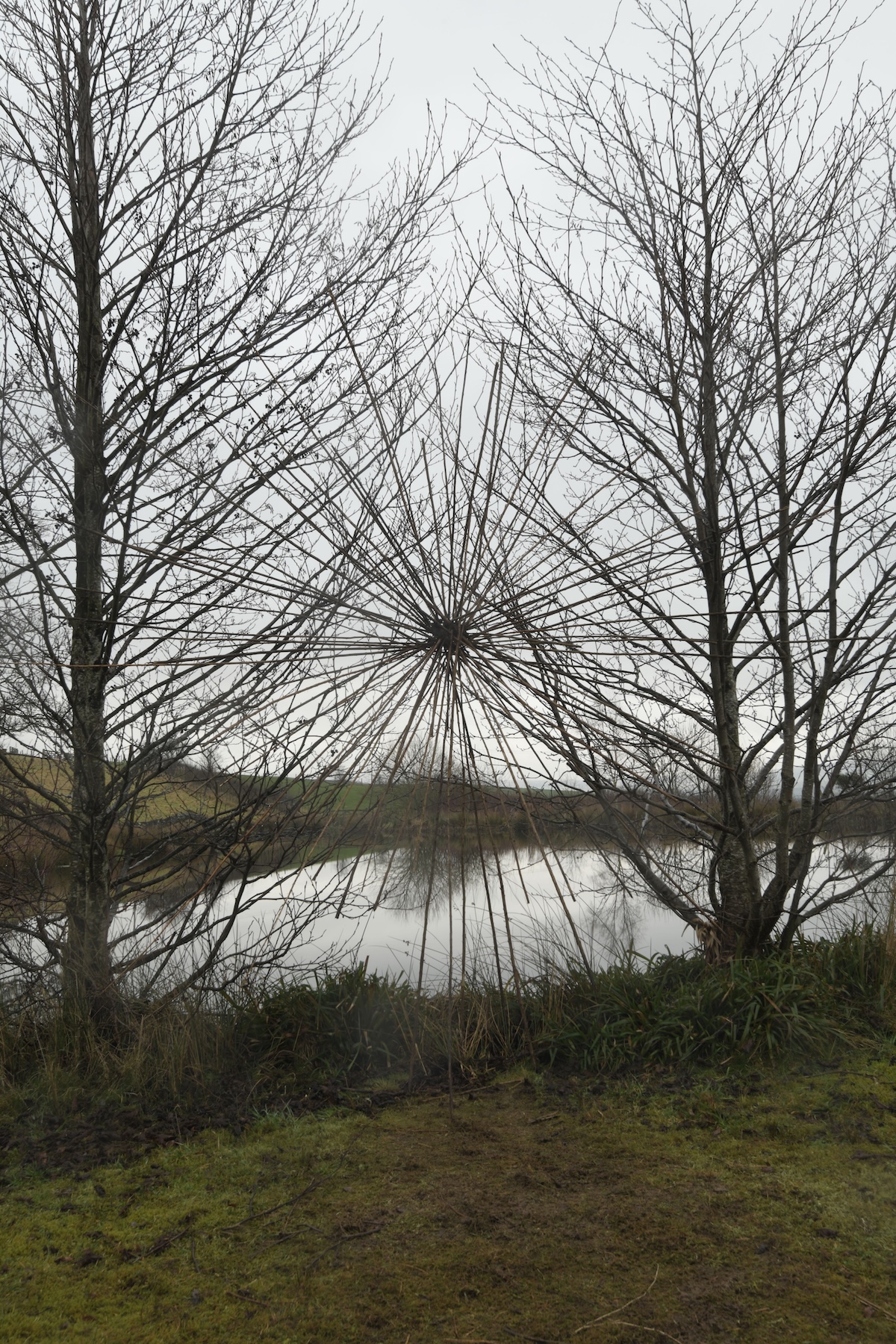
| Fireweed Stalks - Feb 2026 |
Andy Goldsworthy
His words Walking thru hedges and Rockweed and lots from March 26 from NYer article
- “Change is best understood by staying in the same place, and it takes a while before you really get to see and understand change,” he told me, the first time I visited him in Penpont. “When you travel, you see differences, but not really change, so being in the same place is important for me—seeing kids being born and grow up, and people dying.
- "For me, the landscape is not a place you go to for therapy and relaxation—it is to get challenged and have ideas, and to generate thoughts and feelings and emotions,” he told me. “It’s a very powerful thing to deal with.”
- I asked Goldsworthy if he felt that he could realize his work more effectively now because he has a stronger vision, or more resources. He answered, “I have a stronger everything.” Fifty years of making art had taught him how to work confidently with scale and mass and materials, allowing him to produce work that could last for centuries. “At the same time, there are also the ephemeral works,” he said. “They are at their strongest, and then they decay, they change, they collapse, and that can be beautiful, too.” I suggested that Goldsworthy himself was an ephemeral work. “We all are,” he replied.
- ****There are two different ways of looking at the world: you can walk on the path or you can walk through the hedge. and that's the beauty of art - that it makes you step aside from the normal way of walking or looking.
- The point of my art is that I learn through what I'm making. I go to nature not to impose things upon it but to feed from it to try to understand what is going on. Human presence is always there in what I make. I'm not trying to mimic nature. The things that I make are me. I hope they are sensitive to the materials and the place, and my body is a part of that.
- For most of the time I use whatever is around. Normally I don't know even what I'm going to make that day as I go out. The day starts, I start by picking up leaves; it's a response to the weather, the light, and I will use thorns or spits not because I'm trying to play the primitive, but that's the best way to make the work. Find the materials and the means to work the material; there's a huge sense of freedom in that.
- ***The works in this exhibition are of this moment – they have been made in a year that continues to be unpredictable and difficult for everyone. Like everyone else I am trying to work my way through the events of this year. (COVID lockdown)
- It is however important to keep making art. To stop would be for me also to stop thinking or feeling. The urge to create no matter what is not just a way of getting through but also fighting back.
- Art has the capacity and indeed the responsibility to be creative no matter what the circumstances or restrictions - whether they be practical, financial or whatever. It also has the potential to be stronger because of it.
- ***During the making of Road Line, I would, whenever possible, go to the shore, cover myself in rockweed and disappear. I would look at the sky through a lattice-work of rockweed that covered my face, listen to it crackle, be nibbled at by crabs, breathing heavily after the exertion of pulling rockweed over me. As the tide rose my breathing subsidised – the cold-water ebbing and flowing, in and out, as if taking over from where my breathing had left off. My body gently lifted by the sea until I began to float – carried back and forth by the tide. (Rockweed)
What draws me to Goldsworthy.... (what positive message can be taken from this? Zimbardo)
- His respect for nature; his idea that you go outside not for calm, but for inspiration
- His idea that art is a necessary push back, a resistance (getting thru and fighting back)
- His creative impulse - life is making; it is as much a "normal" part of living as feeling and thinking
- His idea that creating/making art is about learning
- Go outside in all (all forms of) nature - rain, wind, rockweed, be immersed in it
- He says art is stronger when it has restrictions
- I use "whatever is around" to work with; find the materials and method
- You either walk on the path or walk thru the hedge - step aside from the normal way of walking
- Getting older in lots of ways gives you "stronger everything"
- There's a difference between seeing difference and seeing "change"
Change your life (how can these lessons improve your future?)
- Go outside, in all weather, touch natural things;
- Use my own making as a "getting thru and fighting back" (against what? conformity?)
- Use my hands, every day. Get out of my own head. Daily diet of making.
- Learn thru making. Thinking and writing go hand in hand... (as does feeling). Keep a journal of making?
- Embrace Fruitsliv (spelling incorrect) - there is no bad weather just wrong clothes?
- Be creative with whatever materials you have: the art will be stronger. (Here, I'm thinking about "creativity" as a close cousin to "critical thinking") (reminds me of Brian Eno)
- Every project has its own "materials and method" that needs to be discovered... no worn paths... part of making new things involves the thinking about how to do it. (this is maybe part of the creativity and critical thinking?)
- Take the analog route. Take side trips. You'll discover more by "walking through the hedge" rather on the sidewalk.
- Embrace "older and growing" (Carl Rogers' idea)
- Be attentive to change, growth, development, decay (what does 'be sensitive to' mean?)

No comments:
Post a Comment