 |
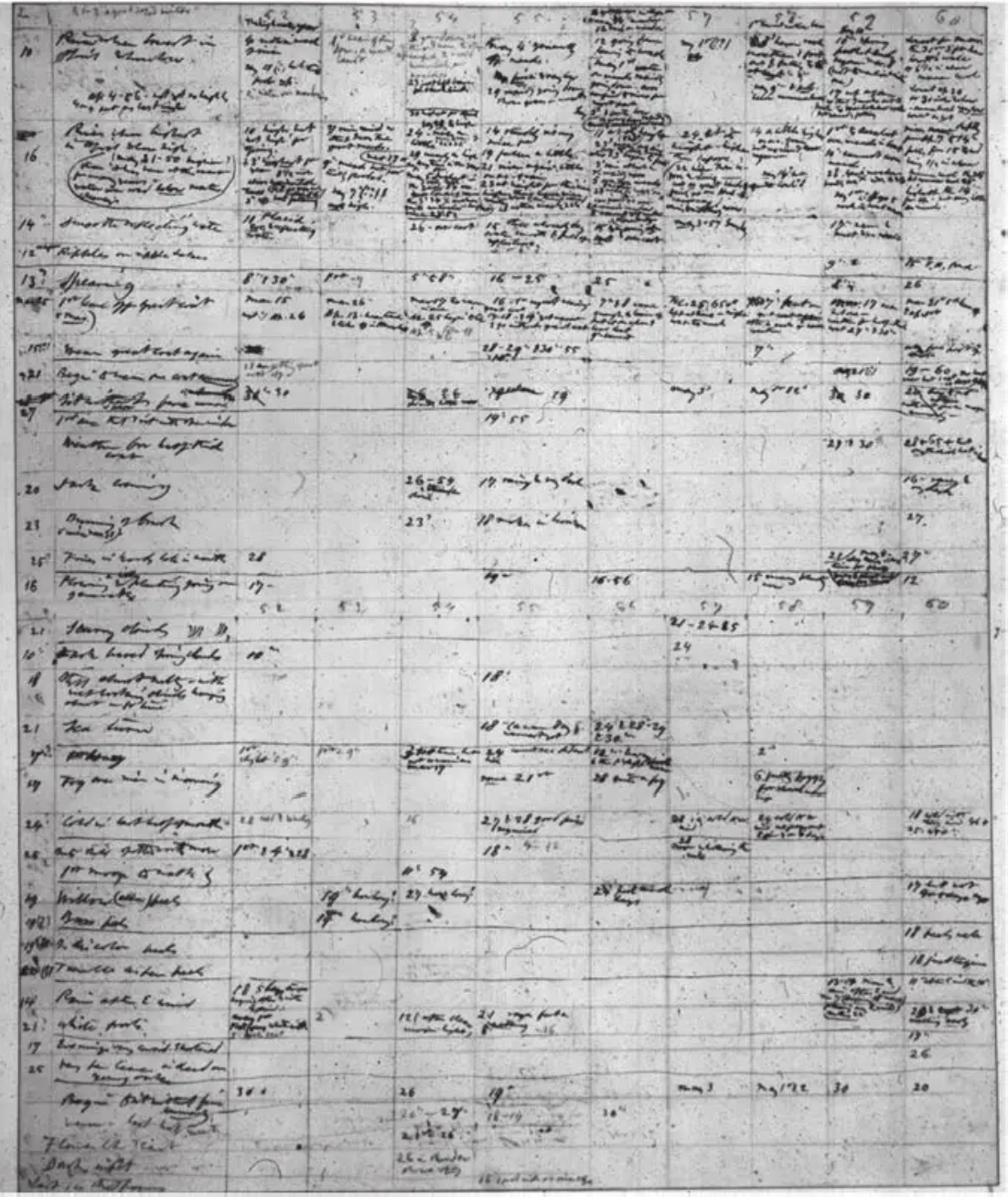
| Thoreau used his field notes to assemble tables showing when plants first come into flower in Concord, such as this one from May 13–15, 1857. Thoreau's handwriting is black; Primack's notes are in blue. |
nb. Here's The Walden Woods Project of all of HDT's journals.
from Thoreau's Contributions to Climate Change Science by Richard Primack from Project Muse
Henry David Thoreau is best known as a transcendentalist, a pioneering environmental philosopher, an abolitionist, and an advocate of civil disobedience. Unbeknownst to many, Thoreau has also contributed to our understanding of the impacts of climate change through his detailed observations of changes in the seasons and differences in the landscape from one year to the next. Walden contains chapters devoted to individual seasons, and he intended to expand his later observations into "a book of the seasons, each page of which should be written in its own season and out-of-doors, or in its own locality wherever it may be [June 11, 1851]."1 Unfortunately, he failed to complete this project before his death in 1862 at the age of 44.
During the 1850s, in preparation for this book, Thoreau set out to develop a calendar of nature's seasonal changes, in the tradition of earlier naturalists such as Alexander von Humboldt, Robert Marsham and his family, and Gilbert White. He carefully recorded the timing of seasonal natural phenomena, what ecologists call phenology, for hundreds of species of plants and animals in Concord. Thoreau walked in the woods for at least four hours every day throughout the year, observing and writing down what plants were in flower and in leaf, what plants were bearing fruits, and what the birds, frogs, fish, and other animals were doing. He wanted to know exactly what day it was by making detailed written observations of the nature he saw around him during his walks.2 As he quickly recognized, these seasonal events are exquisitely linked to each other and are sensitive to changes in weather and climate.
Had his biological studies of the seasons been published and widely read, Thoreau likely would have had profound impacts on modern ecological thinking and climate change biology. Unfortunately, Thoreau's natural history observations, which he organized into a series of tables, were never published. Their existence remained known only to a small circle of Thoreau scholars. Even his extensive observations on climate and phenology in his journals remained largely unexamined by ecologists until a few decades ago.3
Thoreau's contributions to climate change biology complement his better-known writings in philosophy. His arguments in Walden and elsewhere for living simply, connecting with the natural world, and taking action to advance justice and improve society are relevant to [End Page 76] climate change policy. These well-known aspects of his legacy offer timely prescriptions for mitigating future climate change and its harmful consequences.
...
Measuring Reality
Toward the end of his life, Thoreau extracted his observations of plants and animals from his journals and compiled detailed tables documenting the annual flowering times of over 300 plant species,5 the leaf out times of trees and shrubs,6 and the arrival dates of dozens of bird species during the years 1851–1858.7 The names of species and the dates when he observed them provide the starting point for our decades of research.
These tables were a manifestation of a "realometer," a term Thoreau coined in Walden. A realometer was a hoped-for instrument that would allow him to push his way past the "mud and slush of opinion, and prejudice and tradition, and delusion, and appearance … to a hard bottom."8 In this case, his aim was to use the observations to understand nature's calendar of seasons.
Fortunately, in 2003, early in our climate change research, our colleague Phil Cafaro introduced us to Brad Dean, a scholar working on Thoreau's unpublished manuscripts and notes. He showed us Thoreau's tables of observations, and we realized they offer a window into the local ecology of eastern Massachusetts in the mid-19th century. We were confident they could provide unique insights into the impacts of climate change on a specific location.
We set out to repeat Thoreau's observations—to note the same phenomena in the same locations—so that we could compare our observations with his and assess how Concord's forests, wetlands, and other areas had changed over the intervening 150 years. We knew that the landscape of Concord had changed greatly in the time between Thoreau's observations and ours, from a farming community to a forested suburb, but we also recognized that Concord, more than most suburban areas, was extremely well-protected by public and private conservation lands. We would have the opportunity to follow in his footsteps and study the same species that Thoreau observed in some of the same woodlands, pond edges, and river meadows.
----
I find that it's called his Kalendar - link to book at Milkweed and flipbook and news article about it;

No comments:
Post a Comment