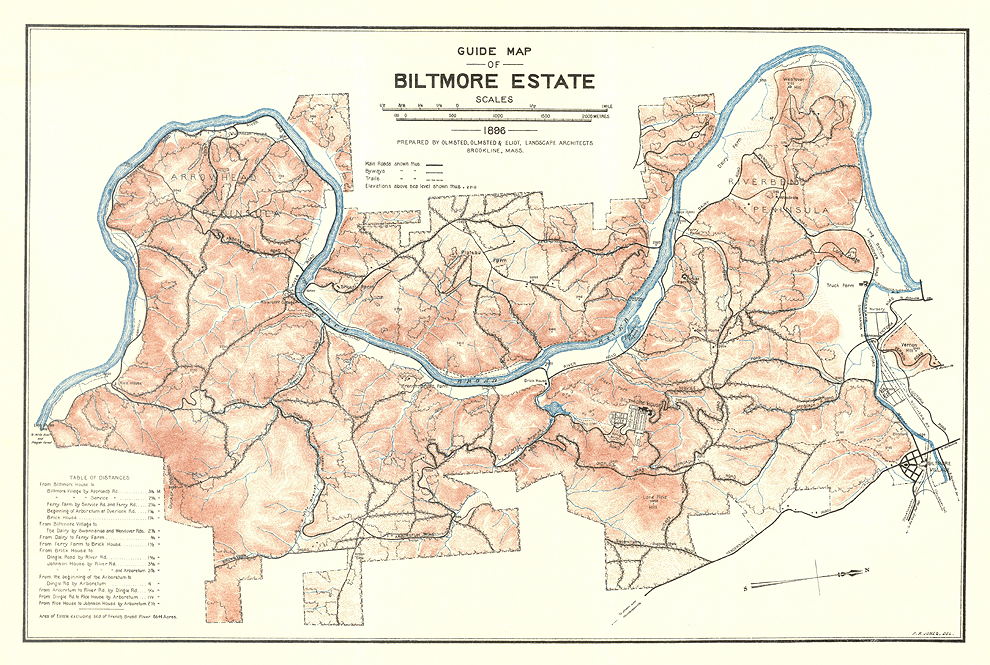
The Library of Congress has released 24,000 items (47,300 images) of Frederick Law Olmsted's papers - mostly from 1838-1903.
Harvard Graduate School in Architecture has 11 images of the construction of the Biltmore gardens here.
"When Parks Were Radical" from The Atlantic by Nathaniel Rich
But it was a trip by foot through England in 1850 that awoke him to the value of public pleasure grounds. In a suburb of Liverpool, he visited Birkenhead Park at the urging of a local baker and was flabbergasted:
Five minutes of admiration, and a few more spent in studying the manner in which art had been employed to obtain from nature so much beauty, and I was ready to admit that in democratic America, there was nothing to be thought of as comparable with this People’s Garden.
Olmsted was especially excited to discover that Birkenhead’s beauty was shared “about equally by all classes”: men, women, children, sheep. This was novel at a time when most parks tended to be located within private estates or, as in the case of New York City’s Gramercy Park, locked behind gates, the keys reserved for wealthy neighbors. Birkenhead, not yet five years old, was the first park in England to be publicly funded.
An unmistakable irony creeps vinelike through Olmsted’s landscape theory: It takes a lot of artifice to create convincing “natural” scenery. Everything in Central Park is man-made; the same is true of most of Olmsted’s designs. They are not imitations of nature so much as idealizations, like the landscape paintings of the Hudson River School. Each Olmsted creation was the product of painstaking sleight of hand, requiring enormous amounts of labor and expense. In his notes on Central Park, Olmsted called for thinning forests, creating artificially winding and uneven paths, and clearing away “indifferent plants,” ugly rocks, and inconvenient hillocks and depressions—all in order to “induce the formation … of natural landscape scenery.” He complained to his superintendents when his parks appeared “too gardenlike” and constantly demanded that they “be made more natural.”
From WNC magazine, there's background on Biltmore and Olmsted's design.
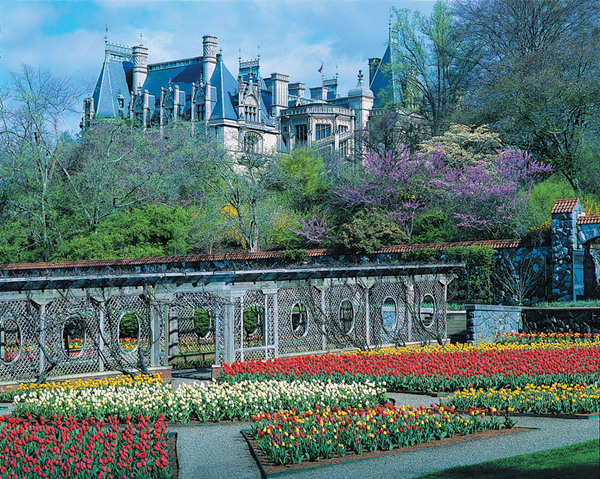
Visiting Biltmore’s manicured and breathtaking grounds today, it’s shocking to think of what the place looked like when Olmsted initially laid eyes on it. Vanderbilt, the scion of one of the country’s wealthiest families, purchased a staggering 125,000 acres of land in and around Asheville. Much of it was thick with foliage and ruggedly beautiful, but the planned homesite was mostly deforested, flat, and scraggly.
“I was at my first visit greatly disappointed with its apparent barrenness and the miserable character of its woods,” Olmsted informed a colleague in one letter. In another, he complained of the “extremely poor and intractable” soil and declared that the estate would have to be built “out of the whole cloth.” According to Olmsted, he asked Vanderbilt, “What do you plan to do with all this land?” “Make a park of it, I suppose,” was the reply.
Olmsted tried to steer Vanderbilt down a different path. “Such land in Europe would be made a forest, partly, if it belonged to a gentleman of large means, as a preserve for game, mainly with a view toward crops of timber,” he argued. “That would be a suitable and dignified business for a man like you to engage in.”
In essence, Olmsted made a case not only for exquisite landscaping to showcase what would become a 250-room château (to be designed by renowned architect Richard Morris Hunt, whom Olmsted often collaborated with), but for a kind of forest management never before seen in the United States. Vanderbilt was persuaded, and took Olmsted’s advice to hire other specialists who would greatly impact the project: the pioneering foresters Gifford Pinchot and Carl A. Schenck. The efforts of those men to cultivate the nation’s first model forest would ultimately earn Western North Carolina the title “Cradle of American Forestry.”


No comments:
Post a Comment