
 |
| while the season's old blossoms dry, two new blossoms! |
Garden. Still raspberries waning, but not gone -- 5-8 every couple days; no sign of hummingbirds this past week. I had a couple salads this week with greens from boxes. The lettuces seem to be fading in color.
Guitar. I have memorized the Weiss. I got through the study I've been working on (name: ). I tried playing the Weiss along with a video and crashed. I have no fluidity.
Projects: in 10 days (9/20-9/30), I only did 4 30-minute chunks:
Project 1: Fretboard Mastery. I only recorded 2 days of practice so far. I did a few 10-minute (not 30 minute) practices. I have the 5th fret middle pretty solidly now (G - A, C - D). I have G and A pretty well down. I noticed this relationship between 6th and 4th string: on the same fret, the note on the fourth string is one note before (on 3rd fret - G on 6th, F on 4th.
P2-Cookbook. just 1 item: "add 10 recipes" (though I don't know to what!)
P3-CSU! just 1 item : office paper sort;

Come hike with us! In January, Jeff and I began our “26 in 2026” adventures—visiting 26 different county’s natural areas new to us this year. We finished on September 6. We eventually hope to visit natural areas in all 102 Illinois counties. Counties on the map below in purple are 2026 visits; counties in green are ones we visited for our “25 in 2025” adventures last year. Counties in blue are still anticipated. In 2026, we visited: #1 -Morrison-Rockwood State Park (Morrison, Whiteside County, IL); #2-Mississippi Palisades State Park (Savanna, Carroll County, IL); #3 Rall Woods State Natural Area (Hanover, Jo Daviess County, IL), #4 Greenlee CemeteryPrairie Nature Preserve, near Cambridge, IL (Henry County); #5 Black Hawk Forest Nature Preserve, Rock Island, IL (Rock Island County); #6 Sue and Wes Dixon Waterfowl Refuge, Hennepin, IL (Putnam County); #7 Doris L. Westfall Nature Preserve, Forest Glen Preserve, near Westville, IL (Vermilion County); #8 Shortline Railroad Prairie, Gifford, IL (Champaign County); #9 Banner Marsh Fish & Wildlife Area, Canton, IL (Fulton County); #10 Rock Island Railroad Trail Prairie Preserve, near Princeton, IL (Peoria County); #11 Rock Island Railroad Trail (near Princeton, Stark County); #12 Upper Embarras Woods Nature Preserve, Walnut State Park, Oakland, IL (Douglas County); #13 Warbler Ridge, Charleston, IL (Coles County); #14 Baber Woods Nature Preserve Kansas, IL (Edgar County); #15 American Beech Woods Nature Preserve, Lincoln Trail State Park, Marshall, IL (Clark County); #16 Crawford County Forest Preserve, Robinson, IL (Crawford County); #17 Prairie Ridge State Natural Area, Newton, IL (Jasper County) (with bonus Robert Ridgway Natural Area); #18 Shepard Prairie, Knox College Green Acres Research Station, Victoria, IL (Knox County); #19 Brownlee Cemetery Prairie, Alexia, IL (Mercer County); #20 Spring Grove Cemetery Prairie, Monmouth, IL (Warren County); #21 Harry N. Patterson Savanna, Oquawka, IL (Henderson County); #22 Argyle Hollow Barrens, near Colchester, IL (McDonough County); #23 Geissler Savanna/Samuel Barnum Mead Savanna, near West Point, IL (Hancock County); #24 Weinberg King State Park, Augusta, IL (Schulyer County); #25 Siloam Springs State Park, Clayton, IL (Brown County) Thank you for following our hikes this year! We’re looking forward to more fun as we continue to hike!
The Way is ever without action, yet nothing is ever left undone. By Lao Tzu
Here’s more context
In the pursuit of learning one knows more every day;
In the pursuit of the way one does less every day.
One does less and less until one does nothing at all,
And when one does nothing at all there is nothing that is undone.
I ask Clausde:
That line points to wu wei — usually translated "non-action," though "effortless action" gets closer to the meaning. It's not about passivity or doing nothing. It's about acting in a way that doesn't force things against their nature.
Think of water. It doesn't strain or struggle, yet it carves canyons and always finds its way downhill. Or think of a skilled craftsman who works with the grain of the wood instead of against it — less effort, better result. Lao Tzu's point is that when you stop forcing outcomes, stop over-managing, stop pushing your will onto every situation, things tend to resolve themselves more naturally and completely than when you grasp at them.
The paradox ("nothing is left undone") is the payoff: forced action often creates resistance and unintended problems, while aligned, minimal action tends to accomplish more with less friction. It shows up in leadership too — a ruler (or manager, or parent) who governs by trusting people and removing obstacles, rather than micromanaging, often gets better results than one who controls everything.
We live in language and it gives us the power to reach across the void between human beings. We live in sentence upon sentence. We speak and write millions of sentences in a year, crafting and refining what we think and know and believe and wonder about. Language is how we will most primarily offer ourselves to others, and that we will do mostly in sentences. Let them be sentences that are precise, that hold paradox and human complication and do not falsely resolve. Let them be sentences that always bear the truth.
Elizabeth Alexander — the fourth poet in history to read at a U.S. presidential inauguration when she welcomed Barack Obama to the White House with her eternal poem “Praise Song for the Day” — takes up the question of what it means and what it takes to be a poet in Signals Across Vast Distances: Essays and Tales (public library). She writes:
From August 2026
Things to remember
Locking in 101*
Erin M names 5 steps to lock in
20 Minute Slots*
Erin M. provides this index card method: clear space to work. Set timer for 20 mins. When done, on index card - make notes on card - what did you do/learn? key words, key definitions, diagrams. Now, flip the card and write the very next things/targets you're going to do in the next 20 minutes. Display this right in front of you.
Should exercise*

From Cindy Crosby "Tallgrass Tuesdays"
Simple ways to make a difference this week: Seed collection on the prairies is underway now! These seeds are often used to start or rejuvenate planted prairies in our communities. Join a volunteer group at a prairie near you on a seed collection day to help make a difference.
Simple ways to make a difference this week: Protect our public lands! Visit https://5calls.org/issue/public-lands-sale-drilling/ to learn how to voice your concerns.
Simple ways to make a difference this week: Protect Grand Staircase-Escalante and Bears Ears National Monuments from development. Contact your congressional representatives— visit here to learn how.
Simple ways to make a difference this week: Our government is planning to sell land for an access road inside Yosemite National Park. Please help us protect our public lands! Contact your congressional representatives— visit here to learn how.
Simple ways to make a difference this week: Early voting in Illinois has begun, as well in other states. Check your voter registration status, and be sure to vote for candidates who care for the natural world and environment. Vote! You can make a difference.
Simple ways to make a difference this week: If you live in Illinois, you have the opportunity to volunteer at several cemetery remnant prairies! For more information, visit Friends of Illinois Nature preserves calendar of volunteer events by clicking here. Commit to a workday and help restore Illinois prairies.
Tree Sparrows

Friday Sept 12
Sat Sept 12
Sunday. Emus. Bemis.
Friday Fbw
Saturday Sept 19
Sunday
 |
| asters in the garden at Honey Hill |
"The Power of Yes" meditation by Tara Brach
When we develop the capacity to say yes, No matter what our experience, We discover the openness and freedom of awareness. Saying yes is not agreeing to unhealthy behavior or an affirmation of a belief. Rather, It's an honest and courageous willingness to be fully present with life as it is. The following guided meditation can shine a light on your habitual way of resisting or controlling experience, And help you to develop the capacity for unconditional presence, For saying yes to this living world. Take some moments to settle into a position, A sitting position that's comfortable, That allows you to be relaxed, And also alert. You might let the eyes gently close and take a few full breaths, Letting the breath help to bring you fully right here. Scanning your life, Sense if there's any situation that's asking for your attention, A situation that's difficult, That might be evoking a reaction of anger or fear, Of grief, Of sorrow. Let whatever situation might be here come into the foreground of your awareness and sense what's really challenging about it. Take some moments to let yourself go to the most difficult part of the situation. It might be a relationship with someone that's evoking a sense of irritation or hurt or insecurity. It might be the loss of a loved one, Power struggle with your child. Maybe it's a illness that you're struggling with or hurtful behavior that you now regret. Take some time to get in touch with the feelings that surround the situation. You might sense what is it that provokes the strongest feelings, What really feels wrong, What you're afraid of. You might sense what you're believing, What bad might happen, What this means about you or your future. So that as you sense into the situation, Really sense the feelings in your body that come up. Be aware of sensations in the stomach, The chest, The throat. In order to see firsthand what happens when you resist experience, When you try to avoid feeling what's difficult, You might experiment by saying no to what you're experiencing right here. Sensing the pain of the situation, Sensing what you don't like, Mentally direct a stream of the word no to the feelings. No to the unpleasantness of fear or anger, Shame or grief. Let the word carry the energy of no, Rejecting, Pushing away what you're experiencing. No communicates this is bad, This is wrong, I don't want this, I don't like this. What's it like to communicate no to an experience in your life? What does this resistance feel like in your body? Do you feel tightness, Pressure? What happens to the painful feelings, The anger or the fear, The grief or the fear of when you say no? What happens to your heart? You might imagine what it would be like in the days and weeks to come if whenever this situation arises you said no. You move through the world with the thoughts and feelings of no. What's your sense of yourself? Do you like yourself when you're saying no? And take a few moments to breathe, Perhaps shift your posture a bit, Maybe open your eyes. Now as you settle, Recall to mind the same painful situation, Even allowing yourself to go to the most difficult part of it, Sensing what you're afraid of, What feels wrong. This time, Let yourself be the Buddha under the Bodhi tree. Or perhaps a Bodhisattva of compassion, An awakened being. And sense what happens when you say yes to exactly what's arising inside you. Direct a stream of the word yes at your experience. Let the feelings float, Be held in an environment of yes. Or if not the word yes, Let the spirit of yes, The softness, The allowing, Be felt. You might imagine bowing to whatever is arising, To the sadness or the fear, Or perhaps communicating it's okay, It's okay, Or this too, This too can be included in my heart. Whatever's arising, Explore what happens if you meet it with the gentleness and the openness of yes. Even if there's waves of resistance in your body, Even if there's a sense of no, Explore what happens when you include that with yes. Include that in the larger field of yes. Yes to the fear. Yes to the hurt. Yes to the grief. Perhaps you're feeling numb or restless right now. Yes to that. What's it like to say yes? Is there softening and opening in your body? Is there more space and openness in your mind? What happens to the unpleasantness as you say yes? Does it get more intense? Does it become more diffuse? What happens to your heart as you say yes? Imagine in the days and weeks to come, Whenever this situation arises, If you could pause, Feel what's happening in the moment, And directly meet that experience with yes. Right in this moment, As you agree or aloud whatever is here, Say yes to this moment. What is your experience of who you are? Continue in silence, Releasing thoughts, And resting in an awake, Open awareness. Let your intention be to say yes to whatever experience arises. When acceptance is felt fully in the heart, It becomes surrender, Surrender into the truth of what we are. Notice what happens as your heart opens fully to the changing expressions of this sacred life.
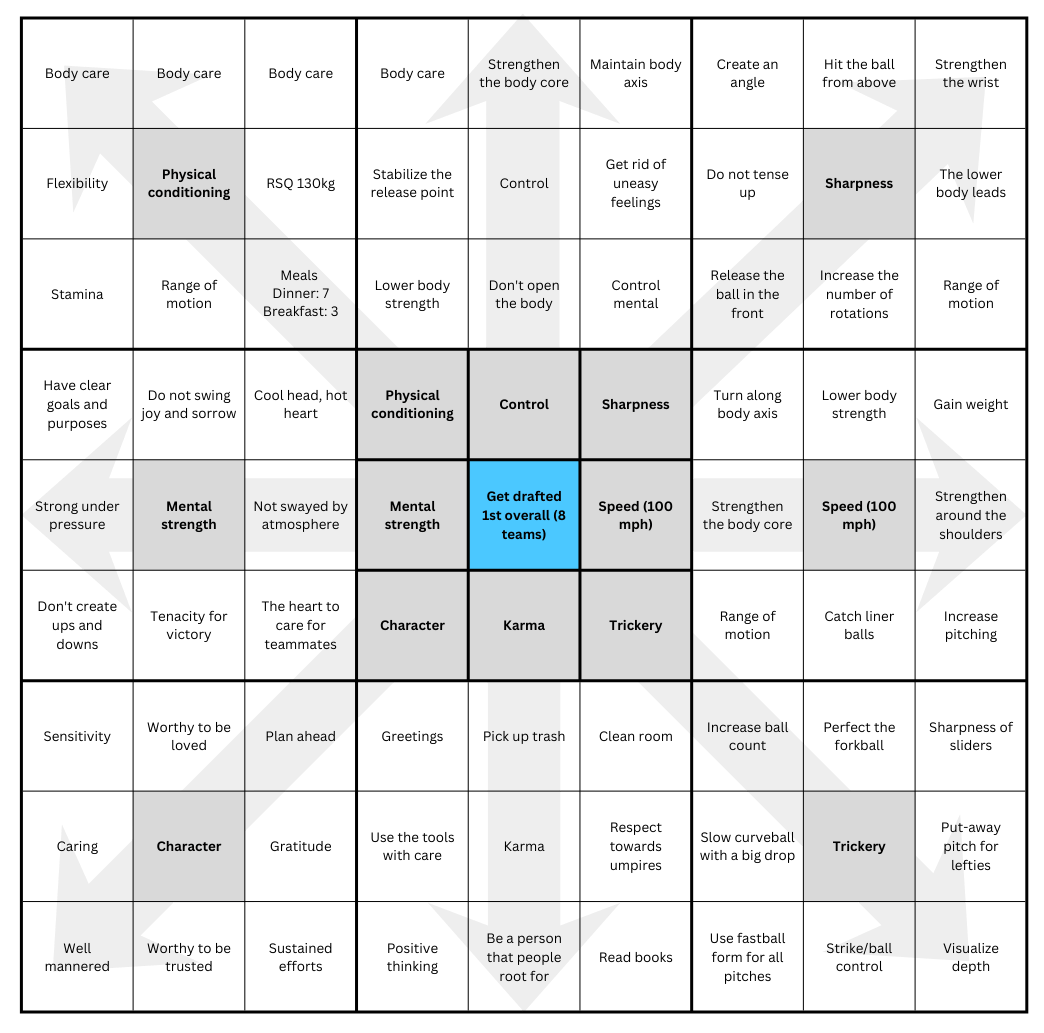
From Harvard Gazette
Ohtani followed a training program called the Harada Method that guided him from a promising high school player to MVP. Tell me about this method.
Takashi Harada, the person who created it, turned around underperforming high school teams at a pretty massive scale using this method and made them startlingly overperforming. So, this didn’t just work for Shohei, loads of people did it and got outsized success. That’s when I started to think it might also be for the rest of us. But then, honestly, it was in my teaching it to students and watching them get captivated by it and do it and start telling me stories of how it has helped them. They notice a before and after in how they’re spending their time and their intentionality on things.
How does it work?
You come up with a multiyear ambition; so really dare to dream. And then, the first step of the chart is, “What are the set of things that if I concentrated on this year, I’d make meaningful progress on my multiyear ambition?” You have one thing in the center: my multiyear ambition. For him, it was “be the No. 1 draft pick” four years later. And then, what are the eight things that if I did this year, I would make progress on my ambition? He had “physical conditioning” and “mental strength” and then four pitching things — “control,” “sharpness,” “speed,” and “trickery.” He had “character” and “karma” for No. 7 and No. 8.
To me, one of the most compelling parts of the method was the inclusion of karma. If karma wasn’t included, I don’t know that it would have captivated my attention.
Then the method asks you to do that one thing surrounded by eight, do it again, one more time. So, each of the eight yearly goals — physical conditioning, mental strength, character, karma, etc. — bring those out and surround them by the eight things I have to do on a daily basis to achieve that.
What’s amazing about the Harada Method is it breaks down your multiyear ambition. Students have found this so captivating because you either are thinking at the broad, multiyear ambition or you’re thinking at the micro — what do I have to do every day? This bridges them in a way that really provides forward momentum.
What did you find so intriguing about Ohtani’s process?
One is how he filled out the grids. There’s the No. 1 ambition, and then there are eight things surrounding it. Four of them having to do with pitching all the way down to the detailed behavior, the body, the mental. “Cool head, hot heart” was one of them. I have since learned it is common Japanese vernacular. I didn’t know it at the time, but that one really struck me. But it was “character” and “karma” that just weakened my knees. And indeed, I encourage everyone who uses this method to include character and karma regardless of if you want to be a pitcher or not. I’ve taught it now to 800 students — 100 percent used “character” and “karma” on theirs because they felt it.
“Pick up the trash” — that one really spoke to me; “clean room” because that’s private. Nobody else is going to see that. “Respect towards umpires.” He is known as the most respectful player. He does a greeting to the umpires at every single at bat. The one that I really wish I had learned a lot earlier was “be a person that people root for.” That one really hit me between the eyes because when I was that age, and for a lot longer, I thought “be a person who was right.”
If he only had the four pitching things, I don’t think he would be as successful. I think it takes all of us, every ounce of us, to give ourselves the best position to achieve greatness. I don’t want to call it an insurance policy, but it’s not a bad word for it.
You’ve tried the Harada Method. What did you learn from that exercise?
Yes, my wife and I did it. We’re pretty ambitious people, and it helped us to clarify and articulate to each other, so we knew how to be helpful to one another: What am I going to do today that’s going to help make progress? It separates the signal from the noise of progress and really channels it. The articulation of it really helps you know what to do and stimulates progress.
My mission in the world is to add a zero for me and others. I’m very ambitious. I’m recovering from cancer and I have a new lease on life. And I’m a woman of a certain age. Jane Fonda taught me you’ve got three acts and I’m in my third act.
“Add a zero” is, instead of selling 100 books, how are you going to sell 1,000 books? Instead of having 1,000 customers, how are you going to get 10,000 customers? My philosophy now is how do we add a zero, and I’m trying to teach that to everyone. I’m trying to unleash ambition in people. I’ve never had such a great technique.
My wife, Anne Morriss, and I are writing our fourth book, which we want to retitle “Add A Zero.” That’s how much this has captivated us. We have our podcast called “Fixable.” I now do weekly office hours that are open to anyone where I teach a lot of these things. I call it Office Hours Live — we usually get about 1,000 people a week to come from all over the world. I taught this method on the goal-setting one.
So even those who aren’t aspiring athletes can benefit from Ohtani’s approach?
I’ve done it with hundreds and hundreds of people who are not athletes who either have ambition or I’m trying to encourage to have more ambition. Because what we know is that if you have a stretch goal, you achieve more than if you don’t.
The individual aspect of this, to me, is the compelling unit of analysis. This is a personal thing, and I think it’s for all ages. Lots of people are reading the case with their family and then decide who in the family wants to do the Harada Method. And then they start talking about the grids and then they talk about how their relationship shifts, how it just opens up pathways in doing it.
Recent MIT report on teaching and AI here.
Getting the right answer from a chatbot can create the illusion of learning – but it can also trigger “cognitive surrender”4, where students fall back on AI at the first hint of struggle.
here's a direct link to the study footnoted ("Thinking Fast, Slow, and Artificial")
The MIT report:
In the same spirit, collectively, we need to shape MIT’s use of AI in education to be “pro-learner” – not to replace the “hard fun” of thinking, learning, creating, and problem solving, but to expand what’s possible for students to think about, learn, and solve. In short, AI should be used to augment and enhance curiosity, creativity, and learning, not automate them.
Here are 9 thinking skills where the "friction" of doing it yourself is exactly what tempts students to hand it over to an LLM instead:
Generate ideas
Generate questions
Formulate problems/research questions
Retrieve relevant knowledge
Structure an argument
Synthesize across sources
Work through ambiguity
Make judgments
Estimate/sanity-check
Diagnose your own thinking
Self-explain
Edit/revise your reasoning
Evaluate the quality of an answer
Sit with uncertainty
Recover from being stuck
Revise after failure
Develop an internal standard of quality
Coming up with possibilities before someone else supplies them
Moving past the first obvious idea toward something more interesting
Making connections between things that don't initially seem connected
Exploring an idea that is incomplete, awkward, or uncertain
Developing an idea rather than simply selecting one from a list
Deciding what the central claim should be
Determining which ideas need to come first and which should follow
Deciding what evidence belongs with which claim
Figuring out how individual pieces of reasoning build toward a larger conclusion
Recognizing when an argument has a gap, redundancy, or weak connection
Identifying meaningful similarities and differences among sources
Noticing when two sources complicate or contradict one another
Deciding which connections among sources actually matter
Combining information to produce an idea that isn't simply present in any one source
Moving from “Source A says…” and “Source B says…” to “Taken together, these suggest…”
Moving from a broad topic to something genuinely worth investigating
Identifying what is puzzling, unresolved, or interesting about a topic
Narrowing a question enough to make it answerable
Recognizing when a question is merely factual rather than intellectually productive
Revising a question as understanding of the subject develops
Remaining comfortable when there isn't an obvious answer
Considering multiple plausible interpretations
Holding competing ideas in mind without immediately choosing one
Asking what evidence might support or challenge each interpretation
Recognizing that uncertainty can be a productive part of thinking
Explaining why an answer makes sense rather than simply stating it
Putting reasoning into one's own words
Identifying the evidence or assumptions behind a conclusion
Explaining the steps taken to arrive at an answer
Discovering gaps in understanding by trying to explain something clearly
Looking back at your thinking rather than assuming your first attempt is sound
Finding a claim that isn't adequately supported
Recognizing when evidence doesn't actually prove what you think it proves
Revising a line of reasoning rather than simply replacing it with someone else's
Learning from the weaknesses of an unsuccessful attempt
Predicting roughly what an answer should look like before calculating or researching
Using prior knowledge to establish a reasonable expectation
Asking, “Does this answer make sense?”
Detecting answers that are technically plausible but intuitively wrong
Comparing an external answer against your own independent estimate
Recognizing exactly where you are stuck
Trying a different strategy when the first one doesn't work
Rereading, reconsidering, or breaking a problem into smaller pieces
Using a resource or asking for a hint without handing over the entire problem
Experiencing difficulty as something to work through rather than something to immediately escape
Deciding which idea is worth pursuing
Deciding which evidence is strongest or most relevant
Determining which interpretation is most convincing
Distinguishing between something that is merely plausible and something that is genuinely insightful
Choosing among competing possibilities and being able to explain why
Identifying what you actually understand versus what you only recognize
Locating the specific point where your reasoning breaks down
Recognizing an assumption you may have made
Identifying what information or knowledge you're missing
Deciding what kind of help would actually move your thinking forward
Trying to remember something before looking it up
Bringing relevant knowledge to mind when confronting a new problem
Strengthening memory through repeated retrieval
Using what you already know to make sense of something unfamiliar
Developing a body of internal knowledge rather than relying entirely on external retrieval
Noticing something confusing, surprising, contradictory, or interesting
Asking “why?” or “how?” rather than stopping at “what?”
Turning curiosity into a question worth pursuing
Generating follow-up questions as new information emerges
Questioning an assumption rather than simply accepting the premise
Developing a sense of what makes an argument strong or weak
Learning to recognize effective versus ineffective writing
Comparing your own work against examples and identifying differences
Developing an instinct for when something is incomplete, superficial, awkward, or unconvincing
Producing enough work yourself to develop the judgment that lets you recognize quality in someone else's work
There is a progression hidden inside it:
Generate → Reason → Monitor → Persist → Judge

