 |
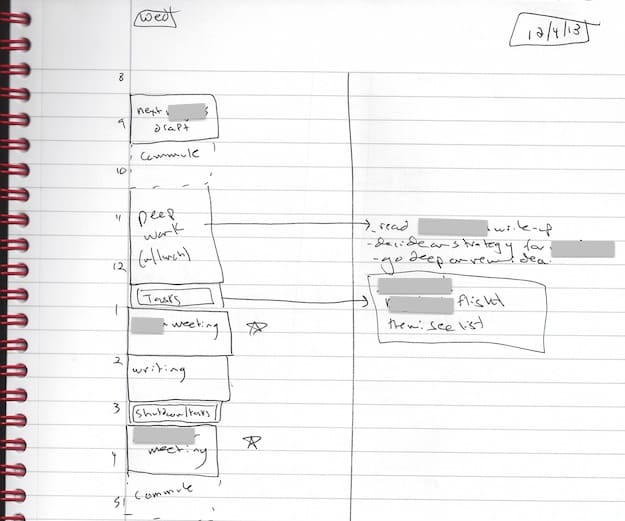
| Time blocking - two columns for revision during day |
10 Things I Learned from Deep Work
- "Attention Residue": Multitasking leaves fragments of your attention on the previous task, wrecking your depth.
- Time Block Your Day: Plan every minute so shallow tasks do not naturally fill your empty spaces. I call this planning method time blocking. I take time blocking seriously, dedicating ten to twenty minutes every evening to building my schedule for the next day. During this planning process I consult my task lists and calendars, as well as my weekly and quarterly planning notes. My goal is to make sure progress is being made on the right things at the right pace for the relevant deadlines.This type of planning, to me, is like a chess game, with blocks of work getting spread and sorted in such a way that projects big and small all seem to click into completion with (just enough) time to spare. you can ensure that you consistently dedicate time to the deep efforts that matter for creative pursuits;
- Execute a Shutdown Ritual: Every evening, you review your task lists, ensure everything important is filed away for tomorrow, look at your scoreboard, and say a specific phrase (like "Shutdown complete") to cleanly cut off your working brain.... I quickly skim every task in every list, and then look at the next few days on my calendar. These two actions ensure that there’s nothing urgent I’m forgetting or any important deadlines or appointments sneaking up on me. I have, at this point, reviewed everything that’s on my professional plate. To end the ritual, I use this information to make a rough plan for the next day. Once the plan is created, I say, “Shutdown complete,” and my work thoughts are done for the day.”
- The Whirlwind is the Problem. knowing what to do is rarely the problem; the real issue is execution, because we constantly get sucked into what 4DX calls the "whirlwind"—the endless flood of urgent, shallow daily tasks. if you don't choose a "Wildly Important Goal" (WIG), your default state will be fighting the whirlwind (answering emails, attending low-value meetings, and tweaking small projects)
- Lead Metrics vs. Lag Metrics: Newport argues that traditional goals (like "publish a paper" or "write a book chapter") are lag metrics—by the time you get the result, the time to change your behavior has passed. Deep work hours are a lead metric. They measure the specific behavior you can control today that will inevitably drive the lag metric later.
- The Physical Scoreboard: He recommends keeping a literal, visible tally of your deep work hours. Whether it is a spreadsheet, a notebook on your desk, or a checkmark on a calendar, a physical scoreboard keeps you honest. Seeing a streak of successful days creates a psychological drive to keep going.
- The Weekly Review: Once a week, you look at your scoreboard of deep work hours. You confront the data directly. If you had a bad week, you look at why the whirlwind took over and explicitly adjust your schedule for the upcoming week.
- I batch and habitatize. Any regularly occurring work gets turned into a habit — something I do at a fixed time on a fixed date. For example, I write blog posts on Sunday morning. I do reading for my seminar on Friday and Monday mornings. Etc. Habit-based schedules for the regular work makes it easier to tackle the non-regular projects. It also prevents schedule-busting pile-ups.
- I serialize my projects. I keep two project queues — one from my student projects and one for my writing projects. At any one moment I’m only working on the top project from each queue. When I finish, I move on to the next. This focus lets me churn out quality results without the wasted time of constantly dancing back and forth between multiple efforts
- I’m not available. I often work in hidden nooks of the various libraries on campus. I check and respond to work e-mail only a few times a day. People have to wait for responses from me. It’s often hard to find me. Sometimes they get upset at first. But they don’t really need immediate access. And I will always respond within a reasonable timeframe and get them what they need. So they adjust. And I get things done.
- Four Systems of Deep Work: Monastic, bi-modal (take a day or week or month off), rhythmic (fixed time slot each day) and journalistic (fitting it in when you can)
| Discipline | Corporate Concept | Cal Newport's Individual Adaptation |
|---|---|---|
| Discipline 1 (D1) | Wildly Important Goal | Say "No" to dozens of good projects so you can say "Yes" to one or two massive, high-impact career goals that require intense depth. |
| Discipline 2 (D2) | Act on Lead Measures | Ignore lag metrics (e.g., number of pages written, papers published). Track hours spent in deep work blocks instead. |
| Discipline 3 (D3) | Keep a Compelling Scoreboard | Build a physical, visible tally chart on your desk or wall. Tick off every completed, uninterrupted hour of deep work. |
| Discipline 4 (D4) | Cadence of Accountability | Commit to a Weekly Review to analyze your metrics and schedule the next week's blocks, combined with a daily Shutdown Ritual to review tasks and close the day. |
Setup: Construct a Project Page
Using a single-paged document in your favorite word processor, do the following:
- Make an Active Projects List
List 6 – 12 of the most important projects in your life. Pull from all three relevant spheres: professional (e.g., school or work related); personal (e.g., home, family, fitness); and extra (e.g., big projects like blogging, writing a book, starting a club). - Label Each Project With A Completion Criteria
To quote David Allen, to finish a project you must “know what done looks like.” Next to each project type a concise description of what action must be completed for the project to be completed. (When you do this, you’ll notice how easy it was for you before to think about projects in a much more ambiguous, impossible to complete style). - Label the Bottom Half of the Page as a “Holding Pen”
This is where you can jot down new projects that enter your life while you’re working on the active projects. They can be stored here until you complete the current batch.
- Make an Active Projects List

No comments:
Post a Comment