 |
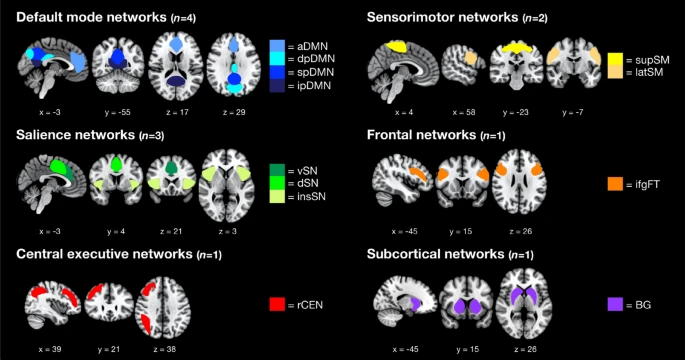
| Extremely scientific seeming imagery from the Nature article on salience network |
from Nature
Taken together, these findings indicate that, among multiple LSNs, one month of MMT leads to increased connectivity between networks of the triple network model (DMN, SN, CEN). This interaction corresponds well to cyclical cortical activations that previous research has linked to cognitive processes during a state of meditation. Based on this framework, we hypothesize that MMT allows the SN to modulate between the DMN and CEN more effectively in favor of the CEN. On a cognitive level, this could allow regular practitioners to notice a loss of attention more effectively and might facilitate its subsequent re-instalment. However, further studies are needed to support this hypothesis with behavioral data and to estimate the influence of training intensity on this evidence.
from wikipedia:
involved in detecting and filtering salient stimuli, as well as in recruiting relevant functional networks.[3][4] Together with its interconnected brain networks, the SN contributes to a variety of complex functions, including communication, social behavior, and self-awareness through the integration of sensory, emotional, and cognitive information.
While the function of the salience network is not exactly known, it has been implicated in the detection and integration of emotional and sensory stimuli,[9] as well as in modulating the switch between the internally directed cognition of the default mode network and the externally directed cognition of the central executive network.[7]
from ChatGPT
A useful way to understand the salience network (SN) and default mode network (DMN) is to think of your brain as having different modes of attention. They aren't two isolated systems, and the brain isn't literally switching between them like a light switch—but the distinction is a helpful model.
The basic idea
| Network | Rough question it helps answer | What it's doing |
|---|---|---|
| Default Mode Network | "What does this mean to me?" | Thinking about yourself, other people, the past, the future, meaning, stories, imagination |
| Salience Network | "What matters right now?" | Detecting what deserves attention and helping shift your mental resources toward it |
| Executive/Control Network | "What should I do about it?" | Deliberate reasoning, working memory, planning, inhibition, problem-solving |
The fascinating part is that the salience network helps regulate the relationship between the other two.
1. The Default Mode Network: the mind's "meaning-making" system
The default mode network became famous because researchers noticed that certain brain regions became more active when people weren't doing an externally focused task.
But "default" is a little misleading. It doesn't mean doing nothing.
When you're walking, showering, driving a familiar route, or sitting quietly, your mind may be doing things like:
remembering something that happened yesterday
imagining next summer's vacation
wondering what someone meant by something they said
thinking about your own life
imagining another person's perspective
connecting an experience to a larger story
daydreaming
constructing possible futures
2. The Salience Network: "Pay attention—this matters."
The salience network is quite different.
Its job is roughly to identify things that are important enough to deserve your attention.
And "important" doesn't necessarily mean pleasant or intellectually interesting.
Your brain is constantly bombarded with information:
sounds + sights + bodily sensations + thoughts + memories + emotions + environmental changes
Most of it doesn't make it into conscious attention.
The salience network helps determine:
Which of these things should I pay attention to right now?
Two particularly important regions are the:
anterior insula
dorsal anterior cingulate cortex (dACC)
For example, imagine you're reading a book and suddenly hear:
CRASH!
Your attention immediately leaves the book.
You don't consciously say:
"I have evaluated the auditory stimulus and determined that it merits attentional allocation."
Your brain essentially says:
WHOA. IMPORTANT.
That's salience.
But salience can be much subtler.
You're reading and suddenly encounter a sentence that makes you think:
Wait. That's exactly what I've been struggling with.
Your attention becomes more concentrated.
That's also salience.
3. Here's where it gets really interesting
The salience network isn't simply an attention network.
One of its important functions appears to be helping the brain shift between different large-scale networks, particularly the DMN and executive/control networks.
Think of it as a switchboard operator.
Situation A: inward reflection
You're sitting on a bench after a run.
Your thoughts wander:
I wonder what retirement is actually going to feel like...
→ DMN becomes relatively prominent.
Then:
Situation B: something changes
You hear a strange sound behind you.
What was that?
Salience processing increases.
Then:
Situation C: deliberate action
You turn around and evaluate what happened.
Oh—someone dropped something.
Your executive/control systems help you respond appropriately.
So a simplified sequence is:
DMN → Salience → Executive Control
or, more accurately:
inner thought / external information → something becomes important → attention gets redirected → deliberate processing/action

No comments:
Post a Comment