 |
| from "understanding records from the French Revolution" (link) |
The "year" and the "month" have astrological reasons. But the week is "an imposter," as Witold Rybczynski says in "Waiting for the Weekend." Why is the week 7 days? It hasn't always been. Here are three examples of civilizations that had 10-day weeks.
The Athenians divided the month into three periods of about ten days each. The first was called "the waxing moon," the last "the waning moon," and the middle period was unnamed. The days within each decade were numbered, as in 'the second day of the wxing moon' or, 'the fourth day of the middle period.' The days of the third decade were counted backward, however, which indicated how many were left until the end of the month, customarily the time for settling debts and paying bills. (26)
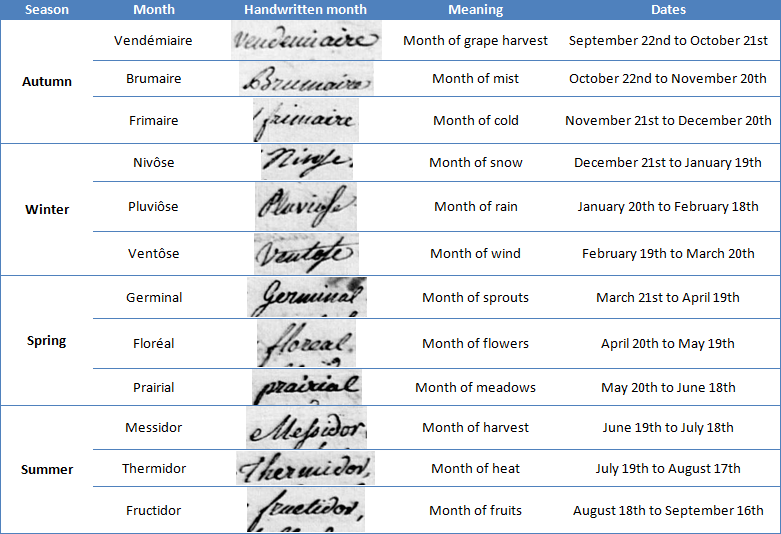
During the French Revolution, weeks got disrupted, months got re-arranged, and a kind of middle-seasons system was devised.
The French Revolution produced an entirely revised calendar, whose object was to divorce the months, days, and weeks from their traditional Christian associations and, at the same time, to rationalize (that is, decimalize) timekeeping. To begin with, the republican calendar did away with Anno Domini; henceforth dates were to be reckoned from the proclamation of the republic -- 1792, or Year 1. The solar year was maintained, and the extra day of the leap year was consecrated to a festival of teh Revolution, the four-year period being called a Franciade. The months, too, were renamed. This task was entrusted to Philippe-Francois-Nazaire Fabre d'Eglantine, a poet, who concocted a sort of twelve seasons - the winter months, for example, were called nivose (snowy), pluviose (rainy), and ventose (windy). There were still twelve months, but, as in the civil Egyptian calendar, they were all of equal thirty-day length. The five days left over were devoted to an end-of-the-year public festival.
Under this system the week fared badly -- it was done away with altogether. Instead, each month was now divided into three ten-day periods. The days of the revolutionary week, or decade, were given numberical designations: primidi, duodi, tridi, and so on. The tenth day - decadi -- was a holiday.
The revolutionary 10-day week based calendar lasted only 19 years. Voltaire wrote that "if you wish to destroy the Christian religion you must first destroy the Christian Sunday." Since most peasants remained believers through the revolution, and maybe since the new calendar deprived citizens of sixteen public holidays, the old 7-day system remained. In Year XIV, Bonaparte restored the traditional Gregorian calendar.

No comments:
Post a Comment