 |
| William Kent's Rousham |
According to philosopher Francis Bacon, the "purest of human pleasures. . . the greatest refreshment to the spirits of man" was not reading books or listening to music, but gardening.
According to Witold Rybczynski,in his book Waiting for the Weekend (1991), gardening is "an indulgence" but an ancient one. The kind of garden Bacon is talking about, and the one I find to be a great pleasure, is more intimate.
The walled domestic garden behind the house was almost secretive, a magical place, not least because it provided privacy. Before the home was subdivided into specialized rooms, gardens were already "refuges of intimacy," in historian Orest Ranum's charming phrase, and afforded an opportunity for the solitary contemplation of nature -- especially flowers... The flower garden (there was usually a kitchen garden elsewhere) was intended for leisure -- it was specifically called a "pleasure gardens" -- and was the perfect place for "doing nothing." There was usually a bench, often set in an arbor, which provided a congenial setting for private conversations and romantic encounters.
Rybczynski cites Charles Moore, the author of The Poetics of Gardens, while saying there are just two basic notions of how to create what has been, throughout history, the main goal of a garden: a happy equilibrium between humankind and nature.
The first is the walled paradise garden, which keeps the outside world at bay and re-creates a perfect, orderly paradise within.[these are ideally square, divided into four quarters, geometric].. The second idea, equally ancient, is of a garden ordered not according to geometry but to the natural world -- asymmetrical, crooked, diversified, picturesque.
The English gardens of the eighteenth century are examples of this. They include gardens like William Kent's Rousham (above), and those of his successors Capability Brown and Humphrey Repton. He also notes Henry Hoare's Stourhead, "considered by many to be the greatest of al eighteenth-century English gardens." (204) The beautiful and useful "Visit Heritage" site with introductions to dozens of great English gardens is here. If the pandemic ends and we get to travel abroad again, I'll use the Map View as an itinerary.
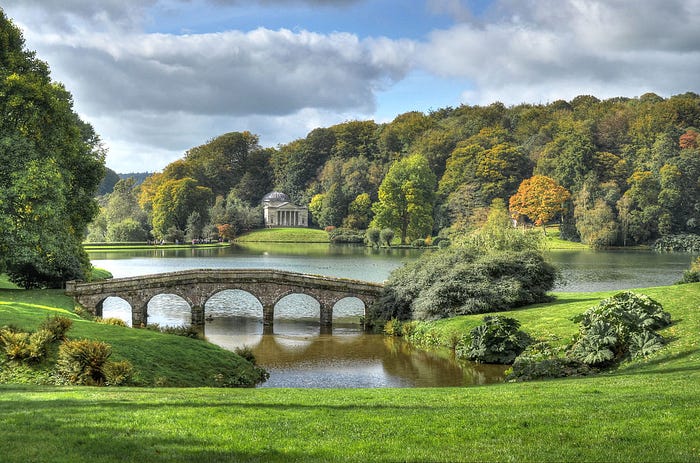 |
| Stourhead, considered to be the greatest of English gardens |
Gardens are very special "indulgence." Gardening, says Rybczynski, "is solitary, but it also involves outdoor physical activities (digging, planting, pruning) that make it an attractive antidote to the mechanized -- and mechanical-- clerical work that characterizes most modern jobs. In that sense, the garden offers possibilities for both recreation (working in the garden) and leisure (sitting in the garden)."
In that way, Bacon appropriately calls them "the purest of human pleasures."

No comments:
Post a Comment