 |
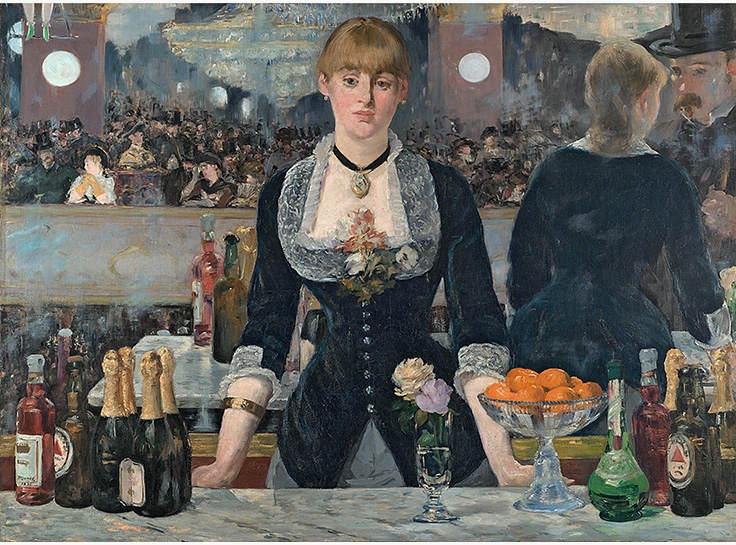
| Edouard Manet's "Bar at teh Folies-Bergere" |
Psychologist Haim Ginott knew the importance of adults WORDS in children’s lives. “Children learn about their physical likeness by seeing their image in a mirror,” he writes in Between Parent and Child,
They learn about their emotional likeness by hearing their feelings reflected to them…. the function of an emotional mirror is to reflect feelings as they are, without distortion:
“It looks like you are very angry.”
“It sounds like you hate him very much.”
“It seems as if you are disgusted with the whole situation.”
To a child who has such feelings, these statements are most helpful. They show clearly what his or her feelings are. Clarity of image, whether in a looking glass or in an emotional mirror, provides opportunity for self-initiated grooming and change.
At times of strong emotion there is nothing as comforting and helpful as a person who listens and understands. What is true for adults is also true for children. Caring communication replaces criticism, lecturing, and advice with the healing balm of human understanding.
When one of our children is distressed, afraid, confused, or sad, we naturally rush in with judgment and advice. The clear, if unintended, message is: “You are too dull to know what to do.” On top of the original pain we add the new insult.
Ginott also believed that parents tend to deny the importance of emotions in children. And to Ginott, emotions are not just an occasional occurrence for humans; it’s air we breath.
Emotions are part of our genetic heritage. Fish swim, birds fly, and people feel. Sometimes we are happy, sometimes we are not; but sometimes in our lives we are sure to feel anger and fear, sadness and joy, greed and guilt, lust and scorn, delight and disgust. While we are not free to choose the emotions that arise in us, we are free to choose how and when to express them, provided we know what they are. That is the crux of the problem.
Many people have been educated out of knowing what their feelings are. When they felt hate, they were told it was only dislike. When they were afraid, they were told there was nothing to be afraid of. When they felt pain, they were advised to be brave and smile. Many of us have been taught to pretend to be happy when we’re not.
As adults, how do we honor kids’ emotional nature and keep them from feeling that emotions are natural (and so keep up their ability to communicate, form relationships, and grow)?
When a child is in the midst of strong emotions, he cannot listen to anyone. He cannot accept advice or consolation or constructive criticism. He wants us to understand him. A child’s strong feelings do not disappear when he is told, “It is not nice to feel that way,” or when the parent tries to convince [them they have no] reason to feel that way.
Strong feelings do not vanish by being banished; they do diminish in intensity when the listener accepts them with sympathy and understanding.
This seems similar to American psychologist Carl Rogers, says children, as much as possible, have to feel “unconditional positive regard” from their parents and teachers.
***
Haim Ginott is perhaps best known -- at least in teaching circle, for this quote about creating climate in his book, Teacher and child: a book for Parents and Teachers:
I have come to the frightening conclusion that I am the decisive element. It is my personal approach that creates the climate. It is my daily mood that makes the weather. I possess tremendous power to make life miserable or joyous. I can be a tool of torture or an instrument of inspiration, I can humiliate or humor, hurt or heal. In all situations, it is my response that decides whether a crisis is escalated or de-escalated, and a person is humanized or de-humanized. If we treat people as they are, we make them worse. If we treat people as they ought to be, we help them become what they are capable of becoming.

No comments:
Post a Comment