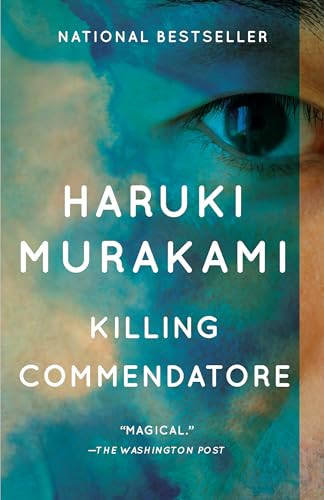
There are many connections between Haruki Murakami's Killing Commendatore and The Great Gatsby. In this section, there's a link between the curious and steady rise of Gatsby (or Menshiki), buying a house in a place he could watch the one desired (Mariye) , the the loss of that object of his intense affection which even (echoing Gatsby) "evaded his grasp."
There's something else about what happens after that pursuit of goals. Menshiki realizes that he has always been a 'straw man.'
"Sometimes I think I'm empty," he confessed. The smile still lingered on his lips.
"Empty?"
"Hollow inside. I know it sounds arrogant, but I've always operated on the assumption that I was a lot brighter and more capable than other people. More perceptive and discerning, with greater powers of judgment. Physically stronger, too. I figured I could succeed at whatever I turned my mind to. And I did. Put my hands on whatever I wanted to possess. Being locked up in Tokyo prison was a clear setback, of course, but I considered that an exception to the rule. When I was young, I saw no limits to what I could achieve. I thought I could attain a state close to perfection. Climb and climb until I reached a height where I could gaze down on everyone else. But when I passed fifty, I looked at myself in the mirror and discovered nothing but emptiness. A zero. What T.S. Eliot called a 'straw man."
I couldn't think of anything to say.
"My whole life may have been a mistake up till now," Menshiki went on. "I feel that way sometimes. That I took a wrong turn somewhere. That nothing I've done has any real meaning. That's why I told you I often find myself envying you."
"Envying what, for example?"
"You have the strength to wish for what you cannot have. While I have only wished for those things I can possess."
I assumed he was talking about Mariye. She was the one thing that had evaded his grasp. Yet there wasn't much I could say about that.
I'm intrigued by the line "you have the strength to wish for what you cannot have." That's a romantic image. And one that seems opposed to ideas like Thubten Chodron's line "You have enough. It is enough. You are enough." Yet, at the same time, the romantic image reminds me of Gatsby in the throes of his goal-seeking. It's related to these Gatsby lines:
For a transitory enchanted moment man must have held his breath in the presence of this continent, compelled into an aesthetic contemplation he neither understood nor desired, face to face for the last time in history with something commensurate to his capacity for wonder.
and to this line
If personality is an unbroken series of successful gestures, then there was something gorgeous about him, some heightened sensitivity to the promises of life, as if he were related to one of those intricate machines that register earthquakes ten thousand miles away.
Gatsby, and Menshiki, are both attuned to higher things (Jaguars, exquisite food, music).

No comments:
Post a Comment