(first the Claude version and then my notes)
(first, here's my prompt: Can you summarize podcasts? Make the 5-10 biggest take-aways, which might include key quotes, especially the focus of the podcast (like if it's on Marx, quotes from Marx form the podcast). If so, can you summarize In Our Time's podcast on "On Liberty"?)
Found a podpulse notes page for this one too — let me pull the full detail.In Our Time: "Maurice Merleau-Ponty" (BBC Radio 4, April 2025), with Komarine Romdenh-Romluc (Sheffield), Thomas Baldwin (York), and Timothy Mooney (University College Dublin).
1. His whole project is an attack on the mind/body split. Merleau-Ponty rejected Descartes' division of a thinking mind from a mechanical body, arguing that our perception of the world can't be pulled apart from the fact that we experience it as embodied creatures — not a ghost operating a machine, but body and awareness as one integrated thing.
2. Two ways of talking about "the body." The panel walks through his distinction between the "objective body" — the body as science or an outside observer would describe it, just tissue and mechanics — and the "phenomenal body," the body as lived from the inside, which is how Merleau-Ponty thought philosophy needed to start.
3. Everyday, unglamorous examples carry the theory. Rather than abstract argument alone, the discussion highlights how something as mundane as brushing your teeth shows his point: your body "knows" how to do it without deliberate thought, revealing a kind of bodily intelligence that precedes and underlies conscious reasoning.
4. The phantom limb case is central evidence. Amputees who still feel a missing limb are used to show the gap between the objective body (the limb is gone) and the phenomenal body (it's still present in lived experience) — for Merleau-Ponty this wasn't a glitch but a clue to how perception actually works.
5. He leaned on Gestalt psychology over pure logic. Where Husserl wanted phenomenology to arrive at self-evident, foundational truths, Merleau-Ponty pulled from Gestalt theory instead, treating perception as holistic — we grasp meaningful wholes, not isolated sense-data assembled afterward.
6. Existentialist company, but a different take on freedom. He was close to Sartre and de Beauvoir and shared their interest in lived existence, but the episode stresses that he pushed back on Sartre's more radical, near-limitless picture of freedom — for Merleau-Ponty, choices are shaped by motivation, history, and social situation, not chosen from nowhere.
7. War shaped his ethics of solidarity. His WWII experience (including an injury while serving) gets discussed as feeding into a sense of interconnected responsibility to others, coloring his later interest in collective movements rather than the isolated individual.
8. Language doesn't just express thought — it makes it. A key later idea raised: speech isn't a wrapper for a fully-formed idea sitting behind it; for Merleau-Ponty, articulating something in language is part of how the thought comes into being at all.
9. The later work pushes even further — "flesh of the world." In The Visible and the Invisible, left unfinished at his death, the panel notes he kept dissolving the subject/object boundary, developing the idea of "flesh" as a way to describe how the perceiver and the perceived world are woven from the same fabric.
10. Politically, he moved from Marxism to a critical socialism. He was a committed Marxist as fascism rose, but grew critical of Soviet practice after the war — a shift that also opened a rift with Sartre, who stayed more sympathetic to Soviet communism.
The two texts anchoring most of this are his first book, The Structure of Behavior (1942), and what the panel treats as his major work, Phenomenology of Perception (1945) — with The Visible and the Invisible (published posthumously, 1964) covering the late, unfinished direction of his thought.
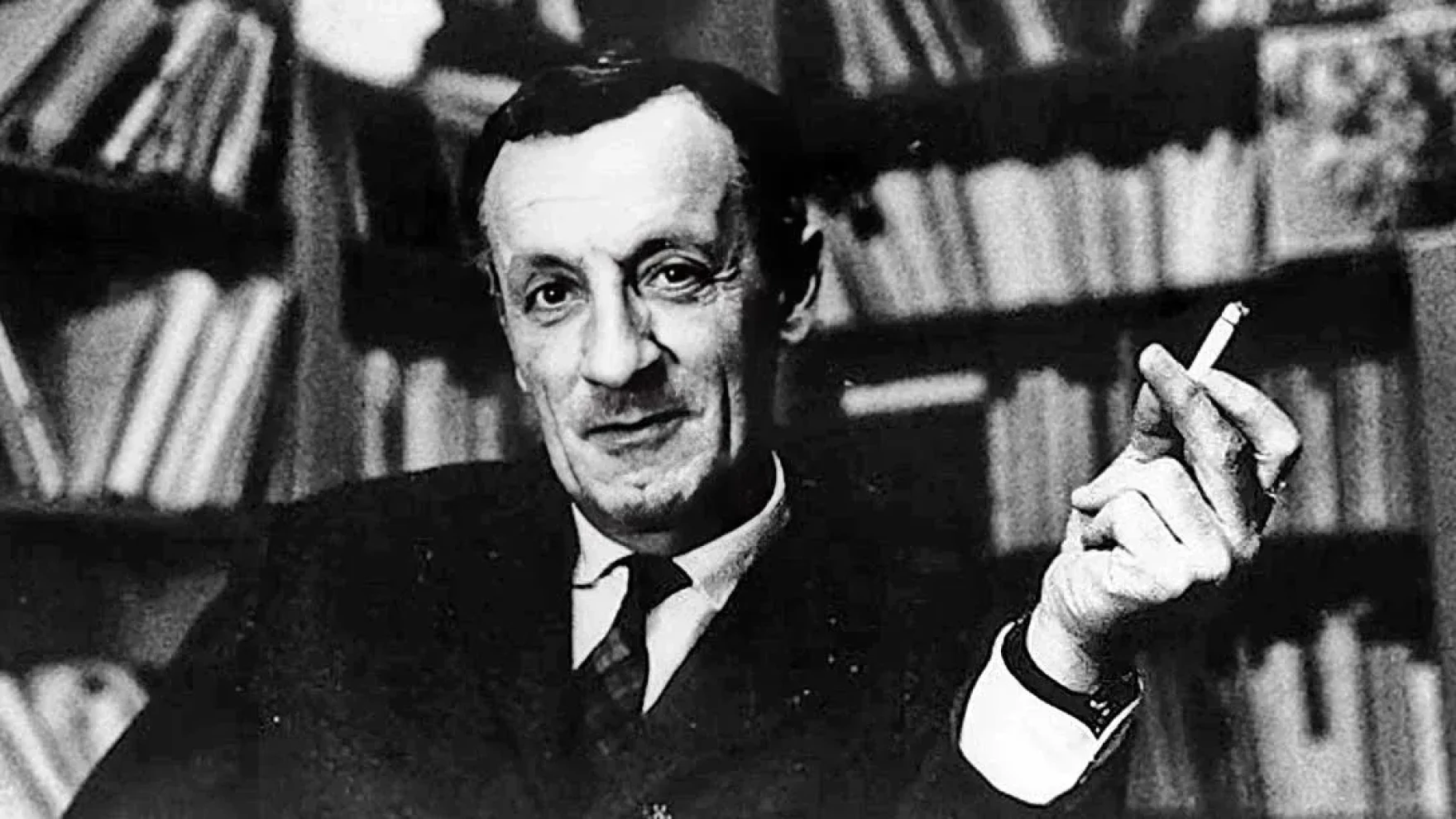
“the French philosopher Maurice Merleau-Ponty, in 1908 to 1961, was part of the movement known as phenomenology. While he's less well known than his contemporary, Jean-Paul Sartre and Simon de Beauvoir, his popularity has increased among philosophers in recent years. Merleau-Ponty rejected René Descartes' division between body and mind, arguing that the way you perceive the world around us cannot be separated from our experience of inhabiting a physical body.
Merleau-Ponty was interested in the down-to-earth questions of what it actually is like to live in the world. While performing actions as simple as brushing our teeth or patting a dog, we shape the world and in turn the world shapes us.”
“He was trying to get away from what he saw as a very bad picture of the body. That comes from what he calls objective thought, and this is the idea that-
Your thought.
Objective thought. It's the idea that all bodies can be understood through physics and chemistry and ultimately reduced to physical processes. One strain of objective thought called empiricism, claim that all thoughts, all volitions could be reduced to physical processes.
Another movement accepted the mechanical picture, and this was Descartes' move, but said, well, if there's such a thing as freedom and responsibility, and it cannot be explained in terms of a physical body, then there must be a separate realm, a realm of a spiritual self. And this picture for Merleau-Ponty is a catastrophically bad one. On the one hand, it gives you a physical body, which is an exterior without an interior.”
“So what Descartes did was he turned consciousness into an interior without an exterior. There was this dreadful cleft where bodies are extended and unthinking, whereas minds are thinking but un-extended. And Merleau-Ponty said quite correctly, if you start with that picture, if you divorce mind and body so catastrophically, you're never going to be able to bring them back together.
So the entire picture has to be abandoned.”
“He calls this the objective body. It's the body insofar as physics or chemistry deals with it from an exterior third person approach and it's also the body that's present to me when I pay attention to it. So if I get a pain in my ankle or if I'm brushing my hair then my body is an object that's present to me and he calls this the objective body.
But he realized that there are other senses of the body and amongst them there's what he calls the phenomenal body and that's the body that's present with me. So I feel myself breathing, I feel myself moving and I'm in constant tactile contact with the world. So my body is present with me even when I'm not paying any attention to my body.
And then he also talked about the body being the body as a repertoire of skills. He called this the habitual body and beneath that again you find a posture organization which he calls the body schemer. So Merleau-Ponty realized that there are multiple senses of the body which the approach of objective thought and of Cartesian dualism quite simply misses.”
“how did his ideas relate to those of other philosophers of the time including Husserl?
Well, there were two groups of philosophers that Merleau-Ponty was particularly drew on. The first was that of Edmund Husserl and his followers, who initiated a kind of reflective inquiry into philosophical foundations, seeking out what they called self-evident a priori truths, which would be the foundations of sciences and other intellectual inquiries. Now, what's distinctive actually about Merleau-Ponty is that he, in a way, takes over Husserl's method of inquiry, but he no longer seeks to find foundations for self-evident truth, for a priori truth.
So there is quite a big difference between what Merleau-Ponty takes from this method and what Husserl was offering. The other group of thinkers, philosophers, but actually you might say scientists, who greatly influenced Merleau-Ponty's work, were the Gestalt Theorists. These are German, basically, theorists writing about perception, particularly visual perception.
And Merleau-Ponty's first book, well, his first philosophy book, The Structure of Behaviour, is a critical account of their work, and then a critical, in a sense, critique of it, just at the end. But what he took from their work[…]”
“But what he took from their work was the mistakenness of a kind of atomistic view of our understanding of perception, that, by and large, our perception of the world is, as we would say, holistic. We take in things as a whole.
We don't build them up in a sort of atomistic, or one might say pointiest way, thinking of some French Impressionist paintings, and then see shapes, shapes of people, or of buildings, or whatever, emerging from our visual perception. Instead, we take in shapes which we recognise as straight away.”
“his most important work is perhaps his Phenomenology of Perception. What does that book argue?
So in the Phenomenology of Perception, one of the things that he's trying to do is re-conceive not just the body but consciousness and our relation to the world, which he also thinks involves a re-conceptualization of what the world is and also our relation to other people. So he's got this very grand project in that book. And he starts off, I think Tom has already mentioned, beginning with studies of perception.
So what is our perceptual experience like? He first of all goes through various scientific viewpoints of his day and critiques them. And that sort of clears the way for a new sort of approach to perception.”
“And then he thinks from focusing on what perceptual experience is like, he can then build out from that to a new understanding of the body, our relation to the world, our relation to other people, what human freedom is.”
“One of the examples from his work is thinking about the body itself. So in the Cartesian world view, you've got the body on the side of the world, consciousness is something separate from the body, and what Merleau-Ponty is trying to do is through thinking about very basic skills and habits and ways of interacting with the world, like brushing your teeth or playing with your dog, the body itself has a kind of consciousness. So, he's thinking about something like...
Can we just pin that down a bit more?
Yeah.
What do you mean by the body having a kind of consciousness?
So, if you think about a simple habit such as brushing your teeth, his thought is what happens when you brush your teeth? You do that thing every day, and through the activity of repeating, you come to see the world in terms of that activity. So, you might think when you look at the toothbrush what you're looking at is a particular object with a size and shape in space that you categorize in a certain way.”
“But for him, through the action of using it in a certain way every day, you come to literally see the toothbrush as inviting you to perform certain actions with it. So, the habit becomes kind of embedded in your perception of the world. And you can then respond to that perception of the toothbrush kind of saying, brush your teeth without needing to think about what you're doing.
So, generally speaking, if I'm brushing my teeth in the morning, I'm not thinking about brushing my teeth. I'm thinking about what I'm going to eat for dinner later, what I'm going to teach my students, the news, all sorts of things. And the reason that I can do this activity whilst thinking about these other things for Merleau-Ponty is because my body has a grasp of the world and how to act with it, how to interact with it.
I'm not like a sort of puppet controlled by the mind. There's this bodily understanding. So that's one aspect of what he means when he talks about the body being a kind of subjectivity.”
“there are several different senses of the body, and he recognized that the body, if I'm to be towards the world and geared into the world, the body has to appear in a certain way. And he showed this with reference to a famous case of an amputee. A man had lost his leg 17 years before, but very often during the day, he would try to walk off from a standing position without a second limb.
He would swing his stump and fall over. Now, when he was aware that he'd lost the limb, that he'd lost his leg, he wouldn't try this. But then he would seem to forget and try and walk off and he would fall over.
Now, one explanation was that it's a causal explanation, that his remaining nerves are producing this use phantom limb. And for Merleau-Ponty, that's a good account, but it's incomplete. Another explanation was psychological.”
“The psychological explanation was forget about the nerves or forget about physiology. The patient is in denial. Because he's in denial about his loss, he's producing a representation of the missing limb.
And Merleau-Ponty realized that both of these accounts went wrong. The empiricist's account was incomplete, whereas the psychological account was wrong from the ground up. And when the patient, the amputee, described his phantom limb, he said in its form, in its situation, it's just like the leg that I had before I moved it.
So Merleau-Ponty realized when the amputee tries to move towards the world, to make a pot of coffee, whatever it might be, to go downstairs to greet a friend, he doesn't think about his phantom limb because it's appearing just as the real limb used to appear. And Merleau-Ponty's great insight was the amputee's objective body was incomplete, but his phenomenal body, the way his body was present with him, was complete. As Merleau-Ponty puts it beautifully, the patient is not denying his deficiency, his deficiency is being hidden from him.”
“Another phrase that's sometimes used to mean the phenomenal body is, the body is lived, to get at this idea that what he's talking about when he's talking about the phenomenal body is the body as we live it every day. So as we experience it, as we go around our daily life, whereas the objective body sometimes understood as the body as studied by science.
And it's maybe worth emphasizing, I don't know whether it's come across in what we've been saying already, but Merleau-Ponty and the other phenomenologists are not anti-science. They think science is obviously a very important way that we know about the world. It's more a question of what the limits of science are and coming against the view that is sometimes called scientism, which is the thought that the ultimate authority over everything and every aspect of human life is science.
And the thought that that's not true. Science has a proper place, but there are areas of human existence which it can't explain.”
“We are the beings that learn to stand upright, and that means that our hands are freed up for manipulating, for caressing, for healing, and it's no accident he says that the rational being is the being who stands up and has opposed fingers and thumbs. And as one scholar has pointed out, we can see the internal complexity of things at a distance, because with our fingers and thumbs, we have seen ourselves taking things apart and putting them back together. That means that the first analysis we ever carried out from the Greek Analoosine, which means on tying or taking apart, was bodily analysis.
We took things apart as the child does, with bakers and spoons and forks and pots and pans. Children take things apart, they disassemble them. Then we learn to put things back together and that's synthesis.
So the body, as it were, has performed proto-rational activities before rational articulation could ever come on the scene. And a great insight of Merleau-Ponty was that unless we had built up our habitual body as a repertoire of skills, we could never engage in rational activity because we would have to concentrate on everything. A habitual activity is something I don't have to think about.
And because, as Komarine has pointed out, we have this repertoire of familiar activities, brushing one's teeth, making the coffee, cycling a bicycle. I can think about other things when I'm engaged in these habitual activities because my body, as it were, is doing everything for me.”
“People have thought of emotions in terms of a kind of feeling that's inside something like a Cartesian theatre, a sort of interior space of the mind. And one of the things that Merleau-Ponty's tried to do in his reconceptualisation of the mind is think of emotions as a kind of affective way, affect, in the sense of feeling, of engaging with the world. So if you think about something like love, he wants to argue that rather than being a feeling contained inside the mind, it's a way of seeing the loved one.
So when I see the person that I love, I see them as inviting me to engage in all sorts of loving forms of behaviour towards them. And that's partly what love is for Merleau-Ponty.”
From In Our Time: Maurice Merleau-Ponty, Apr 24, 2025
https://podcasts.apple.com/us/podcast/in-our-time/id73330895?i=1000700766225&r=2384
This material may be protected by copyright.

No comments:
Post a Comment