 |
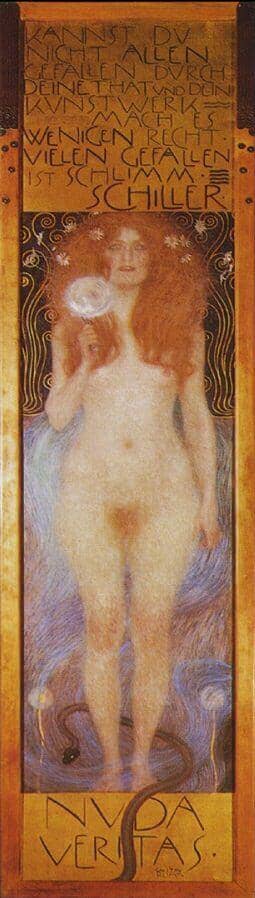
| Gustav Klimt Nuda Veritas (1899) |
From In Our time "Vienna Secession" (first is my summary, then I ask Claude to do it, then I ask Claude to synthesize its notes and my notes at the bottom)
In 1897, Gustav Klimt led a group of radical artists to break free from the cultural establishment of Vienna and found a movement that became known as the Vienna Secession.
In the vibrant atmosphere of coffee houses, Freudian psychoanalysis and the music of Wagner and Mahler, the Secession sought to bring together fine art and music with applied arts such as architecture and design. The Secession's Art Nouveau exhibition hall became a showcase for the international avant-garde and a place to exhibit new ideas about freedom in both art and life.
How and when did the Vienna Secession emerge as a movement?
Just to go back to your introduction, the critical year was 1897-1898. That was a year when Gustav Klimt, who had already created quite a reputation for himself as an artist approved of by the government of Vienna, and he'd already been decorating panels in some of the new buildings created as part of a big development mandated by the ruling Habsburg Emperor. He was a member, he had to be a member in order to exhibit of the only exhibiting body in Vienna, simply called the Künstler Haus or exhibition body, which in fact was a privately owned exhibition gallery, a new building which had also been built on what was called the Ringstrasse, Ring Street Development.
That was in cahoots, if you like, with the Academy of Fine Arts. Both the Academy of Fine Arts in Vienna and the Künstler Haus were extraordinarily conservative about the kind of art that they promoted and that they exhibited. And this led through the years, in fact, leading up to 1987 from the early 1900s to 1890 to a great deal of frustration amongst some artists including Klimt
So Klimt firstly tried to create a kind of breakaway group within the Künstler Haus to gain more freedoms to exhibit the kind of art they wanted. And when that was unsuccessful, he resigned from the Künstler Haus after he'd already sort of gleaned support from a number of notable young architects, designers and other fine artists. And within two years had established the Secession as the leading avant-garde art group of Vienna.
[more context] In these coffee houses, there's a wonderful book by Edward Timms on Vienna at this time, which has a diagram, actually, of circles and people who are members of those circles and how they interact, almost mirroring the tables of the coffee houses in a way. And one of the great things about coffee houses at the time was they were clubs to which anyone could enter and read the newspaper, take the coffee, discuss at a much lesser price than gentlemen's clubs, which would have been the way one might do it in Pall Mall or something like that.
And that tension, I think, between the individual and not so much the collective, because that's a perennial tension, you can hardly have society without that, but between those and those organizational structures, musicians were doing very much the same at the time. Arnold Schoenberg's early music rejected by the Viennese musical institutions, and he and his colleagues going on to to found new musical institutions of themselves. They didn't actually call it a secession, but I think it's part very much of this secession movement.
Klimt's as leader and artist
Klimt was the first president of the Secession. He had these wonderful portraits, society portraits, which were also rather mysterious and puzzling. They were mysterious because they were not like portraits that were painted in order to illustrate the sort of personality of the sitter. They were much more about a telling story about what was happening underneath the surface of Vienna through the decorative elements of the portraits.
The faces and hands of the women, for example, were the only bits, if you like, of the portrait that looked real and often the hands looked terribly tense, which again was a feature of Gustav Klimt's art....
So I think the first one really to start with is Klimt. And he of course is the leader of the group. But he's also extremely important as an artist, not just as someone that people rally around.
One way into this is to think about two particular works that he creates right in this first couple of years of the secession. One of them was called Nuda Veritas, The Naked Truth. And like a lot of his works, it experimented with format.
So it was two meters high, this work and only 50 centimeters wide. So a very tall, narrow format, very unconventional. It depicted a naked woman who was supposed to be a kind of allegory of truth.
But what was so unusual and really very jarring to people about this painting is that she seemed to be a real woman. She was depicted in this naturalistic mode. Even her pubic hair was shown, which would have been completely unheard of in allegorical female nudes, which were of course very common before that.
Famous Quote of the Vienna Secession: Der Zeit ihre Kunst. Der Kunst ihre Freiheit
“To this time, it's art, to art, it's freedom."
The issue of timeliness is very important there. And, you know, is something of a modernistic emblem in that sense. The idea that art is appropriate to a time, rather than necessarily observing classical verities that continue from time to time, I think, is part of what is going on here.
One of their great motives was to create an art which was specifically for Austria. And some of the commentators at the time, Hermann Bahr, who was a great supporter of the secession, theatrical director and impresario, was writing great tracts and criticisms of the cultural environment of Vienna at the time, in terms of the visual arts, that Austria didn't have its own art. And the other guiding principle, essentially, was to create new art which would rejuvenate life.
In the first issue of the new journal begun by the group, called Ver Sacrum ("Sacred Spring"). Bahr wrote, "Our art is not a combat of modern artists against those of the past, but the promotion of the arts against the peddlers who pose as artists and who have a commercial interest in not letting art bloom. The choice between commerce and art is the issue at stake in our Secession. It is not a debate over aesthetics, but a confrontation between two different spiritual states." (this quote from Wikipedia)
Gesamtkunstwerk
So the importance really coming out of that whole Jugendstil, our Nouveau period, was to bring together the fine arts, the applied arts and architecture, to create some greater art form, which would not only be beautiful but would beautify life. And those were two of the driving missions, if you like, of the Vienna Secession.
The "Total Work of Art": The movement's core philosophy was the Gesamtkunstwerk—a total work of art. They sought to elevate interior design, furniture, and architecture to the same tier as painting and sculpture, erasing the barrier between "high art" and everyday objects (this from Google AI summary)
Addressing the unconscious
This blurring of the ethical and the aesthetic is called into question, particularly as newer drives are being taken more into account, whether it be by writers, painters, musicians, particularly, you know, ideas of the unconscious, the truths that lie beneath the surface of the city and of the person.
So you think that psychology is an important part of play in all this?
Very much so. I mean, there's the preoccupation with dreams, for example. The idea that they are getting to a truth that is being concealed by reality, I think is an extremely potent one at this time. And of course, it's the Vienna out of which Freud emerges as well.
Mark, can we now turn to something else that was going on there, which is psychoanalysis. What part did that play in the general melee or organized, wasn't chaos, organization of artists pushing forward on apparently a united front in some ways?
Yes, I mean, I think it's certainly part of what is going on here, although I think in some senses, we perhaps exaggerate the importance, because Freud has been so foundational to 20th century thought and culture thereafter that we see him perhaps as more central to the life of Vienna at the time than perhaps he was, but nonetheless, the great interest in the unconscious, and perhaps in the idea also that even if one buries down to what is at the bedrock of human existence, one might still find a lie, one might never actually get to truth at all, and that that might be the sort of riddle we have to deal with is, of course, a very rich idea and one I think that is perhaps particularly amenable to artistic expression in all sorts of spheres.
Reading List
Mark Berry, Arnold Schoenberg: Critical Lives (Reaktion Books, 2018)
Gemma Blackshaw, Facing the Modern: The Portrait in Vienna 1900 (National Gallery Company, 2013)
Elizabeth Clegg, Art, Design and Architecture in Central Europe, 1890-1920 (Yale University Press, 2006)
Richard Cockett, Vienna: How the City of Ideas Created the Modern World (Yale University Press, 2023)
Stephen Downes, Gustav Mahler (Reaktion Books, 2025)
Peter Gay, Freud, Jews, and Other Germans: Masters and Victims in Modernist Culture (Oxford University Press, 1979)
Tag Gronberg, Vienna: City of Modernity, 1890-1914 (Peter Lang, 2007)
Allan S. Janik and Hans Veigl, Wittgenstein in Vienna: A Biographical Excursion Through the City and its History (Springer/Wien, 1998)
Jill Lloyd and Christian Witt-Dörring (eds.), Vienna 1900: Style and Identity (Hirmer Verlag, 2011)
William J. McGrath, Dionysian Art and Populist Politics in Austria (Yale University Press, 1974)
Tobias Natter and Christoph Grunenberg (eds.), Gustav Klimt: Painting, Design and Modern Life (Tate, 2008)
Carl E. Schorske, Fin-de-siècle Vienna: Politics and Culture (Vintage, 1979)
Elana Shapira, Style and Seduction: Jewish Patrons, Architecture and Design in Fin-de-Siècle Vienna (Brandeis University Press, 2016)
Diane V Silverthorne, Dan Reynolds and Megan Brandow-Faller, Die Fläche: Design and Lettering of the Vienna Secession, 1902-1911 (Letterform Archive, 2023)
Edward Timms, Karl Kraus: Apocalyptic Satirist: Culture & Catastrophe in Habsburg Vienna (Yale University Press, 1989)
Leslie Topp, Architecture and Truth in Fin-de-Siècle Vienna (Cambridge University Press, 2004)
Peter Vergo, Art in Vienna, 1898-1918: Klimt, Kokoschka, Schiele and Their Contemporaries (4th ed., Phaidon, 2015)
Hans-Peter Wipplinger (ed.), Vienna 1900: Birth of Modernism (Walther & Franz König, 2019)
Hans-Peter Wipplinger (ed.), Masterpieces from the Leopold Museum (Walther & Franz König)
Stefan Zweig, The World of Yesterday: An Autobiography (University of Nebraska Press, 1964)
Mostly from In Our Time: The Vienna Secession, Jul 3, 2025
https://podcasts.apple.com/us/podcast/in-our-time/id73330895?i=1000711164724&r=2132
This material may be protected by copyright.
from Claude:
I found the episode details and reading list, but not a detailed transcript-level breakdown like I had for the other two — so this one leans more on the episode's own description plus what's known about the movement itself. I'll flag where I'm filling in general background versus what the episode specifically previews.
In Our Time: "The Vienna Secession" (BBC Radio 4, July 2025), with Mark Berry (Royal Holloway), Leslie Topp (Birkbeck), and Diane Silverthorne (independent art historian, "Vienna 1900" specialist).
1. The founding moment: 1897, a walkout. Gustav Klimt led a group of artists breaking away from Vienna's official art establishment (the conservative Künstlerhaus), forming a rival movement that became the Vienna Secession.
2. The motto carved over the door. The Secession building famously bears the inscription "Der Zeit ihre Kunst, der Kunst ihre Freiheit" — to every age its art, to art its freedom — the closest thing the movement had to a manifesto in a single line.
3. It wasn't just painting — it was a total environment. The Secessionists pursued the Gesamtkunstwerk idea: fusing fine art, architecture, design, and even music into unified, immersive experiences, rather than treating painting as separate from furniture, buildings, or graphic design.
4. The Secession Building itself was a statement. Designed by Joseph Maria Olbrich, its stark cube-and-gilt-dome form (locals reportedly mocked it as looking like a cabbage) became a prototype for the modern art gallery — a deliberately radical rupture from Vienna's grand, historicist Ringstrasse architecture.
5. Klimt's style as the movement's visual signature. His stylized, symbol-heavy paintings, richly worked with gold leaf, are the image most associated with the Secession — work like the Beethoven Frieze, made for a 1902 exhibition inside the building itself, tying visual art directly to music.
6. It grew out of a wider cultural ferment. The episode frames the movement against the backdrop of fin-de-siècle Vienna's coffee-house intellectual culture, the rise of Freudian psychoanalysis, and the music of Wagner and Mahler — treating the Secession as one thread in a broader Viennese modernism rather than an isolated art-world event.
7. It wasn't confined to painting — design and applied arts mattered as much. The reading list points to graphic design and lettering (Secession-style typography and layout) as a serious part of the movement's legacy, alongside the Wiener Werkstätte's work in furniture and decorative arts that grew out of the same circle.
8. Broader cast of contemporaries. Figures like Josef Hoffmann, Koloman Moser, Otto Wagner, and later Egon Schiele and Oskar Kokoschka orbit the movement in the wider literature, representing its expansion from Klimt's initial group into architecture and, eventually, more expressionist directions.
9. Cultural politics were baked in from the start. Founding voices explicitly framed the Secession as a fight between genuine art and commercially-minded art dealers rather than a matter of style alone — a "confrontation between two different spiritual states," as one founding statement put it, positioning the group as much a moral stand as an aesthetic one.
10. Legacy: a template for the modern gallery and a lasting Vienna brand. The Secession building is treated as an early prototype for how modern art institutions present avant-garde work, and the movement remains one of the defining exports of "Vienna 1900" as a cultural moment, still central to how the city markets its own history today.
Happy to dig further into any one of these threads, or do another episode if you've got one in mind.
synthesis of both:
Here's the revised synthesis, folding your transcript notes into the earlier research.
In Our Time: "The Vienna Secession" — Mark Berry (Royal Holloway), Leslie Topp (Birkbeck), Diane Silverthorne (independent art historian).
1. The break was institutional before it was aesthetic. Klimt was already an established, government-approved artist, but as a member of the Künstlerhaus — Vienna's only real exhibiting body, tightly linked to the conservative Academy of Fine Arts — he first tried to win more exhibiting freedom from within the institution. Only when that failed did he resign and, within two years, build the Secession into the city's leading avant-garde group.
2. The coffee house was the real infrastructure. The panel points to Vienna's coffee-house culture as a genuinely democratic meeting space — unlike gentlemen's clubs, anyone could sit, read, and talk for the price of a coffee — and credits historian Edward Timms with mapping how these overlapping social circles actually functioned as the movement's social network.
3. Klimt wasn't just a figurehead — he tested form itself. As first president, he produced portraits that were less about capturing a sitter's likeness than hinting at what lay beneath Vienna's surface — faces and hands rendered almost too real, tense, against otherwise decorative, ornamental settings.
4. Nuda Veritas as an early shock. One of his first Secession-era works — tall and narrow, two meters by fifty centimeters — depicted an allegorical "naked truth" as a real, naturalistically rendered woman, pubic hair included, breaking sharply from the sanitized nude tradition it was supposed to belong to.
5. The motto over the door was a statement of principle. "Der Zeit ihre Kunst, der Kunst ihre Freiheit" — to the age its art, to art its freedom — carried a specifically modernist idea: that art should answer to its own moment rather than to timeless classical rules.
6. The founding fight was framed as art versus commerce. In the Secession's journal Ver Sacrum, Hermann Bahr cast the split not as old artists against new, but as art itself against dealers with a commercial stake in keeping it from flourishing — a "confrontation between two different spiritual states."
7. Gesamtkunstwerk — the total work of art. The driving ambition was to fuse fine art, applied art, and architecture into one integrated form, treating furniture, interiors, and design as equal in status to painting or sculpture, so that art wouldn't just be admired but would actively "beautify life."
8. The unconscious was in the air, but the panel resists overstating Freud's role. There's genuine interest in dreams and hidden truths beneath Vienna's surface running through the period's art, but the panel cautions that Freud's later centrality to 20th-century thought can make him look more important to the scene at the time than he actually was.
9. Music had its own secession, unnamed as such. Arnold Schoenberg's early work was rejected by Vienna's musical establishment, pushing him and his circle to found new institutions of their own — not literally called a "secession," but treated by the panel as part of the same broader pattern of breakaway movements across the arts.
10. The building and its legacy. Olbrich's Secession building — housing works like Klimt's Beethoven Frieze — became a prototype for the modern exhibition space, and the movement's reach into design, typography, and the later Wiener Werkstätte shows the Gesamtkunstwerk ambition wasn't just theory but got built out into everyday objects.

No comments:
Post a Comment